Sumatriptan Sandoz 50 mg film-coated tablets EFG
Spain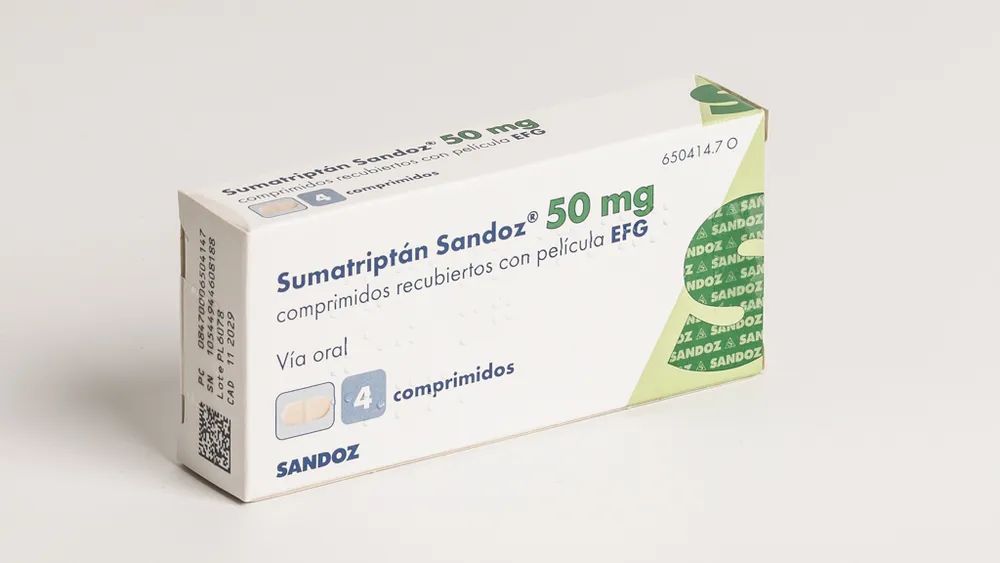
Table of Contents
- Package leaflet: Information for the user
- Introduction
- 1. What Sumatriptán Sandoz is and what it is used for
- 2. What you need to know before taking Sumatriptán Sandoz
- 3. How to take Sumatriptán Sandoz
- 4. Possible adverse effects
- 5. Storage of Sumatriptan Sandoz
- 6. Package contents and additional information
Package leaflet: Information for the user
Introduction
Package leaflet: information for the patient
Sumatriptán Sandoz 50 mg film-coated tablets EFG
Read the entire leaflet carefully before you start taking this medicine, because it contains important information for you.
- Keep this leaflet, as you may need to read it again. If you have any questions, ask your doctor or pharmacist.
- This medicine has been prescribed for you only, and you must not give it to other people, even if they have the same symptoms as you, because it could harm them.
- If you experience any adverse effects, consult your doctor or pharmacist, even if these are not listed in this leaflet. See section 4.
Leaflet contents
-
What Sumatriptán Sandoz is and what it is used for
-
What you need to know before taking Sumatriptán Sandoz
-
How to take Sumatriptán Sandoz
-
Possible adverse effects
-
How to store Sumatriptán Sandoz
-
Contents of the pack and other information
1. What Sumatriptán Sandoz is and what it is used for
Each Sumatriptán Sandoz tablet contains a dose of sumatriptan, which belongs to a group of medicines called triptans (also known as 5-HT1 receptor agonists).
Sumatriptan is used to treat migraine headache with or without aura. Sumatriptan should only be used when a clear diagnosis of migraine has been established.
The symptoms of migraine may be caused by the temporary dilation of blood vessels in the head. Sumatriptan is believed to reduce this dilation of blood vessels, thereby helping to relieve headache pain and other symptoms of a migraine attack, such as nausea or vomiting, and sensitivity to light and sound.
2. What you need to know before taking Sumatriptán Sandoz
Do not take Sumatriptán Sandoz
- if you are allergic to sumatriptan or to any of the other ingredients of this medicine (listed in section 6),
- if you have had any heart problems, such as narrowing of the arteries (ischaemic heart disease) or chest pain (angina), or have had a heart attack,
- if you have circulation problems in your legs causing cramp-like pain when walking (peripheral vascular disease),
- if you have had a stroke or a mini-stroke (also called transient ischaemic attack or TIA),
- if you have high blood pressure. You may be able to use sumatriptan if your high blood pressure is mild and is being treated,
- if you have severe liver disease,
- with other migraine medicines, including those containing ergotamine or similar medicines such as methysergide, or any triptan or 5HT1 agonist (such as naratriptan or zolmitriptan),
- with any of the following medicines used to treat, for example, depression or Parkinson’s disease:
- MAOIs (monoamine oxidase inhibitors) or if you have taken these medicines (e.g., moclobemide or selegiline) within the last 2 weeks.
If any of these apply to you: consult your doctor and do not take sumatriptan tablets.
Warnings and precautions
Talk to your doctor or pharmacist before taking sumatriptan.
If you have any additional risk factors:
- if you are a heavy smoker, or
- if you are on nicotine replacement therapy, and especially
- if you are a man over 40 years of age, or
- if you are a postmenopausal woman.
In very rare cases, patients have developed serious heart problems after using sumatriptan, even though they had no signs of heart disease before. If any of the above apply to you, you have a higher risk of developing heart disease. Therefore**, inform your doctor**, so they can check your cardiac function before sumatriptan is prescribed.
If you have a history of seizures (fits)
Or any other condition that may make seizures more likely, such as head injury or alcoholism. Inform your doctor so they can monitor you closely.
If you have liver or kidney disease
Inform your doctor so they can monitor you closely.
If you are allergic to antibiotics called sulfonamides
If so, you may also be allergic to sumatriptan. If you know you are allergic to an antibiotic but are unsure whether it is a sulfonamide, inform your doctor or pharmacist before using sumatriptan.
If you take sumatriptan frequently
Using sumatriptan too often may cause your headaches to worsen.
Inform your doctor if this happens. They may advise you to stop using sumatriptan.
If you feel pain or tightness in your chest after using sumatriptan
These effects may be intense but usually pass quickly. If they do not pass quickly or worsen, seek medical help immediately. More information about these possible side effects can be found in section 4 of this leaflet.
Children and adolescents
The use of Sumatriptán Sandoz is not recommended in children and adolescents under 18 years of age because:
- sumatriptan has not been studied in children under 10 years of age,
- the effectiveness of sumatriptan in children and adolescents aged 10 to 17 years has not been demonstrated in clinical studies.
Taking Sumatriptán Sandoz with other medicines
Tell your doctor or pharmacist if you are using or have recently used any other medicines, including those obtained without a prescription. This includes herbal remedies, dietary supplements such as vitamins, iron or calcium, or medicines bought without a prescription.
Some medicines should not be taken with sumatriptan, and others may cause adverse effects when taken with sumatriptan.
You must inform your doctor if you are taking:
- ergotamine, also used for the treatment of migraine, or similar medicines such as methysergide. Do not take sumatriptan at the same time as these medicines. Stop taking these medicines at least 24 hours before taking sumatriptan. Do not take medicines containing ergotamine or similar medicines for at least 6 hours after taking sumatriptan,
- other triptans/5-HT1 receptor agonists (such as naratriptan, rizatriptan, zolmitriptan), also used to treat migraine (see section "Do not take Sumatriptán Sandoz" above). Do not use sumatriptan at the same time as these medicines. Stop taking these medicines at least 24 hours before using sumatriptan. Do not take another triptan/5-HT1 receptor agonist for at least 24 hours after using sumatriptan.
- MAOIs (monoamine oxidase inhibitors) used to treat depression or Parkinson’s disease. Do not take sumatriptan if you have taken these medicines within the last two weeks,
- SSRIs (Selective Serotonin Reuptake Inhibitors) and SNRIs (Serotonin and Norepinephrine Reuptake Inhibitors) used to treat depression. Using sumatriptan with these medicines may cause serotonin syndrome (a group of symptoms that may include restlessness, confusion, sweating, hallucinations, increased reflexes, muscle spasms, shivering, increased heart rate, and tremors). Inform your doctor immediately if you experience any of these symptoms.
- St. John’s Wort (Hypericum perforatum). Taking herbal medicines containing St. John’s Wort together with sumatriptan may increase the likelihood of adverse effects.
Pregnancy and breastfeeding
If you are pregnant or breastfeeding, think you may be pregnant, or plan to become pregnant, consult your doctor before using this medicine.
- Information on the safety of sumatriptan in pregnant women is limited, although so far there is no evidence that it increases the risk of malformations. Your doctor will assess with you whether or not you should use sumatriptan during pregnancy.
- Stop breastfeeding for 12 hours after taking sumatriptan. If you produce milk during this time, discard it and do not give it to your baby.
Some women have reported breast and/or nipple pain after using sumatriptan.
This pain is usually temporary and disappears within 3 to 12 hours.
Driving and using machines
This medicine, like migraine itself, may cause drowsiness. If you experience these effects, avoid driving or using machines as it could be dangerous.
Sumatriptán Sandoz contains lactose.
If your doctor has informed you that you have an intolerance to certain sugars, consult with them before taking this medicine.
Sumatriptán Sandoz contains aspartame as a sweetener, a source of phenylalanine.
This medicine contains 0.09 mg of aspartame in each film-coated tablet.
Aspartame contains a source of phenylalanine which may be harmful if you have phenylketonuria (PKU), a rare genetic disorder in which phenylalanine accumulates because the body cannot eliminate it properly.
This medicine contains sodium.
This medicine contains less than 23 mg of sodium (1 mmol) per film-coated tablet; this is essentially “sodium-free”.
3. How to take Sumatriptán Sandoz
Follow exactly the instructions for administering Sumatriptán Sandoz as given by your doctor. If in doubt, consult your doctor or pharmacist again.
When to take Sumatriptán Sandoz
- It is best to take sumatriptan as soon as you feel a migraine, although it can be taken at any time during an attack.
- Do not use sumatriptan to try to prevent an attack; it should only be used after migraine symptoms have started.
Recommended dose
Adults aged 18 to 65
- The recommended dose for adults aged 18 to 65 is one 50 mg Sumatriptán Sandoz tablet. Some patients may require 100 mg. Follow your doctor's advice.
Elderly patients (over 65 years)
- Sumatriptan is not recommended for patients over 65 years of age.
If symptoms return
- You may take a second sumatriptan tablet within the following 24 hours if at least 2 hours have passed since the first tablet. Do not take more than a total of 300 mg within 24 hours.
If the first tablet does not work
- Do not take a second tablet or any other medication containing sumatriptan for the same attack. In such cases, the attack may be treated with painkillers such as paracetamol, acetylsalicylic acid, or ibuprofen. You may take sumatriptan for the next attack.
If you have mild to moderate hepatic impairment
- For patients with mild to moderate hepatic impairment, doses of 25–50 mg should be considered. Follow your doctor's advice.
If sumatriptan does not relieve your symptoms, consult your doctor or pharmacist.
Method of administration
Film-coated tablets or half a tablet should be swallowed whole with water.
The 50 mg tablet may be divided into equal doses.
If you take more Sumatriptán Sandoz than you should
Do not take more than 6 tablets of 50 mg or 3 tablets of 100 mg (total 300 mg) within 24 hours. Taking too much sumatriptan may make you feel unwell.
If you have taken more than 300 mg within 24 hours, contact your doctor.
If you have taken more Sumatriptán Sandoz than you should, consult your doctor or go immediately to the nearest hospital, or call the Toxicology Information Service. Telephone: 91 562 04 20, indicating the medication and the amount ingested.
4. Possible adverse effects
Like all medicines, this medicine can cause adverse effects, although not everyone experiences them.
Some of these symptoms may be caused by migraine itself.
Allergic reactions: seek medical help immediately.
The following adverse effects have occurred, but their exact frequency is unknown.
- Signs of allergy include rash, hives (itching and rash); wheezing; swollen eyelids, face or lips; complete collapse.
If you notice any of these symptoms shortly after using sumatriptan:
Do not use sumatriptan again. Contact your doctor immediately.
Common adverse effects (may affect up to 1 in 10 people)
- dizziness, drowsiness,
- sensory disturbances such as tingling and reduced sensitivity,
- sudden, transient increase in blood pressure after treatment,
- hot flushes,
- difficulty breathing (dyspnea),
- nausea or feeling unwell, which has occurred in some patients, but it is unclear whether this is related to sumatriptan or to the disease itself,
- feelings of heaviness (usually transient, may be intense, and may affect any part of the body, including the chest and throat),
- pain in one or more muscles,
- pain, sensation of heat or cold, pressure or tightness (usually transient and may be intense, and may affect any part of the body, including the chest and throat),
- feelings of weakness, fatigue (both adverse effects are mostly mild to moderate in intensity and duration).
Rare adverse effects (may affect up to 1 in 1,000 people)
- breast pain
Very rare adverse effects (may affect up to 1 in 10,000 people)
- minor abnormalities in liver function tests.
Frequency not known (cannot be estimated from available data)
- hypersensitivity reactions of all severity grades, ranging from cutaneous hypersensitivity (such as urticaria) to cases of anaphylaxis,
- seizures, although some have occurred in patients with a history of seizures or concomitant conditions predisposing to seizures. They have also been observed in patients without evident predisposing factors.
- tremor, muscle spasms leading to abnormal posture and impaired movement control,
- eye tremors, visual field loss, blinking, double vision, reduced vision, vision loss, including cases of permanent visual disturbances. However, visual disorders may also occur during a migraine attack itself,
- slowing of the heart rate (bradycardia), increased heart rate (tachycardia), palpitations, cardiac arrhythmias, coronary arterial vasospasm, chest pressure, myocardial infarction,
- decreased blood pressure, circulatory disorders in the extremities e.g., in the finger (Raynaud's syndrome),
- inflammation of part of the colon due to circulatory disturbances,
- diarrhea,
- difficulty swallowing,
- neck stiffness,
- pain in one or more joints,
- abnormal sensation of fear, often with psychological signs (such as sweating, tension, and rapid pulse),
- excessive sweating,
- If you have recently had an injury or have inflammation (such as rheumatism or inflammation of the colon), you may experience pain or worsening of pain at the site of injury or inflammation.
Reporting of adverse effects
If you experience any type of adverse effect, talk to your doctor, pharmacist or nurse, even if it is a possible adverse effect not listed in this leaflet. You can also report them directly via the Spanish Pharmacovigilance System for Human Medicines: https://www.notificaram.es. By reporting adverse effects, you can help provide more information on the safety of this medicine.
5. Storage of Sumatriptan Sandoz
Keep this medicine out of the sight and reach of children.
Do not use this medicine after the expiry date stated on the strip, blister, container, and carton after EXP. The expiry date refers to the last day of the month indicated.
No special storage conditions are required.
Medicines must not be disposed of via wastewater or household waste. Dispose of unused containers and medicines at the SIGRE collection point at your pharmacy. If in doubt, ask your pharmacist how to dispose of containers and medicines you no longer need. This will help protect the environment.
6. Package contents and additional information
Composition of Sumatriptan Sandoz
- The active substance is sumatriptan (as succinate).
Each film-coated tablet contains 50 mg of sumatriptan (as succinate).
- Other components are:
Tablet core: lactose monohydrate, microcrystalline cellulose, sodium croscarmellose, and magnesium stearate.
Tablet coating: lactose monohydrate, corn starch, soluble starch, mannitol, aspartame, polysorbate 80, titanium dioxide (E171), red iron oxide (E172), and talc.
Appearance of the product and contents of the container
Sumatriptan Sandoz is available as pink, capsule-shaped, film-coated tablets, convex on one side and scored on the other.
The film-coated tablets are packaged in ALU/ALU strips or PVC/PE/PVDC/Al blisters inserted into cardboard boxes, or packaged in PP bottles with LDPE caps.
ALU/ALU strips: 1, 2, 4, 6, 12 film-coated tablets.
PVC/PE/PVDC/Al blisters: 1, 2, 4, 6, 12, 18 film-coated tablets.
PP bottle with LDPE cap: 12 film-coated tablets.
Only certain pack sizes may be marketed.
Marketing Authorization Holder and Manufacturer
Marketing Authorization Holder
Sandoz Farmacéutica, S.A.
Centro Empresarial Parque Norte
Edificio Roble
C/ Serrano Galvache, 56
28033 Madrid
Spain
Manufacturer
Lek Pharmaceuticals d.d
Verovskova 57
1526 Ljubljana
Slovenia
or
Sandoz GmbH
Biochemiestrasse 10
A-6250 Kundl
Austria
or
Salutas Pharma GmbH
Otto-von-Guericke Allee 1
39179 Barleben
Germany
or
S.C. Sandoz, S.R.L.
Str. Livezeni nr. 7A
RO-540472 Targu-Mures
Romania
or
Lek Pharmaceuticals d.d,
Trimlini 2 D,
9220 Lendava
Slovenia
This medicinal product is authorized in the European Economic Area member states under the following names:
Austria: Sumatriptan Sandoz 50 mg - Filmtabletten
Czech Republic: SUMIGRA 50 MG
Denmark: Sumatriptan “Sandoz”
Finland: Sumatriptan Sandoz tabletti, kalvopäällysteinen
Germany: Sumatriptan Sandoz 50 mg Filmtabletten
Italy: SUMATRIPTAN SANDOZ
Netherlands: Sumatriptan Sandoz 50, filmomhulde tabletten 50 mg
Norway: Sumatriptan Sandoz 50 mg tabletter, filmdrasjerte
Poland: SUMIGRA 50 MG, TABLETKI POWLEKANE
Slovenia: Sumigra 50 mg filmsko obložene tablete
Switzerland: Sumatriptan Sandoz 50 mg filmdragerad tablett
Date of the most recent review of this leaflet: September 2025
Detailed and up-to-date information on this medicinal product is available on the website of the Spanish Agency of Medicines and Health Products (AEMPS) http://www.aemps.gob.es/