Stesolid 10 mg rectal solution
Spain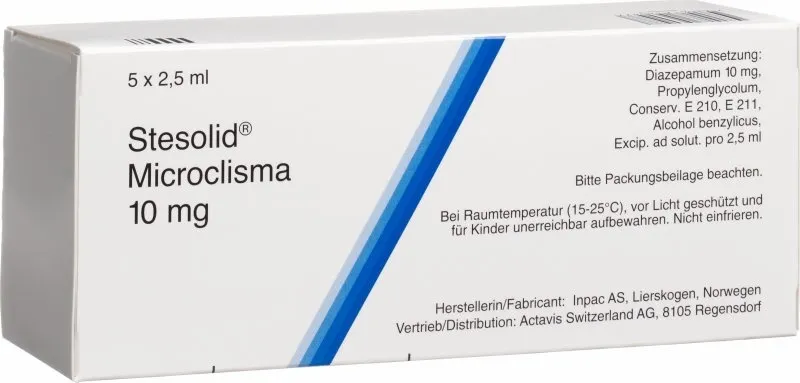
Table of Contents
Package leaflet: Information for the user
Introduction
Package leaflet: information for the user
Stesolid 10 mg rectal solution
diazepam
Read the entire leaflet carefully before you start using this medicine, because it contains important information for you.
- Keep this leaflet, as you may need to read it again.
- If you have any questions, ask your doctor or pharmacist.
- This medicine has been prescribed for you only and must not be given to other people, even if they have the same symptoms as you, since it may harm them.
- If you experience any adverse effects, consult your doctor or pharmacist, even if such effects are not listed in this leaflet. See section 4.
Leaflet contents
- What Stesolid 10 mg is and what it is used for
- What you need to know before using Stesolid 10 mg
- How to use Stesolid 10 mg
- Possible side effects
- How to store Stesolid 10 mg
- Contents of the pack and other information
1. What Stesolid 10 mg is and what it is used for
Diazepam belongs to a group of medicines called benzodiazepines. It is indicated for the treatment of febrile seizures in children over 1 year of age (approximately 10 kg) and in epileptic seizures; in states of anxiety, agitation, or tension; and as a sedative in minor surgery, diagnostic procedures, and endoscopic procedures.
2. What you need to know before using Stesolid 10 mg
Do not use Stesolid 10 mg
- if you are allergic (hypersensitive) to the active substance or to any of the other ingredients of this medicine (see section 6).
- if you are allergic (hypersensitive) to any of the medicines known as "benzodiazepines".
- if you have the muscle disease called "myasthenia gravis".
- if you have respiratory problems such as sleep apnoea syndrome (brief breathing pauses during sleep) or severe respiratory insufficiency.
- if you suffer from severe liver disease (severe hepatic insufficiency).
- if you have closed-angle glaucoma (an eye condition causing increased pressure within the eyeball).
- if you have dependence on other substances, including alcohol. An exception to this is the treatment of acute withdrawal reactions.
Warnings and precautions
Consult your doctor or pharmacist before starting to use Stesolid
- if you have used the medicine continuously for a long period of time, as it may lead to dependence. Chronic use as a daily anticonvulsant is not recommended, since after prolonged use, a certain degree of reduced effectiveness may be observed.
- if you have epilepsy. You should be aware that cases of increased seizures have been reported in epileptic patients treated with diazepam.
- if you have porphyria, as diazepam may trigger a recurrence of the disease.
- if you have any liver or kidney disorder. Your doctor will decide whether you should take a lower dose or not take the medicine at all.
- if you are an elderly patient. Due to the muscle-relaxing effect, there is a risk of falls and consequently of fractures, especially when getting up at night. In these patients, a 5 mg dose is recommended, as indicated in section 3 of this leaflet.
If after taking the medicine you experience reactions such as: restlessness, agitation, irritability, aggression, delirium, rage attacks, nightmares, hallucinations, psychosis, inappropriate behaviour, or other adverse effects on behaviour, inform your doctor immediately. These reactions are more frequent in children and elderly patients.
After taking this medicine, you should ensure that you will be able to sleep uninterrupted for 7–8 hours. Otherwise, although this rarely occurs, you may not remember parts of what happened while you were awake.
If you have previously had problems with drug or alcohol dependence, you should not use this medicine unless your doctor specifically instructs you to do so.
Diazepam may alter the results of the following laboratory tests:
- Blood: increase (biological) in cholesterol, estradiol, phenytoin, prolactin, and testosterone. Decrease (biological) in thyroxine.
- Urine: increase (analytical interference) in 5-hydroxy-indole-acetic acid. Decrease (analytical interference) in glucose.
Children and adolescents
Due to lack of studies on safety and efficacy, the use of Stesolid is not recommended in children under one year of age (less than 10 kg), unless otherwise directed by your doctor.
Other medicines and Stesolid
Inform your doctor or pharmacist if you are currently using, or have recently used, any other medicines, including those obtained without a prescription.
Taking Stesolid together with other medicines that act on the central nervous system, such as those used to treat insomnia, anxiety, depression, severe pain, psychiatric disorders, epilepsy, and allergies, as well as some anaesthetics, may make the effect of the medicine too strong. If you are taking any medicine for these conditions, you must inform your doctor.
Please note that these instructions may also apply to medicines taken before or that may be taken later.
Tell your doctor if you are taking or have taken any of the following medicines:
- amitriptyline, fluoxetine, fluvoxamine, sertraline, lithium, haloperidol (medicines used to treat depression and other psychiatric disorders),
- clozapine (a medicine used to treat schizophrenia),
- amprenavir, atazanavir, ritonavir (medicines used to treat HIV/AIDS infection),
- fluconazole, itraconazole, ketoconazole (medicines used to treat fungal infections),
- barbiturates (medicines used as sedatives or anaesthetics),
- propranolol, metoprolol (medicines used to treat high blood pressure),
- buprenorphine, fentanyl (medicines for pain),
- centrally acting muscle relaxants such as baclofen, chlorphenesin, tizanidine, methocarbamol,
- cimetidine, omeprazole (medicines to prevent or treat stomach ulcers),
- digitalis medicines (heart medications),
- ethinyl estradiol, mestranol (oral contraceptives),
- phenytoin, phenobarbital, carbamazepine, valproic acid (medicines used to treat epilepsy),
- rifampicin, isoniazid (used to treat tuberculosis),
- propofol (anaesthetic),
- clarithromycin, erythromycin, roxithromycin (antibiotics),
- disulfiram (a medicine used to help treat chronic alcoholism),
- levodopa (a medicine used in the treatment of Parkinson's disease),
- ethanol,
- caffeine, theophylline,
- ginkgo, St. John's wort (Hypericum perforatum), valerian.
Use of Stesolid 10 mg with food and drinks
You should not drink alcoholic beverages while using this medicine.
Pregnancy and breastfeeding
Consult your doctor or pharmacist before using any medicine.
You should not use this medicine during pregnancy unless your doctor considers it essential.
This medicine is excreted in breast milk, so breastfeeding must be discontinued if necessary.
Driving and using machines
Stesolid may impair your ability to drive or operate machinery, as it may cause drowsiness, reduce your attention, or slow your reaction time. These effects are more likely at the beginning of treatment or when the dose is increased. Do not drive or operate machinery if you experience any of these effects. Concomitant use with alcoholic drinks may enhance these effects.
Stesolid contains benzoic acid (E-210), sodium benzoate (E-211), benzyl alcohol, propylene glycol (E-1520), and ethanol
This medicine contains 2.5 mg of benzoic acid (equivalent to 1 mg/ml) and 122.5 mg of sodium benzoate (equivalent to 49 mg/ml) in each single-dose container. Benzoic acid and sodium benzoate may cause local irritation. Benzoic acid and sodium benzoate may increase the risk of jaundice (yellowing of the skin and eyes) in newborns (up to 4 weeks of age).
This medicine contains 37.5 mg of benzyl alcohol in each single-dose container (equivalent to 15 mg/ml). Benzyl alcohol may cause allergic reactions and moderate local irritation.
This medicine contains 1000 mg of propylene glycol in each single-dose container (equivalent to 400 mg/ml). Propylene glycol may cause skin irritation. Do not use this medicine in infants under 4 weeks of age with open wounds or large areas of damaged skin (such as burns) without first consulting your doctor or pharmacist.
This medicine contains 250 mg of ethanol in each single-dose container (equivalent to 100 mg/ml). It may cause a burning sensation on damaged skin. In newborns (premature infants and full-term newborns), high concentrations of ethanol may cause severe local reactions and systemic toxicity due to significant absorption through immature skin.
Seek advice from your doctor or pharmacist if your child is under 5 years of age, if you have any liver or kidney disease, or if you are pregnant or breastfeeding. This is because the excipients may cause adverse effects. Your doctor may need to adjust the dose if you or your child are using other medicines containing benzyl alcohol, propylene glycol, or alcohol.
3. How to use Stesolid 10 mg
Follow exactly the instructions for using Stesolid 10 mg as given by your doctor. If you have any doubts, consult your doctor or pharmacist again.
Stesolid 10 mg is administered rectally.
To ensure correct administration of this medicine, follow the INSTRUCTIONS FOR PROPER ADMINISTRATION OF STESOLID indicated below:
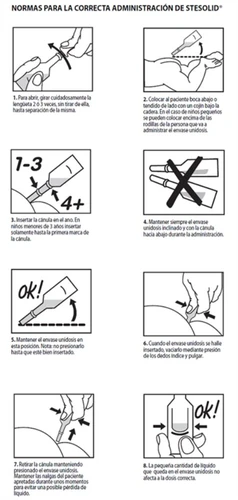
The recommended dose is:
Children
- 5 mg for children weighing between 10-15 kg (approximately 1 to 3 years of age). In this case, it is recommended to use a single-dose container from the 5 mg formulation (Stesolid 5 mg rectal solution).
- 10 mg for children weighing more than 16 kg (approximately 3 years of age).
Your child should not receive more than one dose in a single day if under 5 years of age.
Stesolid 10 mg is not indicated for children under 1 year of age.
Adults
- 10 mg in most cases.
Elderly patients and patients with hepatic impairment
The recommended dose for elderly patients and patients with hepatic impairment is 5 mg. In this case, it is recommended to use a single-dose container from the 5 mg formulation (Stesolid 5 mg rectal solution).
Patients with renal impairment
Although it has not been proven that doses need to be reduced in patients with renal disease, caution is advised. If this applies to you, consult your doctor before using this medicine.
If you think that the effect of Stesolid is too strong or too weak, inform your doctor or pharmacist.
If you use more Stesolid 10 mg than you should
You may experience symptoms ranging from drowsiness to coma. However, due to the route of administration, overdose intoxication is unlikely.
If an overdose occurs, contact your doctor or pharmacist immediately, go to the nearest hospital, and bring this leaflet with you.
In case of overdose or accidental ingestion, contact the Toxicology Information Service, Telephone 91 562 04 20.
If you forget to use Stesolid 10 mg
Do not use a double dose to make up for forgotten doses.
If you stop using Stesolid 10 mg
Your doctor will advise you on the duration of your treatment with Stesolid. Do not stop treatment earlier or abruptly, as your condition may return or you may experience other symptoms.
If you stop using the medicine abruptly, you may experience the following symptoms: insomnia, headache or muscle pain, anxiety, tension, restlessness, confusion, and irritability. Treatment should be discontinued gradually, following your doctor's instructions.
If you have any further questions about the use of this medicine, ask your doctor or pharmacist.
4. Possible adverse effects
Like all medicines, Stesolid 10 mg may cause adverse effects, although not everyone experiences them.
Usually, with medicines containing diazepam, adverse effects such as drowsiness, apathy, reduced alertness, confusion, fatigue, headache, dizziness, muscle weakness, lack of coordination, or double vision have been detected at the beginning of treatment. These phenomena usually disappear with continued treatment.
Occasionally, other adverse effects have been reported, such as gastrointestinal disturbances, skin reactions, or changes in sexual desire.
In general, following administration of diazepam, the following adverse effects have been described:
Very common (may affect more than 1 in 10 patients)
Common (may affect between 1 and 10 in 100 patients)
Uncommon (may affect between 1 and 10 in 1,000 patients)
Rare (may affect between 1 and 10 in 10,000 patients)
Very rare (may affect fewer than 1 in 10,000 patients)
Blood and lymphatic system disorders
Rare: neutropenia (decreased number of neutrophils), with prolonged administration of diazepam.
Very rare: anaemia, pancytopenia (reduction in all blood cell elements), decreased platelet count.
Immune system disorders
Very rare: allergies
Endocrine disorders
Very rare: cases of nipple discharge in women with normal serum prolactin levels, and breast enlargement in men who regularly took diazepam.
Benzodiazepines may reduce body temperature, probably in a dose-dependent manner; this effect has been observed in neonates of mothers who took benzodiazepines in the late stages of pregnancy.
Psychiatric disorders
Rare: depression, decreased libido, paradoxical excitation which may lead to hostility, aggression and disinhibition, anxiety, hallucinations, insomnia, sleep disturbances. Mild mental disturbances: memory loss, slowed reaction time.
Very rare: difficulty in remembering certain things.
Nervous system disorders
Very common: drowsiness.
Common: headache, lack of muscular coordination, dizziness, confusion.
Uncommon: hyperactivity, speech disturbances, tremor.
Rare: rebound seizures.
Eye disorders
Rare: blurred vision, double vision, involuntary eye movements.
Diazepam has some anticholinergic activity, which could cause pupil dilation and thus exacerbate narrow-angle glaucoma.
Ear and labyrinth disorders
Uncommon: vertigo.
Cardiac disorders (only reported when administered intravenously)
Uncommon: heart rhythm disturbances, inflammation of veins with thrombus formation.
With rapid intravenous administration
Uncommon: thrombus formation in veins, inflammation of veins, local irritation, swelling.
Rare: severe drop in blood pressure, decreased heart rate, circulatory collapse.
Vascular disorders
Very rare: bullous vasculitis (purple skin rash due to small vessel damage).
Respiratory disorders
Common: respiratory depression.
Gastrointestinal disorders
Uncommon: gastrointestinal disturbances, nausea, constipation, salivation disorders.
Hepatobiliary disorders
Very rare: yellowing of the skin, elevated liver enzymes.
Skin and subcutaneous tissue disorders
Uncommon: rash and urticaria, sweating, local irritation after rectal administration.
Very rare: a clinical condition characterized by fever, rashes, and blood abnormalities (Sweet's syndrome) has been described.
Musculoskeletal disorders
Very rare: in patients with low blood sodium concentration, muscle pain and weakness may occur, which can become very severe.
Renal and urinary disorders
Uncommon: urinary retention, incontinence
Reporting of adverse effects
If you experience any type of adverse effect, consult your doctor or pharmacist, even if it is a possible adverse effect not listed in this leaflet. You may also report them directly via the Spanish Pharmacovigilance System for Human Medicines: www.notificaRAM.es. By reporting adverse effects, you can help provide more information on the safety of this medicine.
5. Storage of Stesolid 10 mg
Keep this medicine out of sight and reach of children.
Do not use this medicine after the expiry date stated on the packaging after EXP. The expiry date is the last day of the month indicated.
No special storage conditions are required.
Medicines must not be disposed of via wastewater or household waste. Unused medicines and their containers should be returned to the SIGRE collection point at your pharmacy. If you are unsure, ask your pharmacist how to dispose of unused medicines and their containers. This will help protect the environment.
6. Contents of the pack and other information
Composition of Stesolid 10 mg
- The active substance is diazepam. Each single-dose container of 2.5 ml rectal solution contains 10 mg of diazepam.
- The other components (excipients) are: benzoic acid (E-210), sodium benzoate (E-211), propylene glycol (E-1520), ethanol, benzyl alcohol, and purified water.
Appearance of the product and contents of the pack
Stesolid 10 mg is a practically colourless, clear solution supplied in single-dose containers for rectal administration. Each single-dose container contains 2.5 ml of rectal solution.
It is available in cartons containing 2 and 5 single-dose containers.
Marketing Authorization Holder
Faes Farma, S.A.
Autonomia Etorbidea, 10
48940 Leioa (Bizkaia)
Spain
Manufacturer
Faes Farma, S.A.
Maximo Agirre Kalea, 14
48940 Leioa (Bizkaia)
Spain
Or
Faes Farma, S.A.
Parque Científico y Tecnológico de Bizkaia
Ibaizabal Bidea, Edificio 901
48160 Derio (Bizkaia)
Spain
Date of the most recent revision of this leaflet: October 2024
Detailed information on this medicine is available on the website of the Spanish Agency for Medicines and Health Products (AEMPS) http://www.aemps.gob.es/