Stelara 45 mg solution for injection in pre-filled syringe
Spain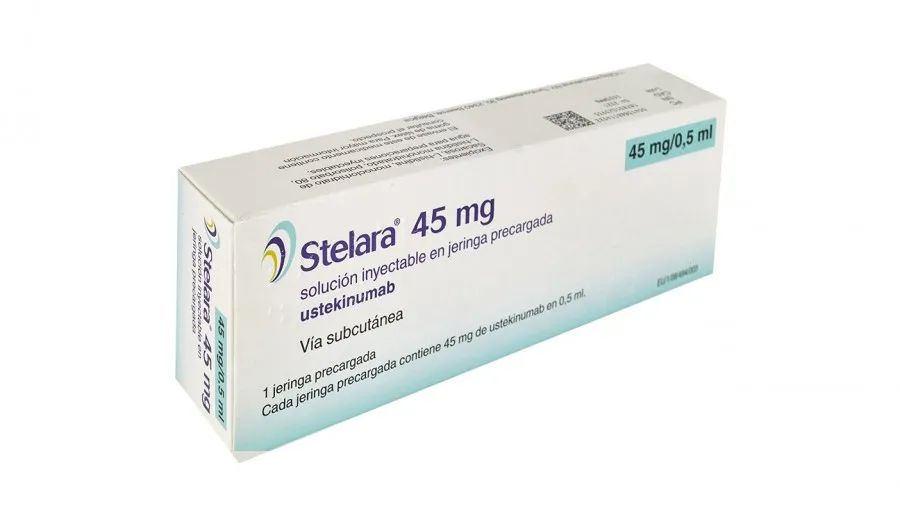
Table of Contents
- Package leaflet: Information for the user
- Introduction
- 1. What Stelara is and what it is used for
- 2. What you need to know before using Stelara
- 3. How to use Stelara
- Stelara should be used under the guidance and supervision of a physician experienced in the treatment of the conditions for which STELARA is indicated.
- 4. Possible adverse effects
- 5. Storage of Stelara
- 6. Contents of the pack and other information
Package leaflet: Information for the user
Introduction
Package leaflet: Information for the patient
STELARA 45 mg solution for injection in pre-filled syringe
ustekinumab
Read the entire leaflet carefully before you start using this medicine, because it contains important information for you.
This leaflet has been written for the person using the medicine. If you are the parent or caregiver of a child who will be given Stelara, please read this information carefully.
-
Keep this leaflet, as you may need to read it again.
-
If you have any questions, ask your doctor or pharmacist.
-
This medicine has been prescribed for you only, and you should not give it to other people even if they have the same symptoms as you, because it could harm them.
-
If you experience any adverse effects, consult your doctor or pharmacist, even if they are adverse effects not listed in this leaflet. See section 4.
Leaflet contents
-
What Stelara is and what it is used for
-
What you need to know before using Stelara
-
How to use Stelara
-
Possible side effects
-
How to store Stelara
-
Contents of the pack and other information
1. What Stelara is and what it is used for
What Stelara is
Stelara contains the active substance “ustekinumab”, a monoclonal antibody. Monoclonal antibodies are proteins that specifically recognize and bind to certain proteins in the body.
Stelara belongs to a group of medicines called “immunosuppressants”. These medicines work by suppressing part of the immune system.
What Stelara is used for
Stelara is used to treat the following inflammatory conditions:
-
Plaque psoriasis – in adults and children aged 6 years and older
-
Psoriatic arthritis – in adults
-
Moderately to severely active Crohn’s disease – in adults
-
Moderately to severely active ulcerative colitis – in adults
Plaque psoriasis
Plaque psoriasis is a skin disease causing inflammation that affects the skin and nails. Stelara reduces inflammation and other signs of the disease.
Stelara is used in adults with moderate to severe plaque psoriasis who cannot use ciclosporin, methotrexate, or phototherapy, or when these treatments are ineffective.
Stelara is used in children and adolescents aged 6 years and older with moderate to severe plaque psoriasis who are unable to tolerate phototherapy or other systemic therapies, or when these treatments are ineffective.
Psoriatic arthritis
Psoriatic arthritis is an inflammatory joint disease, which is usually accompanied by psoriasis. If you have active psoriatic arthritis, you will first be given other medications. If you do not respond adequately to these medications, you may be treated with Stelara to:
-
Reduce the signs and symptoms of your disease.
-
Improve your physical function.
-
Reduce joint damage.
Crohn’s disease
Crohn’s disease is an inflammatory bowel disease. If you have Crohn’s disease, you will first be given other medications. If you do not respond adequately or cannot tolerate these medications, you may be given Stelara to reduce the signs and symptoms of your disease.
Ulcerative colitis
Ulcerative colitis is an inflammatory bowel disease. If you have ulcerative colitis, you will first be given other medications. If you do not respond adequately or cannot tolerate these medications, you may be given Stelara to reduce the signs and symptoms of your disease.
2. What you need to know before using Stelara
Do not use Stelara:
-
If you are allergic to ustekinumab or to any of the other ingredients of this medicine (listed in section 6).
-
If you have an active infection that your doctor considers significant.
If you are unsure whether any of the above applies to you, speak with your doctor or pharmacist before using Stelara.
Warnings and precautions
Talk to your doctor or pharmacist before starting treatment with Stelara. Your doctor will assess your condition before each treatment. Make sure to inform your doctor of any medical conditions you have before each treatment. Your doctor will also ask whether you have recently been in contact with someone who might have tuberculosis. Your doctor will examine you and perform a test to detect tuberculosis before you start using Stelara. If your doctor believes you are at risk of tuberculosis, they may prescribe medication to treat it.
Watch for serious side effects
Stelara may cause serious side effects, including allergic reactions and infections. You should be aware of certain signs of illness while using Stelara. See the complete list of these side effects under “Serious side effects” in section 4.
Before using Stelara, tell your doctor:
-
If you have ever had an allergic reaction to Stelara. Consult your doctor if you are unsure.
-
If you have ever had any type of cancer – because immunosuppressants like Stelara weaken part of the immune system, which may increase the risk of developing cancer.
-
If you have or have recently had an infection.
-
If you have any new skin lesions or changes in existing lesions within the psoriasis-affected area or on intact skin.
-
If you have ever had an allergic reaction to latex or to Stelara injection – the container of this medicine contains latex rubber, which may cause severe allergic reactions in people sensitive to latex. See “Watch for serious side effects” in section 4 for signs of an allergic reaction.
-
If you are taking any other treatments for psoriasis and/or psoriatic arthritis – such as other immunosuppressants or phototherapy (when your body is treated with a type of ultraviolet (UV) light). These treatments may also weaken part of the immune system. The use of these treatments in combination with Stelara has not been studied, but it could increase the likelihood of developing illnesses related to a weaker immune system.
-
If you are receiving or have ever received allergy shots (immunotherapy) – it is unknown whether Stelara may affect these treatments.
-
If you are 65 years of age or older – you may be at higher risk of developing infections.
If you are unsure whether you have any of these conditions, speak with your doctor or pharmacist before using Stelara.
Children and adolescents
The use of Stelara is not recommended in children under 6 years of age with psoriasis, or in children under 18 years of age with psoriatic arthritis, Crohn’s disease, or ulcerative colitis, as it has not been studied in these age groups.
Use of Stelara with other medicines and vaccines
Inform your doctor or pharmacist:
-
If you are currently using, have recently used, or might use any other medicines.
-
If you have recently been vaccinated or are scheduled to receive a vaccine. Certain types of vaccines (live vaccines) must not be administered while you are being treated with Stelara.
Pregnancy and breastfeeding
-
It is preferable to avoid using Stelara during pregnancy. The effects of Stelara in pregnant women are unknown. If you are a woman of childbearing potential, you are advised to avoid becoming pregnant and to use appropriate contraceptive measures while using Stelara and for at least 15 weeks after the last dose.
-
Inform your doctor if you are pregnant, think you might be pregnant, or plan to become pregnant.
-
Inform your doctor if you are breastfeeding or plan to breastfeed. You and your doctor will decide whether you should breastfeed or use Stelara. Do not do both simultaneously.
Driving and using machines
The effect of Stelara on the ability to drive and use machines is negligible or none.
3. How to use Stelara
Stelara should be used under the guidance and supervision of a physician experienced in the treatment of the conditions for which STELARA is indicated.
Always follow exactly the administration instructions for this medicine as given by your physician. If in doubt, consult your physician. Ask your physician when you should receive your injections and about follow-up appointments.
How much Stelara should be administered
Your physician will decide the amount of Stelara you need to use and the duration of treatment.
Adults aged 18 years and older
Psoriasis or psoriatic arthritis
-
The recommended starting dose is 45 mg of Stelara. Patients weighing more than 100 kilograms (kg) may start with a dose of 90 mg instead of 45 mg.
-
After the initial dose, you will receive the next dose 4 weeks later, and then every 12 weeks thereafter. Subsequent doses are usually the same as the starting dose.
Crohn’s disease or ulcerative colitis
- During treatment, your physician will administer the first dose of approximately 6 mg/kg of Stelara as an intravenous infusion (through a drip into a vein in your arm). After the initial dose, you will receive the next dose of 90 mg of Stelara 8 weeks later, and then every 12 weeks, as an injection under the skin (“subcutaneously”).
- In some patients, after the first subcutaneous injection, 90 mg of Stelara will be administered every 8 weeks. Your physician will decide when you should receive the next dose.
Children and adolescents aged 6 years and older Psoriasis
-
Your physician will determine the correct dose for you, including the amount (volume) of Stelara to inject to deliver the correct dose. The appropriate dose for you will depend on your body weight at the time each dose is given.
-
A 45 mg vial is available for children who need to receive less than the total 45 mg dose.
-
If you weigh less than 60 kg, the recommended dose is 0.75 mg of Stelara per kg of body weight.
-
If you weigh between 60 kg and 100 kg, the recommended dose is 45 mg of Stelara.
-
If you weigh more than 100 kg, the recommended dose is 90 mg of Stelara.
-
After the initial dose, you will receive the next dose 4 weeks later, and then every 12 weeks thereafter.
How Stelara is administered
-
Stelara is administered by subcutaneous injection (“under the skin”). At the beginning of your treatment, medical or nursing staff may administer Stelara to you.
-
However, you and your physician may decide that you will self-inject Stelara. In that case, you will be trained on how to self-inject Stelara.
-
For instructions on how to inject Stelara, see “Administration Instructions” at the end of this leaflet.
Consult your physician if you have any questions about how to self-inject.
If you use more Stelara than you should
If you have used or been administered too much Stelara, speak immediately with your physician or pharmacist.
Always carry the medicine pack with you, even if it is empty.
If you forget to use Stelara
If you miss a dose, speak with your physician or pharmacist. Do not take a double dose to make up for missed doses.
If you stop treatment with Stelara
Stopping Stelara is not dangerous. However, if you stop, your symptoms may return.
If you have any further questions about the use of this medicine, ask your physician or pharmacist.
4. Possible adverse effects
Like all medicines, this medicine can cause adverse effects, although not everyone experiences them.
Serious adverse effects
Some patients may experience serious adverse effects that may require urgent treatment.
Allergic reactions – these may require urgent treatment. Contact your doctor or seek immediate medical help if you notice any of the following signs.
-
Severe allergic reactions ("anaphylaxis") are rare in patients taking Stelara (may affect up to 1 in 1,000 people). Signs include:
-
difficulty breathing and swallowing
-
low blood pressure, which may cause dizziness or mild headaches
-
swelling of the face, lips, mouth, or throat.
-
Common signs of an allergic reaction include rash and hives (these may affect up to 1 in 100 people).
In rare cases, lung-related allergic reactions and lung inflammation have been reported in patients treated with ustekinumab. Inform your doctor immediately if you develop symptoms such as cough, difficulty breathing, or fever.
If you have a severe allergic reaction, your doctor may decide that you should not use Stelara again.
Infections – these may require urgent treatment. Contact your doctor immediately if you notice any of these signs.
-
Nasal or throat infections and the common cold are common (may affect up to 1 in 10 people).
-
Chest infections are uncommon (may affect up to 1 in 100 people).
-
Inflammation of tissues beneath the skin ("cellulitis") is uncommon (may affect up to 1 in 100 people).
-
Herpes (a type of painful blistering rash) is uncommon (may affect up to 1 in 100 people).
Stelara may affect your ability to fight infections, and some of these infections could become serious.
You should monitor for signs of infection while taking Stelara. These include:
-
fever, flu-like symptoms, night sweats
-
feeling tired or having difficulty breathing; persistent cough
-
skin that feels hot, red, and painful, or a painful blistering skin rash
-
burning sensation when urinating
-
diarrhea.
Contact your doctor immediately if you notice any of these signs of infection, as they may indicate serious infections such as chest infections, skin infections, or herpes that could lead to serious complications. You should also inform your doctor if you have any infection that does not go away or keeps returning. Your doctor may decide that you should not use Stelara until the infection resolves. Also contact your doctor if you have any open cuts or ulcers that could become infected.
Skin peeling – increased redness and peeling of the skin over a large area of the body may be symptoms of erythrodermic psoriasis or exfoliative dermatitis, which are serious skin disorders. If you notice any of these symptoms, you must inform your doctor immediately.
Other adverse effects
Common adverse effects (may affect up to 1 in 10 people):
-
Diarrhea
-
Nausea
-
Vomiting
-
Feeling tired
-
Dizziness
-
Headache
-
Itching ("pruritus")
-
Back, muscle, or joint pain
-
Sore throat
-
Redness and pain at the injection site
-
Sinusitis
Uncommon adverse effects (may affect up to 1 in 100 people):
-
Dental infections
-
Vaginal yeast infections
-
Depression
-
Nasal congestion or stuffiness
-
Bleeding, bruising, hardening, swelling, and itching at the injection site
-
Feeling weak
-
Drooping eyelid and sinking of the facial muscles on one side of the face ("facial paralysis" or "Bell's palsy"), which is usually temporary
-
A change in psoriasis with redness and new small yellow or white blisters on the skin, sometimes accompanied by fever (pustular psoriasis)
-
Skin peeling (exfoliation of the skin)
-
Acne
Rare adverse effects (may affect up to 1 in 1,000 people):
-
Redness and peeling of the skin over a large area of the body, which may cause itching or pain (exfoliative dermatitis). Similar symptoms may develop as a natural change in psoriasis symptoms (erythrodermic psoriasis)
-
Inflammation of small blood vessels, which may cause a skin rash with small red or purple raised spots, fever, or joint pain (vasculitis)
Reporting of adverse effects
If you experience any adverse effect, talk to your doctor or pharmacist, even if it is a possible adverse effect not listed in this leaflet. You can also report them directly through the national reporting system detailed in Appendix V. By reporting adverse effects, you can help provide more information on the safety of this medicine.
5. Storage of Stelara
Keep the medicine out of the sight and reach of children.
Do not use this medicine after the expiry date which is stated on the carton and pre-filled syringe or pre-filled pen label after EXP. The expiry date refers to the last day of that month.
The pre-filled syringe or pre-filled pen should be stored in the original carton to protect from light.
Keep the pre-filled syringe or pre-filled pen in the refrigerator (2°C – 8°C). Do not freeze. Keep the pre-filled syringe or pre-filled pen in the original carton to protect from light.
If necessary, the pre-filled syringe or pre-filled pen can be stored at room temperature (up to 30°C) for a single period of up to 7 days. Discard if not used within 7 days. Do not return to the refrigerator after being stored at room temperature.
Do not use Stelara if you notice changes in the appearance of the solution or if it contains particles.
Keep the pre-filled syringe or pre-filled pen in the original carton to protect from light.
After removal from the refrigerator, Stelara should be administered within 24 hours.
Stelara does not contain a preservative. Once the pre-filled syringe or pre-filled pen has been removed from the refrigerator, use it immediately or discard it.
Keep the pre-filled syringe or pre-filled pen in the original carton to protect from light.
For instructions on the use and handling of the medicine before administration, see section 6.
The chemical and physical in-use stability has been demonstrated for 24 hours at 25°C.
Do not store above 30°C.
Do not freeze.
Do not use Stelara if you notice changes in the appearance of the solution or if it contains particles.
Keep the pre-filled syringe or pre-filled pen in the original carton to protect from light.
-
Keep this medicine out of the sight and reach of children.
-
Store in a refrigerator (2°C–8°C). Do not freeze.
-
Keep the pre-filled syringe in the outer packaging to protect it from light.
-
If necessary, individual Stelara pre-filled syringes may also be stored at room temperature up to 30°C for a single continuous period of up to 30 days in their original carton to protect them from light. Write the date when the pre-filled syringe is first removed from the refrigerator and the date when it must be discarded in the designated spaces on the outer packaging. The discard date must not exceed the original expiry date printed on the carton. Once a syringe has been stored at room temperature (up to a maximum of 30°C), it must not be returned to the refrigerator. Discard the syringe if it is not used within 30 days of storage at room temperature or after the original expiry date, whichever comes first.
-
Do not shake the Stelara pre-filled syringes. Prolonged vigorous shaking may damage the product.
Do not use this medicine:
-
After the expiry date stated on the label and container following “EXP”. The expiry date refers to the last day of the month indicated.
-
If the liquid changes colour, becomes cloudy, or contains foreign particles floating in it (see section 6 “What Stelara looks like and contents of the container”).
-
If you know or suspect it has been exposed to extreme temperatures (such as accidental overheating or freezing).
-
If the product has been shaken vigorously.
Stelara is for single use only. Any unused product remaining in the syringe must be discarded. Medicines must not be disposed of via wastewater or household waste. Ask your pharmacist how to dispose of medicines and containers you no longer need. This will help protect the environment.
6. Contents of the pack and other information
Composition of Stelara
-
The active substance is ustekinumab. Each pre-filled syringe contains 45 mg of ustekinumab in 0.5 ml.
-
The other components are L-histidine, L-histidine monohydrochloride monohydrate, polysorbate 80, sucrose and water for injections.
Appearance of Stelara and contents of the pack
Stelara is a transparent or slightly opalescent (with a pearly sheen), colourless to pale yellow injectable solution. The solution may contain a few translucent or white protein particles.
It is supplied in a pack containing 1 single-use glass pre-filled syringe of 1 ml. Each pre-filled syringe contains 45 mg of ustekinumab in 0.5 ml of injectable solution.
Marketing Authorisation Holder
Janssen-Cilag International NV
Turnhoutseweg 30
B-2340 Beerse
Belgium
Manufacturer
Janssen Biologics B.V.
Einsteinweg 101
2333 CB Leiden
The Netherlands
For further information about this medicine, please contact the local representative of the Marketing Authorisation Holder:
België/Belgique/BelgienLietuva
Janssen-Cilag NV UAB "JOHNSON & JOHNSON"
Tel/Tél: +32 14 64 94 11 Tel: +370 5 278 68 88
[email protected] [email protected]
????????Luxembourg/Luxemburg
„??????? & ??????? ????????” ???? Janssen-Cilag NV
???.: +359 2 489 94 00 Tél/Tel: +32 14 64 94 11
[email protected] [email protected]
Ceská republikaMagyarország
Janssen-Cilag s.r.o. Janssen-Cilag Kft.
Tel: +420 227 012 227 Tel.: +36 1 884 2858
[email protected]
DanmarkMalta
Janssen-Cilag A/S AM MANGION LTD
Tlf: +45 4594 8282 Tel: +356 2397 6000
[email protected]
DeutschlandNederland
Janssen-Cilag GmbH Janssen-Cilag B.V.
Tel: +49 2137 955 955 Tel: +31 76 711 1111
[email protected] [email protected]
EestiNorge
UAB "JOHNSON & JOHNSON" Eesti filiaal Janssen-Cilag AS
Tel: +372 617 7410 Tlf: +47 24 12 65 00
[email protected] [email protected]
Ελλ?δαÖsterreich
Janssen-Cilag Φαρμακευτικ? Α.Ε.Β.Ε. Janssen-Cilag Pharma GmbH
Tηλ: +30 210 80 90 000 Tel: +43 1 610 300
EspañaPolska
Janssen-Cilag, S.A. Janssen-Cilag Polska Sp. z o.o.
Tel: +34 91 722 81 00 Tel.: +48 22 237 60 00
[email protected]
FrancePortugal
Janssen-Cilag Janssen-Cilag Farmacêutica, Lda.
Tél: 0 800 25 50 75 / +33 1 55 00 40 03 Tel: +351 214 368 600
[email protected]
HrvatskaRomânia
Johnson & Johnson S.E. d.o.o. Johnson & Johnson România SRL
Tel: +385 1 6610 700 Tel: +40 21 207 1800
[email protected]
IrelandSlovenija
Janssen Sciences Ireland UC Johnson & Johnson d.o.o.
Tel: +353 1 800 709 122 Tel. +386 1 401 18 00
[email protected]
ÍslandSlovenská republika
Janssen-Cilag AB Johnson & Johnson, s.r.o.
c/o Vistor hf. Tel: +421 232 408 400
Sími: +354 535 7000
[email protected]
ItaliaSuomi/Finland
Janssen-Cilag SpA Janssen-Cilag Oy
Tel: 800.688.777 / +39 02 2510 1 Puh/Tel: +358 207 531 300
[email protected] [email protected]
Κ?προςSverige
Βαρν?βας Χατζηπαναγ?ς Λτδ Janssen-Cilag AB
Tηλ: +357 22 207 700 Tfn: +46 8 626 50 00
[email protected]
LatvijaUnited Kingdom
UAB "JOHNSON & JOHNSON" filiale Janssen-Cilag Ltd.
Latvija Tel: +44 1 494 567 444
Tel: +371 678 93561
[email protected]
Date of latest revision of this leaflet {MM/YYYY}.
Detailed information on this medicine is available on the European Medicines Agency website: http://www.ema.europa.eu/.
Administration instructions
At the beginning of treatment, a healthcare professional will assist you with your first injection. However, you and your doctor may decide that you can self-inject Stelara. In such a case, you will be trained on how to administer Stelara injections. Speak with your doctor if you have any doubts about administering the injections.
-
Do not mix Stelara with other injectable liquids.
-
Do not shake the pre-filled syringes of Stelara. The medicine may deteriorate if shaken vigorously. Do not use the medicine if it has been shaken vigorously.
Figure 1 shows what the pre-filled syringe looks like.
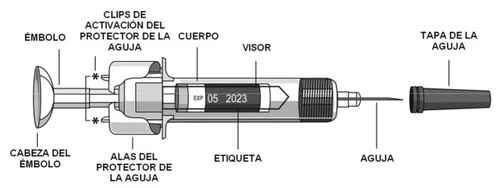
Figure 1
- Check the number of pre-filled syringes and prepare materials: Preparation for using the pre-filled syringe
? Remove the pre-filled syringe(s) from the refrigerator. Leave the pre-filled syringe outside the box for 30 minutes. This will allow the liquid to reach a comfortable temperature for administration (room temperature). Do not remove the needle cap while waiting for the syringe to reach room temperature.
? Hold the pre-filled syringe by the barrel with the covered needle pointing upwards.
? Do not hold the syringe by the plunger head, plunger, needle shield wings, or needle cap.
? Do not pull out the plunger at any time.
? Do not remove the needle cap until instructed to do so.
? Do not touch the activation clips of the needle shield (indicated by asterisks* in Figure 1) to prevent the needle shield from covering the needle prematurely.
Check the pre-filled syringe(s) to ensure that:
-
The number of pre-filled syringes and concentration are correct.
-
If your dose is 45 mg, you will have one 45 mg pre-filled syringe of Stelara.
-
If your dose is 90 mg, you will have two 45 mg pre-filled syringes of Stelara and will need to administer two injections. Choose two different injection sites (e.g., one in the right thigh and one in the left thigh), and inject one immediately after the other.
-
It is the correct medicine.
-
The expiry date has not passed.
-
The pre-filled syringe is not damaged.
-
The solution in the pre-filled syringe is transparent to slightly opalescent (with a pearly sheen) and colourless to slightly yellow.
-
The solution in the pre-filled syringe is not discoloured, cloudy, or containing foreign particles.
-
The solution in the pre-filled syringe is not frozen.
Prepare all necessary materials and place them on a clean surface. Include antiseptic wipes, cotton wool or gauze, and a sharps container.
- Choose and prepare the injection site: Choose the injection site (see Figure 2).
? Stelara is administered by injection under the skin (subcutaneously).
? Suitable injection sites include the upper thigh or the abdominal area (abdomen), at least 5 cm away from the navel.
? Whenever possible, avoid areas of skin affected by psoriasis.
? If someone else is administering the injection, they may also choose the upper arm as an injection site.

Figure 2
Prepare the injection site:
-
Wash your hands thoroughly with soap and lukewarm water.
-
Clean the skin at the injection site with an antiseptic wipe.
-
Do not touch this area again before administering the injection.
- Remove the needle cap (see Figure 3):
-
The needle cap must not be removed until you are ready to inject.
-
Hold the pre-filled syringe and grasp the syringe barrel with one hand.
-
Remove the needle cap and dispose of it. Do not touch the plunger while doing this.
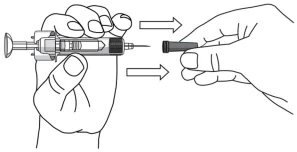
Figure 3
- You may see an air bubble in the pre-filled syringe or a drop of liquid at the tip of the needle. Both are normal and do not need to be removed.
- Do not touch the needle or allow it to touch any surface.
- Do not use the pre-filled syringe if it has been dropped without the needle cap. If this happens, inform your doctor or pharmacist.
- Inject the dose immediately after removing the needle cap.
- Administer the dose:
-
Hold the pre-filled syringe in one hand between the index and middle fingers, place your thumb on the plunger head, and with the other hand gently pinch a fold of disinfected skin between your thumb and index finger. Do not squeeze tightly.
-
Do not pull out the plunger at any time.
-
In one quick motion, insert the needle through the skin as far as it will go (see Figure 4).
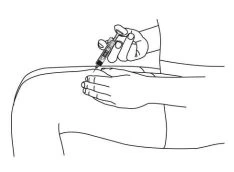
Figure 4
- Inject the full dose by pushing the plunger until the plunger head is completely between the wings of the needle shield (see Figure 5).
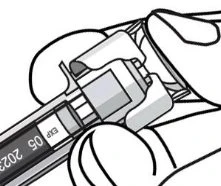
Figure 5
- Once the plunger has been fully depressed, maintain pressure on the plunger head, withdraw the needle, and release the skin (see Figure 6).
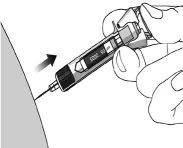
Figure 6
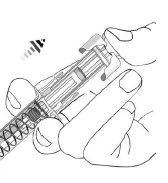
- Slowly release your thumb from the plunger head so that the empty syringe advances until the needle is completely covered by the needle shield, as shown in Figure 7:
|
Figure 7 |
- After the injection:
-
Press the injection site with an antiseptic wipe for a few seconds after the injection.
-
A small amount of blood or fluid may appear at the injection site. This is normal.
-
You may press the injection site with a cotton ball or gauze and hold it for 10 seconds.
-
Do not rub the skin at the injection site. You may cover the injection site with a bandage if necessary.
- Disposal:
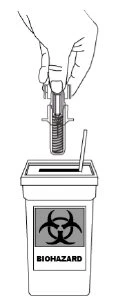
- Used syringes must be placed in a puncture-resistant container, such as a sharps container (see Figure 8). For your safety and health and for the safety of others, never reuse the syringe. Dispose of your sharps container according to your local regulations.
- Antiseptic wipes and other materials may be discarded in the trash.
|
Figure 8 |