Stamaril powder and solvent for injectable suspension in pre-filled syringe
Spain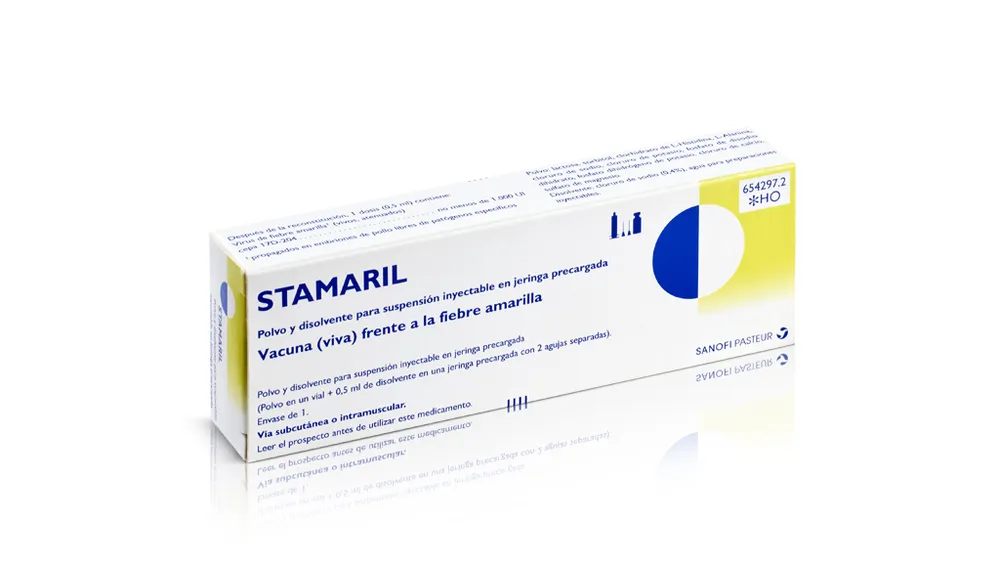
Table of Contents
Package leaflet: Information for the user
Introduction
Package leaflet: Information for the user
STAMARIL, powder and solvent for injectable suspension in pre-filled syringe
Yellow fever (live) vaccine
Read the entire leaflet carefully before you/your child are vaccinated because it contains important information for you.
- Keep this leaflet, as you may need to read it again.
- If you have any questions, consult your healthcare professional.
- This vaccine has been prescribed only for you or your child and must not be given to other people, even if they have the same symptoms as you, because it could harm them.
- If you experience adverse reactions, consult your healthcare professional and inform them that you received the yellow fever vaccine, even if these adverse reactions are not listed in this leaflet. See section 4.
Leaflet contents:
- What Stamaril is and what it is used for
- What you need to know before you or your child are given Stamaril
- How to use Stamaril
- Possible side effects
- How to store Stamaril
- Contents of the pack and other information
1. What Stamaril is and what it is used for
Stamaril is a vaccine that provides protection against a serious infectious disease called yellow fever.
Yellow fever occurs in certain areas of the world and is transmitted to humans through bites from infected mosquitoes.
Stamaril is given to people who:
- are travelling to, transiting through, or living in areas where yellow fever is present.
- are travelling to any country requiring an International Certificate of Vaccination to enter (this may depend on countries previously visited during the same trip).
- may handle infected materials, such as laboratory workers.
To obtain a valid yellow fever vaccination certificate, vaccination must be administered at an authorized vaccination center by a qualified and trained healthcare professional who is authorized to issue an International Certificate of Vaccination. This certificate is valid for 10 years, starting 10 days after the first vaccine dose. In certain circumstances, when a booster dose is required, the certificate (see section 3) becomes valid immediately after the injection.
2. What you need to know before you or your child start using Stamaril
It is important to consult your healthcare professional if any of the following apply to you or your child. If there is anything you do not understand, ask your healthcare professional to explain it to you.
Do not use Stamaril if you or your child:
- are allergic to:
- the active substance, or
- any of the other components of this vaccine (listed in section 6), or
- eggs or chicken proteins.
- have experienced a severe allergic reaction after a previous dose of any yellow fever vaccine,
- are less than 6 months of age,
- have a weakened or impaired immune system for any reason, such as due to illness or medical treatments (for example, high-dose steroids or any other medication affecting the immune system, or chemotherapy). If you are unsure whether a medication may affect the immune system, speak with your healthcare professional before administering the vaccine,
- have an impaired immune system due to HIV infection. Your healthcare professional will advise whether you or your child can still receive Stamaril based on blood test results,
- are infected with HIV and have active symptoms due to the infection,
- have a history of thymus gland disorders or have had the thymus gland removed for any reason,
- have a moderate or high fever or an acute illness. Vaccination will be postponed until you or your child have recovered.
Warnings and precautions
Before using Stamaril, it is important to complete a risk assessment with a qualified healthcare professional to determine whether you should receive the vaccine.
- If you are over 60 years of age or if your child is under 9 months of age, because of an increased risk of certain rare but serious reactions to the vaccine (including serious reactions affecting the brain and nerves, and vital organs; see section 4). You will only receive the vaccine if the risk of infection with the virus is clearly established in the countries you will be visiting,
- If your child is between 6 and 9 months of age. Stamaril may be administered to children between 6 and 9 months of age only in special circumstances and according to current official recommendations,
- If you or your child are infected with HIV but do not have active symptoms due to the infection. Your healthcare professional will advise whether you can still receive Stamaril based on laboratory test results and specialist advice,
- If you or your child have a bleeding disorder (such as hemophilia or low platelet count) or are taking any medication that prevents blood from clotting normally. You may still receive Stamaril provided it is injected subcutaneously and not intramuscularly (see section 3).
- If you have previously had an allergic reaction to latex, you may experience severe allergic reactions because the stopper at the end of the pre-filled syringe contains a derivative of natural rubber latex (latex rubber).
Like all vaccines, Stamaril may not fully protect all vaccinated individuals.
Fainting may occur after any injection with a needle, or even before the injection. Therefore, inform your healthcare professional if you or your child have previously fainted after an injection.
Use of Stamaril with other medicines
Inform your healthcare professional if you are taking, have recently taken, or might need to take any other medicines.
If you have recently received any treatment or medicine that may have weakened your immune system, vaccination should be postponed until laboratory tests show that your immune system has recovered. Your doctor will advise you when it is safe for you to be vaccinated.
Stamaril may be administered at the same time as measles vaccine or typhoid fever vaccines (those containing Vi capsular polysaccharide of typhoid fever) and/or hepatitis A vaccines.
Vaccination with Stamaril may lead to false positive results in blood tests for dengue or Japanese encephalitis. If you or your child are prescribed such tests in the future, please inform your doctor about this vaccination.
Pregnancy and breastfeeding
If you are pregnant or breastfeeding, think you may be pregnant, or are planning to become pregnant, consult your healthcare professional before using this medicine.
You should not receive Stamaril during pregnancy or breastfeeding unless unavoidable. In addition, it is recommended that you avoid becoming pregnant within one month after receiving STAMARIL. Your healthcare professional will advise you whether vaccination is essential. If vaccination is necessary, breastfeeding should be interrupted for at least 2 weeks after receiving STAMARIL. If you receive the vaccine during pregnancy or breastfeeding, consult your healthcare professional.
STAMARIL contains sodium, potassium, and sorbitol
This medicine contains less than 1 mmol of sodium (23 mg) per dose, which is considered essentially “sodium-free”, and less than 1 mmol of potassium (39 mg) per dose, which is considered essentially “potassium-free”.
This medicine contains approximately 8 mg of sorbitol per dose.
3. How to use Stamaril
Dosage
Stamaril is administered as a single dose of 0.5 millilitres to adults and children from 6 months of age.
The first dose should be given at least 10 days before protection against yellow fever is needed. This is because the first vaccine dose takes 10 days to become effective and provide adequate protection against the yellow fever virus. The protection provided by this dose is expected to last at least 10 years and may last for life.
Under certain circumstances, a booster dose (0.5 millilitres) may be necessary:
- if you or your child have had an inadequate response to the first dose and you or your child remain at risk of infection with the yellow fever virus,
- or depending on official recommendations.
How Stamaril is administered
Stamaril is administered by injection by a qualified and trained healthcare professional. It is usually injected under the skin, but may be injected into a muscle.
It must not be injected into a blood vessel.
If you or your child have been given more Stamaril than you should
In some cases, more than the recommended dose has been used.
In these cases, when side effects were reported, they were consistent with those described in section 4.
If you have any further questions about the use of this vaccine, consult your healthcare professional.
4. Possible adverse effects
Like all medicines, this vaccine may cause adverse effects, although not everyone will experience them.
Serious adverse effects
The following serious adverse effects have been reported:
Allergic reactions:
- Rash, itching, or hives on the skin
- Swelling of the face, lips, tongue, or other parts of the body
- Difficulty swallowing or breathing
- Loss of consciousness
Reactions affecting the brain and nerves:
These may occur within one month after vaccination and have sometimes been fatal.
Symptoms may include:
- High fever with headache and confusion
- Excessive tiredness
- Stiffness of the neck
- Inflammation of the brain and nervous tissue
- Seizures
- Loss of movement or sensation in part or all of the body (e.g., Guillain-Barré syndrome)
- Personality changes
Serious reactions affecting vital organs:
These may appear within 10 days after vaccination and may be fatal. The reaction may resemble infection with the yellow fever virus. It usually begins with a feeling of fatigue, fever, headache, muscle pain, and sometimes low blood pressure. It may then progress to severe muscle and liver disorders, a decrease in the number of certain types of blood cells leading to unusual bruising or bleeding and increased risk of infections, and loss of normal kidney and lung function.
If you experience ANY of the above symptoms after vaccination, seek medical attention IMMEDIATELY and mention that you have recently received STAMARIL.
Other adverse effects
Very common (may affect more than 1 in 10 people)
- Headache
- Tiredness or mild to moderate weakness (asthenia)
- Pain or discomfort at the injection site
- Muscle aches
- Fever (in children)
- Vomiting (in children)
Common (may affect up to 1 in 10 people)
- Fever (in adults)
- Vomiting (in adults)
- Joint pain
- Feeling unwell (nausea)
- Reactions at the injection site: redness, bruising, swelling, or formation of a lump (hard nodule)
Uncommon (may affect up to 1 in 100 people)
- Dizziness
- Stomach pain
- A small bump (papule) at the injection site
Rare (may affect up to 1 in 1,000 people)
- Diarrhea
- Runny, stuffy, or itchy nose (rhinitis)
Frequency not known (cannot be estimated from available data)
- Swollen glands (lymphadenopathy)
- Numbness or tingling sensation (paresthesia)
- Flu-like illness
Other side effects in children
Very common (may affect more than 1 in 10 children)
- Irritability, crying
- Loss of appetite
- Sleepiness
These adverse effects generally occurred within 3 days following vaccination and usually did not last longer than 3 days. Most of these side effects were mild in intensity.
Reporting of adverse effects
If you experience any adverse effects, consult your healthcare professional, even if they are possible adverse effects not listed in this leaflet. You may also report them directly via the Spanish Pharmacovigilance System for Human Medicinal Products: https://www.notificaRAM.es.
By reporting adverse effects, you can help provide more information on the safety of this medicine.
5. Storage of Stamaril
- Keep this vaccine out of the sight and reach of children.
- Do not use this vaccine after the expiry date stated on the container after EXP. The expiry date refers to the last day of the month indicated.
- Store in a refrigerator (between 2°C and 8°C). Do not freeze.
- Keep the powder vial and the solvent syringe in the outer packaging to protect from light.
- Use immediately after reconstitution.
- Medicines should not be disposed of via wastewater or household waste. Ask your pharmacist how to properly dispose of unused medicines and their packaging. This will help protect the environment.
6. Contents of the pack and other information
Composition of Stamaril
After reconstitution, one 0.5 ml dose contains:
- The active substance is:
Yellow fever virus1 (live, attenuated), strain 17D-204………… not less than 1,000 IU
1 propagated in specific pathogen-free chicken embryos
- The other components are:
Lactose, sorbitol, L-histidine hydrochloride, L-alanine, sodium chloride, potassium chloride, disodium phosphate dihydrate, potassium dihydrogen phosphate, calcium chloride, magnesium sulfate, and water for injections.
Appearance of the product and contents of the pack
Stamaril is supplied as a powder and solvent for injectable suspension (powder in a vial (0.5 ml dose) + solvent in a pre-filled syringe (0.5 ml dose) with or without needle). Pack size: 1.
After reconstitution, the suspension is beige to pinkish beige in colour and more or less opalescent.
Only certain pack sizes may be marketed.
Marketing Authorization Holder
Sanofi Winthrop Industrie
82 avenue Raspail
94250 Gentilly
France
Manufacturer
Sanofi Winthrop Industrie
1541 avenue Marcel Mérieux
69280 Marcy l’Etoile
France
or
Sanofi Winthrop Industrie
Voie de l’Institut – Parc Industriel d’Incarville
B.P 101
27100 Val de Reuil
France
Local Representative
sanofi-aventis, S.A.
C/ Rosselló i Porcel, 21
08016 Barcelona
Spain
Tel: +34 93 485 94 00
This medicinal product is authorized in the Member States of the European Economic Area under the following names:
STAMARIL: Austria, Belgium, Bulgaria, Cyprus, Czech Republic, Denmark, Estonia, Finland, France, Germany, Croatia, Hungary, Ireland, Italy, Latvia, Lithuania, Luxembourg, Malta, Poland, Portugal, Romania, Slovakia, Spain, Sweden, Netherlands, United Kingdom, Iceland, Norway.
Date of the most recent revision of this leaflet: 12/2020
Other sources of information
Detailed information on this medicinal product is available on the website of the Spanish Agency of Medicines and Medical Devices (AEMPS) http://www.aemps.gob.es/
This information is intended for healthcare professionals only:
Instructions for reconstitution:
Prior to use, the beige to orange-beige coloured powder is mixed with the colourless and transparent sodium chloride solvent provided in a syringe to obtain a beige to pinkish beige suspension, which is more or less opalescent.
For syringes without fixed needle only: after removing the cap at the end of the syringe, the needle must be firmly attached to the end of the syringe and secured by rotating a quarter turn (90º).
The vaccine is reconstituted by adding the solvent provided in the pre-filled syringe to the vial. The vial is shaken and, after complete dissolution, the resulting suspension is withdrawn using the same syringe for injection.
Contact with disinfectants must be avoided, as they may inactivate the virus.
Use immediately after reconstitution.
Before administration, the reconstituted vaccine must be shaken vigorously.
Any unused medicinal product or waste material must be disposed of in accordance with local regulations.
See also section 3. How to use Stamaril