Spiriva 18 micrograms inhalation powder
Spain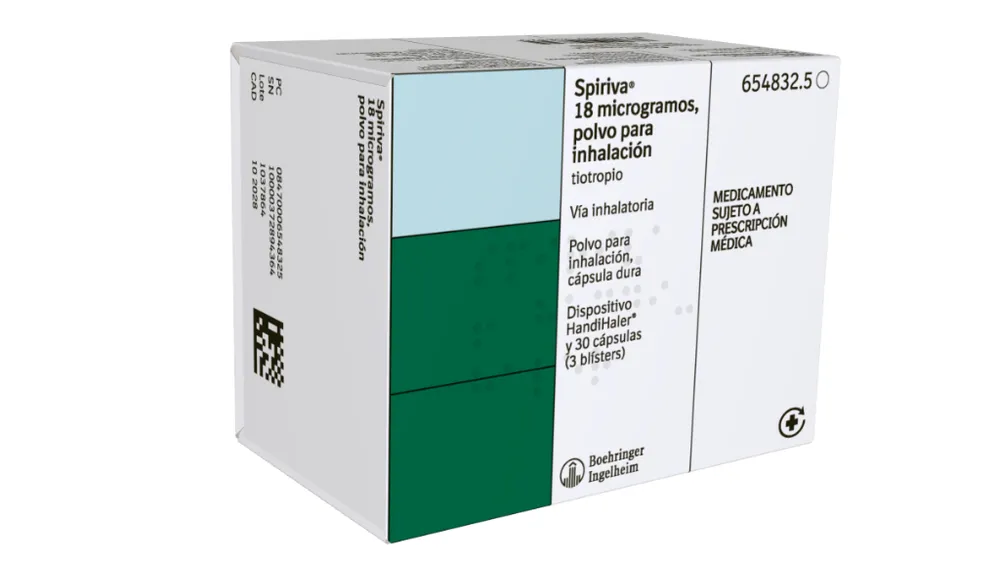
Table of Contents
- Package leaflet: Information for the user
- Introduction
- 1. What Spiriva 18 micrograms is and what it is used for
- 2. What you need to know before using Spiriva 18 micrograms
- 3. How to use Spiriva 18 micrograms
- 4. Possible adverse effects
- 5. Storage of Spiriva 18 micrograms
- 6. Contents of the pack and other information
Package leaflet: Information for the user
Introduction
Package leaflet: information for the user
Spiriva 18 micrograms, inhalation powder
tiotropium
Read the entire leaflet carefully before you start using this medicine, because it contains important information for you.
- Keep this leaflet as you may need to read it again.
- If you have any questions, ask your doctor or pharmacist.
- This medicine has been prescribed for you only, and you should not give it to others, even if they have the same symptoms as you, because it could harm them.
- If you experience any side effects, consult your doctor or pharmacist, even if they are side effects not listed in this leaflet. See section 4.
Leaflet contents:
- What Spiriva 18 micrograms is and what it is used for
- What you need to know before using Spiriva 18 micrograms
- How to use Spiriva 18 micrograms
- Possible side effects
- How to store Spiriva 18 micrograms
- Contents of the pack and other information
1. What Spiriva 18 micrograms is and what it is used for
Spiriva 18 micrograms helps people with chronic obstructive pulmonary disease (COPD) to breathe more easily. Chronic obstructive pulmonary disease (COPD) is a chronic lung disease that causes difficulty breathing and coughing. The term COPD is associated with chronic bronchitis and emphysema. Since COPD is a chronic disease, you must use Spiriva 18 micrograms every day, not only when you have breathing problems or other COPD symptoms.
Spiriva 18 micrograms is a long-acting bronchodilator that helps open the airways and makes it easier to take air in and out of the lungs. Regular use of Spiriva 18 micrograms can also help when you have ongoing breathing difficulties due to your disease, and will help minimize the impact of the disease on your daily life. It also helps you stay active for longer. Daily use of Spiriva 18 micrograms will also help prevent sudden, short-term symptoms of worsening COPD, which may last for several days.
The effect of this medicine lasts for 24 hours; therefore, you only need to use it once a day. For correct dosing of Spiriva 18 micrograms, see section 3, How to use Spiriva 18 micrograms, and the instructions on how to use the HandiHaler device at the end of this leaflet.
2. What you need to know before using Spiriva 18 micrograms
Do not use Spiriva 18 micrograms
- if you are allergic (hypersensitive) to tiotropium, its active substance, or to any other component of this medicine (listed in section 6).
- if you are allergic (hypersensitive) to atropine or its derivatives, e.g. ipratropium or oxitropium.
Warnings and precautions
Consult your doctor or pharmacist before using Spiriva 18 micrograms
-
Consult your doctor if you have narrow-angle glaucoma, prostate problems, or difficulty urinating.
-
If you have kidney problems, please consult your doctor.
-
Spiriva 18 micrograms is indicated for the maintenance treatment of your chronic obstructive pulmonary disease (COPD); it should not be used to treat a sudden episode of shortness of breath or wheezing.
-
Immediately after administration of Spiriva 18 micrograms, immediate allergic reactions such as rash, swelling, itching, wheezing, or shortness of breath may occur. If this happens, please consult your doctor immediately.
-
Inhaled medicines such as Spiriva 18 micrograms may cause chest tightness, cough, wheezing, or shortness of breath immediately after inhalation. If this occurs, please consult your doctor immediately.
-
Be careful that the inhaled powder does not enter your eyes, as this may cause or worsen narrow-angle glaucoma, an eye condition. Eye pain or discomfort, blurred vision, halos, colored images, or eye redness may be signs of an acute episode of narrow-angle glaucoma. Ocular symptoms may be accompanied by headache, nausea, or vomiting. You must stop using tiotropium bromide and consult your doctor immediately, preferably an ophthalmologist, if symptoms or signs of narrow-angle glaucoma appear.
-
Dry mouth, which has been observed during treatment with anticholinergics, may be associated over time with dental caries. Therefore, remember to maintain good oral hygiene.
-
If you have had a myocardial infarction within the last 6 months, or if you have unstable or life-threatening cardiac arrhythmias, or severe heart failure in the past year, inform your doctor. This is important to determine whether Spiriva is the appropriate medicine for you.
-
You should not use Spiriva 18 micrograms more than once a day.
Children and adolescents
Spiriva 18 micrograms is not recommended for children and adolescents under 18 years of age.
Other medicines and Spiriva 18 micrograms
Tell your doctor or pharmacist if you are taking, have recently taken, or might need to take any other medicines, including those available without a prescription.
Tell your doctor or pharmacist if you are taking or have taken similar medicines for your lung disease, such as ipratropium or oxitropium.
No specific adverse reactions have been reported when Spiriva 18 micrograms has been used together with other medicines commonly used in the treatment of COPD, such as rescue inhalers, e.g. salbutamol, methylxanthines such as theophylline, and/or oral and inhaled steroids, such as prednisolone.
Pregnancy and breastfeeding
If you are pregnant or breastfeeding, think you may be pregnant, or are planning to become pregnant, consult your doctor or pharmacist before using this medicine. You should not use this medicine unless specifically advised by your doctor.
Driving and using machines
Dizziness, blurred vision, or headache may affect your ability to drive or operate machinery.
Spiriva 18 micrograms contains lactose monohydrate
When administered according to the recommended dose—one capsule once daily—each dose provides up to 5.5 mg of lactose monohydrate. If your doctor has informed you of an intolerance to certain sugars or an allergy to milk proteins (which may be present in small amounts in the lactose monohydrate ingredient), please contact your doctor before taking this medicine.
3. How to use Spiriva 18 micrograms
Follow exactly the instructions for using this medicine as given by your doctor or pharmacist. If in doubt, consult your doctor or pharmacist again.
The recommended dose is inhalation of the contents of one capsule (18 micrograms of tiotropium) once daily. Do not use more than the recommended dose.
You should try to use the capsule at the same time each day. This is important because Spiriva 18 micrograms is effective for 24 hours.
The capsules are for inhalation only and must not be taken orally.
Do not swallow the capsules.
The HandiHaler device, into which you place the Spiriva capsule, pierces the capsule and allows you to inhale the powder.
Make sure you have a HandiHaler device and that you know how to use it correctly. Read the instructions on how to use the HandiHaler device provided at the end of this leaflet.
Ensure that you do not blow into the HandiHaler.
If you have any difficulty using the HandiHaler, ask your doctor, nurse, or pharmacist to show you how it works.
You must clean your HandiHaler once a month. Instructions for cleaning the HandiHaler are provided at the end of this leaflet, see “Instructions on how to use the HandiHaler device”.
When using Spiriva 18 micrograms, take care not to get the powder into your eyes. If powder gets into your eyes, it may cause blurred vision, eye pain and/or eye redness. Immediately rinse your eyes with lukewarm water. Contact your doctor immediately for further advice.
If you notice that your breathing worsens, contact your doctor as soon as possible.
Use in children and adolescents
Spiriva 18 micrograms is not recommended for children and adolescents under 18 years of age.
If you use more Spiriva 18 micrograms than you should
If you inhale more than one capsule of Spiriva 18 micrograms in one day, you must speak to your doctor immediately. You may be at increased risk of experiencing an adverse reaction such as dry mouth, constipation, difficulty urinating, increased heart rate, or blurred vision.
If you forget to use Spiriva 18 micrograms
If you forget a dose, take it as soon as you remember, but do not take two doses at the same time or on the same day. Then take your next dose as usual.
If you stop using Spiriva 18 micrograms
Before stopping treatment with Spiriva 18 micrograms, you must speak to your doctor or pharmacist.
If you stop treatment with Spiriva 18 micrograms, your COPD symptoms may worsen.
If you have any further questions about the use of this medicine, ask your doctor or pharmacist.
4. Possible adverse effects
Like all medicines, this medicine may cause adverse effects, although not everyone experiences them.
The adverse effects listed below have been reported by people who have taken this medicine and are listed according to their frequency as follows: common, uncommon, rare, or frequency not known.
Common (may affect up to 1 in 10 patients):
- Dry mouth: this is usually mild
Uncommon (may affect up to 1 in 100 patients):
- dizziness
- headache
- taste disturbances
- blurred vision
- irregular heart rhythm (atrial fibrillation)
- throat inflammation (pharyngitis)
- hoarseness (dysphonia)
- cough
- heartburn (gastro-oesophageal reflux)
- constipation
- fungal infection in the mouth or throat (oropharyngeal candidiasis)
- rash
- difficulty urinating (urinary retention)
- pain when urinating (dysuria)
Rare (may affect up to 1 in 1,000 patients):
- difficulty sleeping (insomnia)
- visual halos or colored images associated with redness of the eyes (glaucoma)
- increased eye pressure
- irregular heart rhythm (supraventricular tachycardia)
- increased heart rate (tachycardia)
- awareness of your heartbeat (palpitations)
- chest tightness, associated with cough, wheezing, or difficulty breathing immediately after inhalation (bronchospasm)
- nosebleed (epistaxis)
- inflammation of the larynx (laryngitis)
- inflammation of the sinuses (sinusitis)
- intestinal blockage or absence of intestinal movement (intestinal obstruction including paralytic ileus)
- inflammation of the gums (gingivitis)
- inflammation of the tongue (glossitis)
- difficulty swallowing (dysphagia)
- mouth inflammation (stomatitis)
- feeling of dizziness (nausea)
- hypersensitivity, including immediate reactions
- severe allergic reaction causing swelling of the face and throat (angioedema)
- hives (urticaria)
- itching (pruritus)
- urinary tract infection
Not known (cannot be estimated from available data):
- loss of body water (dehydration)
- dental caries
- severe allergic reaction (anaphylactic reaction)
- skin infections or ulcerations
- dry skin
- swelling of the joints
After administration of Spiriva 18 micrograms, serious adverse reactions may occur individually or as part of a severe allergic reaction (anaphylactic reaction), including allergic reactions causing swelling of the face and throat (angioedema) or other hypersensitivity reactions (such as sudden drop in blood pressure or dizziness). Additionally, as with all inhaled medicines, some patients may experience unexpected chest tightness, cough, wheezing, or difficulty breathing immediately after inhalation (bronchospasm). If you experience any of these reactions, consult your doctor immediately.
Reporting of adverse effects
If you experience any adverse effects, talk to your doctor or pharmacist, even if they are possible adverse effects not listed in this leaflet. You may also report them directly via the Spanish Pharmacovigilance System for Human Medicinal Products: https://www.notificaram.es. By reporting adverse effects, you can help provide more information on the safety of this medicine.
5. Storage of Spiriva 18 micrograms
Keep this medicine out of the sight and reach of children.
Do not use this medicine after the expiry date stated on the packaging and on the blister.
The expiry date refers to the last day of the month indicated.
Once you have used the first capsule from the blister, you must continue using the capsules for the next 9 days, one capsule per day, from the same blister.
Discard the HandiHaler device 12 months after first use.
Do not store above 25 °C.
Do not freeze.
Medicines should not be disposed of via wastewater or household waste. Dispose of containers and unused medicines at the SIGRE point in your pharmacy. Ask your pharmacist how to dispose of containers and medicines you no longer need. This will help protect the environment.
6. Contents of the pack and other information
Composition of Spiriva 18 micrograms
The active substance is tiotropium. Each capsule contains 18 micrograms of the active substance tiotropium (as monohydrate bromide). During inhalation, 10 micrograms of tiotropium are released from the mouthpiece of the HandiHaler device.
The other ingredient is monohydrate lactose (which may contain small amounts of milk proteins).
Appearance of the product and contents of the pack
Spiriva 18 micrograms, powder for inhalation, is a hard capsule of light green colour containing the powder for inhalation, with the product code TI 01 and the company logo printed on the capsule.
The product is available in the following pack sizes:
Pack containing 30 capsules
Pack containing 60 capsules
Pack containing 90 capsules
Pack containing 10 capsules and one HandiHaler device
Pack containing 30 capsules and one HandiHaler device
Hospital pack: box containing 5 packs of 30 capsules plus one HandiHaler device
Hospital pack: box containing 5 packs of 60 capsules
Additionally, a pack containing one HandiHaler device is available.
Only certain pack sizes may be marketed.
Marketing Authorization Holder and Manufacturer
The Marketing Authorization Holder of Spiriva 18 micrograms is:
Boehringer Ingelheim International GmbH
Binger Strasse 173
55216 Ingelheim am Rhein
Germany
The manufacturer of Spiriva 18 micrograms is:
Boehringer Ingelheim Pharma GmbH & Co. KG
Binger Strasse 173
55216 Ingelheim am Rhein
Germany
Boehringer Ingelheim France
100-104 avenue de France
75013 Paris
France
Local representative:
Boehringer Ingelheim España, S.A.
Prat de la Riba, 50
08174 Sant Cugat del Vallès (Barcelona)
This medicinal product is authorized in the Member States of the European Economic Area and in the United Kingdom (Northern Ireland) under the following names:
Austria, Liechtenstein, Belgium, Cyprus, Czech Republic, Denmark, Estonia, Finland, France, Germany, Greece, Hungary, Iceland, Ireland, Malta, United Kingdom (Northern Ireland), Italy, Latvia, Lithuania, Luxembourg, Netherlands, Norway, Portugal, Romania, Slovakia, Slovenia, Spain, Sweden | Spiriva |
Bulgaria | ??????? |
Date of the most recent review of this leaflet: March 2023
Detailed and up-to-date information on this medicine is available on the website of the Spanish Agency for Medicines and Health Products (AEMPS) http://www.aemps.gob.es/.
Instructions on how to use the HandiHaler device
The HandiHaler is an inhalation device that allows you to inhale the medication contained in the Spiriva capsule prescribed by your doctor for your breathing problems.
The HandiHaler is specifically designed for Spiriva. You must not use it to take any other medication.
The HandiHaler is for your personal use only and is intended to be used multiple times.
 Remember to carefully follow your doctor's instructions for using Spiriva.
After first use, you may use your HandiHaler for a period of up to one year to take your medication.
 The HandiHaler
1 Cap
2 Mouthpiece
3 Base
4 Piercing button
5 Central chamber

-
To open the cap, press the piercing button fully down and release.
-
Open the cap completely by lifting it upwards and backwards.
Then open the mouthpiece by lifting it upwards and backwards.
-
Remove one Spiriva capsule from the blister pack (only immediately before use; see blister handling instructions) and place it into the central chamber (5), as shown in the figure. The orientation of the capsule within the chamber does not matter.
-
Close the mouthpiece firmly until you hear a click, leaving the cap open.
-
Hold the HandiHaler device with the mouthpiece pointing upwards. Press the piercing button fully down in one motion and release. This action pierces the capsule and allows the medication to be released when inhaled.
-
Breathe out fully. Important: never breathe into the mouthpiece.

-
Bring the HandiHaler to your mouth and close your lips tightly around the mouthpiece. Keep your head upright and inhale slowly and deeply until you hear or feel the capsule vibrating. Continue inhaling until your lungs are full; then hold your breath for a moment while simultaneously removing the HandiHaler from your mouth. Resume normal breathing. Repeat steps 6 and 7 once more; this will completely empty the capsule.
-
Open the mouthpiece again. Remove the used capsule and discard it. Close the mouthpiece and cap to store the HandiHaler device.
Cleaning the HandiHaler
 Clean the HandiHaler once a month. Open the cap and mouthpiece. Then open the base by lifting the piercing button. Rinse the entire inhaler with warm water to remove any powder. Dry the HandiHaler thoroughly by removing excess water with a paper towel and then allow it to air-dry completely, leaving the cap, mouthpiece, and base open. Since air-drying takes 24 hours, cleaning should be done immediately after use so that the device will be ready for the next use. If necessary, the exterior of the mouthpiece may be wiped with a damp (not wet) paper tissue.
Blister pack handling

|

- Remove the aluminum foil (only immediately before use) by lifting the tab until one capsule becomes completely visible.
If another capsule is accidentally exposed to air, it must not be used.

- Remove the capsule.
The amount of powder contained in Spiriva capsules is small, so the capsule is only partially filled.