Spevigo 150 mg solution for injection in pre-filled syringe
SpainTable of Contents
Package leaflet: Information for the patient
Introduction
Package leaflet: information for the patient
Spevigo 150mg solution for injection in a prefilled syringe
espesolimab
This medicinal product is subject to additional monitoring, which will allow for faster detection of new safety information. You can help by reporting any side effects you may experience. Information on how to report side effects is included at the end of section 4.
Read this leaflet carefully, as it contains important information for you.
- Keep this leaflet, as you may need to read it again.
- If you have any questions, consult your doctor or nurse.
- If you experience any side effects, consult your doctor or nurse, even if they are side effects not listed in this leaflet. See section 4.
Contents of the leaflet
- What Spevigo is and what it is used for
- What you need to know before using Spevigo
- How to use Spevigo
- Possible side effects
- How to store Spevigo
- Contents of the pack and other information
1. What Spevigo is and what it is used for
What Spevigo is
Spev游戏副本
2. What you need to know before using Spevigo
A doctor experienced in the treatment of patients with inflammatory skin diseases will initiate and supervise your treatment.
Do not use Spevigo if:
- you are allergic to spesolimab or to any of the other ingredients of this medicine (listed in section 6).
- you have active tuberculosis or other serious infections (see "Warnings and precautions").
Warnings and precautions
Consult your doctor or nurse before starting and during treatment with Spevigo if:
- you currently have an infection or have an infection that keeps recurring. Fever, flu-like symptoms, fatigue, difficulty breathing, persistent cough, hot, red and painful skin, or a painful rash with blisters may be signs and symptoms of infection.
- you have, have had, or have been in close contact with someone who has tuberculosis.
- you have recently received or plan to receive a vaccine. You should not receive certain types of vaccines (live microorganism vaccines) for at least 16 weeks after receiving Spevigo. Your doctor will check whether you need any vaccinations before starting Spevigo.
- you experience symptoms such as new weakness in your arms or legs, numbness (loss of sensation), tingling, or a burning sensation anywhere in your body. These could be signs of peripheral neuropathy (peripheral nerve damage).
It is important to keep a record of the batch number of Spevigo.
Each time you obtain a new package of Spevigo, write down the date and the batch number (shown on the packaging after "Batch") and keep this information in a safe place.
Infections
Inform your doctor as soon as possible if you notice any signs or symptoms of infection while using Spevigo (see section 4 "Possible side effects").
Allergic reactions
Contact your doctor immediately if you notice any signs or symptoms of an allergic reaction during or after using this medicine. You may also experience allergic reactions several days or weeks after starting Spevigo. For signs and symptoms, see section 4 "Possible side effects".
Children and adolescents
Use of Spevigo is not recommended in children under 12 years of age, as it has not been studied in this age group.
Other medicines and Spevigo
Inform your doctor if:
- you are taking, have recently taken, or might need to take any other medicines.
- you are due to receive or have recently received a vaccine. You should not receive certain types of vaccines (live microorganism vaccines) for at least 16 weeks after receiving Spevigo.
If you are unsure, consult your doctor, pharmacist, or nurse before using Spevigo and during treatment.
Pregnancy and breastfeeding
Pregnancy
If you are pregnant, think you may be pregnant, or plan to become pregnant, consult your doctor before using this medicine. This is because it is not known how this medicine may affect your unborn child.
Therefore, it is preferable to avoid using Spevigo during pregnancy.
If you are pregnant, you should only use this medicine if clearly recommended by your doctor.
Breastfeeding
It is unknown whether Spevigo is excreted in human breast milk. Spevigo may pass into breast milk during the first days after delivery. Therefore, you must inform your doctor if you are breastfeeding or plan to breastfeed, so that you and your doctor can decide whether you may use Spevigo.
Driving and using machines
Spevigo is not expected to affect your ability to drive or operate machinery.
Spevigo contains polysorbate
This medicine contains 0.4 mg of polysorbate 20 in each 1 ml pre-filled syringe. Polysorbates may cause allergic reactions. Inform your doctor if you have any known allergies.
Spevigo contains sodium
This medicine contains less than 1 mmol of sodium (23 mg) per dose, which is essentially "sodium-free".
3. How to use Spevigo
Follow exactly the administration instructions for this medicine provided by your doctor or pharmacist. If in doubt, consult your doctor or pharmacist again.
Amount of Spevigo to be used
Adults and adolescents aged 12 years and older weighing at least 40 kg
How much? | When? | |
1st dose | 600 mg (four injections of 150 mg) | As directed by your doctor |
Subsequent doses | 300 mg (two injections of 150 mg) | Every 4 weeks starting from the 1st dose |
The first dose will be administered by your doctor or nurse.
You and your doctor or nurse will decide whether you should self-inject this medicine. Do not inject this medicine yourself unless your doctor or nurse has shown you how to do so. A caregiver may also administer the injections after having been trained to do so.
Read the “Instructions for use” section at the end of this leaflet before injecting Spevigo.
Adolescents from 12 years of age with a body weight between 30 and less than 40 kg
How much? | When? | |
1st dose | 300 mg (two injections of 150 mg) | As directed by your doctor |
Subsequent doses | 150 mg (one injection of 150 mg) | Every 4 weeks starting from the 1st dose |
Spevigo will be administered to you by your doctor or nurse.
If you use more Spevigo than you should
If you have used more Spevigo than you should, or if you have administered the dose earlier than prescribed, consult your doctor.
If you forget to use Spevigo
If you forget to use Spevigo, inject a dose as soon as you remember. Consult your doctor if you are unsure about what to do.
If you stop treatment with Spevigo
Do not stop treatment with Spevigo without consulting your doctor first. If you stop treatment, your symptoms may return or you could experience a flare-up.
If you have any further questions about the use of this medicine, ask your doctor, pharmacist, or nurse.
4. Possible side effects
Like all medicines, this medicine can cause side effects, although not everyone will experience them.
Contact your doctor immediately if you notice any sign or symptom of an allergic reaction during or after using this medicine. These may include:
- difficulty breathing or swallowing
- swelling of the face, lips, tongue, or throat
- intense itching of the skin, with a red rash or lumps different from the symptoms of PPG
- feeling dizzy
You may also experience allergic reactions several days or weeks after using Spevigo.
Contact your doctor immediately if you develop a widespread skin rash that you have not had before, fever, and/or swelling of the face between 2 and 8 weeks after using the medicine. These could be signs of a delayed allergic reaction (hypersensitivity).
Inform your doctor as soon as possible if you notice any sign or symptom of an infection. These may include:
Very common (may affect more than 1 in 10 people)
- fever, cough
Common (may affect up to 1 in 10 people)
- frequent urination, pain or burning when urinating, or blood in the urine, which may be symptoms of urinary tract infections
Tell your doctor or nurse if you experience any of the following additional side effects:
Very common (may affect more than 1 in 10 people)
- redness, swelling, hardening, warmth, pain, skin peeling, small solid lumps on the skin, itching, skin rash, or hives at the injection site
Common (may affect up to 1 in 10 people)
- itching
- feeling tired
Frequency not known (cannot be estimated from available data)
- allergic reaction
Reporting of side effects
If you experience any type of side effect, consult your doctor or nurse, even if it is a possible side effect not listed in this leaflet. You may also report them directly through the national reporting system detailed in Appendix V. By reporting side effects, you can help provide more information on the safety of this medicine.
5. Storage of Spevigo
Keep this medicine out of the sight and reach of children.
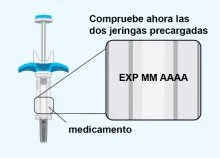
Do not use this medicine after the expiry date stated on the pre-filled syringe and the carton after EXP or CAD. The expiry date refers to the last day of the month indicated.
Store in a refrigerator (between 2 °C and 8 °C). Do not freeze. Do not use Spevigo if it has been frozen, even if it has been thawed.
If necessary, Spevigo may be stored at temperatures up to 25 °C for a maximum of 14 days. Discard Spevigo if it has been stored at temperatures up to 25 °C for longer than 14 days.
Keep in the original packaging to protect from light.
Do not use this medicine if the solution is cloudy or contains flakes or large or coloured particles.
Medicines must not be disposed of via wastewater or household waste. Ask your pharmacist how to dispose of medicines and packaging you no longer need. This will help protect the environment.
6. Contents of the pack and other information
Composition of Spevigo
- The active substance is spesolimab. Each pre-filled syringe contains 150 mg of spesolimab in 1 ml of solution.
- The other components are sodium acetate trihydrate (E262), glacial acetic acid (E260) (for pH adjustment), sucrose, arginine hydrochloride, polysorbate 20 (E432), and water for injections.
Appearance of the product and contents of the pack
Spevigo injectable solution is a solution ranging from transparent to slightly opalescent and from colourless to slightly yellowish-brown in a pre-filled syringe with a safety shield. The liquid may contain very small white or transparent particles. Each pre-filled syringe contains 150 mg in 1 ml of injectable solution.
Each pack contains two pre-filled syringes.
Marketing Authorization Holder
LEO Pharma A/S
Industriparken 55
DK 2750 Ballerup
Denmark
Manufacturer
LEO Pharma A/S
Industriparken 55
DK-2750 Ballerup
Denmark
Boehringer Ingelheim Pharma GmbH & Co. KG
Birkendorfer Strasse 65
88397 Biberach an der Riss
Germany
More information about this medicinal product is available upon request by contacting the local representative of the Marketing Authorization Holder:
Belgium/Belgium/Belgium LEO Pharma N.V./S.A Tel/Tel: +32 3 740 7868 | Lithuania LEO Pharma A/S Tel: +45 44 94 58 88 |
| Luxembourg/Luxembourg LEO Pharma N.V./S.A Tél/Tel: +32 3 740 7868 |
Czech Republic LEO Pharma s.r.o. Tel: +420 734 575 982 | Hungary LEO Pharma A/S Tel.: +45 44 94 58 88 |
Denmark LEO Pharma AB Tlf.: +45 70 22 49 11 | Malta LEO Pharma A/S Tel: +45 44 94 58 88 |
Germany LEO Pharma GmbH Tel: +49 6102 2010 | Netherlands LEO Pharma B.V. Tel: +31 205104141 |
Estonia LEO Pharma A/S Tel: +45 44 94 58 88 | Norway LEO Pharma AS Tlf: +47 22514900 |
Greece LEO Pharmaceutical Hellas S.A. Tel: +30 212 222 5000 | Austria LEO Pharma GmbH Tel: +43 1 503 6979 |
Spain Laboratorios LEO Pharma, S.A. Tel: +34 93 221 3366 | Poland LEO Pharma Sp. z o.o. Tel.: +48 22 244 18 40 |
France Laboratoires LEO Tél: +33 1 3014 4000 | Portugal LEO Farmacêuticos Lda. Tel: +351 21 711 0760 |
Croatia LEO Pharma A/S Tel: +45 44 94 58 88 | Romania LEO Pharma A/S Tel: +45 44 94 58 88 |
Ireland LEO Laboratories Ltd Tel: +353 (0) 1 490 8924 | Slovenia LEO Pharma A/S Tel: +45 44 94 58 88 |
Iceland LEO Pharma A/S Sími: +45 44 94 58 88 | Slovakia LEO Pharma s.r.o. Tel: +420 734 575 982 |
Italy LEO Pharma S.p.A Tel: +39 06 52625500 | Finland/Sweden LEO Pharma Oy Puh/Tel: +358 20 721 8440 |
Cyprus LEO Pharma A/S Tel: +45 44 94 58 88 | Sweden LEO Pharma AB Tel: +46 40 3522 00 |
Latvia LEO Pharma A/S Tel: +45 44 94 58 88 |
Date of the most recent review of this leaflet: {MM/YYYY}.
Other sources of information
Detailed information on this medicine is available on the website of the European Medicines Agency: https://www.ema.europa.eu.
Instructions for use
Spevigo 150 mg solution for injection in a pre-filled syringe
These “Instructions for use” contain information on how to inject Spevigo if the prescribed dose for you or your child requires 2 pre-filled syringes of Spevigo 150 mg.
Description of Spevigo
The pre-filled syringe contains the active substance espesolimab in a solution for subcutaneous injection, which helps deliver a fixed dose of espesolimab.
Before you begin using this medicine on yourself or your child, make sure your doctor or nurse has shown you how to use it. Then read the leaflet and these instructions for use to ensure you administer the correct dose. If you have visual impairment or poor eyesight, a caregiver trained in using the device should assist you.
If you have further questions, consult your doctor, pharmacist, or nurse.
Spevigo is for single use only. Do not reuse the pre-filled syringe.
Appearance of the Spevigo pre-filled syringe
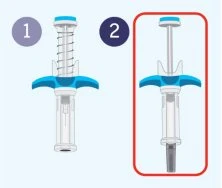
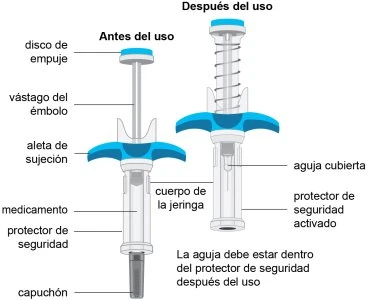
Spevigo is a pre-filled syringe with a safety shield. The needle retracts into the safety shield after injection.
The following image shows the Spevigo pre-filled syringe before use and after use with the safety shield activated.
Your doctor has prescribed a dose of Spevigo for you or your child consisting of two injections to deliver a complete dose. You must inject the contents of the two pre-filled syringes provided in the pack to administer the full dose.
Important information you need to know before injecting Spevigo
-
Do not use the pre-filled syringe until you have been properly trained in the correct way to administer the injection and have read and understood these handling instructions.
-
Inspect the product packaging to ensure it contains the correct medicine and the correct number of pre-filled syringes for the dose prescribed for you or your child, check for any damage, and verify the expiration date.
-
Do not remove the cap until you are ready for injection.
-
Do not use Spevigo:
- if the solution is cloudy or contains flakes or large particles
- if the expiry date (EXP) has passed
- if the pre-filled syringes have been dropped or appear damaged
-
It is important to keep a record of the Spevigo batch number. Each time you receive a new pack of Spevigo, note the date and the batch number (shown on the packaging after “Batch”) and keep this information in a safe place.
-
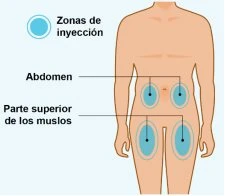
Inject Spevigo under the skin (subcutaneous injection) into the upper thigh or abdominal area (abdomen). Do not inject Spevigo into any other body area.
-
If you experience any problems with the injection, do not continue with the injection steps using the Spevigo pre-filled syringe. Contact your doctor for assistance.
-
If you have any further questions, consult your doctor or pharmacist.
Follow the steps below when using Spevigo
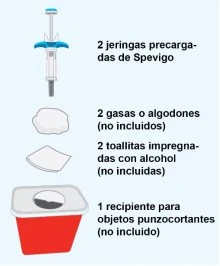
STEP 1 | Preparation of materials |
|
|
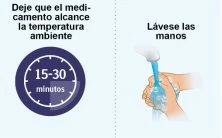
STEP 2 | Preparing to inject Spevigo |
|
|
STEP 3 | Inspecting the prefilled syringes |
| Check both prefilled syringes now:
|
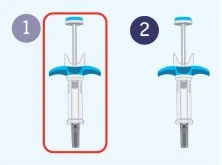
Preparation for the first injection | |
| Prepare for the first of the two injections. Remember, you will repeat the following steps with the second prefilled syringe immediately after the first injection. Two injections are required for a complete dose. |
STEP 4 | Choosing the injection site |
| Choose an injection site.
|
STEP 5 | Cleaning the injection site |
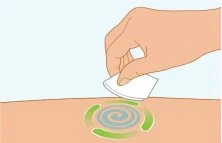
|
|
STEP 6 | Removing the cap |
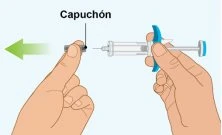
|
|
STEP 7 | Pinch the skin |
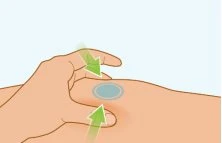
|
|
STEP 8 | Before injection, review steps A, B, and C to learn the correct administration technique |
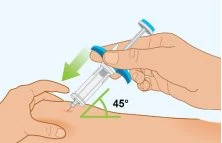
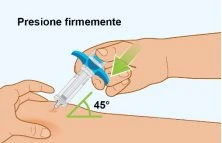
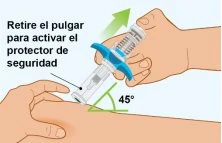
Important: Do not move the prefilled syringe when inserting the needle into the skin, during injection, or when removing the needle from the skin. | |
|
|
A Needle insertion | |
| To inject Spevigo:
|
B Injecting the medication | |
|
|
C Checking that the injection is complete | |
STEP 9 | Second injection |
|
The new injection site must be at least 2 cm away from the previous injection site.
Important: You must inject the contents of both prefilled syringes of Spevigo to administer a complete dose. |
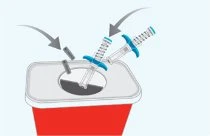
STEP 10 | Disposal of used prefilled syringes and caps |
|
Important: Always keep the sharps container out of the reach of children. |