Somatostatin GP PHARM 3 mg powder and solvent for solution for infusion EFG
Spain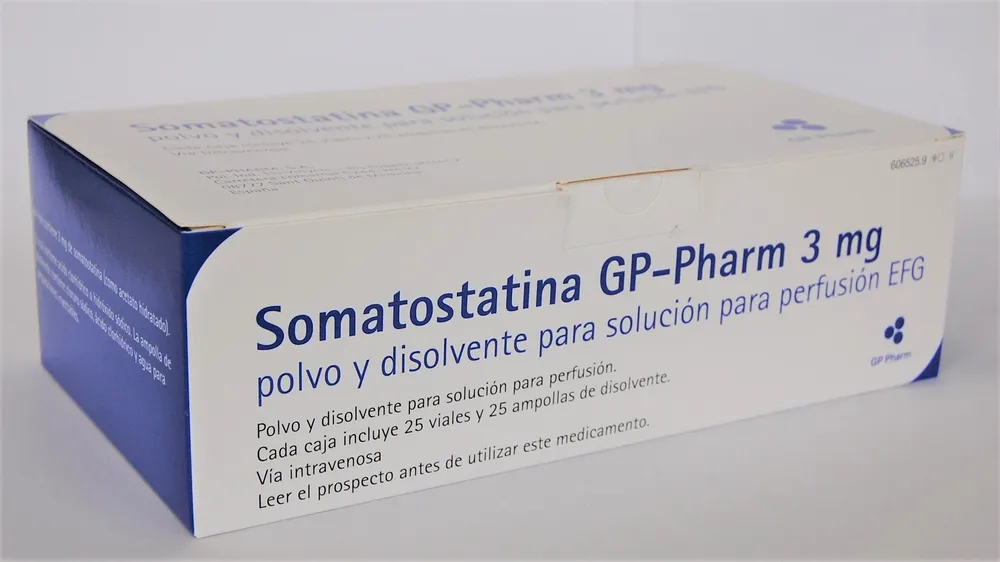
Table of Contents
- Package leaflet: Information for the user
- Introduction
- 1. What Somatostatin GP-Pharm is and what it is used for
- 2. What you need to know before using Somatostatina GP-Pharm
- 3. How to use Somatostatina GP-Pharm
- 4. Possible adverse effects
- 5. Storage of Somatostatina GP-Pharm
- 6. Contents of the pack and other information
- **This information is intended for healthcare professionals only:**
Package leaflet: Information for the user
Introduction
Package leaflet: information for the patient
Somatostatina GP-Pharm 3 mg powder and solvent for solution for infusion EFG
Somatostatine
Read the entire leaflet carefully before you start using this medicine, because it contains important information for you.
- Keep this leaflet, as you may need to read it again.
- If you have any questions, ask your doctor or pharmacist.
- This medicine has been prescribed for you; do not give it to other people, even if they have the same symptoms as you, because it could harm them.
- If you experience any adverse reactions, consult your doctor or pharmacist, even if they are adverse reactions not listed in this leaflet. See section 4.
Leaflet contents:
- What Somatostatina GP-Pharm is and what it is used for
- What you need to know before using Somatostatina GP-Pharm
- How to use Somatostatina GP-Pharm
- Possible side effects
- How to store Somatostatina GP-Pharm
- Contents of the pack and other information
1. What Somatostatin GP-Pharm is and what it is used for
Somatostatin is a polypeptide hormone composed of fourteen amino acids, primarily found in the hypothalamus and the gastrointestinal tract. Somatostatin GP-Pharm is a synthetic somatostatin identical to the naturally occurring hormone.
Somatostatin inhibits the secretion of numerous hormones, such as growth hormone (somatotropin), corticotropin (ACTH), gastrin, insulin, and glucagon, as well as both endocrine and exocrine pancreatic and gastric secretions. It also reduces gastrointestinal motility and splanchnic blood flow.
Somatostatin GP-Pharm is indicated for:
- Treatment of gastrointestinal bleeding due to rupture of esophageal varices. It should always be used in conjunction with other therapeutic measures (such as sclerotherapy or surgery), complementing but not replacing them.
- Adjunctive treatment of pancreatic fistulas with daily secretion of at least 500 ml.
2. What you need to know before using Somatostatina GP-Pharm
Do not use Somatostatina GP-Pharm:
- if you are allergic (hypersensitive) to the active substance or analogues of somatostatin, or to any of the other components of this medicine (listed in section 6)
- if you are pregnant or during breastfeeding.
Warnings and precautions
Consult your doctor or pharmacist before starting treatment with Somatostatina GP-Pharm:
- if you have severe renal impairment (creatinine clearance ≤ 30 ml/min), half of the recommended dose will be administered;
- blood glucose levels should be monitored regularly (every 4–6 hours) during administration of Somatostatina GP-Pharm, since somatostatin exerts inhibitory effects on the release of glucagon and insulin;
- regular monitoring of renal function and plasma electrolytes is required, as treatment with Somatostatina GP-Pharm may reduce glomerular filtration rate, urine flow, and plasma sodium levels;
- Somatostatina GP-Pharm inhibits the secretion of other gastrointestinal hormones. Interruption of treatment may lead to a rebound effect, especially in patients with fistula; therefore, after healing has occurred, half the dose should be administered via infusion over the following 48 hours to prevent rebound;
- if you are insulin-dependent, frequent blood glucose monitoring is necessary, as somatostatin inhibits insulin release.
In any case, your doctor will assess whether its use in hospital is appropriate. Furthermore, during treatment you will be under strict medical supervision at all times.
Other medicines and Somatostatina GP-Pharm
Inform your doctor or pharmacist if you are taking, have recently taken, or might need to take any other medicines.
Somatostatin may interact with drugs that influence the regulation of plasma glucose, plasma renin levels, and blood pressure.
Concomitant administration of any form of sugar (including glucose solutions, fructose, or total parenteral nutrition) may exacerbate glucose disturbances and requires close monitoring of blood sugar levels. Insulin administration may occasionally be necessary.
Cases of synergistic effects (additive effects) with cimetidine (a drug used to treat ulcers) have been reported.
Somatostatin prolongs the hypnotic (sedative) effect of barbiturates (drugs with sedative and hypnotic properties) and enhances the action of pantoprazole (a drug that reduces gastric acid secretion). Therefore, somatostatin should not be administered concomitantly with these drugs; existing treatments should be discontinued.
Use of Somatostatina GP-Pharm with food and drink
Caution is advised when administering any form of sugar (see Interaction of Somatostatina GP-Pharm with other medicines).
Pregnancy and breastfeeding:
If you are pregnant or breastfeeding, think you may be pregnant, or are planning to become pregnant, consult your doctor or pharmacist before using this medicine.
Due to its inhibitory action on growth hormone secretion, somatostatin is contraindicated during pregnancy, childbirth, and breastfeeding. If administration is necessary in a breastfeeding mother, natural breastfeeding must be discontinued.
Driving and use of machines:
Not applicable.
Somatostatina GP-Pharm contains sodium
This medicine contains less than 23 mg of sodium per dose; hence, it is essentially “sodium-free”.
3. How to use Somatostatina GP-Pharm
Follow exactly the instructions provided by your doctor for this medicine. If in doubt, consult your doctor again.
Due to its short half-life of 1 to 2 minutes, Somatostatina GP-Pharm must be administered via continuous and uniform intravenous infusion to maintain plasma levels.
Somatostatina GP-Pharm must be reconstituted with physiological saline immediately before use, and the resulting solution added to the infusion fluid.
Patients must be closely monitored after discontinuation of treatment.
Adults:
The recommended dose is 3.5 micrograms/kg/hour, or typically 6 mg/24 hours for a 75 kg patient, administered as a continuous infusion of 250 micrograms/hour. The infusion rate should be adjusted for 12 hours or 24 hours (for 3 mg and 6 mg, respectively).
Elderly patients:
Dose adjustment is recommended in elderly patients with severe renal impairment (see below, patients with renal impairment).
Children and adolescents:
Adequate clinical studies establishing the safety and efficacy of Somatostatina GP-Pharm in children and adolescents have not been conducted. Therefore, use in this patient population is not recommended.
Patients with severe renal impairment:
The dose should be reduced to 1.75 micrograms/kg/hour as a continuous infusion, and 1.75 micrograms/kg for a loading dose.
Patients with hepatic impairment:
Dose adjustment is not necessary in patients with hepatic impairment alone.
In the treatment of gastrointestinal bleeding and bleeding from ruptured esophageal varices, immediately after starting the continuous infusion, a loading dose of 250 micrograms should be administered as a slow intravenous injection over approximately 3 minutes to avoid the occurrence of nausea and sensation of warmth. BLOOD PRESSURE MUST BE CLOSELY MONITORED DURING ADMINISTRATION OF THE LOADING DOSE. For this indication, the minimum duration of treatment is 48 hours and the maximum duration is 120 hours (5 days).
Pancreatic fistulas require a longer treatment duration and an initial loading dose is not necessary. Fistula closure is usually achieved in most patients between 7 and 14 days of treatment, although shorter or longer periods are possible. It should be noted that while somatostatin reduces fistula output and may facilitate stoma skin care, it does not increase the number of fistula closures and therefore does not reduce the proportion of patients who ultimately require surgical closure. It also does not replace standard treatment measures. To avoid possible rebound effects after healing, half the dose (1.75 micrograms/kg/hour) should be infused for the subsequent 48 hours.
If you use more Somatostatina GP-Pharm than you should
No cases of somatostatin overdose have been reported.
If necessary, discontinue the infusion and provide symptomatic treatment. There is no known specific antidote.
In case of overdose or accidental ingestion, contact the Toxicology Information Service, indicating the name of the medicine and the amount ingested. Tel. 915 620 420.
If you forget to use Somatostatina GP-Pharm
Do not use a double dose to make up for missed doses.
If you stop using Somatostatina GP-Pharm
Sudden or inappropriate interruption of the infusion may cause a secretory rebound effect.
If you have any further questions about the use of this medicine, ask your doctor or pharmacist.
4. Possible adverse effects
Like all medicines, this medicine may produce adverse effects, although not everyone experiences them.
Frequent adverse effects (may affect between 1 and 10 out of every 100 patients) are: abdominal pain, nausea, hyperglycemia (increased blood glucose), and hot flushes.
Uncommon adverse effects (may affect between 1 and 10 out of every 1,000 patients) are: diarrhea, decreased blood glucose (hypoglycemia), decreased heart rate (bradycardia), decreased blood pressure (hypotension), and increased blood pressure (hypertension).
Adverse effects for which there are no data to determine frequency are: atrioventricular block, arrhythmia, ventricular extrasystoles, and vomiting.
At the beginning of the infusion, hypoglycemia may occur, possibly followed after 2 to 3 hours by an increase in blood glucose due to disturbances in the balance of the counter-regulatory hormones insulin and glucagon. Therefore, blood glucose levels must be monitored regularly, and simultaneous administration of any type of sugar (including glucose solutions) should be avoided. Insulin administration may be necessary.
Sudden interruption of the infusion may lead to a rebound effect, especially during treatment of patients with fistulas.
During repeated treatments, the risk of hypersensitivity (allergy) to somatostatin cannot be excluded.
If you experience any adverse effects, consult your doctor or pharmacist, even if they are adverse effects not listed in this leaflet.
Reporting of adverse effects
If you experience any type of adverse effect, consult your doctor or pharmacist, even if they are possible adverse effects not listed in this leaflet. You may also report them directly through the Spanish Pharmacovigilance System for Human Medicines. Website: www.notificaram.es. By reporting adverse effects, you can help provide more information on the safety of this medicine.
5. Storage of Somatostatina GP-Pharm
Keep this medicine out of the sight and reach of children.
Store in a refrigerator between 2 and 8 °C.
Stability period of reconstituted and diluted solutions:
After reconstitution with 1 ml of saline solution: Physicochemical stability under use conditions has been demonstrated for 24 hours at temperatures not exceeding 25°C.
After dilution: Physicochemical stability under use conditions has been demonstrated for 48 hours at temperatures not exceeding 25°C.
From a microbiological standpoint, the product should be used immediately, unless the reconstitution and dilution methods exclude the risk of microbiological contamination. If not used immediately, the storage times under use conditions and the conditions prior to use shall be the responsibility of the user.
Do not use this medicine after the expiry date stated on the packaging after EXP. The expiry date refers to the last day of the month indicated.
Medicines must not be disposed of via wastewater or household waste. Ask your pharmacist how to dispose of medicines and packaging you no longer need. This will help protect the environment.
6. Contents of the pack and other information
Composition of Somatostatina GP-Pharm
The active substance is somatostatin. Each vial contains 3 mg of somatostatin (as hydrated acetate). The other components are hydrochloric acid or sodium hydroxide (for pH adjustment).
Each solvent ampoule contains 1 ml of 0.9% sodium chloride solution. In the solvent ampoules, the other components are hydrochloric acid (for pH adjustment) and water for injection.
Appearance of the medicinal product and contents of the pack
Somatostatina GP-Pharm is presented as a powder and solvent for solution for infusion. Each pack contains one vial and one solvent ampoule. The hospital pack contains 25 vials and 25 solvent ampoules.
Marketing Authorization Holder and Manufacturer
GP-PHARM, S.A.
Pol. Ind. Els Vinyets-Els Fogars, 2. Ctra. C-244, Km 22
08777 Sant Quintí de Mediona – Barcelona
Spain
Date of the most recent revision of this leaflet: 07/2022
Other sources of information
Detailed information on this medicinal product is available on the website of the Spanish Agency of Medicines and Medical Devices (AEMPS) http://www.aemps.gob.es
This information is intended for healthcare professionals only:
Treatment should preferably be administered in an intensive care unit.
Patients receiving Somatostatin should remain under strict medical supervision. The infusion must be administered slowly and continuously. When an intravenous bolus dose of 0.25 mg is required prior to the infusion, it must be administered slowly and continuously (over more than 3 minutes).
Somatostatin exerts a blocking effect on the release of both glucagon and insulin. Due to this effect, blood glucose levels should be monitored regularly every 4–6 hours during treatment; special attention should be paid to insulin-dependent patients.
It is recommended to avoid concomitant administration of the drug with carbohydrates requiring insulin for their metabolism, as well as infusion solutions containing glucose or fructose, to prevent glycemic disturbances. In cases where deemed appropriate, additional doses of insulin may be administered.
Somatostatin causes inhibition of intestinal absorption of certain nutrients. Therefore, parenteral nutrition should be administered concomitantly during prolonged treatment with Somatostatin.
In all cases, patients should be monitored after discontinuation of the drug.
Sudden or inappropriate interruption of the infusion may result in a secretory rebound effect.
For 15 minutes following intravenous administration of the drug, the patient should remain in the supine position.
Method of administration
-
Continuous infusion administration:
- The lyophilized powder should be reconstituted with 1 mL of physiological saline immediately before use. No special handling instructions are required beyond those applicable to any injectable formulation.
- This solution should then be injected into the infusion bottle.
- Adjust the infusion rate to the prescribed rate.
-
Loading dose administration of 250 micrograms:
- The 3 mg lyophilized powder should be reconstituted with 3 mL of physiological saline immediately before use (note that the solvent vial provided with the product contains only 1 mL of physiological saline). No special handling instructions are required beyond those applicable to any injectable formulation.
- Withdraw 0.25 mL of the resulting solution, corresponding to 250 micrograms, and administer to the patient via slow intravenous injection over approximately 3 minutes. If necessary, to facilitate bolus injection over 3 minutes, the 0.25 mL may be diluted with physiological saline to an appropriate volume (up to 5 mL).
Incompatibilities
Somatostatin is unstable at alkaline pH; therefore, its dissolution in solutions with a pH greater than 7.5 should be avoided.