Solinitrina 0.8 mg sublingual coated tablets
Spain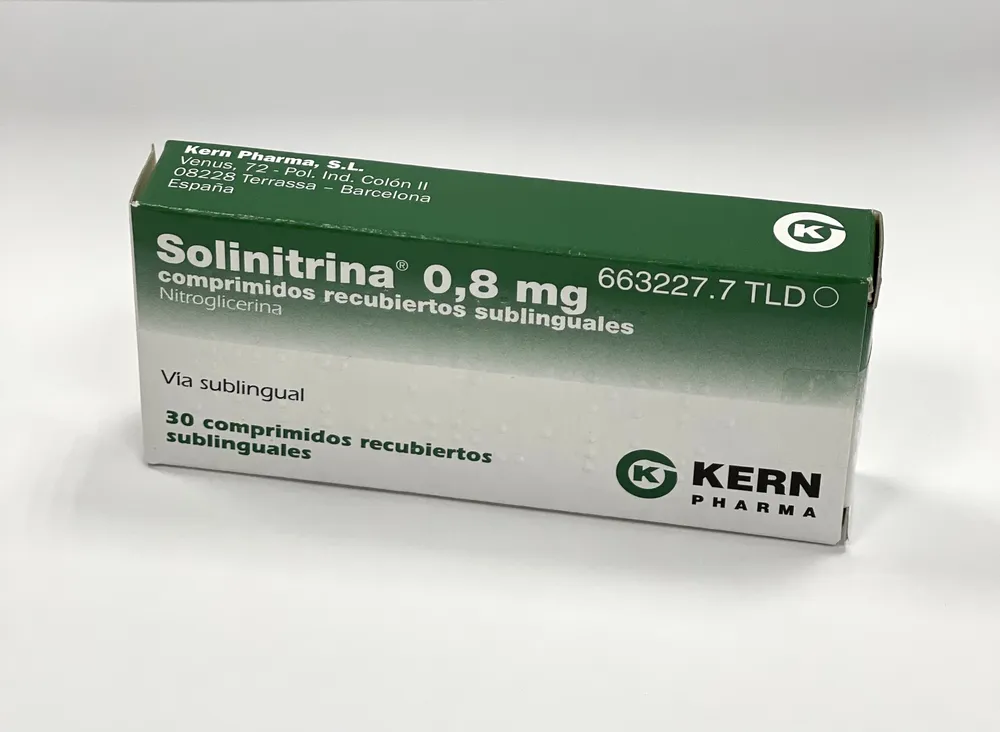
Table of Contents
Package leaflet: Information for the user
Introduction
Package leaflet: information for the user
Solinitrina 0.8 mg film-coated sublingual tablets
Nitroglycerin
Read the entire leaflet carefully before you start taking this medicine.
- Keep this leaflet as you may need to read it again.
- If you have any questions, ask your doctor or pharmacist.
- This medicine has been prescribed for you and should not be given to others, even if they have the same symptoms, as it may harm them.
- If you experience any serious side effects or any side effects not listed in this leaflet, inform your doctor or pharmacist.
Leaflet contents:
- What Solinitrina is and what it is used for
- Before you take Solinitrina
- How to take Solinitrina
- Possible side effects
- How to store Solinitrina
- Further information
1. What SOLINITRINA is and what it is used for
Solinitrina is a medication administered sublingually and presented in the form of tablets.
The active substance, nitroglycerin, belongs to the group of drugs known as nitrates and related substances.
It is used:
- As an emergency medication during painful episodes of angor pectoris (angina pectoris), stenocardia, and precordial pain (chest pain at the level of the heart) caused by myocardial ischemia (lack of oxygen in the heart).
- To prevent exertional angina (angina pectoris caused by physical exertion), stress-induced angina (angina pectoris caused by stress), and nocturnal angina (angina pectoris occurring at night).
- To achieve faster healing and recovery of damaged myocardial (heart) areas after a myocardial infarction.
- In congestive left ventricular failure (the heart's inability to pump sufficient blood).
2. BEFORE TAKING SOLINITRINA
Do not take Solinitrina
- If you are allergic (hypersensitive) to nitroglycerin or to any of the other components of Solinitrina.
- In case of anemia (reduction in red blood cells in the blood), cerebral hemorrhage (bleeding in the brain), or cranioencephalic trauma (injury to the skull) associated with increased intracranial pressure (elevated pressure in the brain).
- If you have uncorrected hypovolemia (reduced blood volume) or severe hypotension (low blood pressure).
- If you have increased intraocular pressure (elevated pressure in the eyes).
- If you have a history of allergy to nitro derivatives.
- If you have been diagnosed with obstructive cardiomyopathy (a heart disease), especially if associated with aortic or mitral stenosis (narrowing of heart valves) or constrictive pericarditis (inflammation of the heart lining).
- If you are being treated with sildenafil or other drugs with similar action (medications used for erectile dysfunction).
Take special care with Solinitrina
- If you have ischemic heart failure (inability of the heart to pump sufficient blood) or severe cerebral ischemia (lack of blood flow to the brain), as reduced oxygen supply may reduce the effectiveness of nitroglycerin.
- If you have thyroid disorders, malnutrition, severe kidney or liver disease, hypothermia (low body temperature), or are predisposed to closed-angle glaucoma (an eye disease characterized by pain, seeing halos around lights, increased eye pressure, and sometimes nausea and vomiting).
- If you have recently suffered an acute myocardial infarction (heart attack) or acute heart failure, as careful clinical monitoring may be required.
Consult your doctor, even if any of the above-mentioned conditions occurred in the past.
Use of other medicines
Inform your doctor or pharmacist if you are taking, or have recently taken, any other medicines, including those obtained without a prescription.
- Caution is recommended if nitroglycerin is administered simultaneously with other drugs that act similarly to nitroglycerin (papaverine, ergotamine, vincamine, etc.) due to the possibility of an enhanced effect.
- Concomitant treatment with other medications such as calcium channel blockers, beta-blockers, diuretics, antihypertensives, tricyclic antidepressants, and major tranquilizers may enhance the hypotensive effect (lowering of blood pressure) of nitroglycerin.
- It cannot be ruled out that the intake of acetylsalicylic acid and non-steroidal anti-inflammatory agents may reduce the response to nitroglycerin.
- The cardiac effect of this medication may be altered if used together with preparations containing sildenafil or other similar drugs used for erectile dysfunction.
Please note that these instructions may also apply to medications taken or used previously or that may be taken or used in the future.
Taking Solinitrina with food and drinks
Avoid consuming alcoholic beverages.
Pregnancy and breastfeeding
If you are pregnant, suspect you may be pregnant, or are planning to become pregnant, inform your doctor, who will decide whether or not you should take Solinitrina.
It is unknown whether nitroglycerin is excreted in breast milk; therefore, risk to newborns/infants cannot be excluded.
Consult your doctor or pharmacist before using any medication.
Driving and operating machinery
Solinitrina may cause flushing, dizziness, or decreased blood pressure, especially at the beginning of treatment. If you experience any of these effects, avoid driving or operating machinery.
Important information about some components of Solinitrina
This medicine contains sucrose. If your doctor has informed you that you have an intolerance to certain sugars, consult him before taking this medicine.
3. How to TAKE SOLINITRINA
Follow exactly the instructions for using Solinitrina as given by your doctor.
If you have any doubts, consult your doctor or pharmacist.
Remember to take your medicine.
Place one tablet in your mouth, chew it, and then place it under your tongue to achieve faster absorption. After about 10 minutes, a second tablet dose may be repeated if the pain has not completely subsided. A third tablet may be administered after another 10 minutes if the pain persists.
Solinitrina may be used as many times as necessary throughout the day. As a prophylactic measure, it should be taken approximately 10 minutes before beginning physical exertion or activity suspected of triggering anginal pain.
In the treatment of ischemic disorders during the acute phase of myocardial infarction, one tablet of Solinitrina should be administered regularly at intervals of 3 to 6 hours, for several consecutive days.
If you feel that the effect of Solinitrina is too strong or too weak, inform your doctor or pharmacist.
Please note that with chronic treatment using high doses, the effects of nitroglycerin may decrease.
If you take more Solinitrina than you should
A condition of hypotension, shock, and bluish discoloration of the skin may occur.
In case of overdose or accidental ingestion, contact your doctor or pharmacist immediately or call the Toxicology Information Service at telephone number: 91 562 04 20, stating the name of the medicine and the amount ingested.
If you forget to take Solinitrina
Do not take a double dose to make up for the missed dose.
If you stop treatment with Solinitrina
Your doctor will advise you on the duration of your treatment with Solinitrina. Do not stop treatment prematurely, as this could lead to a possible withdrawal reaction. It is recommended to gradually reduce the dose.
4. Possible adverse effects
Like all medicines, Solinitrina may cause adverse effects, although not everyone experiences them.
It may cause headache, which usually resolves within a few days. This headache can be treated with analgesics, although it may be necessary to reduce the dose or discontinue treatment. Other possible adverse effects include flushing, nausea, dizziness, hypotension, and tachycardia. Occasionally, vomiting and bluish discoloration of the skin have been reported.
If you consider any of the adverse effects you experience to be severe, or if you notice any adverse effects not listed in this leaflet, inform your doctor or pharmacist.
5. Storage of SOLINITRINA
Keep out of the reach and sight of children.
If you carry a small number of tablets with you, use a suitable container and store them in it without removing them from their individual blister pockets. Avoid carrying the container close to the body, as body heat may affect the medicine.
Store preferably in the original packaging, in a cool and dry place. Do not store in the refrigerator.
Do not use Solinitrina after the expiry date stated on the packaging after "EXP". The expiry date refers to the last day of the month indicated.
Medicines must not be disposed of via wastewater or household waste. Dispose of unused medicines and their packaging at the SIGRE collection point at your pharmacy. If in doubt, ask your pharmacist how to properly dispose of unused medicines and their packaging. This will help protect the environment.
6. ADDITIONAL INFORMATION
Composition of Solinitrina 0.8 mg sublingual coated tablets
- The active substance of Solinitrina is nitroglycerin. Each tablet contains 0.8 mg of nitroglycerin.
- The other components are: Core: talc, colloidal silicon dioxide, sucrose, and semi-synthetic solid glycerides. Coating: magnesium carbonate, sucrose, talc, titanium dioxide (E-171), and macrogol.
Appearance of the medicinal product and contents of the pack
Film-coated, round, biconvex tablets of white-ivory color. Each pack contains 30 tablets.
Marketing Authorization Holder and Manufacturer
Kern Pharma, S.L.
Polígono Ind. Colón II,
Venus 72
08228 Terrassa (Barcelona)
This leaflet was approved in June 2011
Detailed and up-to-date information on this medicinal product is available on the website of the Spanish Agency of Medicines and Health Products (AEMPS) www.aemps.gob.es