Softacort 3.35 mg/ml eye drops solution in single-dose containers
Spain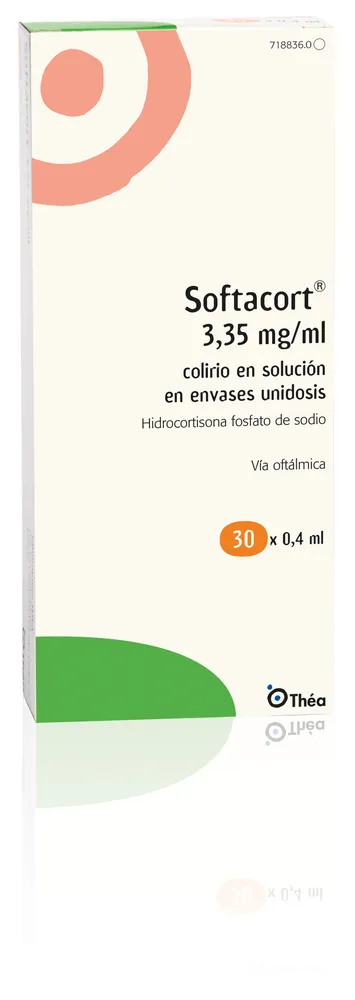
Table of Contents
Package leaflet: Information for the user
Introduction
Package leaflet: information for the user
Softacort 3.35 mg/ml eye drops solution in single-dose containers
Sodium hydrocortisone phosphate
Read the entire leaflet carefully before you start using this medicine, because it contains important information for you.
- Keep this leaflet, as you may need to read it again.
- If you have any questions, ask your doctor, pharmacist or nurse.
- This medicine has been prescribed for you only, and you should not give it to other people, even if they have the same symptoms as you, because it could harm them.
- If you experience any adverse effects, consult your doctor, pharmacist or nurse, even if they are adverse effects not listed in this leaflet. See section 4.
Contents of the leaflet:
-
What Softacort is and what it is used for
-
What you need to know before using Softacort
-
How to use Softacort
-
Possible side effects
- Storage of Softacort
-
Contents of the pack and other information
1. What Softacort is and what it is used for
This medicine is an ophthalmic solution in single-dose containers containing a substance called hydrocortisone. This substance is a corticosteroid that inhibits the symptoms of inflammation.
It is used to treat mild allergic or inflammatory conditions of the surface of your eye or eyes (conjunctivae).
The eye must not be infected (see Do not use Softacort).
2. What you need to know before using Softacort
Do not use Softacort
- If you are allergic to the active substance (hydrocortisone) or to any of the other components of this medicine (listed in section 6).
- If you have high eye pressure (ocular hypertension), which is known to be associated with the use of glucocorticoids (the corticosteroid family) or other causes.
- If you have acute viral infections caused by the herpes virus, and in most other viral diseases in the ulcerative phase (unless the infection is being treated with anti-infective therapy for herpes virus).
- If you have conjunctivitis with ulcerative inflammation of the cornea (keratitis), even in the early stage.
- If you have a bacterial infection in the eye (acute purulent infection, conjunctivitis, blepharitis, or stye).
- If you have a fungal infection in the eye (ocular mycosis).
- If you have a bacterial infection called tuberculosis affecting your eye (ocular tuberculosis).
Warnings and precautions
-
Consult your doctor, pharmacist, or nurse before starting to use this medicine.
-
If you have a red eye that has not been diagnosed, do not use this medicine.
-
If you have a viral eye infection (herpes), use this medicine only if the infection is being treated with anti-infective therapy and close monitoring of your eyes is ensured.
-
If you have a disease causing thinning of the outer part of your eye (cornea and sclera), there may be an increased risk of perforation due to the use of topical corticosteroids applied to the eye.
-
If you have been using a corticosteroid medicine for a long time and have an eye wound (corneal ulcer), a fungal infection may be suspected.
-
Close and regular monitoring of your eyes is required during treatment. Prolonged use of corticosteroids has been shown to cause increased pressure inside the eye and the onset of glaucoma, especially in patients who already suffer from high intraocular pressure or who are at risk of developing this condition with local steroid treatment (see Possible side effects), and may cause clouding of the lens in your eye (cataract), particularly in children and elderly patients.
-
The use of corticosteroids may cause opportunistic eye infections. In addition, topical ocular corticosteroids may promote, worsen, or mask signs and symptoms of opportunistic eye infections.
-
You should avoid wearing contact lenses during treatment with this medicine.
-
Contact your doctor if you experience blurred vision or other visual disturbances.
Children
There are no safety and efficacy data in children.
Long-term continued corticosteroid treatment may cause adrenal suppression.
Increased eye pressure occurs more frequently, more severely, and more rapidly in children than in adults.
Using Softacort with other medicines
Inform your doctor or pharmacist if you are taking, have recently taken, or might need to take any other medicines, including medicines obtained without a prescription.
Some medicines may increase the effects of Softacort, and your doctor may wish to monitor you closely if you are taking these medicines (including some medicines for HIV: ritonavir, cobicistat).
Pregnancy and breastfeeding
If you are pregnant or breastfeeding, think you may be pregnant, or plan to become pregnant, consult your doctor or pharmacist before using this medicine.
- Use of this medicine during pregnancy is not recommended, except when considered necessary by your doctor and under strict supervision.
It is unknown whether this medicine passes into breast milk. Your doctor will decide whether you can use this medicine during breastfeeding.
Driving and using machines
You may experience blurred vision immediately after applying Softacort. Do not drive or operate machinery until this effect has disappeared.
Softacort contains phosphate
This medicine contains 0.227 mg of phosphates in each drop.
3. How to use Softacort
Follow exactly the instructions for administering this medicine as given by your doctor or pharmacist. If in doubt, consult your doctor or pharmacist again.
The recommended dose is 2 drops in the affected eye(s), 2 to 4 times daily, as prescribed by your doctor. A gradual reduction in dose is recommended to avoid relapse. The duration of treatment may vary from a few days up to a maximum of 14 days.
The same dose is used for both adults and elderly patients.
Use in children
Efficacy and safety have not been established in children.
Instructions for use
This medicine is intended for ocular administration.
To use the eye drops, please follow these instructions:
- Wash your hands and sit or stand comfortably.
- Open the sachet containing 10 single-dose units. Record the date of first opening on the sachet.
- Separate one single-dose unit from the strip.
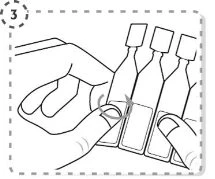
- Twist the tip of the single-dose unit as shown. Do not touch the tip after opening the container.
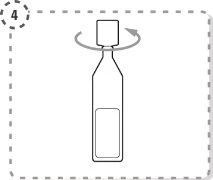
- Use your finger to gently pull down the lower eyelid of the affected eye.
- Place the tip of the single-dose container near the eye, without touching it.
- Gently press the single-dose container so that two drops fall into the eye, then release the lower eyelid.
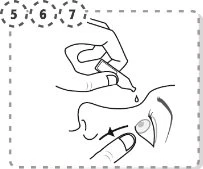
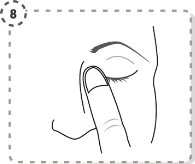
- Press with your finger on the corner of the affected eye near the nose. Apply pressure for 1 minute, keeping your eye closed.
-
Repeat the procedure in the other eye, if instructed by your doctor. Each single-dose container contains enough solution for both eyes.
-
Discard the single-dose container after use. Do not save it for later use.
-
Place unused single-dose containers back into the sachet. Place the opened sachet inside the carton. Unused containers may be used within one month after opening the sachet.
If you are using any other eye drops, wait at least 5 minutes between each application.
If you use more Softacort than you should
Rinse the eye with sterile water if an excessive amount of product has been administered and prolonged irritation occurs.
Contact your doctor or pharmacist immediately.
If you forget to use Softacort
Do not apply an extra drop to make up for a missed dose.
If you stop using Softacort
Do not stop treatment suddenly. Always consult your doctor if you are considering discontinuing treatment.
If you have any further questions about the use of this medicine, ask your doctor, pharmacist, or nurse.
4. Possible adverse effects
Like all medicines, this medicine may cause adverse effects, although not everyone experiences them.
Frequency not known: cannot be estimated from the available data
- transient ocular discomfort (burning, stinging) after application.
The following adverse effects have been reported with medicines of the same group (corticosteroids) when used to treat ocular conditions.
Frequency unknown: cannot be estimated from the available data
- allergic reactions
- delayed wound healing
- clouding of the lens of the eye (posterior subcapsular cataract)
- opportunistic infections (viral, such as herpes, fungal infections)
- increased pressure in your eye (glaucoma)
- dilation of the pupil (mydriasis)
- drooping eyelids (ptosis)
- inflammation inside your eye (uveitis)
- changes in the thickness of the front part of the eye (cornea)
- corneal inflammation (crystalline keratopathy)
- blurred vision
If you have severe damage to the transparent layer on the front part of your eye (cornea), treatment with phosphates, in very rare cases, may lead to cloudy patches in the cornea due to calcium deposits.
Reporting of adverse effects
If you experience any adverse effects, consult your doctor, pharmacist, or nurse, even if they are possible adverse effects not listed in this leaflet. You may also report them directly via the Spanish Pharmacovigilance System for Human Medicinal Products: https://www.notificaram.es. By reporting adverse effects, you can help provide more information on the safety of this medicine.
5. Storage of Softacort
Keep this medicine out of the sight and reach of children.
Do not use this medicine after the expiry date stated on the carton, sachet, and single-dose container after CAD or EXP. The expiry date refers to the last day of the month indicated.
Store below 25°C.
After first opening of the sachet: use the single-dose container within one month.
Keep the single-dose containers inside the sachet to protect them from light.
Write down the date of first opening of the sachet.
After first opening of the single-dose container: use immediately and discard the single-dose container after use.
Sterility cannot be maintained once a single-dose container is opened; therefore, a new container must be opened before each use.
Medicines must not be disposed of via wastewater or household waste. Dispose of unused containers and medicines at the SIGRE collection point at your pharmacy. If in doubt, please consult your pharmacist on how to dispose of unused containers and medicines. This will help protect the environment.
6. Contents of the pack and other information
Composition of Softacort
- The active substance is sodium hydrocortisone phosphate.
1 ml of eye drops solution contains 3.35 mg of sodium hydrocortisone phosphate.
- The other components are disodium phosphate dodecahydrate, sodium dihydrogen phosphate monohydrate, sodium chloride, disodium edetate, hydrochloric acid (for pH adjustment), water for injections.
Presentation of the product and contents of the container
This medicine is presented as an eye drop solution in single-dose units.
The solution is practically transparent, colourless to slightly yellow, and practically free from particles. It is contained in sachets of 10 units. Each single-dose unit contains 0.4 ml of eye drop solution.
Packs contain 10 (1 x 10), 20 (2 x 10), 30 (3 x 10) or 60 (6 x 10) single-dose units.
Only certain pack sizes may be marketed.
Marketing Authorization Holder and Manufacturer
Marketing Authorization Holder
LABORATOIRES THEA
12 RUE LOUIS BLERIOT
63017 CLERMONT-FERRAND CEDEX 2
FRANCE
Manufacturer
LABORATOIRES UNITHER
1 rue de l’Arquerie
50200 Coutances
FRANCE
or
LABORATOIRES THEA
12, rue Louis Blériot
63017 CLERMONT-FERRAND Cedex 2
FRANCE
Local Representative
LABORATORIOS THEA, S.A.
C/ Enric Granados nº 86-88, 2ª planta
08008 – BARCELONA
This medicine is authorized in the Member States of the European Economic Area under the following names:
Germany, Austria, Bulgaria, Cyprus, Croatia, Denmark, Slovenia, Spain, Finland, France, Greece, Iceland, Norway, Poland, Portugal, Czech Republic, Slovak Republic, United Kingdom, Romania, Sweden: Softacort
Belgium, Netherlands, Luxembourg: Softacor
Ireland: Zoftazot
Italy: Sofacor
Date of the most recent review of this leaflet: October 2023
Detailed information on this medicine is available on the website of the Spanish Agency of Medicines and Health Products (AEMPS) http://www.aemps.gob.es/.