Sodium chloride Physan 0.9% solution for infusion
Spain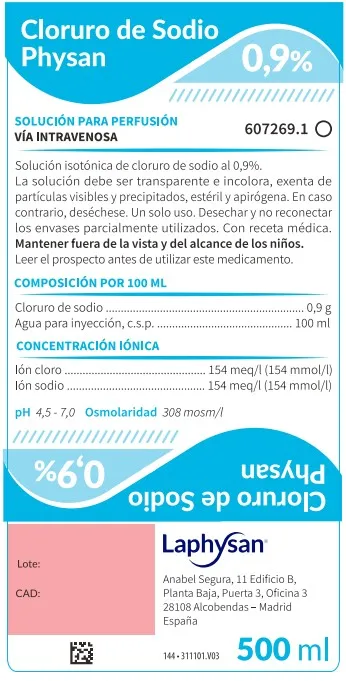
Table of Contents
- Package leaflet: Information for the user
- Introduction
- **Sodium Chloride Physan 0.9% infusion solution**
- 1. What Cloruro de Sodio Physan 0.9% is and what it is used for
- 2. What you need to know before using Sodium Chloride Physan 0.9%
- 3. How to use Sodium Chloride Physan 0.9%
- 4. Possible adverse effects
- 5. Storage of Sodium Chloride Physan 0.9%
- 6. Contents of the pack and other information
Package leaflet: Information for the user
Introduction
Package leaflet: information for the user
Sodium Chloride Physan 0.9% infusion solution
Sodium chloride
Read the entire package leaflet carefully before starting to use this medicine, as it contains important information for you.
- Keep this leaflet, as you may need to read it again.
- If you have any questions, consult your doctor, pharmacist, or nurse.
- If you experience any adverse effects, consult your doctor, pharmacist, or nurse, even if they are effects not listed in this leaflet. See section 4.
Contents of the package leaflet
- What Sodium Chloride Physan 0.9% is and what it is used for
- What you need to know before using Sodium Chloride Physan 0.9%
- How to use Sodium Chloride Physan 0.9%
- Possible side effects
- How to store Sodium Chloride Physan 0.9%
- Contents of the pack and other information
1. What Cloruro de Sodio Physan 0.9% is and what it is used for
Cloruro de Sodio Physan 0.9% belongs to the group of medicines known as electrolyte solutions. It is used to provide electrolytes in cases of dehydration with loss of salts. In conditions of hypovolemia (decreased blood volume). Mild alkalosis. As a vehicle for the administration of medications and electrolytes.
2. What you need to know before using Sodium Chloride Physan 0.9%
Do not use Sodium Chloride Physan 0.9% solution for infusion:
-
If you are allergic to sodium chloride or any of the other components of this medicine (listed in section 6).
-
If you have ever been diagnosed with or have high blood pressure, edema, kidney or liver disease, or any heart disorder.
-
If you have hypernatremia (increased blood sodium concentration), hyperchloremia (increased blood chloride concentration), hypokalemia (low blood potassium levels), or acidosis (pH below the normal range).
-
In cases of hyperhydration.
Warnings and precautions
Talk to your doctor, pharmacist, or nurse before using Sodium Chloride Physan 0.9%.
Frequent monitoring of ion levels should be performed during prolonged therapy and in patients with acid-base imbalance, congestive heart failure, severe renal failure, decompensated cirrhosis, as well as in patients receiving corticosteroids or ACTH.
Pain, infection, and phlebitis may occur if the infusion is continuously administered at the same site.
Your doctor may request blood tests to monitor your condition, as the balance of water and electrolytes in the body must be controlled.
Large-volume infusions require special monitoring in patients with cardiac or pulmonary insufficiency and in patients with non-osmotic release of vasopressin (including SIADH), due to the risk of hospital-acquired hyponatremia (see below).
Hyponatremia
Patients with non-osmotic vasopressin release (e.g., in critical conditions, pain, postoperative stress, infections, burns, and central nervous system disorders), patients with heart, liver, or kidney disease, and patients exposed to vasopressin agonists are at particular risk of developing acute hyponatremia following infusion of hypotonic solutions.
Acute hyponatremia may cause acute hyponatremic encephalopathy (cerebral edema), characterized by headache, nausea, seizures, lethargy, and vomiting. Patients with cerebral edema are at particular risk of severe, irreversible, and potentially fatal brain damage.
Children, women of reproductive age, and patients with reduced cerebral compliance (e.g., in cases of meningitis, intracranial hemorrhage, cerebral contusion, and cerebral edema) are at particular risk of severe and potentially fatal cerebral edema caused by acute hyponatremia.
Use of Sodium Chloride Physan 0.9% with other medicines
Inform your doctor or pharmacist if you are taking, have recently taken, or might need to take any other medicines.
Before mixing with other medicines, compatibility tables should be consulted, the pH considered, and electrolyte content monitored.
Administration of sodium chloride increases renal excretion of lithium, leading to a reduction in its therapeutic effect.
It should be administered with caution in patients treated with corticosteroids or ACTH, as they may retain water and sodium.
Medicines that enhance the effect of vasopressin
The following medicines increase the effect of vasopressin, reducing renal excretion of electrolyte-free water and increasing the risk of hospital-acquired hyponatremia when inadequately balanced intravenous infusion solutions are administered:
-
Medicines that stimulate vasopressin release include: chlorpropamide, clofibrate, carbamazepine, vincristine, selective serotonin reuptake inhibitors, 3,4-methylenedioxy-N-methamphetamine, ifosfamide, antipsychotics, narcotics
-
Medicines that potentiate vasopressin action include: chlorpropamide, NSAIDs, cyclophosphamide
-
Vasopressin analogues include: desmopressin, oxytocin, vasopressin, terlipressin
Other medicines known to increase the risk of hyponatremia include diuretics in general and antiepileptic drugs such as oxcarbazepine.
Pregnancy and breastfeeding:
Sodium Chloride Physan 0.9% should be administered with particular caution in pregnant women during childbirth, especially if administered in combination with oxytocin, due to the risk of hyponatremia.
If you are pregnant or breastfeeding, think you may be pregnant, or plan to become pregnant, consult your doctor or pharmacist before using this medicine.
When administered correctly and under control, no adverse effects are expected during pregnancy and breastfeeding.
To date, no relevant epidemiological data are available; therefore, it is recommended that use during pregnancy and breastfeeding be done with caution.
Driving and using machines:
Not applicable
3. How to use Sodium Chloride Physan 0.9%
Your doctor will determine the most appropriate dose for your needs. Generally, intravenous drop-by-drop administration is recommended, with the dosage adjusted according to your age, body weight, clinical condition, fluid balance, electrolyte levels, and acid-base balance.
Typically, a drip rate of 120–180 mL/hour is recommended, corresponding to 40–60 drops/minute.
It must be administered intravenously.
If you have been given more Sodium Chloride Physan 0.9% than you should have:
In case of overdose, hypernatremia may occur (characterized by diarrhea, muscle twitching, hyperreactivity, confusion, stupor, seizures, or coma).
Administration should be discontinued and symptomatic treatment initiated.
Consult your doctor or pharmacist.
In case of overdose, contact the Toxicology Information Service. Telephone: 91 562 04 20.
4. Possible adverse effects
Like all medicines, this medicine may cause adverse effects, although not everyone will experience them.
Inappropriate or excessive administration may lead to hyperhydration (excess water), hypernatremia (excess sodium), hyperchloremia (excess chloride), and related manifestations such as metabolic acidosis (blood pH lower than normal), cardiac overload, and edema formation.
If used as a vehicle for the administration of other medications, the nature of the added medications will determine the likelihood of other adverse reactions.
If you notice any of these adverse effects or any others not described in this leaflet, consult your doctor or pharmacist.
Adverse reactions:
- Hospital-acquired hyponatremia*
- Acute hyponatremic encephalopathy*
*Hospital-acquired hyponatremia may cause irreversible brain damage and death due to the development of acute hyponatremic encephalopathy, frequency not known.
Reporting of adverse effects
If you experience any type of adverse effect, consult your doctor, pharmacist, or nurse, even if it is a possible adverse effect not listed in this leaflet. You may also report them directly via the Spanish Pharmacovigilance System for Human Medicinal Products: www.notificaRAM.es. By reporting adverse effects, you can help provide more information on the safety of this medicine.
5. Storage of Sodium Chloride Physan 0.9%
Keep this medicine out of the sight and reach of children.
No special storage conditions are required.
Do not use this medicine after the expiry date stated on the label after EXP. The expiry date refers to the last day of the month indicated.
Do not use this medicine if you notice any visible signs of deterioration.
Medicines must not be disposed of via wastewater or household waste. Ask your pharmacist how to dispose of medicines and packaging that you no longer need. This will help protect the environment.
6. Contents of the pack and other information
Composition of Sodium Chloride Physan 0.9%
- The active substance is sodium chloride; each 100 ml of solution contains 0.9 g of sodium chloride.
- The other components (excipients) are: water for injections, and hydrochloric acid (for pH adjustment).
Ionic composition:
Sodium 154 mmol/l (154 mEq/l)
Chloride 154 mmol/l (154 mEq/l)
Theoretical osmolarity: 308 mOsm/l
pH: 4.5 to 7.0
Appearance of the product and contents of the pack
Clear, colourless solution, free from visible particles, sterile and pyrogen-free.
Sodium Chloride 0.9% Physan is an infusion solution available in containers of 100 ml containing 50 ml or 100 ml of solution, as well as 250 ml, 500 ml and 1000 ml containers.
For single-dose containers:
Available in Type II glass bottles, PVC and polypropylene (PP).
Also in bags: polypropylene (PP) and polyvinyl chloride (PVC).
Available in the following capacities:
- Bottle and Bag of 100 ml containing 50 ml or 100 ml of solution
- Bottle and Bag of 250 ml
- Bottle and Bag of 500 ml
- Bottle and Bag of 1000 ml
For clinical packs:
Available in the following presentations:
1.- Glass Bottles:
- 30 bottles of 100 ml containing 50 ml or 100 ml of solution – 20 bottles of 100 ml containing 50 ml or 100 ml of solution
- 24 bottles of 250 ml
- 10 bottles of 250 ml
- 10 bottles of 500 ml
- 10 bottles of 1000 ml
2.- PP Bottles:
- 50 bottles of 50 ml
- 50 bottles of 100 ml
- 30 bottles of 100 ml containing 50 ml of solution
- 30 bottles of 100 ml
- 20 bottles of 250 ml
- 24 bottles of 250 ml
- 10 bottles of 500 ml
- 20 bottles of 500 ml
- 10 bottles of 1000 ml
3.- PVC Bags:
- 50 bags of 100 ml containing 50 ml or 100 ml of solution
- 30 bags of 250 ml
- 20 bags of 500 ml
- 10 bags of 1000 ml
Only certain container sizes may be commercially available.
Marketing Authorization Holder and Manufacturer
Marketing Authorization Holder
LAPHYSAN S.A.U.
Anabel Segura, 11, Building A, 4th Floor, Door D
28108 Alcobendas
MADRID
Spain
Manufacturer
S.M. FARMACEUTICI SRL
Industrial Zone
85050 TITO – POTENZA, Italy
or
SALF SPA LABORATORIO FARMACOLOGICO
Via Marconi 2
24069 Cenate Sotto (Bergamo), Italy
or
PARACELSIA INDUSTRIA FARMACEUTICA
Rua Antero de Quental, 639
P-4200-068 Porto, Portugal
or
LABORATORIOS BASI - INDUSTRIA FARMACÉUTICA, S.A.
Parque Industrial Manuel Lourenço Ferreira, Nos. 8, 15 and 16
3450-232 Mortágua – Portugal
Date of the most recent revision of this leaflet: April 2019
This information is intended for healthcare professionals only:
This medicine must always be administered by trained healthcare personnel. It is administered by intravenous infusion via a central or peripheral vein.
The solution must be clear, free from particles and precipitates. Do not administer if this is not the case.
The contents of each bottle, vial or bag are intended for single use only; any unused portion must be discarded.
Use an aseptic technique when administering the solution and when preparing mixtures.
Before adding medications to the solution or administering it simultaneously with other medicinal products, compatibility must be verified.
Discard after single use.
Discard partially used containers.
Do not reconnect partially used containers.
Fluid balance, serum electrolytes and acid-base balance should be monitored before and during administration, with particular attention to serum sodium levels in patients with non-osmotic vasopressin release (syndrome of inappropriate antidiuretic hormone secretion, SIADH) and in patients receiving concomitant treatment with vasopressin agonists due to the risk of hyponatremia. Monitoring of serum sodium is especially important when using hypotonic solutions.
Tonicity of Sodium Chloride 0.9% PHYSAN: isotonic
The infusion rate and infused volume depend on age, weight and clinical condition (e.g., burns, surgery, head injury, infections). The decision regarding the need for concomitant treatment must be made by the responsible physician experienced in pediatric treatments with intravenous infusion solutions.