Sodium chloride Meinsol 9 mg/ml solvent for parenteral use
Spain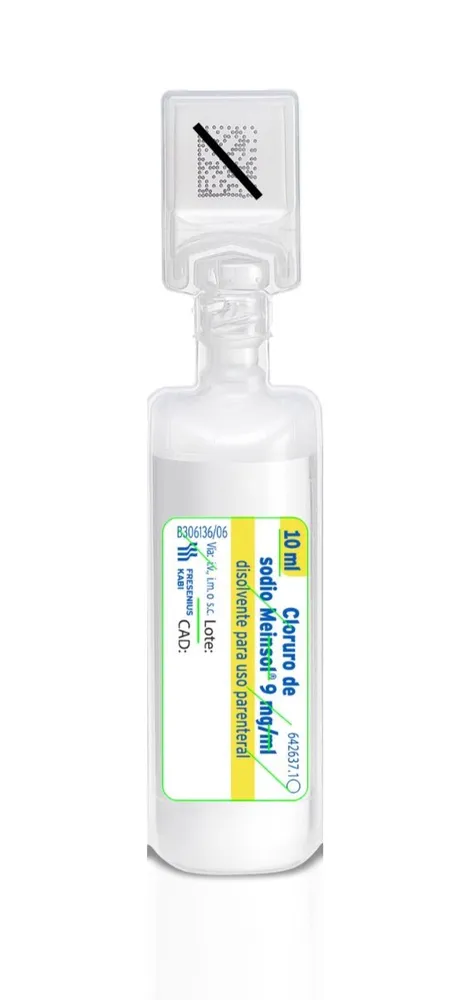
Table of Contents
- Package leaflet: Information for the user
- Introduction
- 1. What Cloruro de sodio Meinsol is and what it is used for
- 2. What you need to know before using Cloruro de sodio Meinsol
- 3. How to use Sodium Chloride Meinsol
- 4. Possible adverse effects
- 5. Storage of Sodium Chloride Meinsol
- 6. Contents of the pack and other information
Package leaflet: Information for the user
Introduction
Package leaflet: information for the user
Sodium Chloride Meinsol 9 mg/ml solvent for parenteral use
Sodium chloride
Read the entire leaflet carefully before you start using this medicine, as it contains important information for you.
- Keep this leaflet, as you may need to read it again.
- If you have any questions, consult your doctor or pharmacist.
- This medicine has been prescribed for you only and must not be given to other people,
even if they have the same symptoms as you, because it could harm them.
- If you experience any adverse effects, consult your doctor or pharmacist, even if they are adverse effects not listed in this leaflet. See section 4.
Contents of the leaflet:
- What Sodium Chloride Meinsol is and what it is used for
- What you need to know before using Sodium Chloride Meinsol
- How to use Sodium Chloride Meinsol
- Possible adverse effects
- How to store Sodium Chloride Meinsol
- Contents of the pack and other information.
1. What Cloruro de sodio Meinsol is and what it is used for
Cloruro de sodio Meinsol is indicated as a solvent for medicines that must be administered by intravenous, intramuscular, or subcutaneous route, and as a vehicle for addition of medicines.
2. What you need to know before using Cloruro de sodio Meinsol
Do not use Cloruro de sodio Meinsol:
- If you have ever had an allergic or unusual reaction to sodium chloride.
- If you have high sodium levels in your blood (hypernatremia).
- If you have increased muscle tone (hypertonia).
- If you suffer from heart failure (inability of the heart to pump the necessary amount of blood).
- If you have heart, liver, or kidney disorders and experience fluid accumulation in the body (edema).
- If you have severe high blood pressure (severe hypertension).
- If you have excess acidity in the blood (metabolic acidosis).
Warnings and precautions
Consult your doctor or pharmacist before starting to use Cloruro de sodio Meinsol:
- Solutions, once opened, must be used immediately.
- In case of subcutaneous administration, do not add any supplement that could alter the isotonicity of the solution.
- Do not use the solution if it is not clear and free of precipitates.
- Ensure physicochemical compatibility when adding medication to the ampoule.
- The addition of alcohol to sodium chloride solutions should be avoided.
Children
Newborns may develop excessively high sodium levels due to immature kidney function. Therefore, repeated injections of sodium chloride should only be administered after blood sodium levels have been determined.
Sodium chloride should be used with caution in patients with hypertension, cardiac failure, pulmonary or peripheral edema, impaired renal function, pre-eclampsia, hyperaldosteronism, cirrhosis, and other cirrhotic liver diseases, hypervolemia, urinary tract obstruction, hypoproteinemia, and other conditions and treatments (e.g., corticosteroids) associated with sodium retention.
Use of Cloruro de sodio Meinsol with other medicines:
Inform your doctor or pharmacist if you are taking, have recently taken, or might need to take any other medicines.
Interactions with other medicines depend on the specific drug added.
Sodium chloride solution 9 mg/ml is incompatible with hydrocortisone, amphotericin B, tetracyclines, cephalothin, erythromycin, lactobionate, and lithium salts.
It is incompatible with active substances that are insoluble in sodium chloride solution, due to possible precipitation of the active substance, as well as with medications whose stability or solubility require a highly acidic or strongly alkaline pH.
Pregnancy and breastfeeding:
If you are pregnant or breastfeeding, think you may be pregnant, or are planning to become pregnant, consult your doctor or pharmacist before using this medicine.
Due to the characteristics of the product, no effects on pregnant or breastfeeding women are expected, provided the administration is correct and controlled.
Driving and using machines:
There is no evidence suggesting that isotonic sodium chloride solution may affect the ability to drive or operate machinery.
3. How to use Sodium Chloride Meinsol
Follow these instructions unless your doctor has given you different ones. Sodium chloride Meinsol is administered intravenously, intramuscularly, or subcutaneously.
There is no need to sterilize the ampoule before opening.
No cutting device is required to open the ampoule.
Once the ampoule is opened, the nozzle fits perfectly onto the Luer cone of the syringe, so there is no need to use a needle.
To open:
To separate one ampoule from the rest, rotate one ampoule against the others in the strip without touching the head and neck of the ampoules (1). Shake the ampoule with a single motion as shown in the illustration to remove any liquid that may be in the stopper (2). To open the ampoule, turn the body and head in opposite directions until the neck breaks (3). Attach the Luer or Luer-lock syringe as shown in the illustration (4).
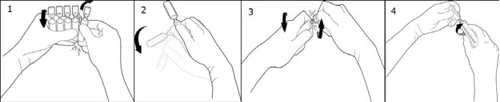
Therefore, a needle is not required to withdraw the solution. Withdraw the liquid.
The solution does not contain any preservative or bactericidal agent, so opened ampoules that are not used must be discarded immediately.
The amount to be used will vary depending on the concentration of the medication to be dissolved.
Your doctor will indicate the duration of treatment with your medication.
If you feel the effect of Sodium Chloride Meinsol is too strong or too weak, inform your doctor.
If you use more Sodium Chloride Meinsol than you need:
If you have received more Sodium Chloride Meinsol than required, consult your doctor immediately.
Given the nature of the product, when correctly indicated and administered under control, there is no risk of poisoning.
However, an excess of sodium chloride, in its most acute form, may cause dehydration of internal organs, nausea, vomiting, diarrhoea, abdominal cramps, thirst, decreased salivation and lacrimation, sweating, fever, hypotension, tachycardia, renal failure, pulmonary oedema, acidosis, respiratory arrest, headache, dizziness, irritability, muscle spasms, stiffness, coma, and death.
If any symptoms of poisoning occur, administration should be discontinued and symptomatic treatment initiated.
In children, coma and convulsions may persist and lead to vascular lesions. Respiratory difficulty with tachypnoea and redness of the nasal alae may also occur.
In case of overdose or accidental ingestion, go immediately to a medical centre or call the Toxicology Information Service at telephone 91 562 04 20.
4. Possible adverse effects
Like all medicines, this medicine can cause adverse effects, although not everyone experiences them.
Improper or excessive administration of physiological saline solution may lead to hyperhydration, hypernatremia, hyperchloremia, and related manifestations, such as metabolic acidosis due to decreased bicarbonate concentration, and edema formation.
Excess sodium chloride may cause nausea, vomiting, and headache.
Adverse reactions may also be related to any added medication.
Reporting of adverse effects
If you experience any type of adverse effect, consult your doctor or pharmacist, even if it is a possible adverse effect not listed in this leaflet. You may also report them directly through the Spanish Pharmacovigilance System for Human Medicines: http://www.notificaram.es. By reporting adverse effects, you can help provide more information on the safety of this medicine.
5. Storage of Sodium Chloride Meinsol
Keep this medicine out of the sight and reach of children.
No special storage conditions are required.
Do not use this medicine after the expiry date stated on the packaging after EXP. The expiry date refers to the last day of the month indicated.
Once the container is opened, the product should be used immediately.
6. Contents of the pack and other information
- The active substance is Sodium chloride. Each 100 ml contains 0.9 g of sodium chloride.
- The excipients are water for injections, hydrochloric acid and sodium hydroxide.
Composition per 100 ml:
Electrolytes mmol/l mEq/l
Sodium chloride 0.9 g Na+ 154 154
Water for injections q.s. to 100 ml Cl- 154 154
Osmolarity: 308 mOsmol/litre.
Appearance of the product and contents of the container
Sodium chloride Meinsol 9 mg/ml solvent for parenteral use is a clear, colourless solution, free or practically free from particles.
Sodium chloride Meinsol is a solvent for parenteral use available in the following pack sizes:
Box containing 20 ampoules of 5 ml (Clinical pack)
Box containing 50 ampoules of 5 ml (Clinical pack)
Box containing 20 ampoules of 10 ml (Clinical pack)
Box containing 50 ampoules of 10 ml (Clinical pack)
Box containing 20 ampoules of 20 ml (Clinical pack)
Only certain pack sizes may be marketed.
Marketing Authorisation Holder:
FRESENIUS KABI ESPAÑA, S.A.U.
C/ Marina, 16-18
08005-Barcelona (Spain)
Manufacturer:
FRESENIUS KABI ESPAÑA, S.A.U.
C/ Dr. Ferran, 12
08339 Vilassar de Dalt
Spain
This medicinal product is authorised in the Member States of the European Economic Area under the following names:
Member State | Medicinal product name |
Belgium | Natriumchloride 0,9% Fresenius Kabi solution for parenteral use |
Czech Republic | 0,9% Sodium Chloride Kabi |
Estonia | Sodium chloride Kabi 0,9%, solution for parenteral use |
Greece | Sodium Chloride 0.9%/Fresenius |
Hungary | Sodium chloride Kabi 9 mg/ml solution for parenteral use |
Ireland | Sodium Chloride 0.9% w/v solvent for parenteral use |
Lithuania | Sodium Chloride Kabi 0,9 % solution for parenteral use |
Latvia | Sodium chloride Kabi 0,9% solution for parenteral use |
Poland | Natrium chloratum 0,9% Kabi, 9 mg/ml, solvent for preparations for parenteral use |
Romania | Serum physiologic 9 mg/ml Kabi, solvent for parenteral use |
Slovak Republic | 0,9 % Sodium chloride Kabi |
Slovenia | Sodium chloride Fresenius Kabi 9 mg/ml |
Spain | Sodium chloride Meinsol 9 mg/ml, solvent for parenteral use |
Date of the last revision of this leaflet: January 2015
Detailed and up-to-date information about this medicine is available on the website of the Spanish Agency for Medicines and Health Products (AEMPS) http://www.aemps.gob.es/