Sodium chloride Grifols 0.9% solution for infusion
Spain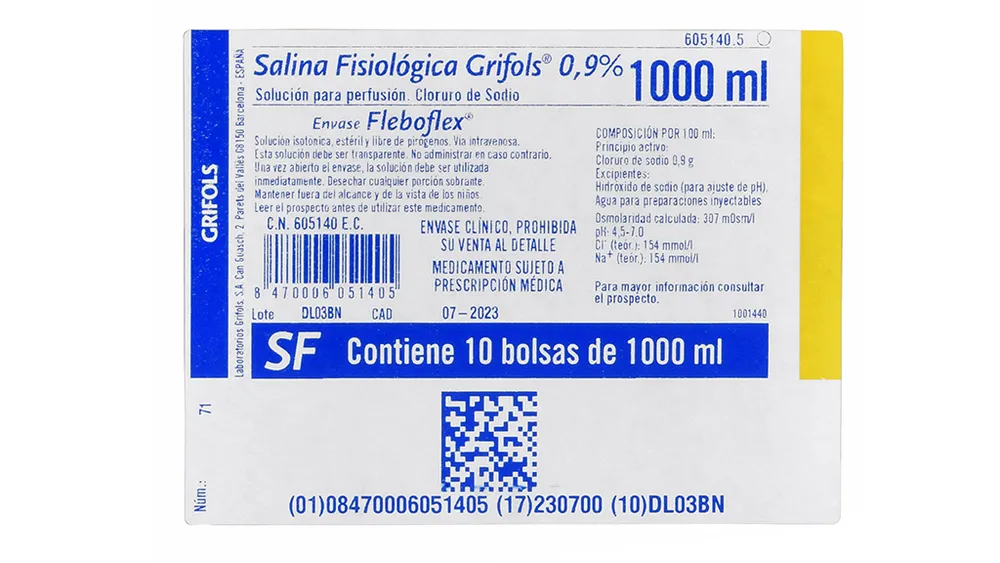
Table of Contents
- Package leaflet: Information for the user
- Introduction
- 1. What Cloruro de Sodio Grifols 0.9% is and what it is used for
- 2. What you need to know before using Sodium Chloride Grifols 0.9%
- 3. How to use Sodium Chloride Grifols 0.9%
- 4. Possible adverse effects
- 5. Storage of Sodium Chloride Grifols 0.9%
- 6. Contents of the pack and other information
Package leaflet: Information for the user
Introduction
Package leaflet: information for the user
Sodium Chloride Grifols 0.9% Solution for infusion
Read the entire leaflet carefully before you start using this medicine, because it contains important information for you.
- Keep this leaflet, as you may need to read it again.
- If you have any questions, consult your doctor or nurse.
- If you experience any adverse reactions, consult your doctor or nurse, even if they are not listed in this leaflet. See section 4.
Leaflet contents
- What Sodium Chloride Grifols 0.9% is and what it is used for
- What you need to know before using Sodium Chloride Grifols 0.9%
- How to use Sodium Chloride Grifols 0.9%
- Possible adverse effects
- How to store Sodium Chloride Grifols 0.9%
- Contents of the pack and other information
1. What Cloruro de Sodio Grifols 0.9% is and what it is used for
Cloruro de Sodio Grifols 0.9% belongs to a group of medicines called intravenous solutions affecting electrolyte balance – electrolytes (used to maintain body fluids in proper equilibrium).
This medicine provides sodium, chloride (both electrolytes), and water, and is indicated for:
- states of dehydration accompanied by salt losses
- hypochloremic metabolic alkalosis
- treatment of hypovolemia (decrease in blood volume)
- as a vehicle for the administration of compatible medicines and electrolytes.
2. What you need to know before using Sodium Chloride Grifols 0.9%
Do not use Sodium Chloride Grifols 0.9%:
- if your blood levels of chloride and/or sodium are high (hyperchloremia and hypernatremia, respectively) or if you have hyperhydration (excess body water)
- if you have acidosis (pH below the normal range)
Warnings and precautions
Sodium Chloride Grifols 0.9% is an isotonic solution.
Consult your doctor or nurse before starting to use Sodium Chloride Grifols 0.9%.
-
This medicine should be administered with caution if you have hypertension, including preeclampsia (development of high blood pressure during pregnancy)/eclampsia (a complication of severe preeclampsia), congestive heart failure, pulmonary or peripheral edema, severe renal failure, decompensated cirrhosis (liver disease with symptoms and potentially life-threatening complications), primary hyperaldosteronism (excessive production of the hormone aldosterone), or if you are taking corticosteroids or adrenocorticotropic hormone (a hormone that stimulates the secretion of cortisol and other steroid hormones) (see next subsection).
-
This medicine should be administered with caution if your blood potassium levels are low (hypokalemia), as pre-existing electrolyte imbalance may worsen, causing cardiovascular complications, especially if you have heart problems.
-
It should also be administered with special caution if you are elderly, as you may have heart or kidney problems.
-
Administration of large volumes requires special monitoring if you are a patient with heart or lung failure or if you have non-osmotic release of vasopressin (antidiuretic hormone) (including the syndrome of inappropriate antidiuretic hormone secretion, SIADH), due to the risk of hospital-acquired hyponatremia (low sodium levels in blood during hospitalization).
Hyponatremia:
If you are a patient with non-osmotic release of vasopressin (e.g., in critical conditions, pain, postoperative stress, infections, burns, and central nervous system diseases), if you have heart, liver, or kidney disease, or if you are exposed to vasopressin agonists (see next subsection), you are at special risk of developing acute hyponatremia after administration of hypotonic and even isotonic solutions.
Acute hyponatremia may cause acute hyponatremic encephalopathy (cerebral edema) characterized by headache, nausea, seizures, lethargy, and vomiting. Patients with cerebral edema are at special risk of suffering severe, irreversible, and potentially fatal brain damage.
Children, women of childbearing age, and patients with reduced cerebral compliance (e.g., in cases of meningitis, intracranial hemorrhage, and cerebral contusion) are at special risk of suffering severe and potentially fatal cerebral edema caused by acute hyponatremia.
-
In prolonged therapies or whenever your doctor considers it necessary, such as in case of existing or imminent acid-base imbalance, periodic monitoring of fluid balance, serum electrolyte concentrations, and acid-base balance should be performed.
-
Sodium re-equilibration should not be carried out too rapidly, especially due to the risk of serious neurological complications such as osmotic demyelination syndrome (a brain disease caused by severe damage to the myelin sheath of brain cells) (see section 3).
-
This medicine should only be used for short-term therapy, as prolonged administration may lead to metabolic acidosis.
-
Due to the administration technique, during intravenous infusion you may experience extravasation (leakage or escape of fluid from a vein into surrounding tissues) and/or thrombophlebitis (inflammation of a vein with clot formation) (see section 4). Extravasation may cause tissue damage (local pain, erythema, burning, itching, swelling, and ulceration) at the injection site or along the vein. Thrombophlebitis may occur if administration is prolonged at the same injection site. In such cases, your doctor or nurse should interrupt the intravenous infusion and initiate necessary therapeutic measures. Possible signs of inflammation at the injection site should be checked periodically.
-
Due to the risk of gas embolism (when one or more gas bubbles enter a vein or artery), your doctor or nurse must take special care in handling the administration sets.
When adding a medicine to the solution, your doctor or nurse must check compatibility, clarity, and color before use. The mixture must not be stored.
Children and adolescents
In premature infants and infants, sodium chloride should only be administered after determining blood sodium levels.
There are no other specific warnings or precautions for children and adolescents.
Use of Sodium Chloride Grifols 0.9% with other medicines
Certain medicines may interact with Sodium Chloride Grifols 0.9%. In such cases, it may be necessary to adjust the dose or discontinue treatment with one of the medicines.
It is important that you inform your doctor if you are taking any of the following medicines:
- lithium carbonate, as administration of sodium chloride accelerates renal excretion of lithium, leading to a reduction in its therapeutic effect.
- corticosteroids or adrenocorticotropic hormone, due to their ability to retain water and sodium.
- medicines that enhance the effect of antidiuretic hormone (such as chlorpropamide, clofibrate, carbamazepine, vincristine, selective serotonin reuptake inhibitors, 3,4-methylenedioxy-N-methamphetamine, ifosfamide, antipsychotics, narcotics, NSAIDs (non-steroidal anti-inflammatory drugs), cyclophosphamide, desmopressin, oxytocin, vasopressin, terlipressin). These medicines reduce water excretion in urine and increase the risk of hospital-acquired hyponatremia after receiving inadequately balanced intravenous perfusion solutions (see previous subsection and sections 3 and 4).
- diuretics in general and antiepileptic drugs such as oxcarbazepine, which increase the risk of hyponatremia.
Inform your doctor if you are taking, have recently taken, or might need to take any other medicines.
Pregnancy, breastfeeding, and fertility
If you are pregnant or breastfeeding, think you might be pregnant, or plan to become pregnant, consult your doctor before using this medicine.
There is no evidence indicating that maternal infusion of 0.9% sodium chloride during pregnancy has harmful effects on the fetus or newborn.
This medicine should be administered with special caution in pregnant women during labor, and special monitoring of serum sodium is required if it is administered in combination with oxytocin (see previous subsections and section 4).
Extreme caution should be exercised during pregnancy in cases of preeclampsia (see Warnings and precautions).
Sodium chloride is excreted in breast milk, but since it is a natural constituent of milk, no adverse effects in the infant are expected after intravenous administration of therapeutic doses to the mother. Nevertheless, caution is recommended during these periods.
There are no data on fertility and the use of sodium chloride solutions, but adverse effects are not expected.
When this medicine is used as a vehicle for the administration of compatible medicines and electrolytes, the nature of the additive and its use during pregnancy and breastfeeding must be evaluated separately.
In any case, the doctor must assess whether treatment is advisable.
Driving and using machines
Not applicable.
3. How to use Sodium Chloride Grifols 0.9%
This medicine will be administered by healthcare professionals.
It is given intravenously by infusion.
Your doctor will determine the dose, infusion rate, and duration of treatment based on your age, weight, and clinical condition (e.g., burns, surgery, head injury, infections). Generally, it is recommended to administer the solution at an average rate of 40 to 60 drops per minute (120–180 mL/h).
You may need to be monitored for fluid balance, serum electrolytes, and acid-base balance before and during administration, with special attention to serum sodium levels if you have increased non-osmotic release of vasopressin (SIADH) or are receiving concomitant treatment with vasopressin agonists, due to the risk of hospital-acquired hyponatremia (see sections 2 and 4).
Your doctor will decide whether concomitant treatment is necessary (see sections 2 and 4).
When administering this solution, the total daily fluid requirement should be taken into account. The recommended daily fluid dose is as follows:
- Adults: 25–35 mL/kg
- Children:
- Less than 10 kg body weight: 100 mL/kg
- Between 10–20 kg body weight: 1,000 mL + 50 mL/kg for each kg above 10 kg
- More than 20 kg body weight: 1,500 mL + 20 mL/kg for each kg above 20 kg
In adults, the maximum daily fluid dose is 40 mL/kg (corresponding to 6 mmol of sodium/kg), not exceeding 3,000 mL, and the maximum infusion rate is 5 mL/kg/hour. Pediatric patients rarely require more than 2,500 mL in boys and 2,000 mL in girls.
In cases of acute plasma volume deficiency (e.g., imminent or manifest hypovolemic shock), the required volume of solution should be 3–4 times the volume of blood lost.
When this medicine is used as a vehicle for the administration of compatible drugs and electrolytes, the administered dose and infusion rate will depend on the nature and dose of the prescribed medication.
If you receive more Sodium Chloride Grifels 0.9% than you should
Excessive administration of 0.9% sodium chloride solution may result in fluid overload (hypervolemia, hyperhydration) and/or salt overload (hypernatremia and hyperchloremia) (see section 4). In such cases, administration should be discontinued and appropriate therapeutic measures initiated.
If fluid overdose occurs (hypervolemia, hyperhydration), you may experience pulmonary and/or peripheral edema and its consequences (heart failure).
With excessive sodium administration, hypernatremia may develop, leading to intracellular dehydration (loss of water from cells, potentially causing cellular desiccation), which must be treated in a specialized setting. If this occurs, you may experience nausea, vomiting, diarrhea, abdominal cramps, thirst, reduced salivation and lacrimation, fever, sweating, tachycardia, hypertension, headache, dizziness, agitation, irritability, weakness, lightheadedness (transient loss of consciousness), muscle spasms and stiffness, somnolence, confusion, which may progress to seizures, coma, renal failure, cerebral, peripheral and pulmonary edema, respiratory failure, and death.
Severe neurological complications such as osmotic demyelination syndrome (a brain disorder caused by severe damage to the myelin sheath of brain cells) may occur several days after overly significant and/or rapid correction of hyponatremia (see section 2). If this occurs, you may gradually develop the following clinical signs: confusion, difficulty speaking and/or swallowing, limb weakness, tetraplegia, delirium, and ultimately coma.
Excessive chloride administration may cause hyperchloremia and, consequently, bicarbonate loss and acidosis. Hyperchloremia often does not cause any symptoms. When symptoms do occur, they are similar to those of hypernatremia.
When this medicine is used as a vehicle for the administration of other compatible drugs and electrolytes, additional signs and symptoms of overdose related to the added medication may occur. If this happens, treatment should be discontinued and you should be monitored for clinical signs and symptoms related to the administered medication. You should receive symptomatic treatment and necessary supportive care.
In case of overdose or accidental ingestion, contact the Toxicology Information Service. Telephone: 915 620 420.
If you have any further questions about the use of this medicine, ask your doctor or nurse.
4. Possible adverse effects
Like all medicines, this medicine can cause adverse effects, although not everyone will experience them.
Inappropriate or excessive administration of this medicine may cause hyperhydration, hypernatremia, hyperchloremia, and hypervolemia (excess body water, plasma sodium, plasma chloride, and blood volume, respectively), and related manifestations such as edema formation (abnormal accumulation of fluid in the tissues between body cells) or metabolic acidosis due to decreased bicarbonate concentration (increased plasma acidity due to insufficient bicarbonate to effectively neutralize the effects of acid).
Patients with non-osmotic vasopressin release, patients with heart, liver, or kidney diseases, and patients treated with vasopressin agonists are at special risk of developing acute hyponatremia following the administration of hypotonic and even isotonic solutions. Hospital-acquired hyponatremia may cause irreversible brain damage and death due to the development of acute cerebral edema (see sections 2 and 3).
Adverse effects may also arise from prolonged intravenous administration at the same infusion site. These effects include pain or reaction at the injection site, fever, infection, extravasation, venous thrombosis (formation of a blood clot within a vein obstructing blood flow), and phlebitis (inflammation of a vein) extending from the injection site.
If used as a vehicle for the administration of other compatible medicines, additional adverse effects may occur attributable to the nature of the added medicines.
Reporting of adverse effects
If you experience any type of adverse effect, consult your doctor or nurse, even if it is a possible adverse effect not listed in this leaflet. You may also report them directly via the Spanish Pharmacovigilance System for Human Medicinal Products (website: www.notificaRAM.es). By reporting adverse effects, you can help provide more information on the safety of this medicine.
5. Storage of Sodium Chloride Grifols 0.9%
Keep this medicine out of the sight and reach of children.
Do not use this medicine after the expiry date stated on the container. The expiry date is the last day of the month indicated.
This medicine does not require any special storage conditions.
After opening the container, the solution should be used immediately.
Do not use this medicine if you notice that the solution is not clear or contains particles, or if the container is damaged.
6. Contents of the pack and other information
Composition of Sodium Chloride Grifols 0.9%
The active substance is sodium chloride. Each 100 ml of solution contains 0.9 g of sodium chloride.
The other component (excipient) is water for injections.
The calculated osmolarity of the solution is 308 mOsm/L and the pH is 4.5–7.0. The theoretical content of sodium and chloride is 154 mmol/L.
Appearance of the medicinal product and contents of the pack
Sodium Chloride Grifols 0.9% is an infusion solution. It is a clear, colourless aqueous solution.
This medicine is available in flexible polypropylene bags (Fleboflex) containing 50 ml, 100 ml, 250 ml, 500 ml and 1000 ml of solution.
Marketing Authorization Holder
LABORATORIOS GRIFOLS, S.A.
Can Guasch, 2
08150 Parets del Vallès, Barcelona (SPAIN)
Manufacturer
Laboratorios Grifols, S.A.
Polígono Los Llanos. Calle Marte, 4
30565 Las Torres de Cotillas, Murcia (SPAIN)
This medicinal product is authorized in the Member States of the European Economic Area and in the United Kingdom (Northern Ireland) under the following names:
Spain: | Sodium Chloride Grifols 0.9% Solution for infusion |
Austria: | Sodium Chloride Grifols 0.9% Infusion solution |
France: | Sodium Chloride Grifols 0.9% Solution for infusion |
Hungary: | Sodium Chloride Grifols 0.9% infusion solution |
Germany: | Sodium Chloride Grifols 0.9% Infusion solution |
Slovak Republic: | Sodium Chloride Grifols 0.9% infusion solution |
United Kingdom (Northern Ireland): | Sodium Chloride Grifols 0.9% w/v Solution for infusion |
Czech Republic: | Sodium Chloride Grifols |
Date of the most recent review of this leaflet: May 2024
Other sources of information
Detailed information on this medicinal product is available on the website of the Spanish Agency of Medicines and Medical Devices (AEMPS) http://www.aemps.gob.es/
This information is intended for healthcare professionals only:
Before administering Sodium Chloride Grifols 0.9%, check that:
- there are no leaks (by pressing firmly on the bag)
- the solution is clear and free of particles.
Do not administer if otherwise (see section 5).
Do not remove the overpouch until ready for use. The bag maintains the sterility of the product.
Once the container is opened, the solution must be administered immediately.
To connect the infusion set, separate the protective tab from the infusion port to expose the access membrane of the bag. Remove all air from the syringe and associated tubing before infusion to avoid the risk of air embolism.
Discard after single use.
Discard any unused portion.
Do not reconnect partially used bags.
The compatibility of additives with Sodium Chloride Grifols 0.9% solution must be verified before adding any medication.
It is the physician's responsibility to determine incompatibility of the added drug with Sodium Chloride Grifols 0.9% and its container by monitoring for any discoloration and/or formation of precipitates, insoluble complexes, or crystals. The package insert of the drug to be added must be consulted.
Before adding a drug, verify whether it is soluble and stable in water at the pH of Sodium Chloride Grifols 0.9%.
When adding drugs to 0.9% sodium chloride solution and when administering the solution, use an aseptic technique.
Mix the solution thoroughly after additives have been introduced.
When a compatible drug is added to Sodium Chloride Grifols 0.9%, the solution must be administered immediately. Do not store solutions containing additives.
This medicinal product is physically incompatible with amphotericin B, an antifungal chemotherapeutic agent.
This medicine must not be mixed with other medicines unless compatibility has been confirmed.
Due to the administration technique, extravasation and/or thrombophlebitis may occur during intravenous infusion (see section 4). In such cases, intravenous infusion should be discontinued and appropriate therapeutic measures initiated. The injection site should be periodically checked for possible signs of inflammation.