Sodium chloride Fresenius Kabi 5.84% solution for injection
Spain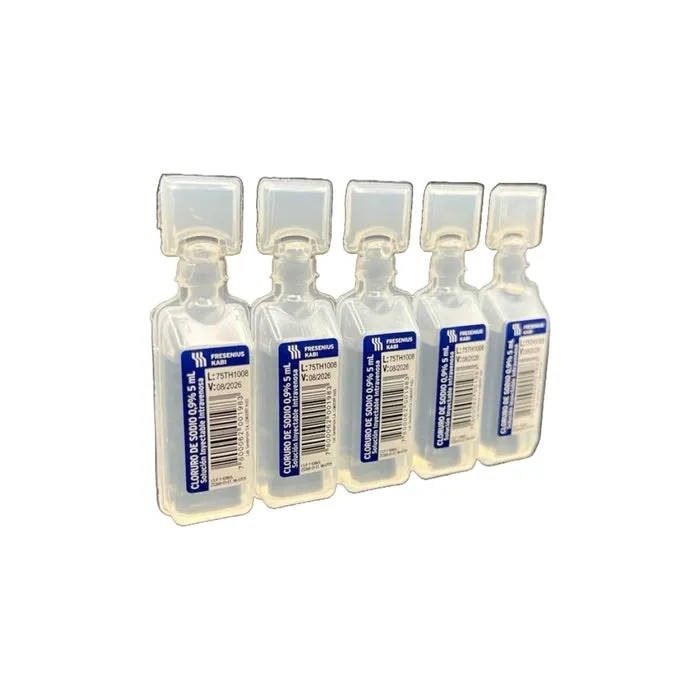
Table of Contents
Patient Information Leaflet
Introduction
PACKAGE LEAFLET: INFORMATION FOR THE USER Sodium Chloride Fresenius Kabi 5.84% Injection Solution
Read the entire patient information leaflet carefully before you start using this medicine.
|
In this leaflet:
- What CLORURO DE SODIO FRESENIUS KABI is and what it is used for
- Before using CLORURO DE SODIO FRESENIUS KABI
- How to use CLORURO DE SODIO FRESENIUS KABI
- Possible side effects
- Storage of CLORURO DE SODIO FRESENIUS KABI
- Further information
1. What CLORURO DE SODIO FRESENIUS KABI is and what it is used for
CLORURO DE SODIO FRESENIUS KABI is an injectable solution, belonging to the group of medicines known as electrolyte solutions.
CLORURO DE SODIO FRESENIUS KABI is indicated in the treatment of severe hyponatremia (low blood sodium levels) of various causes.
2. BEFORE USING SODIUM CHLORIDE FRESENIUS KABI
Do not use SODIUM CHLORIDE FRESENIUS KABI:
- if you are allergic (hypersensitive) to the active substance or to any of the other components of Sodium Chloride Fresenius Kabi.
- if you have edema (excessive fluid accumulation)
- if you have eclampsia (seizures not attributable to another cause during pregnancy)
- if you have hypernatremia (high sodium levels in the blood)
Take special care with SODIUM CHLORIDE FRESENIUS KABI:
Sodium chloride must be used with extreme caution in patients with heart failure, severe renal insufficiency (marked decrease in kidney function), hepatic cirrhosis (chronic progressive liver disease), and in those receiving corticosteroids or corticotropin (medications used as anti-inflammatory agents). Special caution is also required in elderly patients and those recovering from surgery.
Excess chloride in the body may lead to bicarbonate loss, resulting in a consequent decrease in pH. Excessive intravenous administration of sodium chloride may also cause low blood potassium levels.
The coexistence of inadequate blood oxygenation and low blood sodium levels may lead to brain damage, even in the absence of any correction of the low sodium levels.
It should be administered with caution in patients with high blood pressure.
If continuously administered at the same injection site, pain, infection, and phlebitis (inflammation of the vein wall) may occur.
Consult your doctor, even if any of the above-mentioned conditions ever occurred in the past.
Use of other medicines:
Before mixing with other medicines, compatibility tables should be checked, pH considered, and ions monitored.
Concomitant administration of sodium chloride and corticosteroids or corticotropin (medications used as anti-inflammatory agents) may lead to excessive fluid accumulation due to the sodium content.
The interaction between sodium and lithium (a medication used in the treatment of certain psychiatric disorders) is considered clinically significant. Excess sodium may prevent the establishment of adequate lithium levels, whereas a deficiency of sodium chloride may lead to increased lithium levels up to toxic values.
Please note that these instructions may also apply to medicines that have been used previously or may be used in the future.
Inform your doctor or pharmacist if you are taking or have recently taken any other medicines, including those obtained without a prescription.
Pregnancy and breastfeeding:
Consult your doctor or pharmacist before using any medicine.
The safety of its use during pregnancy and breastfeeding has not been established. Therefore, it should only be used when clearly necessary and when the beneficial effects outweigh the potential risks to the fetus or nursing infant.
Driving and using machines:
Not applicable due to the nature of its use.
3. HOW TO USE SODIUM CHLORIDE FRESENIUS KABI:
Follow exactly the administration instructions for Sodium Chloride Fresenius Kabi as indicated by your doctor. Consult your doctor or pharmacist if you have any doubts.
Dosages will be adjusted according to the patient's needs at the physician's discretion, based on age, weight, clinical condition, fluid balance, ion levels, and acid-base balance.
Sodium Chloride Fresenius Kabi is administered intravenously, intramuscularly, or subcutaneously.
It is not necessary to sterilize the ampoule before opening. No cutting device is required to open the ampoule. Once opened, the nozzle fits perfectly onto the Luer cone of the syringe, so a needle is not required.
To open, separate one ampoule from the rest by rotating it away from the other ampoules in the strip without touching the head and neck of the ampoules (1). Shake the ampoule with a single motion as shown in the drawing to remove any liquid that may be in the stopper (2). To open the ampoule, turn the body and head of the ampoule in opposite directions until it breaks at the neck (3). Attach the Luer or Luer-lock syringe as shown in the drawing (4).
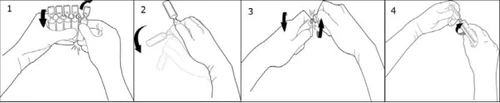
The solution contains no preservatives or bactericidal agents; therefore, opened ampoules that are not used must be discarded immediately.
If you use more SODIUM CHLORIDE FRESENIUS KABI than you should:
Accidental overdose may lead to symptoms associated with excess sodium in the blood, and the appropriate measures should be taken to reduce high blood sodium levels.
In case of overdose or accidental ingestion, contact your doctor or pharmacist immediately or call the Toxicology Information Service at telephone number 91 562 04 20, indicating the medication and amount used. It is recommended to bring the packaging and leaflet to the healthcare professional.
4. Possible adverse effects
Like all medicines, CLORURO DE SODIO FRESENIUS KABI may have adverse effects.
Since sodium chloride is a normal component of the internal environment, adverse reactions would be related to its concentration, which is higher than that of blood serum.
The adverse effects described have occurred due to excessive or too rapid administration. There are two forms of toxicity: the first is high sodium levels in the blood, and the second is an excess of sodium and water leading to excessive fluid accumulation that may affect the brain, lungs, or peripheral circulation. Symptoms of sodium excess include nausea, vomiting, diarrhea, abdominal cramps, thirst, reduced tear and saliva production, excessive sweating, fever, tachycardia, increased blood pressure, kidney failure, excessive fluid accumulation in different areas of the body and in the lungs, respiratory arrest, headache, dizziness, restlessness, weakness, muscle tremors and rigidity, seizures, coma, and death. However, most cases of hypernatremia reported have resulted from oral use of sodium chloride solutions, rather than from intravenous administration of solutions with sodium concentrations higher than that of blood serum.
The administration of large amounts of chloride may lead to a decrease in the body's pH as a result of reduced bicarbonate concentration.
If you consider any of the adverse effects you experience to be severe, or if you notice any adverse effects not listed in this leaflet, inform your doctor or pharmacist.
5. Storage of SODIUM CHLORIDE FRESENIUS KABI
Keep out of the reach and sight of children.
No special storage conditions are required.
Do not use Sodium Chloride Fresenius Kabi after the expiry date stated on the container after EXP. The expiry date refers to the last day of the month indicated.
Do not use this medicine if you notice that the solution is not clear, colourless and free from particles.
Once the container is opened, the product should be used immediately.
Medicines must not be disposed of via wastewater or household waste. Ask your pharmacist how to dispose of medicines and containers you no longer need. This will help protect the environment.
6. ADDITIONAL INFORMATION
Composition of Sodium Chloride Fresenius Kabi
-
The active substance is: sodium chloride. Each ml of solution contains 58.4 mg of sodium chloride (ionic content: Na+ = Cl- = 1 mEq/ml).
-
The other components are: water for injection, hydrochloric acid or sodium hydroxide.
Appearance of the medicinal product and content of the container
Sodium Chloride Fresenius Kabi is a clear, colourless solution, free or practically free from visible particles.
Sodium Chloride Fresenius Kabi is available in the following pack sizes:
Carton containing 20 ampoules of 10 ml
Carton containing 50 ampoules of 10 ml
Carton containing 20 ampoules of 20 ml
Only certain pack sizes may be marketed.
Marketing Authorisation Holder and Manufacturer
Marketing Authorisation Holder and Manufacturer:
Fresenius Kabi España S.A.U.
Marina 16-18
08005 – Barcelona
This summary of product characteristics was approved in October 2019
"Detailed and up-to-date information on this medicinal product is available on the website of the Spanish Agency of Medicines and Medical Devices (AEMPS): http://www.aemps.gov.es/"
This information is intended for healthcare professionals only:
Infusion solution for intravenous administration.
The ampoule of SODIUM CHLORIDE FRESENIUS KABI must be diluted in a minimum volume of 50 ml of an infusion solution.
Use only if the solution is clear and free from visible particles. If not the entire content is used, discard the remainder.
In acute severe hyponatremia, correction rates of 1 mmol/l/hour are recommended to prevent neurological damage.
If hyponatremia is classified as chronic, furosemide or an osmotic diuretic should be associated with hypertonic saline.
Correction of hyponatremia should not be too rapid to avoid demyelinating injury. Some authors recommend not exceeding a correction of 10 mEq/l in the first 24 hours and 21 mEq/l in the first 48 hours. In general, serum sodium levels should be monitored closely so that replacement can be stopped once normal values are reached.