Skyrizi 150 mg solution for injection in pre-filled syringe
Spain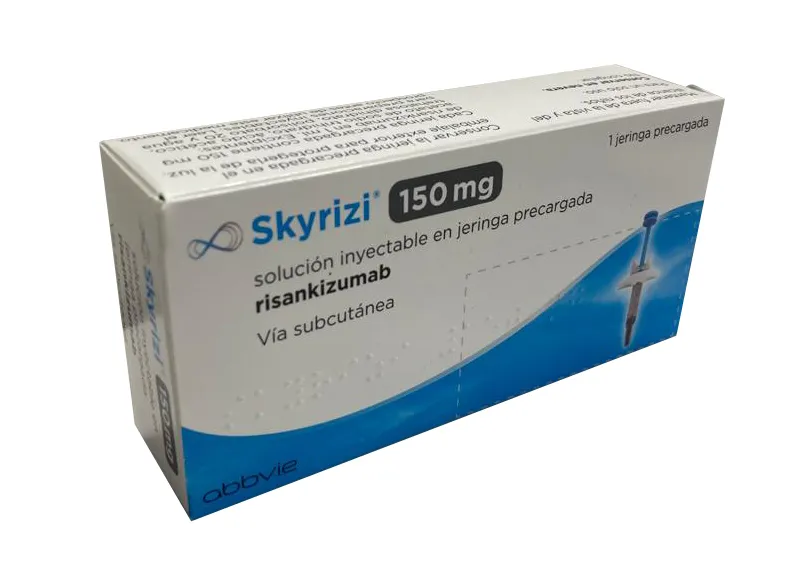
Table of Contents
Package leaflet: Information for the patient
Introduction
Package leaflet: information for the patient
Skyrizi 150mg solution for injection in pre-filled syringe
risankizumab
Read the entire leaflet carefully before you start using this medicine, as it contains important information for you.
- Keep this leaflet, as you may need to read it again.
- If you have any questions, ask your doctor, pharmacist, or nurse.
- This medicine has been prescribed for you only, and you should not give it to other people, even if they have the same symptoms as you, because it may harm them.
- If you experience any adverse reactions, consult your doctor, pharmacist, or nurse, even if they are adverse reactions not listed in this leaflet. See section 4.
Leaflet contents
- What Skyrizi is and what it is used for
- What you need to know before using Skyrizi
- How to use Skyrizi
- Possible side effects
- How to store Skyrizi
- Contents of the pack and other information
- Instructions for use
1. What Skyrizi is and what it is used for
Skyrizi contains the active substance risankizumab.
Skyrizi is used to treat the following inflammatory conditions:
- Plaque psoriasis
- Psoriatic arthritis
How Skyrizi works
This medicine works by blocking a protein in the body called "IL-23" that causes inflammation.
Plaque psoriasis
Skyrizi is used to treat moderate to severe plaque psoriasis in adults. Skyrizi reduces inflammation and, therefore, can help reduce the symptoms of plaque psoriasis such as stinging, itching, pain, redness, and scaling.
Psoriatic arthritis
Skyrizi is used to treat psoriatic arthritis in adults. Psoriatic arthritis is a disease that causes joint inflammation and psoriasis. If you have active psoriatic arthritis, you may first be given other medications. If these medications do not work well enough, Skyrizi will be given either alone or in combination with other medicines to treat your psoriatic arthritis.
Skyrizi reduces inflammation and, thus, can help reduce pain, stiffness, and swelling in and around your joints, pain and stiffness in your spine, psoriatic skin rashes, and nail damage due to psoriasis, as well as slow down bone and cartilage damage in your joints. These effects may make it easier for you to carry out daily activities, reduce fatigue, and improve your quality of life.
2. What you need to know before using Skyrizi
Do not use Skyrizi
- if you are allergic to risankizumab or to any of the other ingredients of this medicine (listed in section 6).
- if you have an infection that your doctor considers significant, for example, active tuberculosis.
Warnings and precautions
Talk to your doctor, pharmacist, or nurse before starting to use Skyrizi and during your treatment:
- if you currently have an infection or if you have a recurring infection.
- if you have tuberculosis (TB).
- if you have recently received or are planning to receive a vaccine. Certain vaccines should not be given during treatment with Skyrizi.
It is important to keep a record of the Skyrizi batch number.
Each time you receive a new Skyrizi pack, write down the date and the batch number (shown on the pack after “Batch”) and keep this information in a safe place.
Severe allergic reactions
Skyrizi may cause serious side effects, including severe allergic reactions (“anaphylaxis”). Contact your doctor or seek immediate medical attention if you notice any signs of an allergic reaction while receiving Skyrizi, such as:
- difficulty breathing or swallowing
- swelling of the face, lips, tongue, or throat
- low blood pressure, which may cause dizziness or lightheadedness
- intense itching of the skin, with a red rash or bumps
Children and adolescents
Skyrizi is not recommended for children and adolescents under 18 years of age, as it has not been studied in this age group.
Other medicines and Skyrizi
Inform your doctor, pharmacist, or nurse:
- if you are taking, have recently taken, or might need to take any other medicines.
- if you have recently been vaccinated or plan to be vaccinated. Certain vaccines should not be administered during treatment with Skyrizi.
If you are unsure, consult your doctor, pharmacist, or nurse before using Skyrizi and during your treatment.
Pregnancy, contraception, and breastfeeding
If you are pregnant, think you may be pregnant, or plan to become pregnant, consult your doctor before using this medicine. This is necessary because it is not known how this medicine may affect the baby.
If you are a woman of childbearing potential, you must use contraception during treatment with this medicine and for at least 21 weeks after your last dose of Skyrizi.
If you are breastfeeding or plan to breastfeed, consult your doctor before using this medicine.
Driving and using machines
It is unlikely that Skyrizi will affect your ability to drive or operate machinery.
Skyrizi contains polysorbate and sodium
This medicine contains 0.2 mg of polysorbate 20 in each 150 mg dose. Polysorbates may cause allergic reactions. Inform your doctor if you have any known allergies.
This medicine contains less than 1 mmol of sodium (23 mg) per pre-filled syringe; this is essentially “sodium-free”.
3. How to use Skyrizi
Follow exactly the administration instructions for this medicine given by your doctor or pharmacist. If in doubt, consult your doctor or pharmacist again.
This medicine is administered by an injection under the skin (called a “subcutaneous injection”).
How much Skyrizi to use
Each dose is 150 mg given as a single injection. After the first dose, the next dose will be administered 4 weeks later, and then every 12 weeks.
You and your doctor, pharmacist, or nurse will decide whether you can inject this medicine yourself. You must not self-inject this medicine unless your doctor, pharmacist, or nurse has trained you how to do so. Alternatively, a caregiver who has been trained may administer the injection.
Read section 7 “Instructions for use” at the end of this leaflet before administering your Skyrizi injection.
If you use more Skyrizi than you should
If you have used more Skyrizi than you should, or if you have administered the dose earlier than prescribed, consult your doctor.
If you forget to use Skyrizi
If you forget to administer Skyrizi, inject a dose as soon as you remember. If in doubt, consult your doctor.
If you stop using Skyrizi
Do not stop using Skyrizi without first talking to your doctor. If you stop treatment, your symptoms may return.
If you have any further questions about the use of this medicine, ask your doctor, pharmacist, or nurse.
4. Possible adverse effects
Like all medicines, this medicine can cause adverse effects, although not everyone will experience them.
Serious adverse effects
Allergic reactions – may require urgent treatment. Inform your doctor or seek immediate medical help if you experience any of the following signs:
Severe allergic reactions ("anaphylaxis") are rare in patients using Skyrizi (may affect up to 1 in 1,000 people). Signs include:
- difficulty breathing or swallowing
- swelling of the face, lips, tongue, or throat
- low blood pressure, which may cause dizziness or lightheadedness
Consult your doctor or seek immediate medical attention if you have any of the following symptoms.
Symptoms of a serious infection, for example:
- fever, flu-like symptoms, night sweats
- feeling tired or short of breath, persistent cough
- warmth, redness, and pain in the skin or a painful skin rash with blisters
Your doctor will decide whether you can continue using Skyrizi.
Other adverse effects
Tell your doctor, pharmacist, or nurse if you notice any of the following adverse effects.
Very common: may affect more than 1 in 10 people
- upper respiratory tract infections with symptoms such as sore throat and nasal congestion
Common: may affect up to 1 in 10 people
- feeling tired
- fungal skin infection
- injection site reactions (such as redness or pain)
- itching
- headache
- rash
- eczema
Uncommon: may affect up to 1 in 100 people
- small red lumps on the skin
- hives (urticaria)
Reporting of adverse effects
If you experience adverse effects, talk to your doctor, pharmacist, or nurse, including any possible adverse effects not listed in this leaflet. You can also report them directly through the national reporting system included in Appendix V. By reporting adverse effects, you can help provide more information on the safety of this medicine.
5. Storage of Skyrizi
Keep this medicine out of the sight and reach of children.
Do not use this medicine after the expiry date stated on the label of the pen and on the outer carton following EXP.
Store in a refrigerator (between 2 °C and 8 °C). Do not freeze.
Keep the pre-filled pen in the original packaging to protect it from light.
If necessary, the pre-filled pen may also be stored outside the refrigerator (at a maximum temperature of 25 °C) for up to 24 hours, while remaining in the original packaging to protect it from light.
Do not use this medicine if the liquid is cloudy or contains flakes or large particles.
Medicines must not be disposed of via wastewater or household waste. Ask your pharmacist how to dispose of medicines and containers you no longer need. This will help protect the environment.
6. Contents of the pack and other information
Composition of Skyrizi
- The active substance is risankizumab. Each pre-filled syringe contains 150 mg of risankizumab in 1 ml of solution.
- The other components are sodium acetate trihydrate, acetic acid, trehalose dihydrate, polysorbate 20, and water for injections. See section 2, “Skyrizi contains polysorbate and sodium”.
Nature and contents of the container
Skyrizi is a clear, colourless to yellow liquid contained in a pre-filled syringe with a needle shield. The liquid may contain tiny transparent or white particles.
Each pack contains 1 pre-filled syringe.
Marketing Authorisation Holder
AbbVie Deutschland GmbH & Co. KG
Knollstrasse
67061 Ludwigshafen
Germany
Manufacturer responsible for batch release
AbbVie S.r.l.
04011 Campoverde di Aprilia
(Latina)
Italy
For more information about this medicine, please contact the local representative of the Marketing Authorisation Holder:
Belgium/Belgium/Belgium AbbVie SA Tel/Tel: +32 10 477811 | Lithuania AbbVie UAB Tel: +370 5 205 3023 |
| Luxembourg/Luxembourg AbbVie SA Belgium/Belgium Tel/Tel: +32 10 477811 |
Czech Republic AbbVie s.r.o. Tel: +420 233 098 111 | Hungary AbbVie Kft. Tel: +36 1 455 8600 |
Denmark AbbVie A/S Tlf: +45 72 30-20-28 | Malta V.J.Salomone Pharma Limited Tel: +356 21220174 |
Germany AbbVie Deutschland GmbH & Co. KG Tel: 00800 222843 33 (toll-free) Tel: +49 (0) 611 / 1720-0 | Netherlands AbbVie B.V. Tel: +31 (0)88 322 2843 |
Estonia AbbVie OÜ Tel: +372 623 1011 | Norway AbbVie AS Tlf: +47 67 81 80 00 |
Greece AbbVie PHARMACEUTICAL S.A. Tel: +30 214 4165 555 | Austria AbbVie GmbH Tel: +43 1 20589-0 |
Spain AbbVie Spain, S.L.U. Tel: +34 91 384 09 10 | Poland AbbVie Sp. z o.o. Tel: +48 22 372 78 00 |
France AbbVie Tél: +33 (0) 1 45 60 13 00 | Portugal AbbVie, Lda. Tel: +351 (0)21 1908400 |
Croatia AbbVie d.o.o. Tel: +385 (0)1 5625 501 | Romania AbbVie S.R.L. Tel: +40 21 529 30 35 |
Ireland AbbVie Limited Tel: +353 (0)1 4287900 | Slovenia AbbVie Biofarmacevtska družba d.o.o. Tel: +386 (1)32 08 060 |
Iceland Vistor Tel: +354 535 7000 | Slovakia AbbVie s.r.o. Tel: +421 2 5050 0777 |
Italy AbbVie S.r.l. Tel: +39 06 928921 | Finland/Suomi AbbVie Oy Tel/Puh: +358 (0)10 2411 200 |
Cyprus Lifepharma (Z.A.M.) Ltd Tel: +357 22 34 74 40 | Sweden AbbVie AB Tel: +46 (0)8 684 44 600 |
Latvia AbbVie SIA Tel: +371 67605000 |
Date of the most recent review of this leaflet:
Other sources of information
Detailed information on this medicine is available on the website of the European Medicines Agency: http://www.ema.europa.eu.
Detailed and up-to-date information on this product is available below or on the outer packaging by scanning the QR code using a smartphone. The same information is also available on the following website:
www.skyrizi.eu
QR code to be included
To request a copy of this leaflet in
7. Instructions for use
Read all of section 7 before using Skyrizi
Skyrizi pre-filled syringe
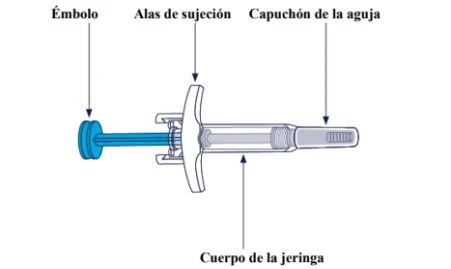
Important information you should know before injecting Skyrizi
- You must have received training on how to inject Skyrizi before self-administering an injection. If you need help, consult your doctor, pharmacist, or nurse.
- Mark the dates on a calendar to keep track of when your next Skyrizi injection is due.
- Keep Skyrizi in its original packaging to protect the medicine from light until the time of use.
- Do not inject the medicine if the liquid is cloudy or contains flakes or large particles. The liquid should be clear to yellow in color and may contain tiny transparent or white particles.
- Do not shake the syringe.
- Wait to remove the needle cap until immediately before injection.
Return this medicine to the pharmacy
- after the expiry date (EXP) indicated.
- if the liquid has ever been frozen (even if it has been thawed).
- if the syringe has been dropped or damaged.
- if the perforations on the box are broken.
For a more comfortable injection: take the box out of the refrigerator and allow it to reach room temperature, away from direct sunlight, for 15 to 30 minutes before injection.
- Skyrizi must not be heated in any other way (e.g., in a microwave or in hot water).
- Keep the syringe in the box until the time of injection.
Follow the steps below every time you use Skyrizi
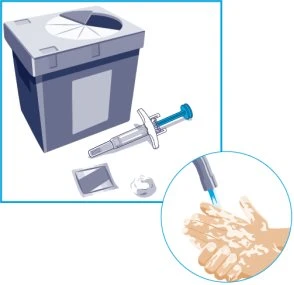
STEP 1
| Remove the prefilled syringe from the carton by holding it at the wings.
On a clean, flat surface, place the following items:
Wash and dry your hands. |
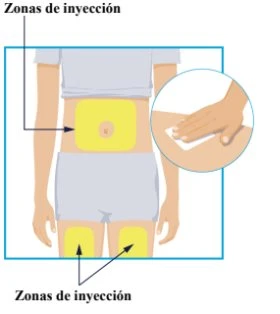
STEP 2
| Choose one of the following 3 areas for your injection:
Before injecting, clean the injection site with an alcohol wipe using circular motions.
|
STEP 3
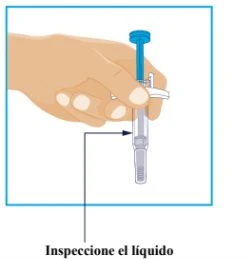
| Hold the syringe with the needle covered by the cap pointing downward as shown. Inspect the liquid in the syringe.
|
STEP 4
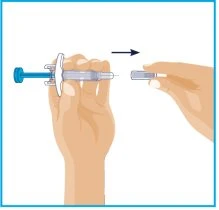
| Remove the needle cap:
|
STEP 5
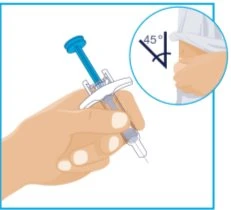
| Hold the barrel of the syringe between your thumb and index finger of one hand, as if holding a pencil. With your other hand, gently pinch and firmly hold a clean area of skin. Insert the needle fully into the skin at an approximate 45-degree angle with a quick, short motion. Keep the syringe steady at the same angle. |
STEP 6
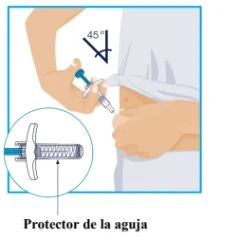
| Slowly push the plunger to the end until all the liquid has been injected. Remove the needle slowly from the skin, maintaining the syringe at the same angle. Slowly release the thumb from the plunger. The needle shield will then automatically cover the needle.
Press a cotton ball or gauze pad over the injection site and hold pressure for 10 seconds. Do not rub the skin at the injection site. Mild bleeding at the injection site may occur. This is normal. |
STEP 7
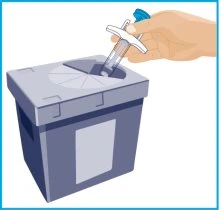
| Dispose of the used syringe immediately into a special waste container.
|