SkyClarys 50 mg hard capsules
Spain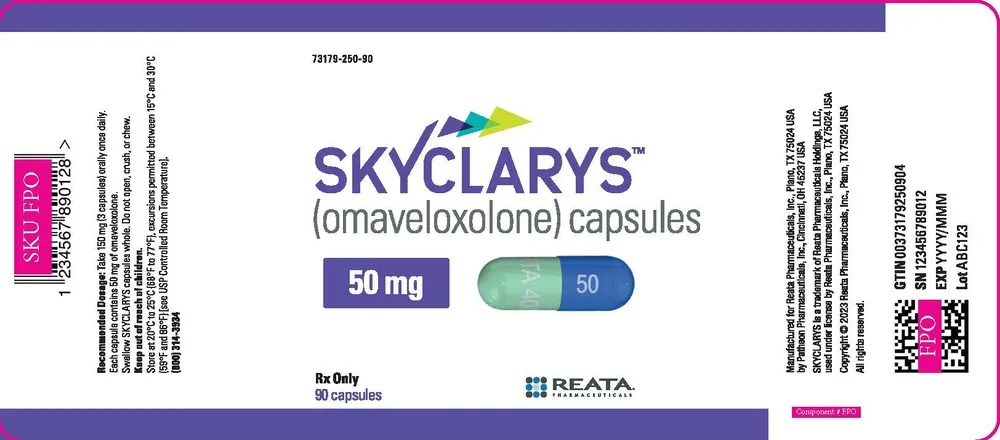
Table of Contents
Package leaflet: Information for the user
Introduction
Package leaflet: information for the patient
Skyclarys 50mg hard capsules
omaveloxolone
This medicinal product is subject to additional monitoring, which will allow for quicker detection of new safety information. You can help by reporting any adverse reactions you may experience. Information on how to report adverse reactions is included at the end of section 4.
Read this entire leaflet carefully before you start taking this medicine, as it contains important information for you.
- Keep this leaflet, as you may need to read it again.
- If you have any questions, consult your doctor.
- This medicine has been prescribed for you only. Do not give it to others, even if they have the same symptoms as you, as it may harm them.
- If you experience any adverse reactions, consult your doctor, even if they are not listed in this leaflet. See section 4.
Leaflet contents
- What Skyclarys is and what it is used for
- What you need to know before taking Skyclarys
- How to take Skyclarys
- Possible side effects
- How to store Skyclarys
- Contents of the pack and other information
1. What Skyclarys is and what it is used for
What Skyclarys is
Skyclarys contains the active substance omaveloxolone, which activates a specific protein, Nrf2, in your body.
What Skyclarys is used for
Skyclarys is used to treat adults and adolescents aged 16 years and older who have Friedreich’s ataxia, a neurodegenerative movement disorder. Friedreich’s ataxia is a rare inherited disease that causes progressive damage to the nervous system and movement problems.
How Skyclarys works
The Nrf2 protein in your body plays a key role in controlling oxidative stress (a condition that can damage the body's cells) and has a protective function in neurodegenerative diseases. In patients with Friedreich’s ataxia, Nrf2 activity is reduced. Skyclarys activates Nrf2 so that it can control oxidative stress.
In a clinical trial, patients treated with Skyclarys achieved better results in tests of neurological function than patients treated with an inactive substance.
2. What you need to know before taking Skyclarys
Do not take Skyclarys if you are allergic to omaveloxolone or to any of the other ingredients of this medicine (listed in section 6).
Warnings and precautions
Talk to your doctor before starting to take Skyclarys:
- if you have liver problems, your doctor may decide to adjust the dose or not to start treatment with Skyclarys;
- inform your doctor about all the medicines you are taking before starting Skyclarys.
Your doctor will check your liver function and your cholesterol levels before you start taking Skyclarys. Your doctor will also check your level of BNP (B-type natriuretic peptide, a blood test to detect heart problems) before you start taking Skyclarys.
Talk to your doctor while taking Skyclarys
Contact your doctor immediately if you experience sudden weight gain, swelling of the legs, ankles or feet, or difficulty breathing, as these may be signs or symptoms of heart problems while taking Skyclarys. Your doctor will decide on the appropriate treatment and whether you should continue taking Skyclarys.
Talk to your doctor if you experience any hypersensitivity reactions (an allergic or allergy-like reaction that may include itchy rash and skin rash).
Your doctor will perform blood tests while you are taking Skyclarys. These will include blood tests to monitor how your liver is functioning during treatment with Skyclarys. Your doctor will decide whether to discontinue treatment with Skyclarys if liver problems occur. Other blood tests will monitor your cholesterol and BNP levels after you start taking Skyclarys.
Inform your doctor if you experience weight loss while taking Skyclarys.
Children and adolescents
Do not give Skyclarys to children and adolescents under 16 years of age, as it has not yet been studied in this patient group.
Other medicines and Skyclarys
Inform your doctor if you are taking, have recently taken, or might need to take any other medicines. This is because some medicines may affect how Skyclarys works. In addition, Skyclarys may affect how certain other medicines work.
Certain medicines may increase the risk of adverse effects of Skyclarys by increasing Skyclarys levels in the blood. Some of these medicines include:
- itraconazole, fluconazole or ketoconazole (antifungal medicines used to treat various fungal infections);
- cyclosporine (a medicine used after organ transplantation);
- ciprofloxacin or clarithromycin (antibiotics used to treat bacterial infections);
- fluvoxamine (an antidepressant known as a selective serotonin reuptake inhibitor [SSRI]).
If your doctor prescribes one of these medicines, your doctor may reduce your dose of Skyclarys to avoid adverse effects when both medicines are taken together.
Certain medicines may reduce the effectiveness of Skyclarys by decreasing the amount of Skyclarys in the blood. Some of these medicines include:
- St. John’s wort (a herbal remedy used for mild depression);
- rifampicin (used to treat tuberculosis);
- carbamazepine, phenobarbital, phenytoin, primidone (used to treat epilepsy);
- efavirenz (a medicine used for HIV).
Skyclarys may reduce the effectiveness of other medicines by decreasing the amount of these medicines in the blood. Some of these medicines include:
- midazolam (used as a sedative and to treat severe agitation);
- repaglinide (a medicine to control type II diabetes);
- rosuvastatin (a statin used to reduce harmful lipids);
- hormonal contraceptives (a type of birth control that uses hormones to prevent pregnancy, such as the pill, patch or ring).
Talk to your doctor if you are taking any medicines, particularly those listed above, as they may affect how Skyclarys or other medicines work.
Use of Skyclarys with food and drink
Avoid eating grapefruit or drinking grapefruit juice while taking Skyclarys.
Pregnancy
You must not take Skyclarys if you are pregnant, think you may be pregnant, or plan to become pregnant. Inform your doctor immediately if you become pregnant while being treated with Skyclarys.
Contraception
The use of Skyclarys may reduce the effectiveness of hormonal contraceptives. You should use a different method of contraception, such as a non-hormonal intrauterine device (IUD) or barrier methods like condoms. You must use a reliable method of contraception during treatment with Skyclarys and for 28 days after stopping treatment with Skyclarys. Talk to your doctor about the most suitable contraceptive method for you.
Breast-feeding
Do not breast-feed while being treated with Skyclarys. It is unknown whether this medicine is excreted in breast milk.
Driving and using machines
Some patients may feel tired after taking this medicine. If you feel tired after taking Skyclarys, avoid driving and using machines.
Skyclarys contains a negligible amount of sodium
This medicine contains less than 1 mmol of sodium (23 mg) per dose; that is, essentially “sodium-free”.
3. How to take Skyclarys
Follow exactly the instructions for administering this medicine as given by your doctor. If in doubt, consult your doctor again.
The recommended dose is 150 mg (3 capsules) once daily.
Taking Skyclarys
- Take the capsules on an empty stomach, at least one hour before or two hours after eating.
- Take the capsules at approximately the same time each day.
- Swallow the capsules whole with a glass of water.
- If you are unable to swallow the capsules whole, open them and sprinkle the entire contents onto 2 tablespoons of applesauce. The entire mixture of applesauce and medicine must be consumed immediately after preparation. Do not store the applesauce-medicine mixture for future use.
If you have liver problems, your doctor may decide to adjust the dose or not to start treatment with Skyclarys.
Some medicines may cause adverse effects if taken at the same time as Skyclarys. If your doctor prescribes one of these medicines while you are taking Skyclarys, your doctor may reduce your dose of Skyclarys to avoid adverse effects when both medicines are taken together.
If you vomit after taking your usual dose, do not take additional capsules to make up the dose. Take your next dose as usual the following day.
If you take more Skyclarys than you should
If you take more Skyclarys than prescribed by your doctor, contact your doctor immediately. Bring this leaflet with you.
In case of overdose or accidental ingestion, contact your doctor or pharmacist immediately, or call the Toxicology Information Service at 91 562 04 20, indicating the medicine and the amount ingested.
If you forget to take Skyclarys
If you miss a dose of Skyclarys, take the next dose as usual the following day. Do not take a double dose to make up for a missed dose.
If you stop taking Skyclarys
Do not stop taking this medicine unless instructed by your doctor.
If you have any further questions about the use of this medicine, ask your doctor.
4. Possible adverse effects
Like all medicines, this medicine can cause adverse effects, although not everyone will experience them.
Some adverse effects of Skyclarys could be or become serious
Consult your doctor immediately if you experience any of these adverse effects.
Very common (may affect more than 1 in 10 people)
-
gastrointestinal problems. You may have symptoms such as
-
nausea (feeling unwell or having an urge to vomit)
-
diarrhea
-
vomiting
-
stomach pain
-
weight loss
If you experience any of these adverse effects, consult your doctor.
Depending on your blood tests, your doctor may tell you that you have:
- elevated liver enzymes in the blood (very common, may affect more than 1 in 10 people)
- elevated BNP levels (a marker of heart problems); (common, may affect up to 1 in 10 people)
- changes in cholesterol and triglycerides in the blood (common, may affect up to 1 in 10 people)
Your doctor will decide on treatment and whether you should continue taking Skyclarys.
Other possible adverse effects of Skyclarys
Very common (may affect more than 1 in 10 people)
- headache
- fatigue
- sore throat
- back pain
- muscle spasms
- influenza (flu)
- decreased appetite
- hypersensitivity (an allergic or allergic-type reaction which may include itchy rash and skin rash)
Common (may affect up to 1 in 10 people)
- urinary tract infection (infection of the structures that carry urine, UTI)
- menstrual pain in women (menstrual cramps)
Reporting of adverse effects
If you experience any adverse effect, consult your doctor, even if it is a possible adverse effect not listed in this leaflet. You may also report them directly through the national reporting system listed in Appendix V. By reporting adverse effects, you can help provide more information on the safety of this medicine.
5. Storage of Skyclarys
Keep this medicine out of sight and reach of children.
Do not use this medicine after the expiry date stated on the carton after “EXP”. The expiry date refers to the last day of the month indicated.
This medicine does not require any special storage conditions.
If the capsule is opened and mixed with apple sauce, the entire mixture of apple sauce and medicine must be ingested immediately after preparation. See section 3, How to take Skyclarys.
Do not use this medicine if you notice that the container is damaged or shows signs of tampering.
Medicines should not be disposed of via wastewater or household waste. Ask your pharmacist how to dispose of medicines and containers you no longer need. This will help protect the environment.
6. Contents of the pack and other information
Composition of Skyclarys
- The active substance is omaveloxolone.
- Each capsule contains 50 mg of omaveloxolone.
- The other components are:
Capsule contents: pregelatinized maize starch, microcrystalline cellulose, sodium croscarmellose, magnesium stearate and colloidal anhydrous silica.
Capsule shell: hypromellose, titanium dioxide (E-171), brilliant blue FCF (E-133) and yellow iron oxide (E-172).
Printing ink: shellac (E-904) and titanium dioxide (E-171).
Appearance of the product and pack contents
Skyclarys 50 mg hard capsules consist of a light green opaque body printed with “RTA 408” in white ink and a blue cap printed with “50” in white ink.
Skyclarys 50 mg is available in packs of 90 hard capsules and in packs containing 3 bottles of 90 hard capsules each.
Only some pack sizes may be marketed.
Marketing Authorization Holder
Biogen Netherlands B.V.
Prins Mauritslaan 13
1171 LP Badhoevedorp
The Netherlands
Manufacturer(s)
BIOGEN DISTRIBUTION SERVICES LIMITED
United Drug House
Magna Drive
Magna Business Park
Citywest Road
Dublin 24
D24 XKE5
Ireland
Biogen Netherlands B.V.
Prins Mauritslaan 13
1171 LP Badhoevedorp
The Netherlands
For further information on this medicinal product, please contact the local representative of the Marketing Authorization Holder:
Belgium/Belgium/Belgium Biogen Belgium N.V./S.A. Tel/Tel: +32 2 219 12 18 | Lithuania Biogen Lithuania UAB Tel: +370 5 259 6176 |
| Luxembourg/Luxembourg Biogen Belgium N.V./S.A. Tél/Tel: +32 2 219 12 18 |
Czech Republic Biogen (Czech Republic) s.r.o. Tel: +420 255 706 200 | Hungary Biogen Hungary Kft. Tel.: +36 1 899 9880 |
Denmark Biogen (Denmark) A/S Tlf.: +45 77 41 57 57 | Malta Pharma MT limited Tel: +356 213 37008/9 |
Germany Biogen GmbH Tel: +49 (0) 89 99 6170 | Netherlands Biogen Netherlands B.V. Tel: +31 20 542 2000 |
Estonia Biogen Estonia OÜ Tel: + 372 618 9551 | Norway Biogen Norway AS Tlf: +47 23 40 01 00 |
Greece Genesis Pharma SA Tel: +30 210 8771500 | Austria Biogen Austria GmbH Tel: +43 1 484 46 13 |
Spain Biogen Spain SL Tel: +34 91 310 7110 | Poland Biogen Poland Sp. z o.o. Tel.: +48 22 351 51 00 |
France Biogen France SAS Tél: +33 (0)1 41 37 95 95 | Portugal Biogen Portugal Tel.: +351 21 318 8450 |
Croatia Biogen Pharma d.o.o. Tel: +385 (0) 1 775 73 22 | Romania Ewopharma România SRL Tel: + 40 21 260 13 44 |
Ireland Biogen Idec (Ireland) Ltd. Tel: +353 (0)1 463 7799 | Slovenia Biogen Pharma d.o.o. Tel.: +386 1 511 02 90 |
Iceland Icepharma hf Sími: +354 540 8000 | Slovakia Biogen Slovakia s.r.o. Tel.: +421 2 323 340 08 |
Italy Biogen Italia s.r.l. Tel: +39 02 584 9901 | Finland/Sweden Biogen Finland Oy Puh/Tel: +358 207 401 200 |
Cyprus Genesis Pharma Cyprus Ltd Tel: +357 22765715 | Sweden Biogen Sweden AB Tel: +46 8 594 113 60 |
Latvia Biogen Latvia SIA Tel: + 371 68 688 158 |
Date of the most recent review of this leaflet:
Other sources of information
Detailed information on this medicine is available on the website of the European Medicines Agency: https://www.ema.europa.eu. There are also links to other websites on rare diseases and orphan medicinal products.