Skilarence 120 mg gastro-resistant tablets
Spain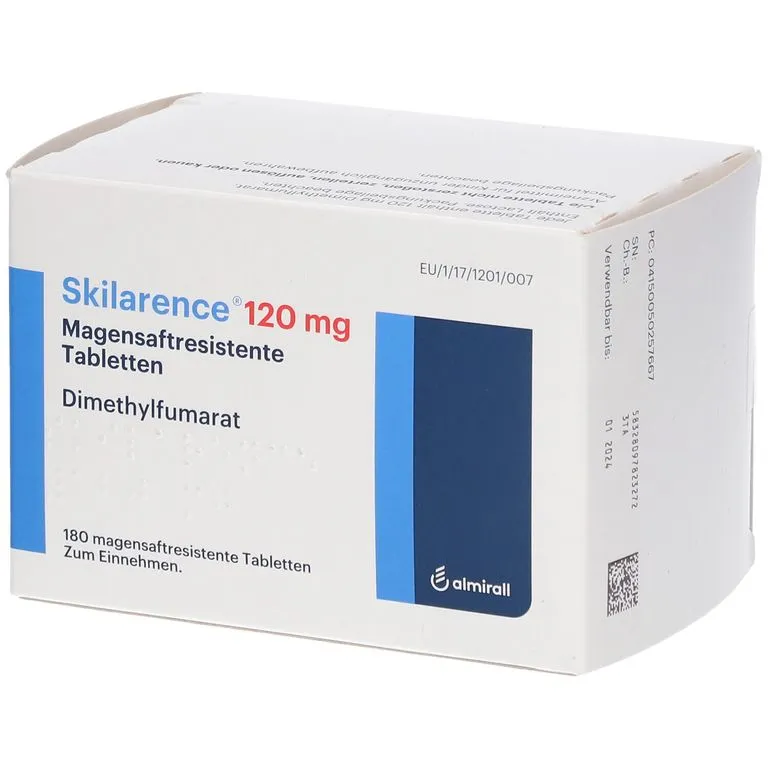
Table of Contents
Package leaflet: Information for the user
Introduction
Package leaflet: information for the patient
Skilarence 120mg gastro-resistant tablets
dimethyl fumarate
Read all of this leaflet carefully before you start taking this medicine because it contains important information for you.
- Keep this leaflet, as you may need to read it again.
- If you have any questions, ask your doctor or pharmacist.
- This medicine has been prescribed for you only, and you should not give it to other people even if they have the same symptoms as you, because it may harm them.
- If you experience any adverse effects, consult your doctor or pharmacist, even if they are adverse effects not listed in this leaflet. See section 4.
Contents of the leaflet
- What Skilarence is and what it is used for
- What you need to know before taking Skilarence
- How to take Skilarence
- Possible side effects
- How to store Skilarence
- Contents of the pack and other information
1. What Skilarence is and what it is used for
What Skilarence is
Skilarence is a medicine that contains the active substance dimethyl fumarate. Dimethyl fumarate acts on cells of the immune system (the body's natural defences), modifying their activity by reducing the production of certain substances involved in the development of psoriasis.
What Skilarence is used for
Skilarence tablets are used to treat moderate to severe plaque psoriasis in adults. Psoriasis is a condition that causes certain areas of the skin to thicken, become inflamed or reddened, often covered with whitish scales.
In general, response to Skilarence can be seen as early as week 3 and improves over time. Experience with related medicines containing dimethyl fumarate has shown that the beneficial effects of treatment last for at least 24 months.
2. What you need to know before taking Skilarence
Do not take Skilarence
- if you are allergic to dimethyl fumarate or to any of the other ingredients of this medicine (listed in section 6)
- if you have severe stomach or intestinal problems
- if you have severe liver or kidney problems
- if you are pregnant or breastfeeding
Warnings and precautions
Talk to your doctor or pharmacist before starting to take Skilarence.
Monitoring
Skilarence may cause blood, liver, or kidney problems. You will have blood and urine tests before starting treatment and then periodically during treatment. These tests are performed to ensure that you are not experiencing these complications and to confirm that you can continue taking this medicine. Depending on the results of these blood and urine tests, your doctor may decide to increase the dose of Skilarence according to the recommended schedule (see section 3), maintain the current dose, reduce the dose, or stop treatment completely.
Infections
White blood cells help your body fight infections. Skilarence may reduce the number of white blood cells. Speak with your doctor if you think you have an infection. Symptoms include fever, pain, muscle aches, headache, loss of appetite, and general weakness. If you develop a serious infection before or during treatment with Skilarence, your doctor may advise you to stop taking Skilarence until the infection has resolved.
Gastrointestinal disorders
Inform your doctor if you have or have had stomach or intestinal problems. Your doctor will advise you on the precautions to take during treatment with Skilarence.
Children and adolescents
Children and adolescents under 18 years of age should not take this medicine, as it has not been studied in this age group.
Other medicines and Skilarence
Tell your doctor or pharmacist if you are taking, have recently taken, or might need to take any other medicines.
In particular, inform your doctor if you are taking the following:
- Dimethyl fumarate or other fumarates: the active substance in Skilarence, dimethyl fumarate, is also used in other medicines, such as tablets, ointments, and bath solutions. You should avoid using other products containing fumarates to prevent excessive intake.
- Other medicines for treating psoriasis, such as methotrexate, retinoids, psoralens, cyclosporine, or other medicines that affect the immune system (such as immunosuppressants or cytostatics). Taking these medicines together with Skilarence may increase the risk of adverse effects on your immune system.
- Other medicines that may affect kidney function, such as methotrexate or cyclosporine (for treating psoriasis), aminoglycosides (for treating infections), diuretics (to increase urination), non-steroidal anti-inflammatory drugs (for pain relief), or lithium (used for bipolar disorder and depression). Taking these medicines together with Skilarence may increase the risk of adverse effects on your kidneys.
If you experience severe or prolonged diarrhoea due to Skilarence, other medicines may not work as effectively. If you have severe diarrhoea, consult your doctor. This is especially important if you are taking an oral contraceptive (the pill), as its effectiveness may be reduced, and you may need to use additional contraceptive methods to prevent pregnancy. Refer to the instructions in the leaflet of the contraceptive you are using.
If you need to be vaccinated, consult your doctor. Certain types of vaccines (live attenuated vaccines) may cause an infection if used during treatment with Skilarence. Your doctor will advise you on the best course of action.
Taking Skilarence with alcohol
Do not consume strong alcoholic drinks (more than 50 ml of spirits containing over 30% alcohol by volume) during treatment with Skilarence, as alcohol may interact with this medicine. This interaction between alcohol and the medicine could cause stomach and intestinal problems.
Pregnancy and breastfeeding
Do not take Skilarence if you are pregnant or planning to become pregnant, as Skilarence may harm the unborn baby. Use effective contraception to avoid pregnancy during treatment with Skilarence (see also “Other medicines and Skilarence” above).
Consult your doctor if you experience stomach or intestinal problems that could reduce the effectiveness of oral contraceptives. Your doctor will advise you on alternative contraceptive methods.
You must not breastfeed during treatment with Skilarence.
Driving and using machines
The effect of Skilarence on the ability to drive and use machines is minor. You may feel dizzy or tired after taking Skilarence. If affected, take care when driving or operating machinery.
Skilarence contains lactose
If your doctor has informed you that you have an intolerance to certain sugars, consult him or her before taking this medicine.
Skilarence contains sodium
This medicine contains less than 23 mg of sodium (1 mmol) per tablet; hence, it is essentially “sodium-free”.
3. How to take Skilarence
Follow exactly the instructions for administering this medicine as given by your doctor or pharmacist. If in doubt, consult your doctor or pharmacist again.
Dosage
Your doctor will start treatment with a low dose of Skilarence using 30 mg tablets. This helps your body adapt to the medicine and reduces the risk of side effects, such as gastrointestinal problems. The dose will be increased by 30 mg each week as indicated in the following table. When reaching the dose of Skilarence 120 mg per day, usually from week 4 onwards, you may switch to 120 mg tablets for convenience. When switching from 30 mg to 120 mg tablets, make sure that the tablet and dose you are taking are correct.
Treatment week | Tablet strength | Number of tablets to take during the day | Number of tablets per day | Total daily dose | ||
Breakfast | Lunch | Dinner | ||||
1 | 30 mg | ‑ | ‑ | 1 | 1 | 30 mg |
2 | 30 mg | 1 | ‑ | 1 | 2 | 60 mg |
3 | 30 mg | 1 | 1 | 1 | 3 | 90 mg |
4 | 120 mg | ‑ | ‑ | 1 | 1 | 120 mg |
5 | 120 mg | 1 | ‑ | 1 | 2 | 240 mg |
6 | 120 mg | 1 | 1 | 1 | 3 | 360 mg |
7 | 120 mg | 1 | 1 | 2 | 4 | 480 mg |
8 | 120 mg | 2 | 1 | 2 | 5 | 600 mg |
9+ | 120 mg | 2 | 2 | 2 | 6 | 720 mg |
Your doctor will monitor how your condition improves after starting Skilarence and also check whether you experience any adverse effects. If you develop severe adverse effects after a dose increase, your doctor may recommend temporarily returning to the previous dose. If the adverse effects are not very bothersome, the dose will be gradually increased until your disease is well controlled. You may not need the maximum dose of 720 mg per day as indicated in the table above. Once your condition has improved sufficiently, your doctor will consider gradually reducing your daily dose of Skilarence to the lowest dose required to maintain improvement.
Instructions for administration
Skilarence tablets should be swallowed whole with liquid. Take the tablet(s) during a meal or immediately after eating. Do not crush, split, dissolve, or chew the tablets, as they have a special coating that helps prevent stomach irritation.
If you take more Skilarence than you should
If you think you have taken too many Skilarence tablets, contact your doctor or pharmacist.
If you forget to take Skilarence
Do not take a double dose to make up for missed doses. Take the next dose at your usual time and continue taking the medicine exactly as described in this leaflet or as agreed with your doctor. If in doubt, consult your doctor or pharmacist.
If you have any further questions about the use of this medicine, ask your doctor or pharmacist.
4. Possible adverse effects
Like all medicines, this medicine may cause adverse effects, although not everyone will experience them. Some of these adverse effects, such as flushing of the face or body, diarrhoea, stomach problems and nausea, usually improve as treatment continues.
The more serious adverse effects that may occur with Skilarence are allergic or hypersensitivity reactions, renal failure or a kidney disease called Fanconi syndrome, or a serious brain infection called progressive multifocal leukoencephalopathy (PML). The frequency with which these occur is unknown. For more information about symptoms, see the details provided below.
Allergic or hypersensitivity reactions
Allergic or hypersensitivity reactions are rare, but may be very serious. Flushing of the face or body (rubefaction) is a very common adverse effect that may affect more than 1 in 10 people. However, if you experience flushing together with any of the following symptoms:
- wheezing, difficulty breathing or shortness of breath;
- swelling of the face, lips, mouth or tongue,
stop taking Skilarence and contact your doctor immediately.
Brain infection called PML
Progressive multifocal leukoencephalopathy (PML) is a rare but serious brain infection, which may lead to severe disability or death. If you notice the onset or worsening of weakness on one side of the body; clumsiness; visual, thinking or memory disturbances; confusion; or personality changes lasting several days, stop taking Skilarence and contact your doctor immediately.
Fanconi syndrome
Fanconi syndrome is a rare but serious kidney disorder that may occur when taking Skilarence. If you are urinating more (or more frequently), feel more thirsty and are drinking more than usual, your muscles seem weaker, you suffer a bone fracture or simply have aches and pains, speak to your doctor as soon as possible so that further tests can be carried out.
Consult your doctor if you experience any of the following adverse effects.
Very common (may affect more than 1 in 10 people):
- Decrease in a type of white blood cells called lymphocytes (lymphopenia)
- Decrease in all white blood cells (leucopenia)
- Flushing of the face or body
- Diarrhoea
- Stomach swelling, pain or cramps
- Feeling sick (nausea)
Common (may affect up to 1 in 10 people):
- Increase in all white blood cells (leucocytosis)
- Increase in specific white blood cells (eosinophils)
- Increase in certain enzymes in the blood (used to check liver health)
- Vomiting
- Constipation
- Gas (flatulence), stomach discomfort, indigestion
- Loss of appetite
- Headache
- Feeling tired
- Weakness
- Feeling of warmth
- Abnormal skin sensations such as itching, burning, stinging, tingling or prickling
- Pink or red spots on the skin (erythema)
Uncommon (may affect up to 1 in 100 people):
- Dizziness
- Excess protein in the urine (proteinuria)
- Increase in serum creatinine (a substance in the blood used to measure kidney function)
Rare (may affect up to 1 in 1,000 people):
- Allergic skin reaction
Very rare (may affect up to 1 in 10,000 people):
- Acute lymphocytic leukaemia (a type of blood cancer)
- Decrease in all types of blood cells (pancytopenia)
Not known (cannot be estimated from available data):
- Herpes zoster (shingles)
Reporting of adverse effects
If you experience any adverse effect, talk to your doctor or pharmacist, even if it is a possible adverse effect not listed in this leaflet.
You can also report them directly through the national reporting system included in Appendix V. By reporting adverse effects, you can help provide more information on the safety of this medicine.
5. Storage of Skilarence
Keep this medicine out of the sight and reach of children.
Do not use this medicine after the expiry date stated on the carton and blister after "EXP". The expiry date is the last day of the month indicated.
No special storage conditions are required.
Medicines should not be disposed of via wastewater or household waste. Ask your pharmacist how to dispose of medicines and packaging you no longer need. This will help protect the environment.
6. Contents of the pack and other information
Composition of Skilarence 120 mg
- The active substance is dimethyl fumarate. One tablet contains 120 mg of dimethyl fumarate.
- The other components are: monohydrate lactose, microcrystalline cellulose, sodium croscarmellose, anhydrous colloidal silica, magnesium stearate, methacrylic acid and ethyl acrylate copolymer (1:1), talc, triethyl citrate, titanium dioxide (E171), simethicone, indigo carmine (E132), and sodium hydroxide.
Appearance of the product and contents of the pack
Skilarence 120 mg is a blue, round tablet with an approximate diameter of 11.6 mm.
Pack sizes: 40, 70, 90, 100, 120, 180, 200, 240, 300, 360 and 400 gastro-resistant tablets. Not all pack sizes may be marketed. The tablets are packed in aluminum and PVC/PVDC blisters.
Marketing Authorization Holder
Almirall, S.A.
Ronda General Mitre, 151
08022 Barcelona
Spain
Telephone +34 93 291 30 00
Manufacturer
Industrias Farmacéuticas Almirall, S.A.
Ctra. de Martorell 41-61
08740 Sant Andreu de la Barca, Barcelona
Spain
Further information on this medicinal product is available from the local representative of the Marketing Authorization Holder:
Belgium/Belgium/Belgium/ Luxembourg/Luxembourg Almirall N.V. Tel/Tel: +32 (0)2 771 86 37 |
EGIS Pharmaceuticals PLC, Tel: +359 2 987 60 40 |
Czech Republic EGIS Praha, spol. s.r.o., Tel: +420 227 129 111 |
Denmark/ Norway/ Sweden Almirall ApS Tlf./Tel: +45 70 25 75 75 |
Germany Almirall Hermal GmbH, Tel: +49 (0)40 72704-0 |
Estonia /Spain/ Croatia/ Cyprus/ Latvia/ Lithuania/ Malta/ Romania/ Slovenia Almirall, S.A., Tel/Tel/Tel: +34 93 291 30 00 |
Greece Galenica A.E, Tel: +30 210 52 81 700 |
France Almirall SAS Tel: +33(0)1 46 46 19 20 |
Ireland Almirall, S.A. Tel: +353 1800 849322 |
Iceland Vistor hf. Tel: +354 535 70 00 |
Italy Almirall SpA Tel: +39 02 346181 |
Hungary Egis Gyógyszergyár Zrt., Tel.: +36 1 803 5555 |
Netherlands Almirall B.V. Tel: +31 (0) 30 711 15 10 |
Austria Almirall GmbH Tel: +43 (0)1/595 39 60 |
Poland EGIS Polska Sp. z o.o., Tel.: +48 417 92 00 |
Portugal Almirall- Productos Farmacêuticos, Lda. Tel: +351 21 415 57 50 |
Romania Egis Pharmaceuticals PLC, Tel: +40 21412 0017 |
Slovak Republic EGIS SLOVAKIA spol s.r.o. Tel: +421 2 32409422 |
Finland/Finland Orion Pharma Tel/Tel: +358 10 4261 |
Date of the latest review of this leaflet
Other sources of information
Detailed information on this medicine is available on the website of the European Medicines Agency: https://www.ema.europa.eu.