Sivextro 200 mg powder for concentrate for solution for infusion
Spain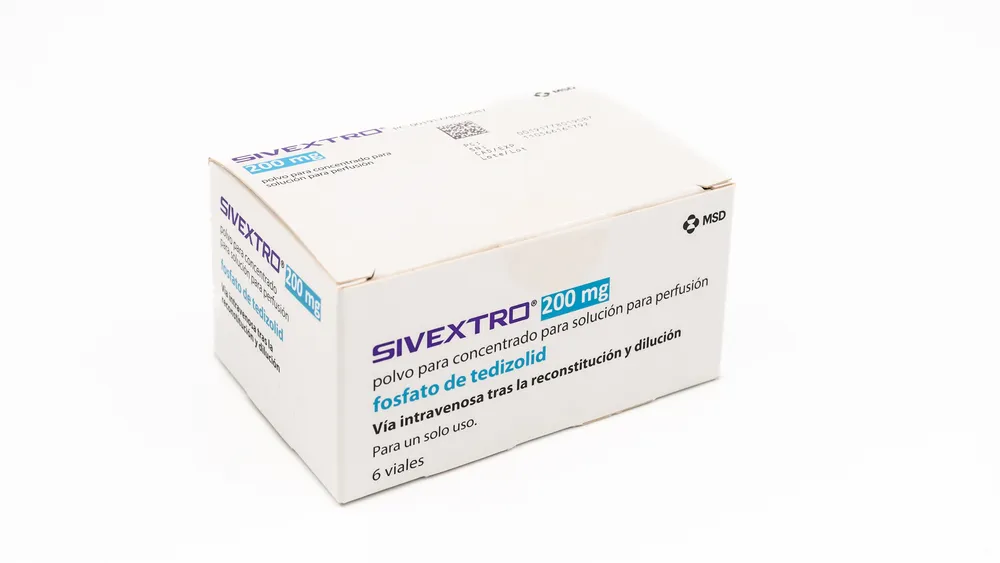
Table of Contents
- Package leaflet: Information for the user
- Introduction
- 1. What Sivextro is and what it is used for
- 2. What you need to know before Sivextro is administered to you
- 3. How Sivextro will be administered to you
- 4. Possible adverse effects
- 5. Storage of Sivextro
- 6. Contents of the pack and other information
Package leaflet: Information for the user
Introduction
Package leaflet: information for the patient
Sivextro 200 mg powder for concentrate for solution for infusion
tedizolid phosphate
Read the entire leaflet carefully before you start receiving this medicine, because it contains important information for you.
- Keep this leaflet, as you may need to read it again.
- If you have any questions, consult your doctor or nurse.
- If you experience any side effects, talk to your doctor or nurse, even if they are side effects not listed in this leaflet. See section 4.
Leaflet contents
- What Sivextro is and what it is used for
- What you need to know before being administered Sivextro
- How Sivextro will be administered to you
- Possible side effects
- How to store Sivextro
- Contents of the pack and other information
1. What Sivextro is and what it is used for
Sivextro is an antibiotic that contains the active substance tedizolid phosphate. It belongs to a group of medicines called "oxazolidinones".
Sivextro is used in all age groups for the treatment of skin and soft tissue infections.
Sivextro works by stopping the growth of certain bacteria that can cause serious infections.
2. What you need to know before Sivextro is administered to you
Do not use Sivextro:
- if you are allergic to tedizolid phosphate or to any of the other ingredients of this medicine (listed in section 6).
Warnings and precautions
Your doctor will decide whether Sivextro is suitable to treat your infection.
Talk to your doctor or nurse before you are given Sivextro if any of the following apply to you:
- if you have diarrhea or have previously had diarrhea when treated with antibiotics (or up to 2 months after taking them).
- if you are allergic to other medicines belonging to the group of "oxazolidinones" (for example, linezolid, cycloserine).
- if you have a history of bleeding or bruising easily (which may be a sign of low platelet count, the small cells involved in blood clotting).
- if you have kidney problems.
- if you are taking certain medicines for depression, called tricyclics, SSRIs (selective serotonin reuptake inhibitors), opioids, or MAOIs (monoamine oxidase inhibitors). Using these medicines together with tedizolid phosphate may lead to serotonin syndrome, a potentially life-threatening condition (with symptoms such as confusion, difficulty concentrating, high temperature, increased reflexes, difficulty coordinating muscle movements). See Other medicines and Sivextro for examples.
- if you are taking certain medicines for migraine called "triptans". See Other medicines and Sivextro for examples.
Talk to your doctor or pharmacist if you are unsure whether you are taking any of these medicines.
Diarrhea
Contact your doctor immediately if you develop diarrhea during or after your treatment. Do not take any medicine for diarrhea without first consulting your doctor.
Antibiotic resistance
Bacteria may become resistant to antibiotic treatment over time. This is when antibiotics can no longer stop bacteria from multiplying or treat your infection. Your doctor will decide whether you should be given Sivextro to treat your infection.
Possible side effects
Some adverse effects have been observed with Sivextro or another member of the oxazolidinone class when administered for longer than the recommended duration for Sivextro. Inform your doctor immediately if you experience any of the following while taking Sivextro:
- low white blood cell count
- anemia (low red blood cell count)
- bleeding or easy bruising
- loss of sensation in hands or feet (e.g., numbness, tingling/prickling, or sharp pain)
- any vision problems, such as blurred vision, changes in color perception, difficulty seeing details, or narrowing of the visual field.
Children
For adolescents and children weighing at least 35 kg, this medicine is available as 200 mg tablets.
Other medicines and Sivextro
Tell your doctor or nurse if you are taking, have recently taken, or might need to take any other medicines. It is especially important that you inform your doctor if you are also taking:
- amitriptyline, citalopram, clomipramine, dosulepin, doxepin, fluoxetine, fluvoxamine, imipramine, isocarboxazid, lofepramine, moclobemide, paroxetine, phenelzine, selegiline, sertraline, duloxetine, and venlafaxine (used to treat depression). There is a risk that tedizolid phosphate may interact with certain medicines, including those listed, and cause adverse effects such as changes in blood pressure or body temperature.
- sumatriptan, zolmitriptan (used to treat migraine)
- opioids (such as fentanyl)
Pregnancy and breastfeeding
If you are pregnant or breastfeeding, think you may be pregnant, or are planning to become pregnant, consult your doctor or nurse before using this medicine.
It is unknown whether Sivextro passes into breast milk. Consult your doctor before breastfeeding your baby.
Driving and using machines
Do not drive or operate machinery if you feel dizzy or tired after using this medicine.
Sivextro contains sodium
This medicine contains less than 1 mmol of sodium (23 mg) per vial; hence, it is essentially "sodium-free".
3. How Sivextro will be administered to you
Sivextro will be administered by a doctor or nurse.
It will be given as an intravenous infusion (a drip) directly into a vein over approximately 1 hour.
Adults, adolescents, and children weighing at least 35 kg
You will receive a 200 mg infusion of Sivextro once daily for 6 days.
Adolescents and children weighing less than 35 kg
Sivextro will be administered twice daily for 6 days. The dose will be based on body weight.
Consult a doctor if you do not improve, or if you worsen after 6 days.
If you are given more Sivextro than you should
Immediately inform your doctor or nurse if you think you may have been given too much Sivextro.
If you miss a dose of Sivextro
Immediately inform your doctor or nurse if you think you may have missed a dose.
If you have any further questions about the use of this medicine, ask your doctor or nurse.
4. Possible adverse effects
Like all medicines, this medicine can cause adverse effects, although not everyone experiences them.
Contact your doctor immediately if you experience diarrhoea during or after your treatment.
Other adverse effects may include:
Frequent adverse effects (may affect up to 1 in 10 people):
- Nausea
- Vomiting
- Headache
- Itching all over the body
- Fatigue
- Dizziness
- Pain or swelling at the infusion site
Uncommon adverse effects (may affect up to 1 in 100 people):
- Fungal infections (fungi) of the skin, mouth, and vagina (thrush / vaginal candidiasis)
- Itching (including itching due to allergic reaction), hair loss, acne, rash with redness and/or itching or hives, excessive sweating
- Decreased or loss of skin sensitivity, tingling or prickling sensation of the skin
- Hot flushes or redness/flushing of the face, neck, or upper chest
- Abscess (swollen lump containing pus)
- Vaginal infection, inflammation, or itching
- Anxiety, irritability, agitation, or tremors
- Respiratory tract infection (sinuses, throat, and chest)
- Dry nose, chest congestion, cough
- Drowsiness, abnormal sleep pattern, difficulty sleeping, nightmares (unpleasant/disturbing dreams)
- Dry mouth, constipation, indigestion, stomach/abdominal pain or discomfort, retching, dry heaves, bright red blood in stools
- Acid reflux disorder (heartburn, pain or difficulty swallowing), flatulence/gas
- Joint pain, muscle cramps, back pain, neck pain, pain/discomfort in limbs, decreased hand grip strength
- Blurred vision, "floaters" (small floating shapes in the visual field)
- Swelling or enlargement of lymph nodes
- Allergic reaction
- Dehydration
- Poor control of diabetes
- Changes in taste sensation
- Slow heart rate
- Fever
- Swelling of ankles and/or feet
- Abnormal odour of urine, abnormalities in blood tests
- Infusion reactions (chills, shivering or chills with fever, muscle pain, facial swelling, weakness, fainting, shortness of breath, chest tightness, and angina)
Frequency not known (cannot be estimated from the available data):
- Bleeding or bruising easily (due to low platelet count, the small cells involved in blood clotting)
Reporting of adverse effects
If you experience any adverse effect, talk to your doctor or nurse, even if it is a possible adverse effect not listed in this leaflet. You can also report them directly through the national reporting system listed in Appendix V. By reporting adverse effects, you can help provide more information on the safety of this medicine.
5. Storage of Sivextro
Keep this medicine out of the sight and reach of children.
Do not use this medicine after the expiry date stated on the vial label after “EXP”. The expiry date refers to the last day of the month indicated.
This medicine does not require any special storage conditions.
Do not use this medicine if you notice the presence of particles or if the solution is cloudy.
Once reconstituted, this medicine should be used immediately. Otherwise, the reconstituted and diluted solution should be stored at room temperature or refrigerated between 2 °C and 8 °C, and administered within 24 hours after reconstitution.
Any unused medicine and materials that have come into contact with it, including materials used for reconstitution, dilution, and administration, must be disposed of in accordance with local regulations.
6. Contents of the pack and other information
Composition of Sivextro
- The active substance is tedizolid phosphate. Each vial of powder contains tedizolid phosphate disodium, equivalent to 200 mg of tedizolid phosphate.
- The other components are mannitol, sodium hydroxide (to adjust pH), and hydrochloric acid (to adjust pH).
Nature of the product and pack contents
Sivextro is a white to off-white powder for concentrate for solution for infusion, packed in a glass vial. The powder will be reconstituted in the vial with 4 ml of water for injections. The reconstituted solution will then be withdrawn from the vial and added to a bag of 0.9% sodium chloride solution for infusion in the hospital setting.
Sivextro is available in packs of 1 or 6 vials.
Only certain pack sizes may be marketed.
Marketing Authorization Holder and Manufacturer
Marketing Authorization Holder
Merck Sharp & Dohme B.V.
Waarderweg 39
2031 BN Haarlem
The Netherlands
Manufacturer
Patheon Italia S.p.A.
2° Trav. SX Via Morolense, 5
03013 Ferentino
Italy
More information on this medicine can be requested by contacting the local representative of the Marketing Authorization Holder:
Belgium/Belgium/Belgium MSD Belgium Tel/Tel: +32(0)27766211 | Lithuania UAB Merck Sharp & Dohme Tel. +370 5 2780 247 |
| Luxembourg/Luxembourg MSD Belgium Tél/Tel: +32(0)27766211 |
Czech Republic Merck Sharp & Dohme s.r.o. Tel.: +420 233 010 111 | Hungary MSD Pharma Hungary Kft. Tel.: +36 1 888 5300 |
Denmark MSD Danmark ApS Tlf.: +45 4482 4000 | Malta Merck Sharp & Dohme Cyprus Limited Tel: 8007 4433 (+356 99917558) |
Germany MSD Sharp & Dohme GmbH Tel.: +49 (0) 89 20 300 4500 medinfo @msd.de | Netherlands Merck Sharp & Dohme B.V. Tel: 0800 9999000 (+31 23 5153153) |
Estonia Merck Sharp & Dohme OÜ Tel: +372 614 4200 | Norway MSD (Norge) AS Tlf: +47 32 20 73 00 |
Greece MSD Α.Φ.Ε.Ε. Tel: +30 210 98 97 300 | Austria Merck Sharp & Dohme Ges.m.b.H. Tel: +43 (0) 1 26 044 |
Spain Merck Sharp & Dohme de España, S.A. Tel: +34 91 321 06 00 | Poland MSD Polska Sp. z o.o. Tel.: +48 22 549 51 00 |
France MSD France Tél: + 33 (0) 1 80 46 40 40 | Portugal Merck Sharp & Dohme, Lda Tel: +351 21 4465700 |
Croatia Merck Sharp & Dohme d.o.o. Tel: + 385 1 6611 333 | Romania Merck Sharp & Dohme Romania S.R.L. Tel: +40 21 529 29 00 |
Ireland Merck Sharp & Dohme Ireland (Human Health) Limited Tel: +353 (0)1 2998700 | Slovenia Merck Sharp & Dohme, inovativna zdravila d.o.o. Tel: +386 1 5204 201 |
Iceland Vistor ehf. Tel: + 354 535 7000 | Slovakia Merck Sharp & Dohme, s. r. o. Tel.: +421 2 58282010 |
Italy MSD Italia S.r.l. Tel: 800 23 99 89 (+39 06 361911) | Finland/Finland MSD Finland Oy Puh/Tel: +358 (0)9 804 650 |
Cyprus Merck Sharp & Dohme Cyprus Limited Tel.: 800 00 673 (+357 22866700) | Sweden Merck Sharp & Dohme (Sweden) AB Tel: +46 77 5700488 |
Latvia SIA Merck Sharp & Dohme Latvija Tel.: +371 67025300 | United Kingdom (Northern Ireland) Merck Sharp & Dohme Ireland (Human Health) Limited Tel: +353 (0)1 2998700 |
Date of the most recent review of this summary of product characteristics: {MM/YYYY}.
Detailed information on this medicine is available on the website of the European Medicines Agency: https://www.ema.europa.eu.
This information is intended for healthcare professionals only:
Important: Consult the package leaflet/summary of product characteristics before prescribing the medicinal product.
Patients initiating treatment with the parenteral formulation may be switched to the oral formulation when clinically appropriate.
Sivextro must be reconstituted with water for injections and subsequently diluted in 250 ml of 0.9% sodium chloride solution for infusion.
Only limited data are available on the compatibility of Sivextro with other intravenous substances; therefore, additives or other medicinal products must not be added to single-use Sivextro vials, nor should they be co-administered by simultaneous infusion. If the same intravenous line is used for sequential infusion of different medicinal products, the line must be flushed before and after infusion with 0.9% sodium chloride solution. Do not use Ringer's lactate injection or Hartmann's solution.
Reconstitution
An aseptic technique must be used to prepare the infusion solution. Reconstitute the contents of the vial with 4 ml of water for injections, and gently swirl until the powder is completely dissolved. Avoid shaking or rapid movements, as this may cause foaming.
Dilution
For administration, the reconstituted solution must be diluted in 0.9% sodium chloride solution. Do not shake the bag. The resulting solution is a clear, colourless or pale yellow solution.
Infusion
The reconstituted solution should be inspected visually for the presence of particles prior to administration. Reconstituted solutions containing visible particles should be discarded.
Sivextro is administered intravenously over approximately 1 hour.
The reconstituted solution must be administered exclusively as an intravenous infusion. It must not be administered as an intravenous bolus. Sivextro must not be mixed with other medicinal products.
Each vial is for single use only.
Dose preparation
Preparation of the 200 mg Sivextro dose for once-daily infusion (adults, adolescents and children weighing ≥35 kg):
-
Withdraw 4 ml of the reconstituted solution from the vial using a syringe and add it to an infusion bag containing 250 ml of 0.9% sodium chloride for injection.
-
Infuse the entire bag over 1 hour.
Preparation of weight-based doses for twice-daily infusion (for adolescents and children weighing <35 kg):
- Preparation of the stock solution (100 ml of 0.8 mg/ml tedizolid phosphate):
Withdraw 1.6 ml of the reconstituted solution from the vial using a syringe and add it to an infusion bag containing 98.4 ml of 0.9% sodium chloride for injection.
-
Preparation of the required volume of stock solution for infusion:
-
Determine the appropriate dose of Sivextro in mg by consulting the dosing table below.
-
Transfer the appropriate volume of the stock solution to a suitably sized infusion bag or infusion syringe. For smaller volumes, it may be necessary to adjust to the nearest graduation mark on an appropriately sized syringe.
Table 1. Preparation of Sivextro for infusion from the 100 ml stock solution of 0.8 mg/ml tedizolid phosphate in paediatric patients weighing <35 kg body weight
Body weight (kg) | Amount (mg) of Sivextro per dose (given twice daily) | Volume (ml) of the stock solution to administer to the patient |
1 to less than 3 | 6 | 7.5 |
3 to less than 6 | 12 | 15 |
6 to less than 10 | 20 | 25 |
10 to less than 14 | 30 | 37.5 |
14 to less than 20 | 40 | 50 |
20 to less than 35 | 60 | 75 |
-
Infuse over 1 hour using an infusion pump or syringe pump.
-
Repeat this procedure for the second dose of the day.
Note: Both doses must be used within the required stability period (see section 6.3 of the Summary of Product Characteristics).