Sinequan 25 mg hard capsules
Spain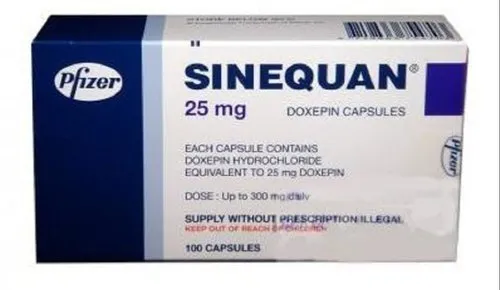
Table of Contents
Package leaflet: Information for the user
Introduction
Package leaflet: information for the patient
Sinequan 25 mg hard capsules
Doxepin
Read the entire leaflet carefully before you start using this medicine, as it contains important information for you.
- Keep this leaflet, as you may need to read it again.
- If you have any questions, ask your doctor or pharmacist.
- This medicine has been prescribed for you only and must not be given to other people, even if they have the same symptoms as you, because it could harm them.
- If you experience any adverse effects, consult your doctor or pharmacist, even if they are adverse effects not listed in this leaflet. See section 4.
Contents of the leaflet
- What Sinequan is and what it is used for
- What you need to know before taking Sinequan
- How to take Sinequan
- Possible adverse effects
- How to store Sinequan
- Contents of the pack and other information
1. What Sinequan is and what it is used for
Sinequan belongs to a group of medicines called tricyclic antidepressants. It contains the active substance doxepin.
This medicine is used to treat depression in adults. Depression is a persistent disturbance of mood, with symptoms that usually include feelings of deep sadness, feelings of worthlessness, loss of interest or pleasure, sleep disturbances, feelings of slowness and inability to concentrate, and/or feelings of anxiety. Symptoms of depression may vary from person to person.
2. What you need to know before taking Sinequan
Do not take Sinequan if:
- you are allergic to doxepine or to any of the other ingredients of this medicine (listed in section 6).
- you have high eye pressure (glaucoma).
- you have urinary retention.
- you are taking, or have taken within the last 14 days, another medicine known as a monoamine oxidase inhibitor (MAOI) (see "Taking doxepine with other medicines").
Warnings and precautions
Talk to your doctor or pharmacist before taking Sinequan if:
-
you are pregnant, trying to become pregnant, or breastfeeding (see "Pregnancy, breastfeeding and fertility").
-
you have heart problems or have recently had a heart attack.
-
you have kidney or liver problems.
- you have epilepsy or a history of epilepsy.
-
you have had suicidal thoughts or worsening of your depression or anxiety disorder.
If you are depressed and/or suffer from an anxiety disorder, you may sometimes have thoughts of self-harm or suicide. These may increase when first starting antidepressants, as all such medicines require time to begin working—usually about two weeks, although in some cases it may take longer.
You may be more likely to have these types of thoughts:
- if you have previously had thoughts of self-harm or suicide.
- if you are a young adult. Clinical trial data have shown an increased risk of suicidal behavior in young adults (under 25 years) with psychiatric disorders treated with an antidepressant.
If at any time you experience thoughts of self-harm or suicide, contact your doctor immediately or go directly to a hospital.
It may be helpful for you to tell a family member or close friend that you are depressed or have an anxiety disorder and ask them to read this leaflet. You may wish to ask them whether they notice your depression or anxiety worsening, or if they are concerned about changes in your behavior.
- In elderly people, caution is advised regarding certain side effects such as blurred vision, dizziness, loss of balance, or low blood pressure upon standing.
Consult your doctor, even if any of the above circumstances occurred in the past.
Taking doxepine with other medicines
Inform your doctor or pharmacist if you are taking, have recently taken, or might need to take any other medicines.
Sinequan may interact with the following medicines:
- MAO inhibitors.
- Other antidepressants, barbiturates, or other sleeping medicines, or other medicines for anxiety, which may increase their effects.
- Medicines for lowering blood pressure.
- Sympathomimetics: medicines for nasal congestion (used in colds and allergic rhinitis) and bronchodilators (for the treatment of asthma).
- Cimetidine (used to treat ulcers and stomach discomfort).
- Tolazamide (an antidiabetic medicine that lowers blood glucose).
Taking Sinequan with food, drinks, and alcohol
If you drink alcohol while being treated with doxepine, alcohol may affect you more than usual.
Avoid taking this medicine with food.
Pregnancy, breastfeeding and fertility
If you are pregnant or breastfeeding, think you may be pregnant, or are planning to become pregnant, consult your doctor or pharmacist before using this medicine.
Doxepine should only be used after your doctor has evaluated the potential benefits and any potential risks to the fetus.
Driving and using machines
During treatment with doxepine, you may feel drowsy or dizzy. Do not drive or operate tools or machinery until you know how this treatment affects you.
3. How to take Sinequan
Follow exactly the instructions for taking this medicine as given by your doctor or pharmacist. If in doubt, consult your doctor or pharmacist again.
Remember to take your medicine.
The recommended initial dose of doxepin in adults is 75 mg per day (3 capsules), but your doctor will determine the dose that is best for you. In patients with milder symptoms, 1 or 2 capsules per day may be sufficient, while higher doses may be required for more severe conditions. The maximum recommended dose is 300 mg per day (12 capsules per day).
For elderly patients or those with liver or kidney problems, your doctor may recommend a lower dose.
This medicine is to be taken orally. Swallow the capsule whole with water and apart from meals.
The daily dose may be taken as a single dose (preferably at bedtime) or divided into several doses throughout the day. If a single daily dose is taken, do not exceed 6 capsules in one dose (150 mg/dose).
Discuss with your doctor how long you should continue taking the medicine. The effect may take up to 2 or 3 weeks to appear after starting treatment. Do not stop taking doxepin or change your dose without consulting your doctor. It is important to treat your condition properly to help you improve. If left untreated, your condition may not resolve and could become more severe and more difficult to treat.
If you feel that the effect of Sinequan is too strong or too weak, inform your doctor or pharmacist.
If you take more Sinequan than you should
In case of severe overdose, you may experience: reduced breathing, seizures, low blood pressure, changes in heart rhythm, and palpitations.
In case of overdose or accidental ingestion, contact your doctor or pharmacist immediately or call the Toxicology Information Service at telephone number 91 562 04 20, indicating the medicine and the amount ingested.
Symptoms of overdose may include drowsiness, stupor, blurred vision, and excessive dryness of the mouth.
If you forget to take Sinequan
If you forget to take a dose, take it as soon as you remember. However, if it is nearly time for your next dose, skip the missed dose and take your next dose at the usual time. Do not take a double dose to make up for a missed dose. Do not take more doxepin than prescribed for you in one day.
If you stop taking Sinequan
Do not stop taking your capsules without consulting your doctor, even if you feel better.
It may be necessary to gradually reduce the dose until treatment is completely stopped. This will help prevent the return of your original condition and avoid side effects such as insomnia, irritability, or excessive sweating.
If you have any further questions about the use of this medicine, ask your doctor or pharmacist.
4. Possible adverse effects
Like all medicines, this medicine may produce adverse effects, although not everyone will experience them. These effects are usually mild to moderate and often disappear within a few weeks. While taking this medicine, you may experience some of the following adverse effects:
Very common adverse effects (may affect more than 1 in 10 patients): somnolence, blurred vision, nausea, dry mouth, and constipation.
Common adverse effects (may affect up to 1 in 10 patients): agitation, insomnia, dizziness, tremor, lack of coordination, extrapyramidal symptoms (difficulty walking), tachycardia, hypotension, vomiting, diarrhea, sweating, fatigue, weight gain.
Uncommon adverse effects (may affect up to 1 in 100 patients): loss of appetite, anorexia, confusion, hallucinations, abnormal sensation of the senses, numbness, headache, dizziness, subjective sensation of ringing in the ears (tinnitus), skin rashes, facial swelling, mouth ulcers, urinary retention, weakness.
Rare adverse effects (may affect up to 1 in 1,000 patients): abnormalities in blood cells (eosinophilia, agranulocytosis, leucopenia, thrombocytopenia), purple-colored skin spots, disturbances in antidiuretic hormone secretion, changes (increase or decrease) in blood glucose levels, disorientation, involuntary movements, seizures, pupil dilation (mydriasis), arrhythmias, hypertension, postural hypotension, worsening of asthma symptoms, intestinal obstruction, yellowish discoloration of the skin, abnormal hair loss, photosensitization, decreased libido, testicular inflammation, breast swelling, and in women, breast secretion, chills.
Adverse effects with frequency not known (cannot be estimated from available data): suicidal thoughts and behaviors, increased intraocular pressure (glaucoma), abdominal pain, increased body temperature, increased risk of bone fractures.
If you notice any other reaction not described in this leaflet, consult your doctor or pharmacist.
Reporting of adverse effects
If you experience any type of adverse effect, consult your doctor or pharmacist, even if it is a possible adverse effect not listed in this leaflet. You may also report them directly through the Spanish Pharmacovigilance System for Human Medicines: www.notificaram.es. By reporting adverse effects, you can help provide more information on the safety of this medicine.
5. Storage of Sinequan
No special storage conditions are required. Store in the original packaging.
Keep this medicine out of the sight and reach of children.
Do not use this medicine after the expiry date stated on the packaging, following EXP. The expiry date refers to the last day of the month indicated.
Medicines must not be disposed of via wastewater or household waste. Dispose of unused medicines and their containers at the SIGRE collection point at your pharmacy. Ask your pharmacist how to properly dispose of medicines and containers you no longer need. This will help protect the environment.
6. Contents of the pack and other information
Composition of Sinequan
The active substance is doxepin hydrochloride.
The other components (excipients) are:
Capsule contents: maize starch, magnesium stearate, sodium lauryl sulfate.
Capsule shell: erythrosine, indigo carmine, titanium dioxide, and gelatin, q.s.
Appearance of the product and contents of the pack
Sinequan is presented in an amber glass bottle with a pink aluminum cap, containing 30 or 100 capsules, packaged in a cardboard box.
Marketing Authorization Holder and Manufacturer
Marketing Authorization Holder
Farmasierra Laboratorios, S.L.
Ctra de Irún km 26,200 San Sebastián de los Reyes
28709 Madrid, Spain
Manufacturer
Farmasierra Manufacturing, S.L.
Ctra de Irún km 26,200 San Sebastián de los Reyes
28709 Madrid, Spain
Date of the most recent revision of this leaflet: September 2023
Detailed information on this medicine is available on the website of the Spanish Agency of Medicines and Health Products (AEMPS) http://www.aemps.gob.es