Sinemet 25 mg/250 mg tablets
Spain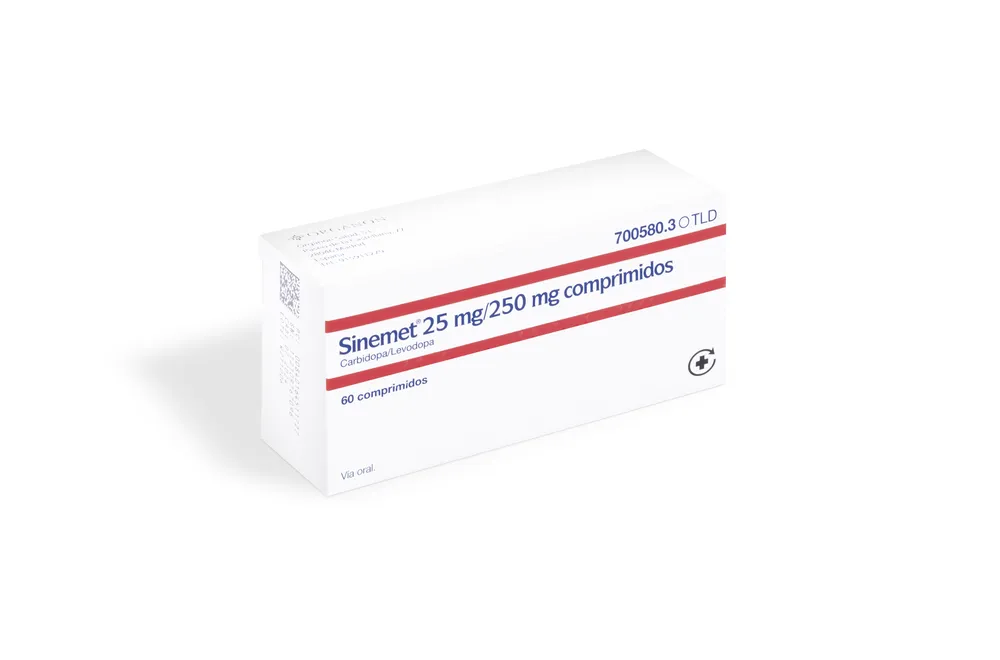
Table of Contents
Package leaflet: Information for the user
Introduction
Package leaflet: information for the user
Sinemet 25 mg/250 mg tablets
carbidopa/levodopa
Read the entire leaflet carefully before you start taking this medicine, because it contains important information for you.
- Keep this leaflet, as you may need to read it again.
- If you have any questions, ask your doctor or pharmacist.
- This medicine has been prescribed for you only, and you must not give it to other people, even if they have the same disease symptoms as you, because it may harm them.
- If you experience any adverse effects, consult your doctor or pharmacist, even if these adverse effects are not listed in this leaflet. See section 4.
Leaflet contents
- What Sinemet is and what it is used for
- What you need to know before taking Sinemet
- How to take Sinemet
- Possible adverse effects
- How to store Sinemet
- Contents of the pack and other information
1. What Sinemet is and what it is used for
Sinemet is indicated for the treatment of Parkinson's disease.
Sinemet contains two active substances: levodopa and carbidopa, and belongs to a group of medicines known as antiparkinsonian agents. Levodopa works by replenishing dopamine in the brain, while carbidopa ensures that a sufficient amount of levodopa reaches the brain when needed. In many patients, this reduces the symptoms of Parkinson's disease.
Parkinson's disease is a chronic condition characterized by slow and unsteady movements, muscle rigidity, and tremors. If left untreated, it can lead to difficulties in carrying out normal daily activities.
The symptoms of Parkinson's disease are believed to be caused by a lack of dopamine, a substance naturally produced in the brain. Dopamine transmits signals in the brain that control muscular movement. When insufficient dopamine is produced, movement difficulties occur.
2. What you need to know before taking Sinemet
Do not take Sinemet
- if you are allergic to the active substances (carbidopa, levodopa) or to any of the other ingredients of this medicine (listed in section 6).
- if you have suspicious skin lesions that have not been examined by your doctor or if you have ever had skin cancer (melanoma).
- if you are being treated with antidepressant medicines from the group known as MAO inhibitors (monoamine oxidase inhibitors) (except for certain low doses of MAO type B inhibitors).
- if you have closed-angle glaucoma (increased intraocular pressure).
Warnings and precautions
Talk to your doctor or pharmacist before taking Sinemet if:
- you have or have had health problems such as allergies, bronchial asthma, depression or mental disturbances, lung, liver, kidney, heart or hormonal disorders, peptic ulcer, seizures, or increased intraocular pressure (glaucoma).
- you require general anesthesia; treatment with this medicine may be continued as long as you are able to take medication orally. If treatment must be temporarily interrupted, Sinemet can be restarted as soon as you are able to take oral medication again.
- you are receiving treatment with medicines to lower blood pressure.
- you fall asleep suddenly during the day (sudden sleep episodes) or experience excessive drowsiness (somnolence) during the day.
Inform your doctor if you, or your family/caregiver, notice that you are developing behaviors resembling addiction, leading to a strong desire for high doses of Sinemet and other medicines used to treat Parkinson's disease.
Inform your doctor if you, or your family/caregiver, notice that you are starting to behave in an unusual way, or if you feel the urge, impulse, or temptation to harm others or to harm yourself.
These behaviors are known as impulse control disorders and may include compulsive gambling, compulsive eating or spending, increased sexual drive, or an increase in sexual thoughts or urges. Your doctor may need to review your treatment.
Inform your doctor if you have previously been treated with levodopa.
Consult your doctor, even if any of the above circumstances have occurred to you in the past.
Children and adolescents
The safety and efficacy of Sinemet have not been established in this population, and its use is not recommended in individuals under 18 years of age.
Taking Sinemet with other medicines
Inform your doctor or pharmacist if you are using, have recently used, or might need to use any other medicines.
This medicine should be used with caution when taken together with the following medicines: medicines used to treat psychiatric disorders or depression, tuberculosis, high blood pressure, muscle spasms, seizures, or other movement disorders, as well as iron preparations or iron supplements. Your doctor or pharmacist has a more complete list of medicines that you should avoid while taking Sinemet.
Taking Sinemet with food, drinks and alcohol
Because levodopa competes with certain amino acids, the absorption of levodopa may be altered in some patients on a high-protein diet. It is therefore recommended to avoid taking the tablets with heavy meals.
Pregnancy and breastfeeding
If you are pregnant or breastfeeding, think you may be pregnant, or are planning to become pregnant, consult your doctor or pharmacist before using this medicine. They will assess the potential benefits against the possible risks of treatment.
The effect of this medicine on pregnancy is unknown.
Levodopa, one of the components of Sinemet, passes into breast milk.
Driving and using machines
This medicine may cause drowsiness and sudden episodes of falling asleep. If this occurs, you should not drive or perform activities where lack of attention could pose a risk or place you or others at risk of death or serious injury (e.g., operating machinery), until these episodes and/or drowsiness have resolved.
3. How to take Sinemet
Follow exactly the instructions for use of this medicine given by your doctor or pharmacist. If in doubt, consult your doctor or pharmacist again.
The optimal daily dose of this medicine is variable and must be determined by individual dose adjustment for each patient, depending on the severity of their disease and their response to treatment.
During the dose adjustment period, special attention should be paid to symptoms such as involuntary movements. Inform your doctor immediately of any changes in your condition, such as abnormal movements, as this may require an adjustment of your prescription.
The score line is intended for dividing the tablet into equal doses.
To avoid breaking the tablets when removing them from the blister pack, it is recommended to remove them carefully, avoiding excessive force. If the tablet breaks when removed from the blister, make sure you have all the pieces to take a complete dose (half a tablet or a whole tablet, depending on the prescribed dose). If you do not have all the pieces of your dose, discard them and use another tablet from the blister pack.
Taking only part of your dose (an incomplete dose) may cause your symptoms to worsen.
Remember to take your medicine. Sinemet should be taken by mouth.
For best results, you must take Sinemet every day. It is important that you follow your doctor's advice regarding the amount and frequency with which you should take Sinemet.
If you feel that the effect of Sinemet is too strong or too weak, inform your doctor or pharmacist.
If you take more Sinemet than you should
In case of overdose or accidental ingestion, contact your doctor or pharmacist immediately or call the Toxicology Information Service at telephone number: 91 562 04 20, indicating the medicine and the amount taken.
If you forget to take Sinemet
Take Sinemet exactly as prescribed. If you forget to take a tablet, take it as soon as you remember. However, if it is almost time for your next dose, do not take the missed dose and wait until your next scheduled dose.
Do not take a double dose to make up for forgotten doses.
If you stop taking Sinemet
Your doctor will advise you on the duration of treatment with Sinemet. Do not stop treatment suddenly or reduce the dose without consulting your doctor. If you do, a group of symptoms may occur, including muscle stiffness, fever, and mental disturbances.
If you have any further questions about the use of this medicine, ask your doctor or pharmacist.
4. Possible adverse effects
Like all medicines, this medicine can cause adverse effects, although not everyone experiences them.
The most common adverse effects are: abnormal movements including muscle twitching or spasms (which may or may not resemble your Parkinson's symptoms) and nausea.
Cases of gambling addiction and increased sexual desire have been reported with medicines that enhance the action in the body of a chemical substance called dopamine, including Sinemet.
You may experience the following adverse effects:
-
Desire for doses of Sinemet higher than those required to control motor symptoms, known as dopamine dysregulation syndrome. Some patients experience severe, abnormal involuntary movements (dyskinesias), mood changes, or other adverse effects after taking high doses of Sinemet. Frequency unknown (cannot be estimated from available data).
-
Inability to resist the impulse to carry out an action that could be harmful, including:
-
Strong urge to gamble excessively despite serious personal or family consequences.
-
Altered or increased sexual interest and behavior involving excessive preoccupation with oneself or others, for example, increased sexual desire.
-
Excessive and uncontrolled shopping or spending.
-
Binge eating (eating large amounts of food in a short time) or compulsive eating (eating more food than normal and more than needed to satisfy hunger).
Inform your doctor if you experience any of these behaviors, as they will seek ways to manage or reduce the symptoms.
Other possible adverse effects are:
Infections and infestations: Urinary tract infections (very common).
Benign, malignant and unspecified neoplasms (including cysts and polyps): Malignant melanoma.
Blood and lymphatic system disorders: Decreased white blood cells (leukopenia) and platelets (thrombocytopenia), reduced number of red blood cells (hemolytic and non-hemolytic anemia), loss of white blood cells (agranulocytosis).
Immune system disorders: Swelling of the face, lips, tongue, and/or throat (angioedema).
Metabolism and nutrition disorders: Loss of appetite (anorexia), weight gain or loss.
Psychiatric disorders: Mental disturbances, sleep disturbances (insomnia, nightmares), euphoria, depression, hallucinations and delusional ideas, confusion, agitation and anxiety, unconscious teeth grinding (bruxism), increased sexual behavior, gambling addiction.
Nervous system disorders: Neuroleptic malignant syndrome, inability to coordinate movements (ataxia), increased hand tremor, activation of latent Horner's syndrome (constricted pupils, drooping eyelid, and facial dryness), abnormal/slow movements (bradykinetic episodes), numbness, tingling (paresthesia), bitter taste, spasms, dizziness, faintness, headache, sensation of stimulation, drowsiness, lethargy, sedation, narcolepsy episodes, dementia, epilepsy (seizures), decreased mental acuity.
Eye disorders: Blurred vision, double vision (diplopia), pupil dilation (mydriasis), involuntary eye movements (oculogyric crises).
Cardiac disorders: Irregular heartbeat and/or palpitations.
Vascular disorders: Inflammation of blood vessels (phlebitis), orthostatic hypotension (dizziness upon standing up quickly), elevated blood pressure (hypertension), redness (rubefaction), hot flushes.
Respiratory, thoracic and mediastinal disorders: Difficulty breathing (dyspnea), hoarseness, hiccups, altered normal breathing.
Gastrointestinal disorders: Vomiting, nausea, diarrhea, constipation, upper abdominal pain, abdominal pain and digestive discomfort, gastrointestinal bleeding, development of duodenal ulcer, flatulence, dark saliva, dry mouth, increased saliva production (sialorrhea), burning sensation in the tongue, stomach pain (dyspepsia), difficulty swallowing (dysphagia).
Skin and subcutaneous tissue disorders: Hair loss (alopecia), rash, increased sweating, dark and foul-smelling sweat, hives, urticaria, itching (pruritus), skin bleeding or bruising (Schönlein-Henoch purpura).
Musculoskeletal and connective tissue disorders: Muscle cramps, muscle twitching, jaw muscle spasm (trismus).
Renal and urinary disorders: Dark-colored urine, urinary retention or urinary incontinence.
Reproductive system and breast disorders: Prolonged penile erection (priapism).
General disorders and administration site conditions: Discomfort, chest pain, asthenia, changes in gait, weakness, edema, fatigue, general malaise.
Investigations: Abnormalities in the results of various laboratory tests have occurred.
Injury, poisoning and procedural complications: Falls.
Reporting of adverse effects
If you experience any adverse effect, talk to your doctor or pharmacist, even if it is a possible adverse effect not listed in this leaflet. You may also report them directly via the Spanish Pharmacovigilance System for Human Medicines: https://www.notificaram.es. By reporting adverse effects, you can help provide more information on the safety of this medicine.
5. Storage of Sinemet
Keep this medicine out of the sight and reach of children.
Do not store above 25°C.
Store in the original packaging.
Do not use this medicine after the expiry date stated on the container after EXP. The expiry date refers to the last day of the month indicated.
Medicines should not be disposed of via wastewater drains or household waste. Unused medicines and their containers should be handed over to the SIGRE point at your pharmacy. If you have any doubts, ask your pharmacist how to dispose of medicines and containers you no longer need. This will help protect the environment.
6. Contents of the pack and other information
Composition of Sinemet
- The active substances are 25 mg of anhydrous carbidopa and 250 mg of levodopa.
- The other components are microcrystalline cellulose, corn starch, pregelatinized corn starch, magnesium stearate, and indigo carmine (E-132).
Appearance of the medicine and contents of the pack
The tablets are mottled light blue in colour, oval-shaped, with one smooth side and the other side engraved with the code "654" and a score line.
Each pack contains 60 or 120 tablets in blisters.
Only certain pack sizes may be marketed.
Other presentations
Sinemet Plus 25 mg/100 mg tablets. Pack containing 100 tablets.
Sinemet Retard 50 mg/200 mg prolonged-release tablets. Pack containing 100 prolonged-release tablets.
Sinemet Plus Retard 25 mg/100 mg prolonged-release tablets. Pack containing 100 prolonged-release tablets.
Marketing Authorization Holder and Manufacturer
Marketing Authorization Holder:
Organon Salud, S.L.
Paseo de la Castellana, 77
28046 Madrid
Spain
Tel.: 915911279
Manufacturer:
N.V. Organon
Kloosterstraat 6
5349 AB Oss
The Netherlands
Merck Sharp & Dohme B.V.
Waarderweg 39,
2031 BN Haarlem
The Netherlands
Date of the most recent revision of this leaflet: May 2023
Detailed and up-to-date information on this medicine is available on the website of the Spanish Agency of Medicines and Health Products (AEMPS) http://www.aemps.gob.es/