Siiltibcy (0.5 micrograms + 0.5 micrograms)/ml solution for injection
Spain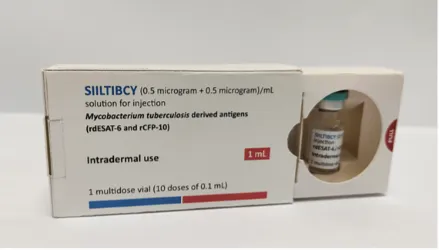
Table of Contents
Package leaflet: Information for the user
Introduction
Package leaflet: information for the patient
SIILTIBCY (0.5 micrograms + 0.5 micrograms)/ml solution for injection
antigens derived from Mycobacterium tuberculosis (rdESAT-6 and rCFP-10)
This medicinal product is subject to additional monitoring, which will allow quicker identification of new safety information. You can help by reporting any side effects you may experience. Section 4 at the end of this leaflet contains information on how to report side effects.
Read the entire leaflet carefully before receiving this skin test, as it contains important information for you.
- Keep this leaflet, as you may need to read it again.
- If you have any questions, consult your doctor, pharmacist, or nurse.
- If you experience any side effects, consult your doctor, pharmacist, or nurse, even if they are side effects not listed in this leaflet. See section 4.
Contents of the leaflet
- What SIILTIBCY is and what it is used for
- What you need to know before receiving SIILTIBCY
- How SIILTIBCY is administered
- Possible side effects
- How to store SIILTIBCY
- Contents of the pack and other information
1. What SIILTIBCY is and what it is used for
SIILTIBCY is for diagnostic use and contains, as active substances, two specific tuberculous proteins (antigens) called rdESAT-6 and rCFP-10.
SIILTIBCY is injected into the skin (intradermally) to detect infection (including disease) caused by Mycobacterium tuberculosis in adults and children older than 28 days.
For interpretation of test results, it is used in conjunction with other medical procedures.
If a person has been infected with Mycobacterium tuberculosis, their immune system will respond by producing cytokines (inflammatory proteins), leading to induration (hardening) at the site where SIILTIBCY was injected, which typically occurs between 48 and 72 hours after injection.
2. What you need to know before receiving SIILTIBCY
You should not receive SIILTIBCY
- if you are allergic to the active substances in SIILTIBCY, rdESAT-6, rCFP-10, or to any of the other components of this medicine (listed in section 6).
- if you are allergic to Lactococcus lactis, a bacterium used to manufacture SIILTIBCY.
- if you have previously experienced a severe local (skin) or systemic (affecting any part of the body*) reaction to other tuberculosis skin tests.*
Warnings and precautions
Talk to your doctor, pharmacist, or nurse before undergoing a SIILTIBCY test if:
- you have undergone a SIILTIBCY test within the last 6 weeks.
- you have been vaccinated within the last 4 weeks with live vaccines (such as vaccines against measles, mumps, and rubella).
- you are taking any medication (such as corticosteroids) or have a disease that may suppress your immune system, such as human immunodeficiency virus (HIV).
Although severe allergic reactions have not been reported with SIILTIBCY, very rare cases of serious allergic reactions (anaphylaxis), including swelling of the lips, face, and throat, breathing difficulties, and urticarial rash, have occurred with other tuberculosis skin tests. Immediately inform the doctor or nurse who performed this skin test, or contact your doctor or nearest emergency service, if you experience one or more of these symptoms after undergoing the SIILTIBCY test.
Children and adolescents
There are no additional warnings or precautions applicable to children or adolescents.
Other types of mycobacteria (nontuberculous mycobacteria) and SIILTIBCY
The use of SIILTIBCY is not suitable for identifying prior exposure to types of mycobacteria that do not cause tuberculosis or prior vaccination with Bacillus Calmette-Guérin.
Pregnancy, breastfeeding, and fertility
If you are pregnant or breastfeeding, think you may be pregnant, or are planning to become pregnant, consult your doctor or pharmacist before undergoing a skin test.
The SIILTIBCY test is not expected to have harmful effects during pregnancy or breastfeeding.
Driving and use of machines
The influence of SIILTIBCY on the ability to drive and operate machinery is negligible or none.
SIILTIBCY contains potassium, sodium, and polysorbate 20
This medicine contains potassium, less than 1 mmol (39 mg) per dose; therefore, it is essentially “potassium-free”.
This medicine contains less than 1 mmol of sodium (23 mg) per dose; therefore, it is essentially “sodium-free”.
This medicine contains 0.011 mg of polysorbate 20 in each dose, equivalent to 0.11 mg/ml.
Polysorbates may cause allergic reactions. Consult your doctor if you have any known allergies.
3. How SIILTIBCY is administered
Your doctor or nurse will inject SIILTIBCY into the upper layer of the skin of your forearm.
The recommended dose is 0.1 ml. The dose is the same for all age groups.
After the injection, a papule (raised bump on the skin) of 8-10 millimeters in diameter will appear and will last for about 10 minutes. Redness and induration (hardening of the skin) may occur at the injection site. After the injection, your doctor or nurse may monitor you for at least 15 minutes to detect signs of an allergic reaction.
You should keep the injection site clean; do not scratch the area, and if itching occurs, a cold compress may be applied.
To read the test result, you must return to your doctor or nurse 48 to 72 hours after the injection to have the result checked. Any redness or induration should decrease by this time.
Detailed information on the administration method of SIILTIBCY and on result evaluation is included in the section "The following information is intended exclusively for medical or healthcare professionals."
The SIILTIBCY test is not affected by previous vaccination with Bacillus Calmette-Guérin (BCG) vaccine.
If you have any further questions about the use of this medicine, ask your doctor, pharmacist, or nurse.
4. Possible adverse effects
Like all medicines, this medicine can cause adverse effects, although not everyone will experience them.
Serious adverse effects
Although there is no evidence that they occur with SIILTIBCY, very rare cases of serious allergic reactions (anaphylaxis) have been reported with other tuberculosis skin tests, such as swelling of the lips, face and throat, breathing difficulties, and urticarial rash. If you experience any of these reactions, inform immediately the doctor or nurse who performed this skin test, or contact your doctor or nearest emergency service without delay.
Other adverse effects
Very common (may affect more than 1 in 10 people)
- Itching at the injection site
Common (may affect up to 1 in 10 people)
- Bruising (haematoma) at the injection site
- Blisters (vesicles) at the injection site
- Headache
- Induration (hardening of the skin) at the injection site
- Swelling at the injection site
- Pain at the injection site
- Rash at the injection site
- Erythema (redness) at the injection site
Uncommon (may affect up to 1 in 100 people)
- Lymphadenopathy (swollen lymph nodes)
- Fever
- Ulcers at the injection site
- Bleeding (haemorrhage) at the injection site
- Malaise (general feeling of discomfort, illness or uneasiness)
- Dizziness
- Rash
- Itching (pruritus)
- Myalgia (muscle pain)
- Fatigue (tiredness)
- Discoloration (discoloured skin) at the injection site
- Pain in limbs (hands, arms, feet or legs)
- Pain
- Gastroenteritis (inflammation of the stomach and intestines)
- Diarrhoea
- Influenza-like illness (flu-like illness)
- Nausea (feeling unwell)
Rare (may affect up to 1 in 1,000 people)
- Lymphadenitis (infection of the lymph nodes)
- Hepatitis (inflammation of the liver)
- Urticaria (raised, red, itchy areas on the skin) anywhere on the body
- Pain in the armpit
- Head discomfort
- Chills
- Hypoaesthesia (numbness) at the injection site
- Papule (raised bump) at the injection site
- Urticaria (raised, red, itchy areas) at the injection site
- Nodule (swollen lump) at the injection site
- Inflammation at the injection site
- Eosinophilia (increase in white blood cells)
- Night sweats
- Arthritis (joint pain and inflammation)
- Vomiting
- Increased transaminases (elevated blood levels of liver enzymes)
- Paresthesia (numbness, tingling or prickling) anywhere on the body
- Jaundice (yellowing of the skin and eyes)
Reporting of adverse effects
If you experience any adverse effect, talk to your doctor, pharmacist or nurse, even if it is a possible adverse effect not listed in this leaflet. You can also report them directly through the national reporting system detailed in Appendix V. By reporting adverse effects, you can help provide more information on the safety of this medicine.
5. Storage of SIILTIBCY
Keep this medicine out of the sight and reach of children.
Do not use this medicine after the expiry date stated on the carton and on the label of the vial after EXP. The expiry date refers to the last day of the month indicated.
Store in a refrigerator (between 2 °C and 8 °C). Do not freeze.
Keep in the original container to protect from light.
After first opening, the vial may be used for up to 28 days, provided it is stored in a refrigerator (between 2 °C and 8 °C).
Medicines should not be disposed of via wastewater. Ask your pharmacist how to dispose of medicines you no longer use. This will help protect the environment.
6. Contents of the pack and other information
Composition of SIILTIBCY
- The active substances are antigens derived from Mycobacterium tuberculosis rdESAT-6 and rCFP-10.
- One dose (0.1 ml) of SIILTIBCY contains 0.05 micrograms of rdESAT-6 and 0.05 micrograms of rCFP-10.
- The other components are disodium hydrogen phosphate dihydrate (E339), potassium dihydrogen orthophosphate (E340), potassium chloride (E508), sodium chloride, polysorbate 20 (E432), phenol, and water for injections (see section 2, "SIILTIBCY contains potassium, sodium and polysorbate 20").
Appearance of the product and contents of the pack
SIILTIBCY injectable solution is a clear, colourless to pale yellow solution. This medicine should not be used if visible particles are observed.
SIILTIBCY is supplied in a pack containing 1 multidose glass vial, or in multiple packs containing 10 (10 packs of 1) multidose glass vials, each containing 1 ml.
Only certain pack sizes may be marketed.
Marketing Authorisation Holder
Serum Life Science Europe GmbH
Ahrensburger Strasse 1
30659 Hannover
Germany
Manufacturer
Bilthoven Biologicals B.V.
Antonie Van Leeuwenhoeklaan 9
3712 MA Bilthoven
The Netherlands
Date of the most recent revision of this leaflet:
Detailed information on this medicine is available on the website of the European Medicines Agency: https://www.ema.europa.eu.
This information is intended for healthcare professionals only
SIILTIBCY must be prepared and administered by intradermal injection by healthcare professionals trained in the Mantoux technique. The medicine must be administered with proper hand hygiene and using an aseptic technique, as described below:
- Draw up 0.1 ml of SIILTIBCY using a 1 ml syringe with a short-bevel needle. Before drawing SIILTIBCY from the multidose vial, expel air from the syringe. If the vial has been previously opened, clean with an alcohol swab and allow to dry before use.
- Administer the 0.1 ml of SIILTIBCY intradermally into the middle third of the forearm using the Mantoux technique. To do this, gently stretch the skin and hold the needle almost parallel to the skin surface with the bevel facing upward. Insert the needle tip into the superficial layer of the dermis. Ensure the needle is visible through the epidermis during injection. Do not administer the test in areas with scars, rashes, burns, or tattoos.
- Inject the 0.1 ml of solution slowly. A small, whitish papule of 8–10 millimetres (mm) in diameter should appear, which should disappear within approximately 10 minutes. If the papule does not appear, repeat a new 0.1 ml injection of SIILTIBCY in the other arm or in the same arm at a minimum distance of 4 cm from the initial injection site.
Close observation of the subject is recommended for at least 15 minutes after the test.
Evaluation of the reaction
Intradermal injection of SIILTIBCY may induce induration at the injection site. The induration may appear as a raised area with a clearly defined margin at and around the injection site. Although erythema may accompany induration, only induration should be measured.
Induration must be measured between 48 and 72 hours after injection by a trained healthcare professional. Measure the diameter of the induration perpendicular to the long axis of the forearm using a ruler. For ease of measurement, it is recommended to use a flexible ruler (or one that can be easily bent).
Typically, induration and erythema will diminish within 4 days and disappear within 28 days following injection.
Interpretation
An induration of ≥ 5 mm is considered a positive result, indicating infection with Mycobacterium tuberculosis.