Siccafluid 2.5 mg/g ophthalmic gel
Spain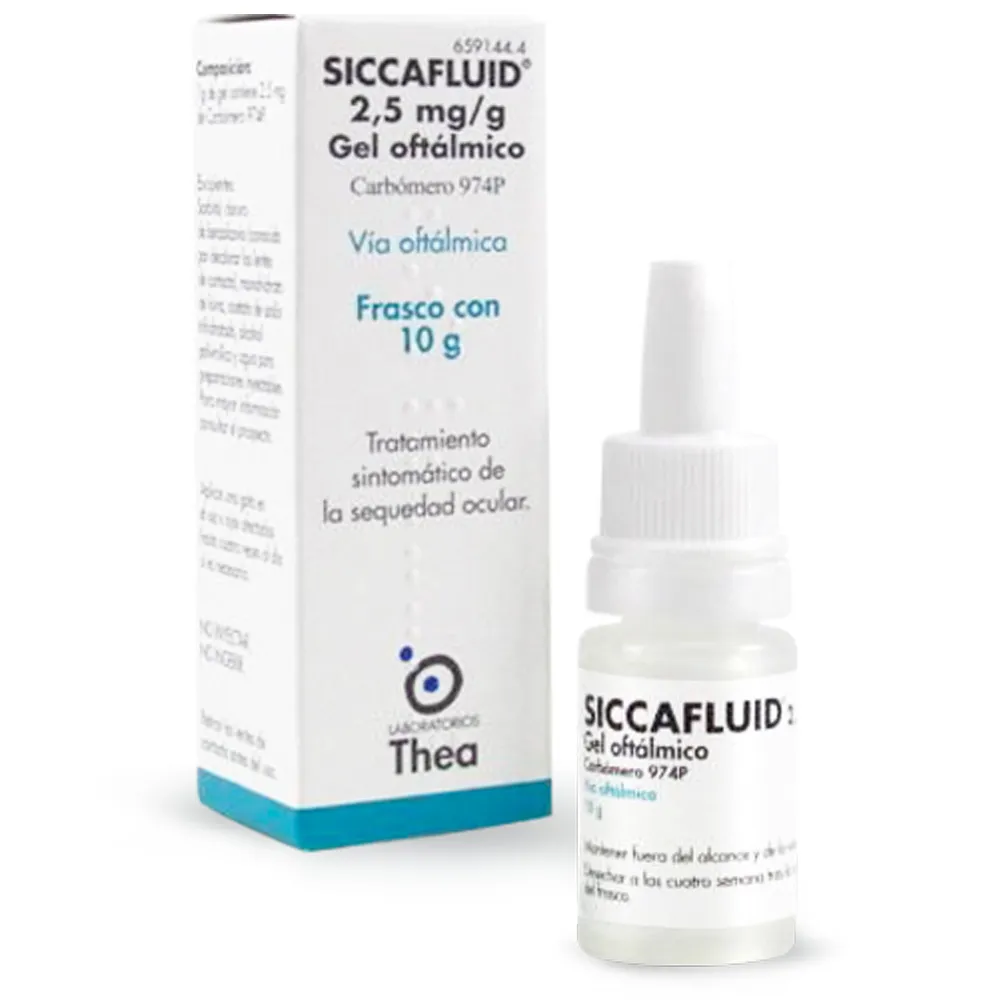
Table of Contents
Package leaflet: Information for the user
Introduction
Package leaflet: information for the user
SICCAFLUID 2.5 mg/g OPHTHALMIC GEL
Carbomer 974 P
Read the entire leaflet carefully as it contains important information for you.
This medicine can be purchased without a prescription. However, to achieve the best results, it must be used correctly.
- Keep this leaflet, as you may need to read it again.
- If you need advice or further information, consult your pharmacist.
- If your symptoms worsen or persist, you should consult your doctor.
- If you consider any of the side effects you experience to be severe or if you notice any side effects not mentioned in this leaflet, inform your doctor or pharmacist.
Leaflet contents
- What Siccafluid is and what it is used for
- Before using Siccafluid
- How to use Siccafluid
- Possible side effects
- How to store Siccafluid
- Further information
1. What SICCAFLUID is and what it is used for
Siccafluid is a tear substitute and contains a lubricant called Carbomer 974P.
It is an ophthalmic gel used to relieve symptoms of dry eye (such as inflammation, burning, irritation, or dryness) caused by insufficient tear production.
2. Before using SICCAFLUID
Do not use Siccafluid
• If you are allergic (hypersensitive) to carbomer or to any of the other ingredients of Siccafluid listed in section 6, “What Siccafluid contains”.
Take special care with Siccafluid
• If you wear soft contact lenses: You must remove them before using Siccafluid. After using Siccafluid, wait at least 30 minutes before reinserting your contact lenses. See also section 2, “Siccafluid contains benzalkonium chloride”.
• If your condition worsens or does not improve after starting treatment with Siccafluid, contact your doctor.
• DO NOT INJECT, DO NOT INGEST.
Children and adolescents up to 18 years of age
The safety and efficacy of SICCAFLUID in children and adolescents at the recommended adult dosage have been established based on clinical experience; however, clinical studies are not available.
Using other medicines
Inform your doctor or pharmacist if you are using or have recently used any other medicines, including those obtained without a prescription.
If you need to use any other eye medication during treatment with Siccafluid: first use the other eye medication, then wait 15 minutes before using Siccafluid.
Pregnancy and breastfeeding
Consult your doctor or pharmacist before using any medicine.
If you are pregnant or breastfeeding, contact your doctor to discuss whether you should start using Siccafluid.
He or she will decide whether you may use Siccafluid.
Driving and using machines
Your vision may become blurred for a short time after using Siccafluid.
Do not drive or operate machinery until your vision returns to normal.
Siccafluid contains benzalkonium chloride
This medicine contains 0.0015 mg of benzalkonium chloride per drop, equivalent to 0.06 mg/g.
Benzalkonium chloride may be absorbed by soft contact lenses and may alter the color of contact lenses. Remove contact lenses before using this medicine and wait 30 minutes before reinserting them.
Benzalkonium chloride may cause eye irritation, especially if you have dry eye or other corneal diseases (the transparent layer at the front of the eye). Consult your doctor if you experience a foreign body sensation, stinging, or eye pain after using this medicine.
3. How to use SICCAFLUID
If Siccafluid has been recommended for you, follow exactly the administration instructions provided by your doctor. Consult your doctor or pharmacist if you have any doubts.
The usual dose is 1 drop administered into the affected eye or eyes up to 4 times a day.
Children and adolescents up to 18 years of age
The safety and efficacy of SICCAFLUID in children and adolescents at the dosage recommended for adults have been established based on clinical experience, but clinical studies are not available in this regard.
How to use:
Do not use the bottle if the tamper-evident seal ring on the cap is broken before first opening.
Wash your hands before opening the bottle. Tilt your head backward and look upward.
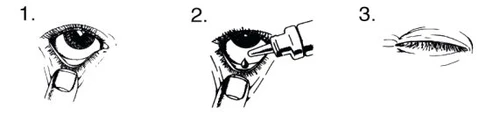
- Gently pull down the eyelid of the affected eye until a small "pocket" is formed.
- Turn the bottle upside down. Squeeze until one drop falls into the "pocket".
- Release the lower eyelid and blink several times.
- Repeat steps 1 to 3 in the other eye if treatment is also needed there.
To help prevent infection, do not touch the eye, surrounding areas, or anything else with the dropper tip of the bottle.
Replace the cap on the bottle after use.
Store the bottle in an upright position, with the cap pointing downward, to facilitate drop formation the next time you use Siccafluid.
Once the bottle has been opened, it must not be used for longer than 28 days; also see section 5, "Conservation of Siccafluid".
If you use more Siccafluid than you should
Using more drops of Siccafluid than recommended does not cause harm.
In case of overdose or accidental ingestion, consult your doctor or pharmacist immediately or call the Toxicology Information Service at: 91 562 04 20.
If you forget to use Siccafluid
Do not apply a double dose to make up for a missed dose. Apply the next dose as scheduled.
If you have any further questions about the use of this product, ask your doctor or pharmacist.
4. Possible adverse effects
Like all medicines, Siccafluid may cause adverse effects, although not everybody gets them.
Contact your doctor if:
• Your symptoms worsen or do not improve after starting treatment with Siccafluid.
If you experience any of the following adverse effects after applying the eye gel to the eye, speak with your doctor if you are concerned:
• Temporary blurred vision
• Mild itching or burning sensation in the eye
The mentioned adverse effects may occur, but the number of people likely to be affected may vary.
Reporting of adverse effects
If you experience any type of adverse effect, consult your doctor, pharmacist, or nurse, even if it is a possible adverse effect not listed in this leaflet. You can also report them directly via the Spanish Pharmacovigilance System for Human Medicines: https://notificaram.es. By reporting adverse effects, you can help provide more information on the safety of this medicine.
5. Storage of SICCAFLUID
Keep out of the reach and sight of children.
Do not use Siccafluid 2.5 mg/g ophthalmic gel after the expiry date stated on the tube label and carton after EXP. The expiry date refers to the last day of the month indicated.
Do not store above 25°C. Keep the tube in the outer packaging to protect it from light.
Store the tube in an upright position with the cap facing downwards to facilitate drop formation the next time you use Siccafluid.
Discard the tube 28 days after first opening, even if there are still some drops remaining.
Medicines must not be disposed of via wastewater drains or household waste. Dispose of unused medicines and their containers at the SIGRE point* at your pharmacy. If you are unsure, please ask your pharmacist how to properly dispose of unused medicines and their packaging. This helps protect the environment.*
6. Additional information
Composition of Siccafluid
- The active substance is Carbomer 974 P 2.5 mg/g.
- The other components are benzalkonium chloride, sorbitol, monohydrate lysine, sodium acetate trihydrate, polyvinyl alcohol, and water for injections.
Appearance of the product and contents of the container
Siccafluid is a slightly yellowish opalescent gel packed in plastic bottles with screw caps.
Each bottle contains 10 g of gel.
Each carton contains one bottle.
Marketing Authorization Holder
LABORATORIOS THEA S.A.
C/ Enric Granados, nº 86-88, 2ª planta, 08008 Barcelona
Manufacturer
URSAPHARM, ARZNEIMITTEL GMBH
Industriestrasse
66129 Saarbrücken, Germany
or
FARMILA-THEA Farmaceutici S.p.A.
Via Enrico Fermi, 50
20019 Settimo Milanese
Italy
This leaflet was approved in March 2025
Detailed and up-to-date information on this medicine is available on the website of the Spanish Agency for Medicines and Health Products (AEMPS): http://www.aemps.es/