Sevelamer Ratiopharm 2,4 g powder for oral suspension
Spain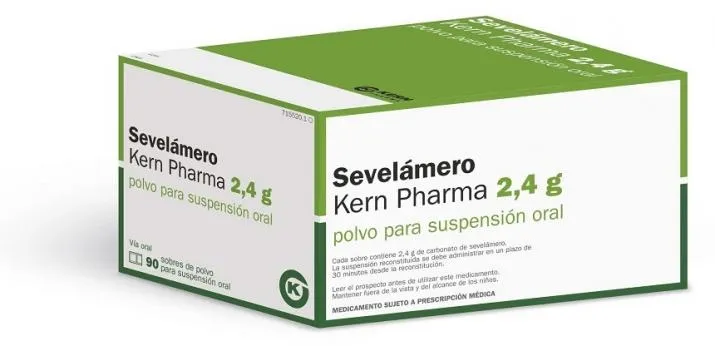
Table of Contents
- Package leaflet: Information for the user
- Introduction
- 1. What Sevelamer ratiopharm is and what it is used for
- 2. What you need to know before starting to take Sevelamer ratiopharm
- 3. How to take Sevelamer ratiopharm
- 4. Possible adverse effects
- 5. Storage of Sevelamer ratiopharm
- 6. Contents of the pack and other information
Package leaflet: Information for the user
Introduction
Package leaflet: information for the user
Sevelamer ratiopharm 2.4 g oral suspension powder
sevelamer carbonate
Read all of this leaflet carefully before you start taking this medicine, because it contains important information for you.
- Keep this leaflet, as you may need to read it again.
- If you have any questions, ask your doctor or pharmacist.
- This medicine has been prescribed for you only, and you should not give it to others, even if they have the same symptoms as you, because it may harm them.
- If you experience any side effects, talk to your doctor or pharmacist, even if they are side effects not listed in this leaflet. See section 4.
Contents of the leaflet
- What Sevelamer ratiopharm is and what it is used for
- What you need to know before taking Sevelamer ratiopharm
- How to take Sevelamer ratiopharm
- Possible side effects
- How to store Sevelamer ratiopharm
- Contents of the pack and other information
1. What Sevelamer ratiopharm is and what it is used for
Sevelamer ratiopharm 2.4 g contains sevelamer carbonate as the active substance. It binds to dietary phosphate in the gastrointestinal tract, thereby reducing serum phosphate levels in the blood.
This medicine is used to control hyperphosphataemia (high blood phosphate levels) in:
- adult patients on dialysis (a blood-cleaning technique). It can be used in patients undergoing haemodialysis (using a machine to filter the blood) or peritoneal dialisis (where fluid is pumped into the abdomen and an internal body membrane filters the blood);
- adult patients with chronic kidney disease (long-term) who are not on dialysis and have a serum (blood) phosphate level equal to or above 1.78 mmol/l;
- pediatric patients over 6 years of age with chronic kidney disease (long-term) and with a certain height and weight (based on which your doctor will calculate the body surface area).
This medicine should be used together with other treatments such as calcium and vitamin D supplements to prevent the development of bone disease.
Elevated serum phosphate levels may lead to hard deposits in the body called calcifications. These deposits may harden blood vessels and make it more difficult for blood to be pumped through the body. Increased serum phosphate may also cause skin itching, red eyes, bone pain, and fractures.
2. What you need to know before starting to take Sevelamer ratiopharm
Do not take Sevelamer ratiopharm:
- if you are allergic to the active substance or to any of the other ingredients of this medicine (listed in section 6).
- if you have low levels of phosphate in the blood (your doctor will check this for you)
- if you have intestinal obstruction
Warnings and precautions
Talk to your doctor or pharmacist before starting sevelamer if you are in any of the following situations:
- problems with motility (movement) of the stomach and intestines
- you frequently have vomiting
- active inflammation of the intestine
- you have undergone major surgery of the stomach or intestine
- if you have severe inflammatory bowel disease
Talk to your doctor while taking sevelamer:
- if you experience severe abdominal pain, stomach or intestinal disorders, or blood in the stool (gastrointestinal bleeding). These symptoms may be due to deposition of sevelamer crystals in the intestine. Contact your doctor, who will decide whether to continue treatment or not.
Additional treatments:
Due to your kidney condition or dialysis treatment, you may:
- have low or high levels of calcium in your blood. As sevelamer does not contain calcium, your doctor may prescribe additional calcium tablets
- have low levels of vitamin D in the blood. Therefore, your doctor may monitor your blood vitamin D levels and prescribe a vitamin D supplement if necessary. If you do not take multivitamin supplements, blood levels of vitamins A, E, K, and folic acid may also decrease, so your doctor may monitor these levels and prescribe vitamin supplements as needed
- have altered blood bicarbonate levels and increased acidity in the blood and other body tissues. Your doctor should monitor the bicarbonate level in your blood.
Special note for patients on peritoneal dialysis:
You may develop peritonitis (infection of the abdominal fluid) associated with peritoneal dialysis. This risk may be reduced by careful use of sterile techniques during bag exchanges. You must inform your doctor immediately if you experience any new signs or symptoms of abdominal discomfort, abdominal swelling, abdominal pain, abdominal tenderness or rigidity, constipation, fever, chills, nausea, or vomiting.
Children
The safety and efficacy have not been studied in children (under 6 years of age). Therefore, the use of sevelamer is not recommended in children under 6 years of age.
Other medicines and Sevelamer ratiopharm
Tell your doctor if you are taking, have recently taken, or might need to take any other medicines.
-
Sevelamer should not be taken at the same time as ciprofloxacin (an antibiotic).
-
If you are taking other medicines for heart rhythm problems or epilepsy, you should consult your doctor when taking sevelamer.
-
The effects of medicines such as cyclosporine, mycophenolate mofetil, and tacrolimus (medicines used to suppress the immune system) may be reduced by sevelamer. Your doctor will advise you if you are taking these medicines.
-
A deficiency of thyroid hormone may rarely occur in certain individuals taking levothyroxine (used to treat low thyroid hormone levels) and sevelamer. Therefore, your doctor may monitor your thyroid-stimulating hormone (TSH) blood levels more closely.
-
Medicines used to treat stomach acidity and reflux in the stomach or esophagus, such as omeprazole, pantoprazole, or lansoprazole, known as "proton pump inhibitors," may reduce the effectiveness of sevelamer. Your doctor should monitor your blood phosphate levels.
Your doctor will regularly check for possible interactions between sevelamer and other medicines.
In some cases, sevelamer must be taken at the same time as another medicine; your doctor may instruct you to take that medicine 1 hour before or 3 hours after taking sevelamer. Your doctor should also consider monitoring blood levels of that medicine.
Pregnancy and breastfeeding
If you are pregnant or breastfeeding, think you may be pregnant, or plan to become pregnant, consult your doctor or pharmacist before using this medicine. The potential risk of sevelamer during human pregnancy is unknown. Discuss with your doctor, who will decide whether you can continue treatment with sevelamer.
It is unknown whether sevelamer passes into breast milk and could affect the baby. Consult your doctor, who will decide whether you can breastfeed or not, and whether treatment with sevelamer needs to be interrupted.
Driving and using machines
It is unlikely that sevelamer will affect your ability to drive or use machines.
Sevelamer ratiopharm contains sodium
This medicine contains less than 23 mg of sodium (1 mmol) per sachet; hence, it is essentially “sodium-free”.
Sevelamer ratiopharm contains benzyl alcohol
This medicine contains 0.0173 mg per sachet. Benzyl alcohol may cause allergic reactions. Consult your doctor or pharmacist if you are pregnant or breastfeeding. This is because large amounts of benzyl alcohol may accumulate in your body and cause adverse effects (metabolic acidosis). Consult your doctor or pharmacist if you have liver or kidney disease. This is because large amounts of benzyl alcohol may accumulate in the body and cause adverse effects (metabolic acidosis).
3. How to take Sevelamer ratiopharm
Follow exactly the administration instructions for this medicine as indicated by your doctor. Your doctor will determine the dose based on your serum phosphorus levels.
For the 2.4 g oral suspension powder per sachet, disperse it in 60 ml of water. Drink within 30 minutes of preparation. It is important to drink all the liquid, and it may be necessary to rinse the glass with water and drink it as well to ensure complete ingestion of the powder.
Instead of water, the powder may be mixed with a small amount of cold beverage (approximately 120 ml or half a glass) or food (about 100 grams), and taken within the following 30 minutes. Do not heat sevelamer powder (e.g., in a microwave) or add it to hot liquids or foods.
The recommended initial dose of this medicine for adults and elderly patients is 2.4–4.8 g per day, divided equally among three meals. Your doctor will determine the exact initial dose and dosing schedule. If in doubt, consult your doctor, pharmacist, or nurse. Take sevelamer after a meal or with food. If a 0.4 g dose is required, please use the 0.8 g powder formulation with dosing spoon.
Use in children and adolescents
The recommended initial dose of sevelamer for children is based on their height and weight (from which your doctor will calculate body surface area). For children, the powder formulation is preferred, as tablets are not suitable for this population. This medicine must not be administered on an empty stomach and should be taken with meals or snacks. Your doctor will determine the exact initial dose and dosing schedule.
Initially, your doctor will check your blood phosphorus levels every 2–4 weeks and may adjust the dose of sevelamer as necessary to achieve an appropriate phosphorus level.
Follow the diet prescribed by your doctor.
If you take more Sevelamer ratiopharm than you should
In case of overdose or accidental ingestion, contact your doctor or pharmacist immediately or call the Toxicology Information Service at 91 562 04 20, indicating the medicine and the amount taken.
If you forget to take Sevelamer ratiopharm
If you miss a dose, skip it and take the next dose at the usual time with food. Do not take a double dose to make up for a missed dose.
If you stop taking Sevelamer ratiopharm
Taking your sevelamer treatment regularly is important to maintain appropriate phosphate levels in your blood. Stopping sevelamer treatment may lead to serious consequences, such as vascular calcification. If you are considering stopping your sevelamer treatment, contact your doctor or pharmacist first.
If you have any further questions about the use of this medicine, ask your doctor or pharmacist.
4. Possible adverse effects
Like all medicines, this medicine can cause adverse effects, although not everyone experiences them.
Constipation is a very common adverse effect (may affect more than 1 in 10 patients). It may be an early sign of intestinal obstruction. If you experience constipation, inform your doctor or pharmacist.
Some adverse effects may be serious. If you experience any of the following adverse effects, seek immediate medical attention:
-
Allergic reaction (signs include rash, hives, swelling, difficulty breathing). This is a very rare adverse effect (may affect up to 1 in 10,000 patients).
-
Intestinal obstruction has been reported (signs include: severe distension, abdominal pain, bloating or cramps, severe constipation). Frequency is unknown (cannot be estimated from available data).
-
Perforation of the intestinal wall has been reported (signs include: severe stomach pain, chills, fever, nausea, vomiting, or tender or painful abdomen). Frequency is unknown.
-
Gastrointestinal bleeding, inflammation of the large intestine, and deposition of crystals in the intestine have been reported. Frequency is unknown.
Other adverse effects reported in patients taking sevelamer:
Very common (may affect more than 1 in 10 patients): vomiting, upper abdominal pain, nausea.
Common (may affect up to 1 in 10 patients): diarrhoea, stomach pain, indigestion, flatulence.
Frequency not known (cannot be estimated from available data): cases of itching, rash, slow intestinal motility (movement).
Reporting of adverse effects
If you experience any type of adverse effect, consult your doctor or pharmacist, even if it is a possible adverse effect not listed in this leaflet. You can also report them directly via the Spanish Pharmacovigilance System for Human Medicinal Products: https://www.notificaram.es. By reporting adverse effects, you can help provide more information on the safety of this medicine.
5. Storage of Sevelamer ratiopharm
Keep this medicine out of the sight and reach of children.
Do not use this medicine after the expiry date stated on the container or sachet, following the letters CAD. The expiry date refers to the last day of the month indicated.
The reconstituted suspension should be administered within 30 minutes of reconstitution. This medicine does not require any special storage conditions.
Medicines must not be disposed of via wastewater or household waste. Return unused medicines and their containers to the SIGRE point at your pharmacy. If you are in doubt, ask your pharmacist how to dispose of medicines and containers you no longer need. This will help protect the environment.
6. Contents of the pack and other information
Composition of Sevelamer ratiopharm
The active substance is sevelamer carbonate. Each sachet of Sevelamer ratiopharm contains 2.4 g of sevelamer carbonate, as indicated on the sachet.
The other components are microcrystalline cellulose, sodium carboxymethylcellulose, sucralose (E955), lemon flavour, orange flavour (contains benzyl alcohol) and yellow iron oxide (E172).
Appearance of the product and contents of the pack
Sevelamer ratiopharm 2.4 g oral suspension powder is a white to yellowish powder supplied in PET/Al/LDPE sachets. The PET/Al/LDPE sachets are packed in an outer carton.
Pack sizes: 90 sachets per carton.
Marketing Authorisation Holder and Manufacturer
Marketing Authorisation Holder
Teva Pharma, S.L.U.
C/Anabel Segura, 11 Edificio Albatros B, 1st floor
28108 Alcobendas (Madrid), Spain
Manufacturer
Synthon Hispania S.L.
C/Castelló, nº1, Pol. Las Salinas, Sant Boi de Llobregat
08830 Barcelona
Spain
or
Synthon BV
Microweg 22
6545 CM Nijmegen
The Netherlands
Date of the most recent revision of this leaflet: August 2022
Other sources of information
Detailed information on this medicine is available on the website of the Spanish Agency of Medicines and Health Products (AEMPS) (http://www.aemps.gob.es/).