Setofilm 4 mg orodispersible films EFG
Spain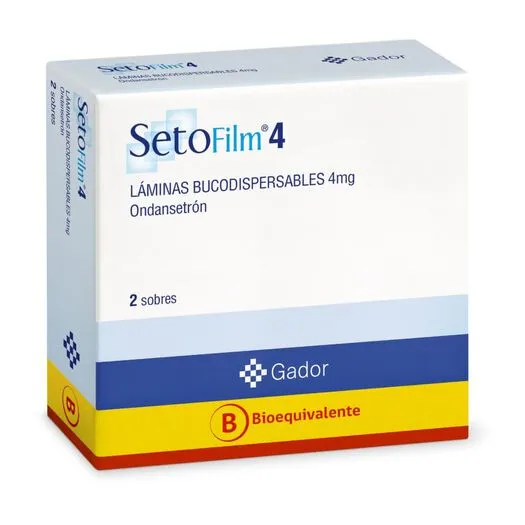
Table of Contents
Package leaflet: Information for the user
Introduction
Package leaflet: information for the user
Setofilm 4 mg orodispersible films EFG
Ondansetron
Read the entire leaflet carefully before you start using this medicine, because it contains important information for you.
- Keep this leaflet, as you may need to read it again.
- If you have any questions, ask your doctor, nurse or pharmacist.
- This medicine has been prescribed for you only and must not be given to other people, even if they have the same symptoms as you, because it could harm them.
- If you experience any adverse reactions, talk to your doctor, nurse or pharmacist, even if they are adverse reactions not listed in this leaflet. See section 4.
Leaflet contents
- What Setofilm is and what it is used for
- What you need to know before using Setofilm
- How to use Setofilm
- Possible adverse effects
- How to store Setofilm
- Contents of the pack and other information
1. What Setofilm is and what it is used for
Setofilm contains a medicine called ondansetron. It belongs to a group of medicines known as antiemetics.
Setofilm is used to treat and prevent nausea and vomiting caused by chemotherapy or radiotherapy. It can also be used after surgery to prevent and treat nausea and vomiting.
2. What you need to know before using Setofilm
Do not use Setofilm
- if you are allergic to ondansetron or to any of the other ingredients of this medicine (listed in section 6).
- if you are allergic to other medicines belonging to the group of selective serotonin receptor antagonists (5-HT3) (e.g. granisetron, dolasetron).
- if you are taking apomorphine (used to treat Parkinson's disease).
For more information, see section "Other medicines and Setofilm".
Warnings and precautions
Talk to your doctor, nurse, or pharmacist before taking Setofilm if:
- you have ever had heart problems
- your heart rhythm is irregular (arrhythmia)
- you have liver problems
- you have intestinal obstruction or suffer from severe constipation
- you have electrolyte imbalances in the blood, such as potassium, sodium, or magnesium
- you are going to have or have recently had a tonsillectomy or adenoidectomy, as treatment with Setofilm may mask symptoms of internal bleeding
- this medicine is prescribed for a child under 2 years of age or with a body surface area less than 0.6 m², and/or a weight equal to or less than 10 kg
- you have depression or other conditions treated with antidepressants. Using these medicines together with Setofilm may cause serotonin syndrome, a potentially life-threatening condition (see "Other medicines and Setofilm").
If you are due to have a blood or urine test, you must inform the person performing the test that you are taking Setofilm.
If you are unsure whether any of the above apply to you, inform your doctor, nurse, or pharmacist before taking Setofilm.
Other medicines and Setofilm Tell your doctor, nurse, or pharmacist if you are taking, have recently taken, or might need to take any other medicines. This includes medicines available without a prescription and herbal medicines. This is because Setofilm may affect how some medicines work. Also, some medicines may affect how Setofilm works.
In particular, inform your doctor, nurse, or pharmacist if you are taking the following medicines:
- Phenytoin, carbamazepine (medicines used to treat epilepsy)
- Rifampicin (to treat serious bacterial infections, such as tuberculosis)
- Antibiotics such as erythromycin
- Antifungal agents such as ketoconazole
- Tramadol (to treat pain)
- Antiarrhythmics (used to treat fast or irregular heart rhythms)
- Beta-blockers (used to treat certain heart or eye conditions, anxiety, or to prevent migraines)
- Medicines that may affect the heart (such as haloperidol or methadone)
- Cancer medicines (especially anthracyclines and trastuzumab)
- Antidepressants such as SSRIs (selective serotonin reuptake inhibitors) used in the treatment of depression and/or anxiety including fluoxetine, paroxetine, sertraline, fluvoxamine, citalopram, and escitalopram; or
- SNRIs (serotonin-norepinephrine reuptake inhibitors) used in the treatment of depression and/or anxiety including venlafaxine and duloxetine
- Apomorphine (a medicine used to treat Parkinson's disease), as excessively low blood pressure and loss of consciousness have been reported during concomitant treatment with Setofilm (ondansetron).
- Buprenorphine/opioids (medicines used to treat pain or narcotic dependence).
If you are unsure whether any of the above apply to you, talk to your doctor, nurse, or pharmacist before taking Setofilm.
Setofilm with food and drink
You may take Setofilm with food and drinks.
Pregnancy, breastfeeding, and fertility
Pregnancy:
Setofilm should not be used during the first trimester of pregnancy. This is because Setofilm may slightly increase the risk of a baby being born with cleft lip and/or cleft palate (openings or splits in the upper lip or palate).
If you are pregnant, think you may be pregnant, or plan to become pregnant, consult your doctor or pharmacist before using this medicine. If you are a woman of childbearing age, you are advised to use an effective method of contraception.
Breastfeeding:
You must not breastfeed while using Setofilm, as Setofilm may pass into breast milk.
Fertility:
There is no information available on the effects of ondansetron on human fertility.
Driving and using machines
The effect of Setofilm on the ability to drive and operate machinery is negligible or none.
3. How to use Setofilm
Follow exactly the instructions for administration of this medicine given by your doctor or pharmacist. If in doubt, consult your doctor or pharmacist again.
Setofilm is for oral use only. It may be particularly suitable for patients who may have difficulty swallowing tablets, such as children or elderly patients.
- Carefully remove the orodispersible film from each sachet, taking care not to damage it, as follows: open the sachet only by the tear notch and tear it slowly. Do not cut the sachet.
- Before use, check that the film is not damaged, as only intact films should be used.
- Make sure your mouth is empty (and your fingers are dry) before placing the orodispersible film on the tongue.
- The film should disintegrate on the tongue within a few seconds without water (in saliva, which can then be swallowed).
Treatment and prevention of nausea and vomiting in patients receiving chemotherapy or radiotherapy
Elderly patients:
Setofilm is well tolerated in these patients. These patients may take the same doses as other adults (see below).
Adults:
8 mg, 1–2 hours before chemotherapy or radiotherapy, followed by 8 mg every 12 hours for up to 5 days. Your doctor may recommend that the first dose be administered by injection.
Children (from 6 months of age) and adolescents (<18 years):
Your doctor will recommend the ondansetron dose to be administered. The individual dose will depend on the child's weight or body surface area.
Prevention and treatment of postoperative nausea and vomiting
Elderly patients:
Ondansetron is well tolerated in these patients. These patients may take the same doses as other adults (see below).
Adults:
- Take 16 mg of Setofilm 1 hour before surgery, or
- take 8 mg one hour before surgery, followed by two further 8 mg doses administered 8 hours apart, as directed by your doctor.
Children over 4 years of age and adolescents:
Children weighing 40 kg or more may take 4 mg of Setofilm 1 hour before surgery, followed by another 4 mg dose 12 hours later.
Hepatic impairment:
Do not take more than 8 mg of ondansetron per day if your liver function is impaired (moderate or severe hepatic disorders).
If you take more Setofilm than you should
If you or your child takes more Setofilm than you should, speak to a doctor or go immediately to the nearest hospital. Take the medicine with you.
In case of overdose or accidental ingestion, contact your doctor or pharmacist immediately, or call the Toxicology Information Service at: 91 562 04 20, stating the medicine and the amount ingested. Take the medicine packaging with you.
If you forget to take Setofilm
If you forget to take Setofilm and feel unwell or vomit:
- Take a dose of Setofilm as soon as possible.
- Take your next dose of Setofilm at the usual time.
- Do not take a double dose to make up for the missed dose.
If you forget to take a dose but do not feel unwell or vomit:
- Take the next dose as scheduled.
- Do not take a double dose to make up for the missed dose.
If you stop using Setofilm
If you feel unwell and stop taking Setofilm, inform your doctor or nurse as soon as possible.
If you have any further questions about the use of this medicine, ask your doctor, pharmacist, or nurse.
4. Possible adverse effects
Like all medicines, this medicine can cause adverse effects, although not everyone experiences them.
Some adverse effects can be serious:
Stop taking Setofilm and contact your doctor immediately or go to the nearest hospital if you or your child experience any of the following symptoms:
Allergic reactions:
Signs of an allergic reaction may include:
- Sudden wheezing, chest pain, or a sensation of tightness in the chest
- Severe skin itching
- Skin rash; red spots or lumps under the skin (urticaria) anywhere on the body
- Swelling of the eyelids, throat, face, lips, tongue, or mouth
- Difficulty breathing or swallowing
- Fainting
Myocardial ischemia:
Signs include:
- Sudden chest pain or
- Chest tightness
Other side effects include:
Very common adverse effects (affect more than 1 in 10 people)
- Headache
Common adverse effects (affect less than 1 in 10 people)
- Feeling of warmth or flushing
- Constipation: inform your doctor if you experience abdominal cramps or difficulty defecating. You should be closely monitored to assess how the treatment is affecting you.
Uncommon adverse effects (affect less than 1 in 100 people)
- Hiccups
- Low blood pressure, which may make you feel weak or dizzy
- Palpitations (awareness of heartbeat), or slow or irregular heartbeats
- Chest pain
- Epileptic seizures (convulsions)
- Unusual involuntary body or eye movements or tremors
- Changes in liver function test results (more frequent if you are taking ondansetron with a medicine called cisplatin)
Rare adverse effects (affect less than 1 in 1,000 people)
- Allergic reactions, sometimes severe, including anaphylaxis
- Dizziness (when ondansetron is administered intravenously, i.e., through a tube into a vein)
- Temporary visual disturbances, e.g., blurred vision (predominantly when ondansetron is administered intravenously)
- Changes in heart rhythm and changes in ECG, including a specific type of arrhythmia called Torsade de Pointes (which may sometimes cause loss of consciousness)
Very rare adverse effects (affect less than 1 in 10,000 people)
- Temporary loss of vision (predominantly when ondansetron is administered intravenously), which usually recovers within about 20 minutes
- **Widespread skin rash with blisters and peeling affecting a large part of the body surface (**toxic epidermal necrolysis )
Reporting of adverse effects
If you experience any adverse effect, talk to your doctor or pharmacist, even if it is a possible adverse effect not listed in this leaflet. You can also report them directly via the Spanish Pharmacovigilance System for Human Medicinal Products: https://www.notificaram.es. By reporting adverse effects, you can help provide more information on the safety of this medicine.
5. Storage of Setofilm
Keep this medicine out of sight and reach of children.
Keep the sachet tightly closed to protect it from moisture.
Do not use this medicine after the expiry date stated on the packaging after EXP. The expiry date refers to the last day of the month indicated.
Do not use Setofilm if you notice it is damaged or degraded.
Medicines must not be disposed of via wastewater drains or household waste. Dispose of unused medicines and their packaging at a SIGRE collection point at your pharmacy. If in doubt, ask your pharmacist how to properly dispose of unused medicines and their packaging. This will help protect the environment.
6. Contents of the pack and other information
Composition of Setofilm
The active substance is ondansetron. Each film contains 4 mg of ondansetron.
The other components are: polyvinyl alcohol, macrogol 1000, potassium acesulfame (E950), glycerol (E422), titanium dioxide (E171), rice starch, levomenthol and polysorbate 80 (E433).
Appearance of the product and contents of the pack
Setofilm 4 mg are white, rectangular orodispersible films (3 cm² in size).
Setofilm 4 mg orodispersible films are supplied in sachets. Each carton contains 6, 10 or 50 sachets.
Only certain pack sizes may be marketed.
Marketing Authorization Holder and Manufacturer
Marketing Authorization Holder:
Norgine de España, S.L.U.
Paseo de la Castellana, 91, 2nd Floor
28046 Madrid
SPAIN
Manufacturer:
LTS Lohmann Therapie-Systeme AG
Lohmannstrasse 2
D-56626 Andernach
GERMANY
This medicinal product is authorized in the European Economic Area member states under the following names: France, Belgium, Spain, Italy: Setofilm.
Date of the most recent revision of this leaflet: April 2023
Detailed information on this medicinal product is available on the website of the Spanish Agency of Medicines and Health Products (Agencia Española de Medicamentos y Productos Sanitarios - AEMPS) http://www.aemps.gob.es/.