Selincro 18 mg film-coated tablets
Spain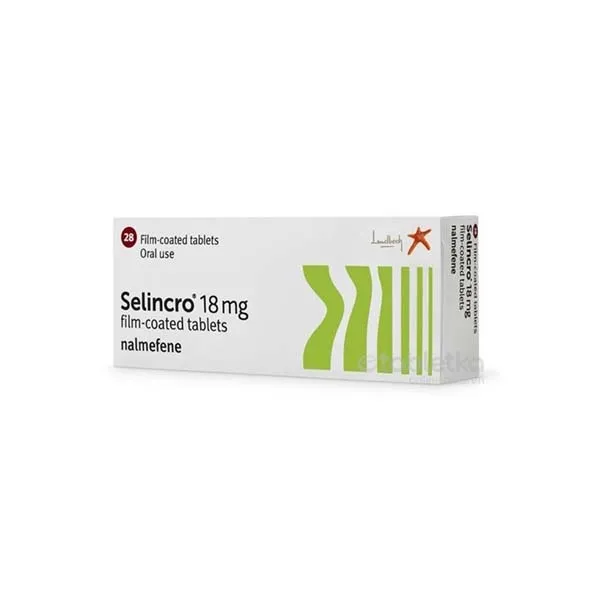
Table of Contents
Package leaflet: Information for the user
Introduction
Package leaflet: information for the patient
Selincro 18 mg film-coated tablets
nalmefene
Read the entire leaflet carefully before you start taking this medicine, as it contains important information for you.
- Keep this leaflet, as you may need to read it again.
- If you have any questions, ask your doctor or pharmacist.
- This medicine has been prescribed for you only, and you should not give it to others, even if they have the same symptoms as you, because it may harm them.
- If you experience any adverse effects, consult your doctor or pharmacist, even if they are adverse effects not listed in this leaflet. See section 4.
Leaflet contents
- What Selincro is and what it is used for
- What you need to know before taking Selincro
- How to take Selincro
- Possible side effects
- How to store Selincro
- Contents of the pack and other information
1. What Selincro is and what it is used for
Selincro contains the active substance nalmefene.
Selincro is used to reduce alcohol consumption in adult patients with alcohol dependence who still have a high level of alcohol consumption 2 weeks after their first consultation with their doctor.
Alcohol dependence occurs when a person has a physical or psychological dependence on drinking alcohol.
A high level of alcohol consumption is defined as consuming more than 60 g of pure alcohol per day in men and more than 40 g of pure alcohol per day in women. For example, one bottle of wine (750 ml; 12% vol. alcohol) contains approximately 70 g of alcohol, and one bottle of beer (330 ml; 5% vol. alcohol) contains approximately 13 g of alcohol.
Your doctor has prescribed Selincro because you have not been able to reduce your alcohol consumption on your own. Your doctor will provide you with advice to help you adhere to the treatment and thereby assist you in reducing your alcohol consumption.
Selincro works by acting on the brain processes responsible for your desire to continue drinking alcohol.
A high level of alcohol consumption is associated with an increased risk of health and social problems.
Selincro may help you reduce your alcohol consumption and maintain a lower level of alcohol intake.
2. What you need to know before taking Selincro
Do not take Selincro:
- If you are allergic to nalmefene or to any of the other components of this medicine (listed in section 6).
- If you are taking medications containing opioids, for example, methadone, buprenorphine, or analgesics (such as morphine, oxycodone, or other opioids).
- If you have or have recently had opioid dependence, as you may experience acute opioid withdrawal symptoms (such as feeling unwell, vomiting, tremors, sweating, and anxiety).
- If you are experiencing or suspect you are experiencing opioid withdrawal symptoms.
- In case of hepatic or renal impairment (liver or kidney dysfunction).
- If you are experiencing or have recently experienced several symptoms of alcohol withdrawal (such as seeing, hearing, or feeling things that do not exist, seizures, and tremors).
Warnings and precautions
Consult your doctor or pharmacist before starting to take Selincro. Inform your doctor about any other medical conditions you may have, such as depression, seizures, or liver or kidney disease.
If you and your doctor have decided that your immediate goal is abstinence (not drinking any alcohol), you should not take Selincro, as it is indicated for alcohol consumption reduction.
If you require emergency medical treatment, inform your doctor that you are taking Selincro. The use of Selincro may influence the choice of emergency treatment.
If you are scheduled for surgery, consult your doctor at least 1 week before the procedure. You may need to temporarily discontinue treatment with Selincro.
If you feel strange, see or hear things that are not real, and this persists for several days, stop taking Selincro and consult your doctor.
The increased risk of suicide in individuals with excessive alcohol consumption or substance abuse, with or without depression, is not reduced by taking nalmefene.
If you are 65 years of age or older, consult your doctor or pharmacist before starting to take Selincro.
Children and adolescents
Selincro must not be used in children or adolescents under 18 years of age, as Selincro has not been evaluated in this age group.
Taking Selincro with other medicines
Inform your doctor or pharmacist if you are taking, have recently taken, or might need to take any other medicines. Caution is required when taking drugs such as diclofenac (an anti-inflammatory medicine used to treat, for example, muscle pain), fluconazole (a medicine used to treat fungal infections), omeprazole (an agent used to block stomach acid production), or rifampicin (an antibiotic used to treat bacterial infections) together with Selincro.
If you take medicines containing opioids, their effect may be reduced or absent when taken together with Selincro. Such medicines include certain cough and cold preparations, specific anti-diarrheal medications, and strong analgesics.
Taking Selincro with food and alcohol
Selincro does not prevent the intoxicating effects of alcohol.
Pregnancy and breastfeeding
If you are pregnant or breastfeeding, think you might be pregnant, or are planning to become pregnant, consult your doctor or pharmacist before using this medicine.
It is unknown whether the use of Selincro is safe during pregnancy and breastfeeding.
If you are pregnant, Selincro is not recommended.
If you are breastfeeding, you and your doctor should decide whether to discontinue breastfeeding or discontinue treatment with Selincro, taking into account the benefits of breastfeeding for the child and the benefits of treatment for you.
Driving and using machines
Side effects such as attention disturbances, visual disturbances, abnormal sensations, nausea, dizziness, somnolence, insomnia, and headache may occur at the beginning of treatment with Selincro. Most of these reactions were mild or moderate, occurred at the start of treatment, and lasted from a few hours to a few days. These side effects may affect your ability to drive or perform any activity requiring alertness, including operating machinery.
Selincro contains lactose
If your doctor has diagnosed you with an intolerance to certain sugars, consult him before taking this medicine.
3. How to take Selincro
Follow exactly the instructions for using this medicine as given by your doctor or pharmacist. If in doubt, consult your doctor or pharmacist again.
Dosage
- The recommended dose is one tablet each day when you anticipate a risk of alcohol consumption.
- The maximum dose is one tablet per day.
How and when to take it
-
Selincro is for oral use.
-
You should take the tablet 1–2 hours before consuming alcohol.
-
Swallow the tablet whole. Do not break or crush it, as Selincro may cause skin sensitization when in direct contact with the skin.
-
You may take Selincro with or without food.
-
You may expect to be able to reduce your alcohol consumption within the first month after starting treatment with Selincro.
-
Your doctor will monitor you regularly, for example monthly from the start of treatment with Selincro; the actual frequency will depend on your progress. You and your doctor will decide together how to proceed.
If you take more Selincro than you should
If you think you have taken more Selincro tablets than you should, inform your doctor or pharmacist.
If you forget to take Selincro
If you have started drinking alcohol without taking Selincro, take one tablet as soon as possible.
If you stop taking Selincro
When you stop treatment with Selincro, you may be less sensitive for several days to the effects of medicines containing opioids.
If you have any further questions about the use of this medicine, ask your doctor or pharmacist.
4. Possible adverse effects
Like all medicines, Selincro may cause adverse effects, although not everyone experiences them.
Adverse effects related to seeing, hearing or feeling things that are not really there, or feeling detached from oneself, are uncommon (may affect up to 1 in 100 people). If you experience any of these adverse effects, consult your doctor.
Adverse effects reported with Selincro have mainly been of mild or moderate intensity, occurred at the beginning of treatment, and lasted from a few hours to a few days.
If you continue treatment with Selincro or restart it after an interruption, you are unlikely to experience adverse effects.
In some cases, you may find it difficult to distinguish between adverse effects and symptoms that may occur when reducing alcohol consumption.
The following adverse effects have been observed with Selincro:
Very common (may affect more than 1 in 10 people):
- feeling dizzy
- dizziness
- inability to sleep
- headache
Common (may affect up to 1 in 10 people):
- loss of appetite
- difficulty sleeping, confusion, restlessness, reduced libido
- drowsiness, body jerks, feeling less alert, unusual skin sensations such as tingling, reduced sense of touch
- rapid heartbeat, awareness of fast, especially strong or irregular heartbeat
- vomiting, dry mouth, diarrhoea
- excessive sweating
- muscle spasms
- feeling of exhaustion, weakness, discomfort or restlessness, feeling of strangeness
- weight loss
Other adverse effects of unknown frequency (frequency cannot be estimated from available data):
- visual disturbance (mainly transient)
- swelling of the face, lips, tongue or throat
- hives
- itching
- rash
- redness of the skin
- muscle pain
- prolonged erection (priapism)
Reporting of adverse effects
If you experience any type of adverse effect, consult your doctor or pharmacist, even if it is a possible adverse effect not listed in this leaflet. You may also report them directly via the Spanish Pharmacovigilance System for Human Medicines: www.notificaRAM.es. By reporting adverse effects, you can help provide more information on the safety of this medicine.
5. Storage of Selincro
-
Keep this medicine out of the sight and reach of children.
-
Do not use this medicine after the expiry date stated on the blister pack and outer carton, indicated by EXP or CAD. The expiry date refers to the last day of the month shown.
-
This medicine does not require any special storage conditions.
-
Do not use this medicine if you notice any visible signs of deterioration in the tablets, such as chipped or broken tablets.
-
Medicines must not be disposed of via wastewater or household waste. Ask your pharmacist how to properly dispose of unused medicines and their packaging. This helps protect the environment.
6. Contents of the pack and other information
Composition of Selincro
- Each film-coated tablet contains 18.06 mg of nalmefene (as hydrochloride dihydrate).
- Other components are:
Tablet core: microcrystalline cellulose, anhydrous lactose, crospovidone (type A), magnesium stearate.
The film coating contains: hypromellose, macrogol 400, titanium dioxide (E171).
Appearance of the product and contents of the pack
Selincro is a white, oval, biconvex film-coated tablet measuring 6.0 × 8.75 mm.
The tablet is marked with "S" on one side.
Selincro is available in packs of 7, 14, 28, 42, 49 or 98 tablets in blisters.
Only certain pack sizes may be marketed.
Marketing Authorization Holder
- Lundbeck A/S
Ottiliavej 9
DK-2500 Valby
Denmark
Manufacturer
- Lundbeck A/S
Ottiliavej 9
DK-2500 Valby
Denmark
Elaiapharm
2881, Route des Crêtes
Z.I. Les Bouillides
Sophia Antipolis
06560 Valbonne
France
Further information on this medicinal product is available upon request to the local representative of the Marketing Authorization Holder:
Spain Lundbeck España S.A. Tel: +34 93 494 9620 |
Other sources of information
Detailed information on this medicinal product is available on the website of the European Medicines Agency: http://www.ema.europa.eu.
Date of latest review of this leaflet: 01/2025