Selexid 400 mg film-coated tablets EFG
Spain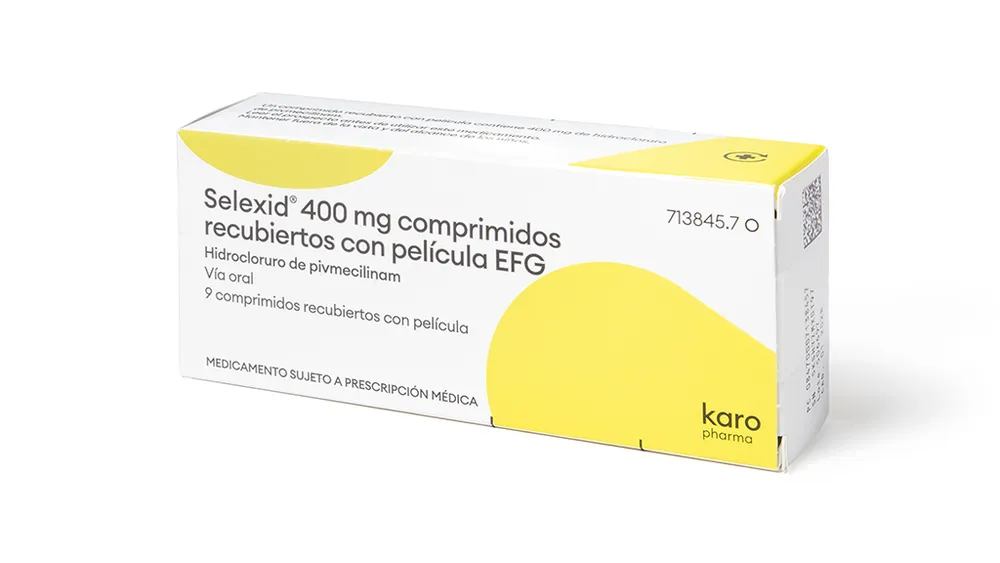
Table of Contents
- Patient Information Leaflet
- Introduction
- 1. What Selexid is and what it is used for
- 2. What you need to know before starting to take Selexid
- Your doctor may have prescribed a different use or dosage than what is indicated in this information. Follow exactly the instructions given by your doctor.
- 3. How to take Selexid
- **Follow exactly the administration instructions for this medicine as described in this leaflet or as indicated by your doctor or pharmacist. In case of doubt, ask your doctor, pharmacist, or nurse. You should take the medicine at regular intervals throughout the day. For example, if you are to take it three times a day, take it at breakfast, lunch, and dinner time. Selexid should be taken with at least half a glass of liquid. Your doctor will tell you how long you need to take Selexid tablets.**
- 4. Possible adverse effects
- 5. Storage of Selexid
- Keep this medicine out of the sight and reach of children.
- 6. Contents of the container and other information
Patient Information Leaflet
Introduction
Patient Information Leaflet
Selexid 400 mg film-coated tablets EFG
Pivmecillinam hydrochloride
Read the entire leaflet carefully before you start taking this medicine, as it contains important information for you.
- Keep this leaflet as you may need to read it again.
- If you have any questions, ask your doctor, pharmacist or nurse.
- This medicine has been prescribed for you only and must not be given to other people, even if they have the same symptoms as you, because it could harm them.
- If you experience any adverse effects, consult your doctor, pharmacist or nurse, even if they are adverse effects not listed in this leaflet. See section 4.
Leaflet Contents
- What Selexid is and what it is used for
- What you need to know before taking Selexid
- How to take Selexid
- Possible adverse effects
- How to store Selexid
- Contents of the pack and further information
1. What Selexid is and what it is used for
Selexid belongs to a group of medicines called penicillins. It is a type of antibiotic. Selexid works by killing germs (bacteria) that cause infections.
Antibiotics are used to treat bacterial infections and are not effective against viral infections. It is important to follow your doctor's instructions regarding dosage, administration intervals, and duration of treatment. Do not store or reuse this medication. If you have any antibiotic left after completing the treatment, return it to the pharmacy for proper disposal. Medicines must not be disposed of via the sink, toilet, or household waste. |
Selexid is used to treat bladder infections (cystitis) in adults.
2. What you need to know before starting to take Selexid
Your doctor may have prescribed a different use or dosage than what is indicated in this information. Follow exactly the instructions given by your doctor.
Do not take Selexid:
- If you are allergic (hypersensitive) to pivmecillinam or to any of the other ingredients of this medicine (listed in section 6).
- If you are allergic (hypersensitive) to other antibiotics. These antibiotics include penicillins and cephalosporins.
- If you have ever experienced a severe skin rash or skin peeling, blisters and/or mouth ulcers after taking Selexid 400 mg film-coated tablets EFG or other beta-lactam antibiotics (such as amoxicillin, penicillin V and flucloxacillin).
- If you have a narrowing of the digestive tract.
- If you have a disorder that may reduce the amount of a substance called carnitine in your body. Such disorders include carnitine transporter defect, methylmalonic aciduria and propionic acidemia.
Warnings and precautions
Talk to your doctor, pharmacist or nurse before starting to take Selexid. The tablets should be taken with at least half a glass of liquid to prevent the tablets from becoming lodged in the digestive tract.
Before starting treatment, inform your doctor:
- If you have porphyria.
- If you have recently used Selexid, as prolonged use may reduce the amount of carnitine in your body.
During treatment:
- Serious skin adverse reactions (SSARs), including Stevens-Johnson syndrome, toxic epidermal necrolysis and drug reaction with eosinophilia and systemic symptoms (DRESS), have been reported in association with treatment with Selexid 400 mg film-coated tablets EFG. Discontinue treatment with Selexid 400 mg film-coated tablets EFG and seek immediate medical attention if you experience any of the symptoms related to serious skin reactions described in section 4.
- If you suddenly develop diarrhea while taking Selexid, inform your doctor immediately. This may be due to inflammation of your intestine (colitis).
- Taking pivmecillinam shortly before delivery may affect the results of neonatal screening tests for inherited metabolic disorders and lead to a false positive. A "false positive" means the result incorrectly indicates that the baby has a disorder. There is no risk to the neonate, but you must inform your doctor that you have taken Selexid shortly before delivery.
Children and adolescents
Do not give this medicine to children and adolescents under 18 years of age, as the potential benefits may not outweigh the risks.
Taking Selexid with other medicines
Tell your doctor or pharmacist if you are taking, have recently taken, or might need to take any other medicines.
Inform your doctor or pharmacist if you are taking any of the following medicines:
- Probenecid (used to treat gout). This may enhance the effect of Selexid.
- Methotrexate (used to treat rheumatoid arthritis and cancer). The elimination of methotrexate from your body may be slower when used together with Selexid.
- Valproate or valproic acid (used to treat epilepsy). This increases the risk of low carnitine levels in your body when used together with Selexid.
- Other antibiotics (e.g., tetracyclines, erythromycin, other beta-lactam antibiotics).
These may influence the effect of Selexid.
Taking Selexid with food and drink
You may take this medicine with or immediately after a meal. Selexid should be taken with at least half a glass of water. It is important to take your medicine with plenty of liquid and well before going to bed. This will help prevent disturbances in the digestive tract.
Pregnancy, breastfeeding and fertility
If you are pregnant or breastfeeding, think you may be pregnant or are planning to become pregnant, consult your doctor or pharmacist before using this medicine.
Pregnancy
Selexid may be used during pregnancy.
There have been reports of some false positive results in neonatal screening tests, where the presence of isovaleric acidemia was simulated. Taking pivmecillinam shortly before delivery may affect the results of neonatal screening tests for inherited metabolic disorders and lead to a false positive. A "false positive" means the result incorrectly indicates that the baby has a disorder. There is no risk to the neonate, but you must inform your doctor that you have taken Selexid shortly before delivery.
Breastfeeding
Selexid may be used during breastfeeding.
Fertility
No clinical studies have been conducted regarding fertility.
Driving and using machines
The influence of Selexid on the ability to drive and use machines is none or negligible.
3. How to take Selexid
Follow exactly the administration instructions for this medicine as described in this leaflet or as indicated by your doctor or pharmacist. In case of doubt, ask your doctor, pharmacist, or nurse. You should take the medicine at regular intervals throughout the day. For example, if you are to take it three times a day, take it at breakfast, lunch, and dinner time. Selexid should be taken with at least half a glass of liquid. Your doctor will tell you how long you need to take Selexid tablets.
The recommended dose is 400 mg three times a day.
Elderly patients: Dose adjustment is not necessary.
In case of renal or hepatic impairment, dose adjustment is not necessary.
If you take more Selexid than you should
Inform your doctor immediately. You may need to stop taking this medicine. You may experience nausea, vomiting, or gastric disturbances.
In case of overdose or accidental ingestion, contact your doctor or pharmacist immediately or call the Toxicology Information Service at telephone number: 91 562 04 20, indicating the medicine and the amount ingested.
If you forget to take Selexid
If you forget to take your dose, take it as soon as you remember. Always take it with at least half a glass of water or other liquid. Then take your next dose at the usual time.
If you stop taking Selexid
It is very important that you take the full amount of medicine prescribed by your doctor. You must complete this treatment even if you feel better, because otherwise your symptoms may return.
If you have any further questions about the use of this medicine, ask your doctor, pharmacist, or nurse.
4. Possible adverse effects
Like all medicines, this medicine may cause adverse effects, although not everyone experiences them.
Serious adverse effects:
Stop treatment with Selexid and seek immediate medical attention if you notice any of the following symptoms:
- Severe allergic reactions (anaphylactic reactions, angioedema, anaphylactic shock): symptoms may include skin rash, swelling of the face, lips, tongue or throat, difficulty breathing or swallowing, fainting due to hypersensitivity. These reactions can be potentially life-threatening.
- Flat, red, target-shaped or circular spots on the trunk, often with central blisters, skin peeling, ulcers in the mouth, throat, nose, genitals and eyes. These severe skin rashes may be preceded by fever and flu-like symptoms (Stevens-Johnson syndrome or toxic epidermal necrolysis).
- Generalized rash, high body temperature and enlarged lymph nodes (DRESS syndrome or drug hypersensitivity syndrome).
- Severe, persistent bloody diarrhoea with stomach pain and fever (Clostridium difficile colitis).
Anaphylactic reactions and Clostridium difficile colitis are uncommon and may affect 1 in 100 people. The frequency of angioedema and anaphylactic shock is unknown.
Contact your doctor if you experience any of the following serious adverse effects:
- Bleeding of the skin and mucous membranes, as well as skin bruising due to blood changes (low platelet count) (thrombocytopenia). Uncommon: may affect 1 in 100 people.
Other adverse effects:
Common (may affect up to 1 in 10 people)
- Fungal vaginal infection
- Diarrhoea
- Nausea
Uncommon (may affect up to 1 in 100 people)
- Headache
- Dizziness
- Vertigo
- Vomiting
- Stomach pain
- Indigestion (digestive problems)
- Mouth or gastrointestinal tract ulcers, inflammation of the gastrointestinal tract
- Liver function disorders
- Changes in haematological or liver values
- Weakness or muscle loss. Fatigue or lack of energy. Low levels of carnitine in the body may cause these symptoms.
- Hives
- Itching
- Fatigue
Reporting of adverse effects
If you experience any adverse effect, consult your doctor, pharmacist or nurse, even if it is a possible adverse effect not listed in this leaflet. You may also report them directly via the Spanish Pharmacovigilance System for Human Medicinal Products: https://www.notificaram.es.
By reporting adverse effects, you can help provide more information on the safety of this medicine.
5. Storage of Selexid
Keep this medicine out of the sight and reach of children.
Do not use this medicine after the expiry date stated on the carton after EXP. The expiry date is the last day of the month indicated.
No special storage conditions are required.
Medicines must not be disposed of via wastewater or household waste. Dispose of empty containers and unused medicines at the SIGRE collection point in your pharmacy. If you are unsure, please ask your pharmacist how to properly dispose of containers and medicines you no longer need. This will help protect the environment.
6. Contents of the container and other information
Composition of Selexid
- The active substance is pivmecillinam hydrochloride. One Selexid tablet contains 400 mg of pivmecillinam hydrochloride.
- The other components are hydroxypropyl cellulose, hypromellose 6 cps, magnesium stearate, microcrystalline cellulose, simeticone emulsion 30%, and synthetic paraffin.
Appearance of the product and contents of the container
Selexid is a white, capsule-shaped, film-coated tablet measuring 8 x 17 mm.
Pack sizes:
9, 10, 15 and 20 tablets in blisters.
Only some pack sizes may be marketed.
Marketing Authorization Holder and Manufacturer
Marketing Authorization Holder:
Karo Pharma AB
Box 16184
103 24 Stockholm
Sweden
Manufacturer:
APL Strängnäs AB, Mariefredsvägen 35, S-645 41 Strängnäs, Sweden
For further information about this medicinal product, please contact the local representative of the Marketing Authorization Holder:
Laboratorios Gebro Pharma, S.A.
Avenida Tibidabo n° 29
08022 Barcelona
Spain
Tel. +34 93 205 86 86
This medicinal product is authorized in the European Economic Area member states under the following names:
Belgium: Selexid® 400 mg Tabletten
Denmark: Pivmecillinamhydrochlorid Karo Pharma
Netherlands: Selexid® 400 mg Filmomhulde tabletten
Ireland: Pivmecillinam hydrochloride Karo Pharma 400 mg film-coated tablets
Italy: XSYSTO®
Luxembourg: Selexid® 400 mg Comprimés pelliculés
Poland: X-SYSTO® 400 mg Tabletki powlekane
Spain: Selexid® 400 mg Comprimidos recubiertos con pelicula
Germany: X-SYSTO® 400 mg Filmtabletten
Date of the most recent review of this leaflet: February 2024
Detailed information on this medicinal product is available on the website of the Spanish Agency for Medicines and Health Products (AEMPS) http://www.aemps.gob.es/.