Secalip 145 mg film-coated tablets
Spain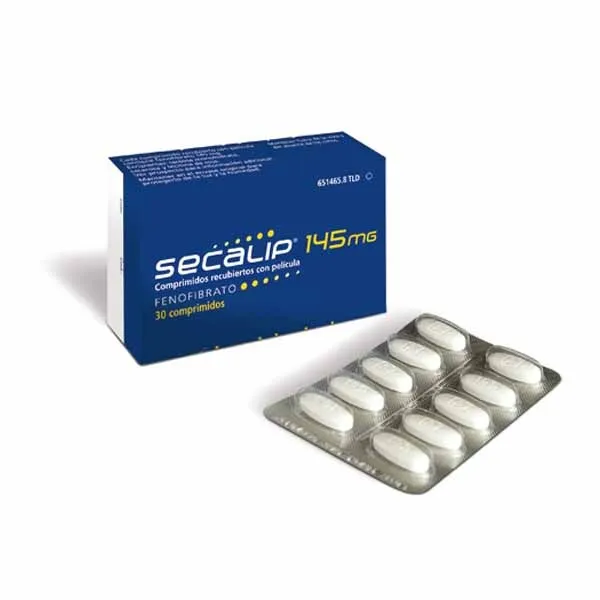
Table of Contents
- Package leaflet: Information for the user
- Introduction
- 1. What Secalip 145 mg film-coated tablets are and what they are used for
- 2. What you need to know before taking Secalip 145 mg film-coated tablets
- **Use of Secalip with other medicines**
- **Driving and operating machinery**
- 3. How to take Secalip 145 mg film-coated tablets
- 4. Possible adverse effects
- 5. Storage of Secalip 145 mg film-coated tablets
- 6. Contents of the pack and other information
- Marketing Authorization Holder
Package leaflet: Information for the user
Introduction
Package leaflet: information for the user
Secalip 145 mg film-coated tablets
Fenofibrate
Read the entire leaflet carefully before you start taking this medicine because it contains important information for you.
- Keep this leaflet as you may need to read it again.
- If you have any questions, ask your doctor or pharmacist.
- This medicine has been prescribed for you only and must not be given to other people, even if they have the same symptoms as you, because it could harm them.
- If you experience any adverse effects, consult your doctor or pharmacist, even if they are effects not listed in this leaflet. See section 4.
Leaflet contents:
-
What Secalip 145 mg film-coated tablets are and what they are used for
-
What you need to know before taking Secalip 145 mg film-coated tablets
-
How to take Secalip 145 mg film-coated tablets
-
Possible adverse effects
-
How to store Secalip 145 mg film-coated tablets
-
Contents of the pack and other information
1. What Secalip 145 mg film-coated tablets are and what they are used for
Secalip belongs to a group of medicines commonly known as fibrates. These medicines are used to reduce the level of fats (lipids) in the blood, for example, fats called triglycerides.
Secalip is used, together with a low-fat diet and other non-medical treatments such as exercise and weight loss, to reduce fat levels in the blood.
Secalip may be used in combination with other medicines [statins] in certain circumstances when a statin alone does not control fat levels in the blood.
2. What you need to know before taking Secalip 145 mg film-coated tablets
Do not take Secalip if:
- you are allergic to fenofibrate or any of the other ingredients of this medicine (listed in section 6: Contents of the container and additional information)
- you are allergic to peanuts, peanut oil, soy lecithin, or related products
- you have previously experienced an allergic reaction or skin injury caused by sunlight or UV light while taking other medicines (such as other fibrates or an anti-inflammatory medicine called ketoprofen)
- you have severe liver or kidney disease or gallbladder problems
- you have pancreatitis (inflammation of the pancreas causing abdominal pain) not caused by high levels of fat in the blood
Do not take Secalip if any of the above apply to you. If you are unsure, consult your doctor or pharmacist before taking Secalip.
Warnings and precautions
Talk to your doctor or pharmacist before starting to take Secalip if:
- you have kidney or liver problems
- you may have liver inflammation (hepatitis)—symptoms include yellowing of the skin and whites of the eyes (jaundice), increased liver enzymes (seen in blood tests), stomach pain, and itching
- you have an underactive thyroid gland (hypothyroidism)
If any of the above apply to you (or if you have any doubts), consult your doctor or pharmacist before taking Secalip.
Secalip and muscle effects
Stop taking Secalip and contact your doctor immediately if you experience:
- unexplained muscle cramps
- muscle pain, tenderness, or weakness while taking this medicine.
This is because this medicine may cause muscle problems, which can be serious.
These problems are rare but may include inflammation and breakdown of muscle tissue. This can lead to kidney damage or even death.
Your doctor may perform blood tests to check your muscles before and after starting treatment.
The risk of muscle problems is higher in some patients. Specifically, consult your doctor if:
- you are over 70 years old
- you have kidney problems
- you have thyroid problems
- you or a close family member has a hereditary muscle disorder
- you drink large amounts of alcohol
- you are taking medicines called "statins" to lower cholesterol (such as simvastatin, atorvastatin, pravastatin, rosuvastatin, or fluvastatin)
- you have previously experienced muscle problems during treatment with statins or fibrates (such as fenofibrate, bezafibrate, or gemfibrozil).
If any of the above apply to you (or if you have any doubts), consult your doctor or pharmacist before taking Secalip.
Use of Secalip with other medicines
Inform your doctor or pharmacist if you are using, have recently used, or might need to take any other medicines.
In particular, inform your doctor or pharmacist if you are taking any of the following medicines:
- anticoagulants to reduce blood clotting (such as warfarin)
- other medicines used to control blood lipid levels (such as statins or fibrates). This is because taking a statin or another fibrate together with Secalip may increase the risk of muscle problems
- a type of medicine used to treat diabetes (such as rosiglitazone or pioglitazone)
- cyclosporine (an immunosuppressant)
If any of the above circumstances apply to you (or if you have any doubts), consult your doctor or pharmacist before taking Secalip.
Pregnancy and breastfeeding
Tell your doctor if you are pregnant, think you may be pregnant, or are planning to become pregnant. This is because it is unknown how Secalip may affect the newborn. Secalip should only be used if prescribed by your doctor.
You must not take Secalip if you are breastfeeding or planning to breastfeed. This is because it is unknown whether Secalip passes into breast milk.
Driving and operating machinery
This medicine does not affect your ability to drive or operate tools or machinery.
Secalip contains sucrose, lactose, and soybean oil
Secalip contains the sugars lactose and sucrose. If your doctor has informed you of an intolerance to certain sugars, consult with him before taking this medicine.
Secalip contains soybean oil. It must not be used if you are allergic to peanuts or soy.
This medicine contains less than 23 mg of sodium (1 mmol) per tablet; hence, it is essentially "sodium-free".
3. How to take Secalip 145 mg film-coated tablets
Follow exactly the instructions for use of this medicine provided by your doctor or pharmacist. If in doubt, consult your doctor or pharmacist again.
Your doctor will determine the appropriate dose for you, depending on your condition, your current treatment, and your personal risk status.
How to take the medicine
The tablet may be taken with or without food at any time of day.
- Swallow the tablet with a glass of water.
- Do not crush or chew the tablet.
Remember that in addition to taking Secalip, it is also important that you:
-
follow a low-fat diet.
-
exercise regularly.
How much to take
The recommended dose is one tablet per day.
If you are currently taking a Secalip 200 mg capsule or a Secalip Supra 160 mg tablet daily, you may switch to one Secalip 145 mg tablet per day. You will continue to receive the same amount of medication.
Patients with kidney problems
If you have kidney problems, your doctor may instruct you to take a lower dose. Consult your doctor or pharmacist about this.
Use in children and adolescents
The use of Secalip is not recommended in children and adolescents under 18 years of age.
If you take more Secalip than you should
Contact your doctor, pharmacist, or call the Toxicology Information Service at telephone number 91.562.04.20 immediately, indicating the medicine and the amount taken.
It is recommended to bring the medicine packaging and leaflet to the healthcare professional.
If you forget to take Secalip
- If you forget to take a dose, take the next dose at the usual time.
- Do not take a double dose to make up for forgotten doses.
If you stop taking Secalip
Do not stop taking Secalip unless your doctor tells you to, or if the tablets make you feel unwell. This is because long-term treatment is required.
If your doctor discontinues the medicine, do not keep the remaining tablets unless your doctor instructs you to. If you have any other questions about the use of this medicine, ask your doctor or pharmacist.
4. Possible adverse effects
Like all medicines, this medicine can cause adverse effects, although not everyone experiences them.
Stop taking Secalip and see your doctor immediately if you notice any of the following serious adverse effects – you may need urgent medical treatment:
Uncommon: may affect up to 1 in 100 people
- muscle cramps or pain, tenderness, or weakness – these may be signs of muscle inflammation or breakdown, which can lead to kidney damage or even death
- stomach pain – this may be a sign that the pancreas is inflamed (pancreatitis)
- chest pain and shortness of breath – these may be signs of a blood clot in the lungs (pulmonary embolism)
- pain, redness, or swelling in the legs – these may be signs of a blood clot in the leg (deep vein thrombosis)
Rare: may affect up to 1 in 1,000 people
- allergic reaction – signs may include swelling of the face, lips, tongue, or throat, which may cause difficulty breathing
- yellowing of the skin and whites of the eyes (jaundice), or increased liver enzymes – these may be signs of liver inflammation (hepatitis)
Not known: frequency cannot be estimated from available data
- severe skin rash that reddens, peels, and swells the skin and resembles a severe burn
- long-term lung problems
Stop taking Secalip and see your doctor immediately if you notice any of the above adverse effects.
Other adverse effects:
Consult your doctor or pharmacist if you experience any of the following adverse effects:
Common: may affect up to 1 in 10 people
- diarrhoea
- stomach pain
- gas (flatulence)
- feeling unwell (nausea)
- discomfort (vomiting)
- elevated liver enzymes in the blood – seen in blood tests
- increased homocysteine (elevated levels of this amino acid in the blood have been associated with a higher risk of coronary heart disease, stroke, and peripheral vascular disease, although a causal relationship has not been established)
Uncommon: may affect up to 1 in 100 people
- headache
- gallstones
- decreased sexual desire
- skin reactions such as rash, itching, or hives
- increased creatinine (a substance excreted by the kidneys) – seen in blood tests
Rare: may affect up to 1 in 1,000 people
- hair loss
- increased urea (produced by the kidneys) – seen in blood tests
- skin becoming more sensitive to sunlight, sunlamps, and solariums
- decrease in haemoglobin (which carries oxygen in the blood) and decrease in white blood cells – seen in blood tests
Not known: frequency cannot be estimated from available data
- muscle wasting
- complications related to gallstones
- feeling of exhaustion (fatigue)
Consult your doctor or pharmacist if you experience any of the adverse effects listed above.
Reporting of adverse effects
If you experience any adverse effect, talk to your doctor, pharmacist, or nurse, even if it is a possible adverse effect not listed in this leaflet. You can also report them directly via the Spanish Pharmacovigilance System for Human Medicinal Products: www.notificaram.es.
By reporting adverse effects, you can help provide more information on the safety of this medicine.
5. Storage of Secalip 145 mg film-coated tablets
Keep this medicine out of the sight and reach of children.
Store below 30ºC.
Do not use this medicine after the expiry date stated on the packaging and blister after EXP. The expiry date refers to the last day of the month indicated.
Medicines should not be disposed of via wastewater or household waste. Dispose of unused containers and medicines at the SIGRE Point at your pharmacy. If you have any doubts, ask your pharmacist how to dispose of containers and medicines you no longer need. This will help protect the environment.
6. Contents of the pack and other information
Composition of Secalip
The active substance is fenofibrate. One tablet contains 145 mg of fenofibrate.
The other components are sucrose, monohydrated lactose, silicified microcrystalline cellulose, crospovidone, hypromellose, sodium lauryl sulfate, sodium docusate and magnesium stearate. The film coating Opadry® is composed of: polyvinyl alcohol, titanium dioxide (E-171), talc, soy lecithin, xanthan gum.
Appearance of the product and contents of the pack
Secalip 145 mg film-coated tablets are presented as white, oblong tablets, with "145" engraved on one side and the "Fournier" logo on the other.
Film-coated tablets are available in blister packs of 10, 20, 28, 30, 50, 84, 90, 98, 100, 280, 300 tablets.
Not all pack sizes may be marketed.
Marketing Authorization Holder and Manufacturer
Marketing Authorization Holder
LACER, S.A. - Boters, 5
08290 Cerdanyola del Vallès
Barcelona – Spain
Manufacturing Responsibility Holder
Astrea Fontaine
Rue des Prés Potets
21121 Fontaine-les-Dijon (France)
or
Mylan Laboratories SAS
Route de Belleville
Lieu-dit Maillard
01400 Châtillon-sur-Chalaronne
France
or
Mylan Hungary Kft.
Mylan utca 1.
Komárom, 2900
Hungary
This medicinal product is authorized in EU Member States under the following names:
Germany: Lipidil 145 One
Austria: Lipanthyl Nanoparticles 145 mg
Belgium: Lipanthylnano 145 mg
Luxembourg: Lipanthylnano 145 mg
Czech Republic: Lipanthyl NT 145 mg
Finland: Lipanthyl Penta 145 mg
France: Lipanthyl 145 mg
Greece: Lipidil NT 145 mg
Hungary: Lipanthyl NT 145 mg
Ireland: Lipantil Supra 145 mg
Italy: Fulcrosupra 145 mg
Poland: Lipanthyl NT 145 mg
Portugal: Lipanthyl 145 mg
Slovak Republic: Lipanthyl NT 145 mg
Spain: Secalip 145 mg
This leaflet was last reviewed in December 2020
Detailed and up-to-date information on this medicinal product is available on the website of the Spanish Agency of Medicines and Medical Devices (AEMPS) http://www.aemps.gob.es