Sarcop 50 mg/g cream
Spain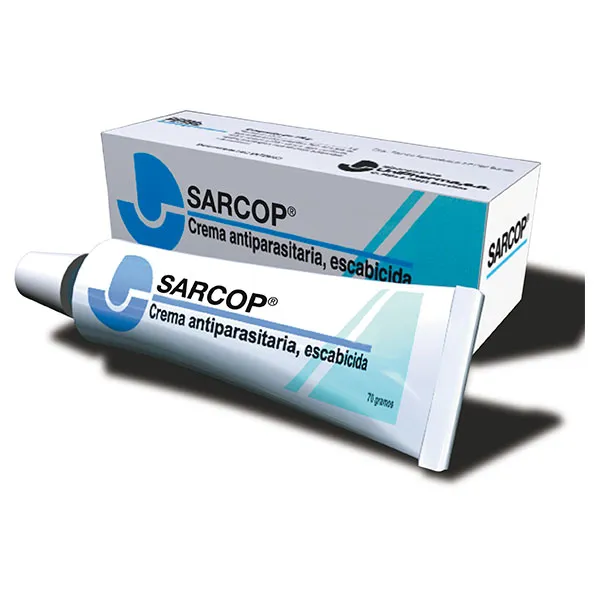
Table of Contents
Package leaflet: Information for the user
Introduction
Package leaflet: information for the user
Sarcop 50 mg/g Cream
Permethrin
Read the entire leaflet carefully before you start using this medicine, because it contains important information for you.
- Keep this leaflet, as you may need to read it again.
- If you have any questions, ask your doctor or pharmacist.
- This medicine has been prescribed for you only, and you should not give it to other people even if they have the same symptoms as you, because it may harm them.
- If you experience any adverse effects, consult your doctor or pharmacist, even if they are effects not listed in this leaflet. See section 4.
Leaflet contents
- What Sarcop Cream is and what it is used for
- What you need to know before using Sarcop Cream
- How to use Sarcop Cream
- Possible side effects
- How to store Sarcop Cream
- Contents of the pack and other information
1. What Sarcop Cream is and what it is used for
It contains the active substance permethrin, an antiparasitic agent effective against various parasites such as Sarcoptes scabiei, a mite that causes scabies.
Sarcop is indicated for the local treatment of scabies infestations (a skin disease).
2. What you need to know before using Sarcop Cream
Do not use Sarcop
- If you are allergic to permethrin, to other pyrethrins (both synthetic and natural), or to any of the other ingredients of this medicine (listed in section 6).
Warnings and precautions
Talk to your doctor or pharmacist before using Sarcop.
-
Scabies is usually accompanied by itching, swelling, and redness of the skin (erythema). Treatment with Sarcop may temporarily increase these symptoms. Although these manifestations usually disappear once the scabies is eliminated, they may persist for a period of about 2 to 4 weeks due to a hypersensitivity reaction. If symptoms persist longer, you should consult your doctor.
-
If you know you are allergic to chrysanthemums or to other plants of the Compositae family, Sarcop should only be used after consulting your doctor.
-
This medicine is intended for single application only. A second application should only be performed if prescribed by your doctor.
- Caregivers are advised to wear gloves when applying the cream.
-
Avoid contact of Sarcop with the eyes. If contact occurs, rinse the eyes immediately with plenty of water.
-
Do not apply on wounds or mucous membranes (such as inside the nose, mouth, or vagina), or in cases of persistent skin irritation.
Children up to 23 months of age
Do not use Sarcop in newborns and infants under 2 months of age, unless specifically instructed by your doctor. There is insufficient experience in infants. Treatment in children up to 23 months of age should only be administered under close medical supervision.
Other medicines and Sarcop
Inform your doctor or pharmacist if you are using, have recently used, or might need to use any other medicines.
No interactions with other medicines are known.
Pregnancy, breastfeeding, and fertility
If you are pregnant or breastfeeding, think you may be pregnant, or are planning to become pregnant, consult your doctor or pharmacist before using this medicine.
There is no experience in pregnant women; therefore, Sarcop should only be used during pregnancy if recommended by your doctor as strictly necessary.
It is not known whether this medicine passes into breast milk. Your doctor will decide whether breastfeeding should be discontinued or whether treatment with Sarcop should be stopped, taking into account the benefits of breastfeeding for the child and the benefits of treatment for the mother.
Driving and using machines
Sarcop does not affect your ability to drive or operate machinery.
Sarcop contains cetostearyl alcohol, macrogol glycerol ricinoleate (polyoxylated castor oil), sodium cetearil sulfate, propyl, ethyl, methyl, and butyl parahydroxybenzoates (E216, E214, E218), and propylene glycol
This medicine may cause skin reactions because it contains polyoxylated castor oil.
This medicine may cause local skin reactions (such as contact dermatitis) because it contains cetostearyl alcohol.
It may cause allergic reactions (possibly delayed) because it contains propyl, ethyl, methyl, and butyl parahydroxybenzoates.
This medicine contains 40 mg of propylene glycol per 1 g of cream. Propylene glycol may cause skin irritation. Do not use this medicine in infants under 4 weeks of age with open wounds or large areas of damaged skin (such as burns) without first consulting your doctor or pharmacist.
3. How to use Sarcop Cream
Follow exactly the administration instructions for this medicine as indicated by your doctor. If in doubt, consult your doctor or pharmacist again.
For topical use only.
One tube is usually sufficient for a standard treatment.
The recommended dose is:
Adults and children over 2 months of age: approximately 30 grams of cream are usually sufficient for one application.
Use in children
Do not apply Sarcop to children under two months of age. (See section 2).
The medicine should be applied as described below.
Prevent children from sucking the cream off their hands. If necessary, it is advisable to use gloves on children.
Use in patients over 65 years of age
No special precautions or dose adjustments are required for individuals over 65 years of age.
Instructions for use:
Apply Sarcop Cream over the entire body, in a thin layer, from the lower part of the neck down to the soles of the feet, avoiding the face and head. However, in children and elderly patients, the scalp and face may sometimes be affected; in such cases, apply the cream also to the scalp, neck, forehead, and temples.
Pay special attention when applying the medicine to areas most affected by the disease, such as the spaces between the fingers, palms and soles of the hands and feet, armpits, groin, testicles, and anal groove (always avoiding mucous membranes, both genital and anal). Note that the nails may harbor the parasites that caused scabies or their eggs, as they may have been transferred during scratching; therefore, you should also apply the cream under and around the nails.
Avoid contact of Sarcop with the eyes, mucous membranes, sensitive skin areas, and wounds.
Only one application is required. Do not bathe or shower until at least 12 hours after applying the cream; you may then shower or bathe. It is recommended to use lukewarm water when washing.
Note that itching may persist after treatment for scabies due to increased sensitivity. This itching will gradually subside.
Take care to change clothes and bed linens daily to avoid re-infection. Clothes can be washed normally in the washing machine. Be aware of the potential for transmission of scabies among family members.
It is recommended that you consult your doctor for a follow-up examination 2 to 4 weeks after treatment.
If you use more Sarcop than you should
If you have used more Sarcop than recommended or in case of accidental ingestion, contact your doctor or pharmacist immediately, call the Toxicology Information Service at telephone number 91 562 04 20, indicating the medicine and amount used, or go to a medical center.
In case of accidental ingestion of Sarcop, gastric lavage and general supportive measures are recommended.
If you forget to use Sarcop
Do not use a double dose to make up for missed doses.
If you have any further questions about the use of this medicine, ask your doctor or pharmacist.
4. Possible adverse effects
Like all medicines, this medicine can cause adverse effects, although not everyone experiences them.
Cases have been reported of patients experiencing itching and/or irritation lasting for two weeks. If these symptoms persist longer, you should consult the doctor who prescribed the treatment.
Very common adverse effects (may affect more than 1 in 10 people) include transient burning and itching sensations after application, as well as itching occurring at various times after application, redness, and numbness.
Common adverse effects: skin sensations (paresthesia) such as tingling, prickling, or burning sensation on the skin.
Reporting of adverse effects
If you experience any type of adverse effect, consult your doctor or pharmacist, even if it is a possible adverse effect not listed in this leaflet. You may also report them directly via the Spanish Pharmacovigilance System for Human Medicinal Products: https://www.notificaram.es
By reporting adverse effects, you can help provide more information on the safety of this medicine.
5. Storage of Sarcop Cream
Keep this medicine out of sight and reach of children.
No special storage conditions are required.
Do not use this medicine after the expiry date stated on the packaging after EXP. The expiry date is the last day of the month indicated.
Medicines must not be disposed of via wastewater or household waste. Unused containers and medicines should be returned to the SIGRE collection point at your pharmacy. If you are unsure, please ask your pharmacist how to dispose of containers and medicines you no longer need. This will help protect the environment.
6. Contents of the container and other information
Composition of Sarcop
-The active substance is permethrin. Each gram of cream contains 50 mg of permethrin (5%).
-The other components (excipients) are: cetostearyl alcohol, macrogol glycerol ricinoleate, sodium cetearil sulphate, deionized water, mineral oil, propylene glycol, and propyl p-hydroxybenzoate (E216), ethyl p-hydroxybenzoate (E214), methyl p-hydroxybenzoate (E218), butyl p-hydroxybenzoate, and phenoxyethanol.
Appearance of the product and contents of the container
Sarcop is presented as a cream that is homogeneous, white, smooth, and easy to spread.
Aluminum tube containing 40 or 70 g of cream, depending on the presentation.
Marketing Authorization Holder and Manufacturer
Marketing Authorization Holder
Unipharma, S.A.
C/ Lagasca, 26
28001 Madrid
Manufacturer
Industria Química y Farmacéutica VIR, S.A.
C/ Laguna 66-68-70, Pol. Industrial Urtinsa II
28923 - Alcorcón (Madrid)
LABORATORIOS BOHM, S.A.
C/ Molinaseca, 23. Pol. Industrial Cobo Calleja
28947 - Fuenlabrada (Madrid)
Date of the most recent review of this leaflet: April 2024
Detailed information on this medicinal product is available on the website of the Spanish Agency for Medicines and Health Products (AEMPS) http://www.aemps.es/