Saphnelo 300 mg concentrate for solution for infusion
Spain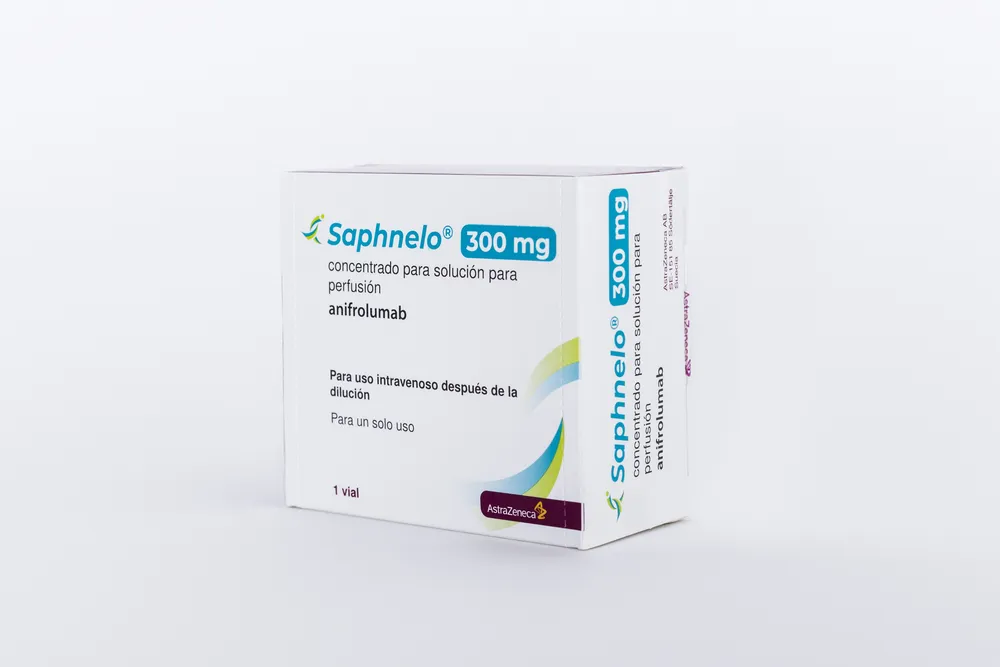
Table of Contents
Package leaflet: Information for the user
Introduction
Package leaflet: information for the patient
Saphnelo 300 mg concentrate for solution for infusion
anifrolumab
This medicinal product is subject to additional monitoring, which will allow quicker detection of new safety information. You can help by reporting any adverse reactions you may experience. Information on how to report adverse reactions is included at the end of section 4.
Read all of this leaflet carefully before you are given this medicine, because it contains important information for you.
- Keep this leaflet, as you may need to read it again.
- If you have any questions, ask your doctor or nurse.
- If you experience any adverse reaction, talk to your doctor or nurse, even if it is a possible adverse reaction not listed in this leaflet. See section 4.
Contents of this leaflet
- What Saphnelo is and what it is used for
- What you need to know before you are given Saphnelo
- How to use Saphnelo
- Possible side effects
- How to store Saphnelo
- Contents of the pack and other information
1. What Saphnelo is and what it is used for
What Saphnelo is
Saphnelo contains the active substance anifrolumab, a "monoclonal antibody" (a type of specialised protein that binds to a specific target in the body).
What Saphnelo is used for
Saphnelo is used to treat moderate to severe lupus (systemic lupus erythematosus, SLE) in adults whose disease is not well controlled with conventional treatments ("oral corticosteroids", "immunosuppressants" and/or "antimalarials").
Saphnelo will be given to you in addition to your usual lupus treatment.
Lupus is a disease in which the system that fights infections (the immune system) attacks your own cells and tissues. This causes inflammation and damage to organs. It can affect almost any organ in the body, such as the skin, joints, kidneys, brain, and other organs. It can cause pain, rashes, joint swelling, fever, and make you feel very tired or weak.
How Saphnelo works
People with lupus have high levels of proteins called "type I interferons" that stimulate immune system activity. Anifrolumab binds to a target (receptor) through which these proteins act, preventing them from working. Blocking their action in this way may reduce the inflammation in your body that causes the signs of lupus.
Benefits of using Saphnelo
Saphnelo may help reduce lupus activity and the number of flares you experience. If you are taking medicines called "oral corticosteroids", using Saphnelo may also allow your doctor to reduce the daily dose of oral corticosteroids needed to help control your lupus.
2. What you need to know before you are given Saphnelo
You should not receive Saphnelo
- if you are allergic to anifrolumab or any of the other ingredients of this medicine (listed in section 6). Speak to your doctor or nurse if you have any doubts.
Warnings and precautions
Talk to your doctor or nurse before you are given Saphnelo:
- if you think you have ever had an allergic reaction to this medicine (see further in "Monitoring for possible signs of severe allergic reactions and infections" below).
- if you develop an infection or have symptoms of an infection (see further in "Monitoring for possible signs of severe allergic reactions and infections" below).
- if you have a long-lasting infection or an infection that keeps recurring.
- if lupus affects your kidneys or nervous system.
- if you have or have had cancer.
- if you have recently been vaccinated or are planning to be vaccinated. You should not receive certain types of vaccines (vaccines containing "live" or "live attenuated" microorganisms) while being treated with this medicine.
- if you are receiving another biological medicine (such as belimumab for your lupus).
If you are unsure whether any of the above apply to you, talk to your doctor or nurse before you are given Saphnelo.
Monitoring for signs of severe allergic reactions and infections
Saphnelo may cause severe allergic reactions (anaphylaxis) – see section 4. Contact your doctor immediately if you think you may be having a severe allergic reaction. Signs may include:
- swelling of the face, tongue, or mouth
- difficulty breathing
- feeling faint, dizzy, or lightheaded (due to a drop in blood pressure).
You may have an increased risk of developing an infection while being treated with Saphnelo. Tell your doctor or nurse as soon as possible if you notice signs of any possible infection, including:
- fever or flu-like symptoms
- muscle aches
- cough or shortness of breath (may be signs of a respiratory tract infection, see section 4)
- burning when urinating or urinating more frequently than usual
- diarrhea or stomach pain
- a painful, red skin rash (may be a sign of shingles, see section 4).
Children and adolescents
Do not give this medicine to children and adolescents under 18 years of age, as it has not been studied in this age group.
Other medicines and Saphnelo
- Inform your doctor if you are taking, have recently taken, or might need to take any other medicines.
- Inform your doctor if you have recently been vaccinated or are planning to be vaccinated. You should not receive certain types of vaccines while using this medicine. If you are unsure, consult your doctor or nurse before and during treatment with Saphnelo.
Pregnancy and breastfeeding
If you are pregnant or breastfeeding, think you may be pregnant, or are planning to become pregnant, consult your doctor before using this medicine.
Pregnancy
It is unknown whether Saphnelo could be harmful to the unborn baby.
- Before starting treatment with Saphnelo, inform your doctor if you are pregnant or think you might be pregnant. Your doctor will decide whether you can be given this medicine.
- Talk to your doctor if you plan to become pregnant while being treated with this medicine.
- If you become pregnant while being treated with Saphnelo, inform your doctor. They will advise you whether you should stop treatment with this medicine.
Breastfeeding
- Before starting treatment with Saphnelo, inform your doctor if you are breastfeeding. It is unknown whether this medicine passes into breast milk. Your doctor will advise you whether you should stop treatment with this medicine during breastfeeding or whether you should stop breastfeeding.
Driving and using machines
It is unlikely that this medicine will affect your ability to drive or use machines.
Saphnelo contains polysorbate
This medicine contains 1 mg of polysorbate 80 (E 433) per vial, equivalent to 0.5 mg/ml. Polysorbates may cause allergic reactions. Inform your doctor if you have any known allergies.
3. How to use Saphnelo
A nurse or doctor will administer Saphnelo to you.
- The recommended dose is 300 mg.
- It is given as an intravenous infusion (a drip into a vein) over 30 minutes.
- It is administered every 4 weeks.
If you miss an appointment for Saphnelo administration, contact your doctor as soon as possible to schedule another appointment.
Discontinuation of treatment with Saphnelo
Your doctor will decide whether you should stop receiving this medicine.
If you have any further questions about how to use this medicine, ask your doctor or nurse.
4. Possible adverse effects
Like all medicines, this medicine can cause adverse effects, although not everyone will experience them.
Severe allergic reactions:
Severe allergic reactions (anaphylaxis) are uncommon (may affect up to 1 in 100 people). Seek immediate medical attention or go to the nearest emergency room if you experience any of the following signs of a severe allergic reaction:
- swelling of the face, tongue, or mouth
- difficulty breathing
- feeling faint, dizzy, or lightheaded (due to a drop in blood pressure).
Other adverse effects:
Inform your doctor or nurse if you notice any of the following adverse effects.
Very common (may affect more than 1 in 10 people)
- nose or throat infections
- chest infection (bronchitis)
Common (may affect up to 1 in 10 people)
- infections of the sinuses or lungs
- shingles (a red rash which may cause pain and burning)
- allergic reactions (hypersensitivity)
- infusion-related reactions: may occur during or shortly after the infusion; symptoms may include headache, feeling sick (nausea), vomiting, severe tiredness or weakness (fatigue), and dizziness.
Frequency not known (cannot be estimated from available data)
- joint pain (arthralgia)
Reporting of adverse effects
If you experience any type of adverse effect, consult your doctor or nurse, even if it is a possible adverse effect not listed in this leaflet. You may also report them directly through the national reporting system listed in Appendix V. By reporting adverse effects, you can help provide more information on the safety of this medicine.
5. Storage of Saphnelo
The physician, nurse, or pharmacist is responsible for the storage of this medicine. The storage details are as follows:
- Do not use this medicine after the expiry date stated on the vial and carton label after "EXP/CAD". The expiry date refers to the last day of the month indicated.
- Keep this medicine out of the sight and reach of children.
- Store in a refrigerator (between 2 °C and 8 °C).
- Do not freeze, shake, or expose to heat.
- Store in the original packaging to protect from light.
6. Contents of the container and other information
Composition of Saphnelo
- The active substance is anifrolumab. Each vial contains 300 mg of anifrolumab.
- The other components are histidine, histidine monohydrochloride monohydrate, lysine hydrochloride, trehalose dihydrate, polysorbate 80 (E 433) (see section 2 “Saphnelo contains polysorbate”), and water for injections.
Nature of the product and contents of the container
Saphnelo is supplied as a concentrated solution that is clear to opalescent, colourless or slightly yellowish.
Saphnelo is available in packs containing 1 vial.
Marketing Authorization Holder
AstraZeneca AB
SE-151 85 Södertälje
Sweden
Manufacturer responsible
AstraZeneca AB
Gärtunavägen
SE-152 57 Södertälje
Sweden
Further information on this medicinal product is available upon request by contacting the local representative of the Marketing Authorization Holder:
Belgium/Belgium/Belgium AstraZeneca S.A./N.V. Tel: +32 2 370 48 11 | Lithuania UAB AstraZeneca Lietuva Tel: +370 5 2660550 |
| Luxembourg/Luxembourg AstraZeneca S.A./N.V. Tél/Tel: +32 2 370 48 11 |
Czech Republic AstraZeneca Czech Republic s.r.o. Tel: +420 222 807 111 | Hungary AstraZeneca Kft. Tel.: +36 1 883 6500 |
Denmark AstraZeneca A/S Tlf.: +45 43 66 64 62 | Malta Associated Drug Co. Ltd Tel: +356 2277 8000 |
Germany AstraZeneca GmbH Tel: +49 40 809034100 | Netherlands AstraZeneca BV Tel: +31 85 808 9900 |
Estonia AstraZeneca Tel: +372 6549 600 | Norway AstraZeneca AS Tlf: +47 21 00 64 00 |
Greece AstraZeneca A.E. Tel: +30 210 6871500 | Austria AstraZeneca Österreich GmbH Tel: +43 1 711 31 0 |
Spain AstraZeneca Farmacéutica Spain, S.A. Tel: +34 91 301 91 00 | Poland AstraZeneca Pharma Poland Sp. z o.o. Tel.: +48 22 245 73 00 |
France AstraZeneca Tél: +33 1 41 29 40 00 | Portugal AstraZeneca Produtos Farmacêuticos, Lda. Tel: +351 21 434 61 00 |
Croatia AstraZeneca d.o.o. Tel: +385 1 4628 000 | Romania AstraZeneca Pharma SRL Tel: +40 21 317 60 41 |
Ireland AstraZeneca Pharmaceuticals (Ireland) DAC Tel: +353 1609 7100 | Slovenia AstraZeneca UK Limited Tel: +386 1 51 35 600 |
Iceland Vistor Sími: +354 535 7000 | Slovakia AstraZeneca AB, o.z. Tel: +421 2 5737 7777 |
Italy AstraZeneca S.p.A. Tel: +39 02 00704500 | Finland AstraZeneca Oy Puh/Tel: +358 10 23 010 |
Cyprus Alkem Pharmaceuticals Ltd Tel: +357 22490305 | Sweden AstraZeneca AB Tel: +46 8 553 26 000 |
Latvia SIA AstraZeneca Latvija Tel: +371 67377100 |

Date of the most recent review of this leaflet:
Other sources of information
Detailed information on this medicine is available on the website of the European Medicines Agency: https://www.ema.europa.eu.
This information is intended for healthcare professionals only:
In order to improve traceability, the name and batch number of the administered medicine should be clearly recorded.
Saphnelo is supplied in a single-dose vial. The infusion solution must be prepared and administered by a healthcare professional, using the following aseptic technique:
Preparation of the solution
-
Visually inspect the vial for particles and discoloration. Saphnelo is a clear to opalescent, colourless or slightly yellowish solution. Discard the vial if the solution is cloudy, discoloured, or if visible particles are present. Do not shake the vial.
-
Dilute 2.0 ml of Saphnelo infusion solution into an infusion bag containing up to 50 ml or 100 ml of sodium chloride 9 mg/ml (0.9%) injection solution.
-
Mix the solution gently by inverting the bag. Do not shake.
-
Any concentrate remaining in the vial must be discarded.
-
From a microbiological standpoint, the product should be used immediately after dilution. If not used immediately, chemical and physical stability has been demonstrated for 24 hours at 2 °C–8 °C or for 4 hours at room temperature. Discard the diluted solution if not used within these timeframes.
If not used immediately, the times and conditions of storage after dilution and prior to use are the responsibility of the user.
Administration
-
The infusion solution is recommended to be administered immediately after preparation. If the infusion solution has been refrigerated, allow it to reach room temperature (between 15 °C–25 °C) before administration.
-
Administer the infusion solution intravenously over 30 minutes through an intravenous line containing a sterile in-line filter with low protein binding of 0.2 to 15 microns or an additional filter.
-
After completion of the infusion, flush the administration set with 25 ml of sodium chloride 9 mg/ml (0.9%) injection solution to ensure that the entire infusion solution has been delivered.
-
Do not administer other medicines through the same infusion line.
Disposal
Any unused medicine and materials that have come into contact with it must be disposed of in accordance with local regulations.