Salbutamol Aldo-Union 100 micrograms/dose inhalation suspension in pressurized container
Spain
Table of Contents
- Package leaflet: Information for the user
- Introduction
- 1. What Salbutamol Aldo-Unión 100 micrograms/dose is and what it is used for
- 2. What you need to know before using Salbutamol Aldo-Unión 100 micrograms/dose
- 3. How to use Salbutamol Aldo-Unión 100 micrograms/dose
- 4. Possible adverse effects
- 5. Storage of Salbutamol Aldo-Unión 100 micrograms/dose
- 6. Contents of the pack and other information
Package leaflet: Information for the user
Introduction
Package leaflet: information for the patient
Salbutamol Aldo-Unión 100 micrograms/dose inhalation suspension in pressurised container
Read all of this leaflet carefully before you start using this medicine, because it contains important information for you.
- Keep this leaflet, as you may need to read it again. If you have any questions, consult your doctor or pharmacist.
- This medicine has been prescribed for you only, and you should not give it to other people, even if they have the same symptoms as you, because it could harm them.
- If you experience any adverse effects, consult your doctor or pharmacist, even if they are adverse effects not listed in this leaflet. See section 4.
Leaflet contents
- What Salbutamol Aldo-Unión 100 micrograms/dose is and what it is used for
- What you need to know before using Salbutamol Aldo-Unión 100 micrograms/dose
- How to use Salbutamol Aldo-Unión 100 micrograms/dose
- Possible side effects
- How to store Salbutamol Aldo-Unión 100 micrograms/dose
- Contents of the pack and other information
1. What Salbutamol Aldo-Unión 100 micrograms/dose is and what it is used for
Salbutamol belongs to a group of medicines called bronchodilators, which work by relaxing the muscles in the walls of the small airways in the lungs. It makes breathing easier and relieves cough.
It is indicated for:
- Symptomatic treatment of bronchospasm (narrowing of the airways in the lungs) in bronchial asthma and in other conditions associated with reversible obstruction of the airways. These are a group of lung diseases that cause inflammation of the airways, resulting in blockage of airflow in the lungs.
- Prevention of exercise-induced bronchospasm (narrowing of the airways in the lungs) or before exposure to a known and unavoidable allergenic stimulus (a substance capable of causing an allergic reaction).
2. What you need to know before using Salbutamol Aldo-Unión 100 micrograms/dose
Do not use Salbutamol Aldo-Unión 100 micrograms/dose:
- If you are allergic to salbutamol or to any of the other ingredients of this medicine (listed in section 6).
Warnings and precautions
Consult your doctor or pharmacist before starting to use this medicine:
- If you have a history of heart disease, irregular heartbeat, or angina pectoris.
- If you suffer from thyrotoxicosis, diabetes mellitus, severe cardiovascular disorders, or hypertension (high blood pressure).
- If your condition worsens during treatment, you should see your doctor, as you may require alternative treatment.
Other medicines and Salbutamol Aldo-Unión 100 micrograms/dose
Inform your doctor or pharmacist if you are taking, have recently taken, or might need to take any other medicines.
It is important that you inform your doctor if you are taking any of the following medicines:
- Non-cardioselective beta-blockers, as they are contraindicated in patients with asthma. Propranolol and similar agents antagonize the effects of salbutamol.
- During treatment with salbutamol, it is preferable not to administer imipramine, chlorpromazine, or chlordiazepoxide.
- Medicines that reduce serum potassium levels, as their effects may be additive when administered concomitantly.
Pregnancy, breastfeeding, and fertility
If you are pregnant or breastfeeding, think you might be pregnant, or are planning to become pregnant, consult your doctor or pharmacist before using this medicine.
The use of salbutamol during pregnancy is not recommended; it should only be administered when, in the physician's judgment, the expected benefit to the mother outweighs any possible risk to the fetus.
If administration is required to a woman who is breastfeeding, replacement of natural breastfeeding is recommended.
Driving and using machines:
Although effects on the ability to drive or operate machinery are not expected, you should be aware of the possibility of experiencing muscle cramps and tremors.
Use in athletes
This medicine contains salbutamol, which may result in a positive doping test.
Salbutamol Aldo-Unión 100 micrograms/dose contains ethanol
This medicine contains 3 mg of alcohol (ethanol) per actuation. The amount per actuation of this medicine is equivalent to less than 1 ml of beer or 1 ml of wine. The small amount of alcohol contained in this medicine does not produce any perceptible effect.
3. How to use Salbutamol Aldo-Unión 100 micrograms/dose
Follow exactly the instructions for using this medicine as given by your doctor or pharmacist. If in doubt, consult your doctor or pharmacist again.
Remember to take your medicine.
This medicine is administered by inhalation.
Salbutamol Aldo-Unión 100 micrograms/dose should be used on an as-needed basis and not on a regular schedule.
If your asthma is active (for example, you have symptoms or frequent attacks such as difficulty breathing that interferes with speaking, eating, or sleeping, coughing, wheezing, chest tightness, or limited physical capacity), you must inform your doctor immediately. Your doctor may start you on a new medicine or increase your current treatment dose, such as an inhaled corticosteroid, to control your asthma.
Inform your doctor as soon as possible if your medicine does not seem to be working as well as usual (for example, if you need higher doses to relieve breathing problems or if your inhaler does not provide relief for at least 3 hours), since your asthma may be worsening and you may require a different medicine.
If you use Salbutamol Aldo-Unión 100 micrograms/dose more than twice a week to treat your asthma symptoms, excluding preventive use before exercise, this indicates poorly controlled asthma and may increase the risk of severe asthma attacks (worsening asthma) that can lead to serious complications and may be life-threatening or even fatal. You should contact your doctor as soon as possible to review your asthma treatment.
If you are taking a daily medicine to reduce inflammation in your lungs, e.g., an “inhaled corticosteroid,” it is important that you continue using it regularly, even if you feel better.
The recommended dose is:
Adults
To relieve acute bronchospasm and treat intermittent asthma episodes, one inhalation may be administered as a single dose, which may be increased to two inhalations if necessary. If the response is inadequate, higher doses than two inhalations may be used. The maximum recommended dose is two inhalations, three or four times daily.
To prevent exercise-induced bronchospasm, one or two inhalations should be taken 15 minutes before exercise.
One or two inhalations may be taken before anticipated exposure to allergens.
Use in elderly patients
The same recommendations as for adults apply.
Use in children and adolescents
The recommended dose to relieve acute bronchospasm in the treatment of episodic asthma or to prevent exercise-induced asthma is one inhalation. If the response is inadequate, higher doses than one inhalation may be administered.
It is very important that you follow the instructions given by your doctor.
Instructions for correct administration of the medicine:
-
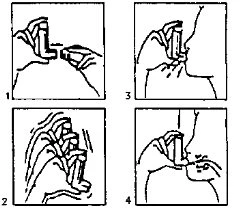
Remove the cap (fig. 1). If this is a new inhaler or has not been used for several days, shake the aerosol (fig. 2) and release one puff to ensure proper functioning of the inhaler. If the inhaler is used regularly, proceed to the following instructions:
- Shake the inhaler (fig. 2).
- Empty your lungs of as much air as possible.
-
Position the aerosol in your mouth as shown in the illustration (fig. 3).
-
Take as deep a breath as possible.
You must press the device, as indicated by the arrows in the illustration (fig. 4), while inhaling.
-
Remove the aerosol from your mouth and try to hold your breath for a few seconds.
-
You should clean the inhaler mouthpiece regularly. To do this, remove the mouthpiece from the inhaler and rinse it thoroughly with water.
-
Store with the cap on to protect it from dust and dirt.
Cleaning the inhaler
Clean the inhaler at least once a week.
- Remove the metal cartridge from the plastic housing of the inhaler and remove the mouthpiece protector.
- Rinse the plastic housing with lukewarm water.
- Allow the plastic housing to dry thoroughly inside and out in a warm place, avoiding excessive heat.
- Reinsert the metal cartridge and replace the mouthpiece protector.
A mild detergent or a solution similar to those used for cleaning baby bottles may be added to the water. Rinse thoroughly with clean water before drying.
Do not immerse the metal cartridge in water.
If you use more Salbutamol Aldo-Unión 100 micrograms/dose than you should
In case of overdose or accidental ingestion, contact your doctor or pharmacist immediately or call the Toxicology Information Service at telephone number 91 562 04 20, indicating the medicine and the amount ingested.
If you take a higher dose than recommended, peripheral vasodilation, increased heart rate, and skeletal muscle tremor may occur. These symptoms resolve rapidly and spontaneously. To counteract the effects of beta-adrenergic stimulation, cardioselective beta-blockers (practolol) may be used. Other adrenergic beta-blockers are not recommended, as they may cause bronchoconstriction in asthmatics. In the case of ventricular arrhythmia occurring during acute intoxication, slow intravenous infusion of potassium chloride, 40 mEq in 500 ml of 5% dextrose injectable solution, is recommended.
If you forget to use Salbutamol Aldo-Unión 100 micrograms/dose
Do not take a double dose to make up for missed doses. Inhale the next dose at the usual time, or earlier if you experience breathlessness or "wheezing."
If you have any further questions about the use of this medicine, ask your doctor or pharmacist.
4. Possible adverse effects
Like all medicines, this medicine may cause adverse effects, although not everyone experiences them.
The adverse effects are dose-dependent and are due to the mechanism of action of beta-2 agonists.
Although the exact frequency is unknown, some people may occasionally experience chest pain (due to heart problems such as angina pectoris). Inform your doctor if you develop these symptoms while being treated with salbutamol, but do not stop taking this medicine unless instructed by your doctor.
Very rarely, allergic reactions have been reported, including angioedema (swelling of the deeper layers of the skin, presenting as large hives around the eyes and lips, and possibly affecting the hands, feet, and throat), urticaria, bronchospasm, hypotension (low blood pressure), and fainting.
Disorders of the cardiac and lymphatic system: potentially severe hypokalemia may occur as a result of systemic treatment with beta-2 agonists.
Psychiatric disorders: nervousness, feeling of tension. As with other beta-2 agonists, hyperactivity in children has rarely been reported.
Nervous system disorders: mild tremor, headache, dizziness.
Cardiovascular disorders: tachycardia, angioedema, hypotension. Cases of cardiac arrhythmias (including atrial fibrillation, supraventricular tachycardia, and extrasystoles) have been reported in association with beta-2 agonists, usually in susceptible patients.
Respiratory, thoracic and mediastinal disorders: as with other inhaled therapies, paradoxical bronchospasm with an immediate increase in wheezing after administration should be considered.
Gastrointestinal disorders: nausea.
Skin and subcutaneous tissue disorders: urticaria.
Musculoskeletal and connective tissue disorders: transient muscle cramps have rarely been reported.
General disorders and administration site conditions: cases of oral and pharyngeal irritation may occur.
If you notice any other adverse reaction not described above, consult your doctor or pharmacist.
Reporting of adverse effects:
If you experience any type of adverse effect, consult your doctor or pharmacist, even if it is a possible adverse effect not listed in this leaflet. You can also report them directly through the Spanish Pharmacovigilance System for Human Medicinal Products: https://www.notificaram.es By reporting adverse effects, you can help provide more information on the safety of this medicine.
5. Storage of Salbutamol Aldo-Unión 100 micrograms/dose
Keep this medicine out of the sight and reach of children.
Do not store above 30 °C. Store in the original packaging to protect from light. Do not freeze.
The container contains a pressurised liquid. Do not expose to temperatures above 50 °C. Do not pierce the container, even when it appears to be empty.
Do not use this medicine after the expiry date stated on the label and carton after Exp. The expiry date refers to the last day of the month indicated.
Medicines must not be disposed of via wastewater or household waste. Dispose of unused medicines and their containers at a SIGRE Point at your pharmacy. If you are in doubt, ask your pharmacist how to dispose of medicines and containers you no longer need. This will help protect the environment.
6. Contents of the pack and other information
Composition of Salbutamol Aldo-Unión 100 micrograms/dose
- The active substance is Salbutamol base (equivalent to 120 micrograms of Salbutamol sulfate)
- The other components are oleic acid, ethanol, and Norflurane (HFA-134a).
This medicine contains fluorinated greenhouse gases.
Each inhaler contains 13.05 g of Norflurane (HFA-134a), which corresponds to 0.0187 tonnes of CO2 equivalent (global warming potential GWP = 1,430).
Nature of the product and pack contents
Salbutamol Aldo-Unión 100 micrograms/dose is presented as a suspension in a pressurized container; each pack contains a 10 ml container providing 200 doses.
Hospital pack: box containing 20 containers of 10 ml with 200 doses each.
Only certain pack sizes may be marketed.
Marketing Authorization Holder and Manufacturer
Laboratorio Aldo-Unión, S.L.
Baronesa de Maldá, 73
08950 Esplugues de Llobregat (Barcelona)
Spain
Date of the most recent revision of this leaflet: March 2026.
Detailed and up-to-date information on this medicine is available on the website of the Spanish Agency for Medicines and Health Products (AEMPS) http://www.aemps.gob.es.