Sabrilex 500 mg film-coated tablets
Spain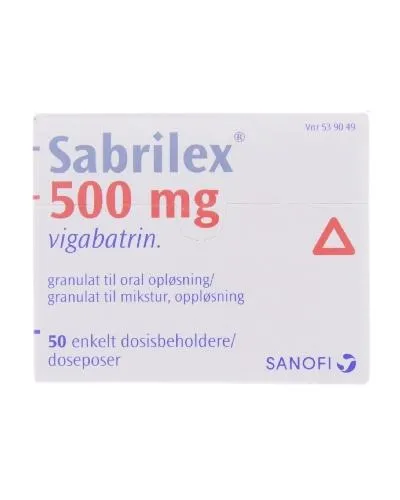
Table of Contents
- Patient Information Leaflet
- Introduction
- 1. What Sabrilex is and what it is used for
- 2. What you need to know before starting to take Sabrilex
- **Taking Sabrilex with other medicines**
- **Pregnancy, lactation, and fertility**
- **Driving and operating machinery**
- 3. How to take Sabrilex
- 4. Possible adverse effects
- 5. Storage of Sabrilex
- 6. Contents of the container and other information
- **Appearance of the Product and Contents of the Package**
Patient Information Leaflet
Introduction
Patient Information Leaflet
Sabrilex 500 mg film-coated tablets
Vigabatrin
Read the entire leaflet carefully before you start taking this medicine, because it contains important information for you.
- Keep this leaflet as you may need to read it again. If you have any questions, consult your doctor or pharmacist.
- This medicine has been prescribed for you only, and you should not give it to other people, even if they have the same symptoms as you, because it may harm them.
- If you experience any adverse effects, consult your doctor or pharmacist, even if they are adverse effects not listed in this leaflet. See section 4.
Leaflet Contents
- What Sabrilex is and what it is used for
- What you need to know before taking Sabrilex
- How to take Sabrilex
- Possible side effects
- How to store Sabrilex
- Contents of the pack and other information
1. What Sabrilex is and what it is used for
Sabrilex is used to help control various forms of epilepsy.
It is used in addition to your current medication to treat "difficult-to-control" epilepsy. It will initially be prescribed by a specialist. Your response to treatment will be monitored.
It is also used to control infantile spasms (West syndrome).
2. What you need to know before starting to take Sabrilex
Do not take Sabrilex
- If you are allergic to vigabatrin, or to any of the other ingredients of this medicine (listed in section 6).
Warnings and precautions
Consult your doctor before starting to take Sabrilex if:
- you are breastfeeding
- you are pregnant or planning to become pregnant
- you currently have or have previously had depression or any other psychiatric illness
- you have had any kidney problems
- you have had any eye problems.
Visual field loss (loss of vision from the edges of your field of vision) may occur during treatment with Sabrilex. You should discuss this possibility with your doctor before starting treatment with this medicine. This visual field loss may be severe, leading to tunnel vision or complete vision loss, and may be irreversible; therefore, early detection is essential. Worsening of visual field loss cannot be ruled out after discontinuation of treatment. It is important that you promptly inform your doctor if you notice any changes in your vision. It is recommended that your healthcare provider examine your vision (or your child's vision), including peripheral vision and visual acuity (ability to read an eye chart), before starting Sabrilex or within 4 weeks after starting Sabrilex, and every 3 to 6 months thereafter while on treatment. It is also recommended that you (or your child) have an eye examination approximately 3 to 6 months after stopping Sabrilex. Sabrilex may cause decreased vision due to eye problems such as retinal disorders, blurred vision, optic atrophy, or optic neuritis (see section 4). If your vision changes, consult your ophthalmologist. |
If you develop symptoms such as drowsiness, decreased consciousness and movement (stupor), or confusion, consult your doctor, who will decide whether to reduce your dose or discontinue treatment.
A small number of people being treated with antiepileptic medicines such as vigabatrin have had thoughts of harming themselves or of suicide. If you ever have these thoughts, contact your doctor immediately.
Children
Movement disorders have been reported in children treated for infantile spasms (West syndrome). If you notice unusual movement disorders in the child, consult your doctor, who will decide whether a change in treatment should be considered.
Taking Sabrilex with other medicines
Please inform your doctor if you are taking clonazepam, as its use together with Sabrilex may increase the risk of sedation.
Inform your doctor or pharmacist if you are taking, have recently taken, or might need to take any other medicine.
Sabrilex must not be taken in combination with other medicines that may have adverse effects related to the eyes.
Pregnancy, lactation, and fertility
If you are pregnant, think you might be pregnant, or plan to become pregnant, consult your doctor before using this medicine. Do not take Sabrilex during pregnancy unless your doctor tells you to do so. Sabrilex may cause problems to the fetus. However, do not abruptly stop treatment, as this may endanger the health of both mother and baby.
Sabrilex passes into breast milk. If you are breastfeeding, consult your doctor before using this medicine. Breastfeeding must not be undertaken during treatment.
Driving and operating machinery
Do not drive or operate machinery if your epilepsy is not controlled.
Sabrilex may sometimes cause symptoms such as drowsiness or dizziness, and your ability to concentrate and react may be reduced. If you experience these symptoms during treatment with Sabrilex, you should not perform any potentially hazardous tasks such as driving or operating machinery.
Visual disturbances, which may affect your ability to drive or operate machinery, have occurred in some patients taking this medicine. If you wish to continue driving, you should have regular examinations (every six months) to rule out the presence of visual disturbances, even if you do not notice any changes in your vision.
Sabrilex contains sodium
This medicine contains less than 23 mg of sodium (1 mmol) per tablet; that is, essentially "sodium-free".
3. How to take Sabrilex
Follow exactly the administration instructions for this medicine as given by your doctor. If in doubt, consult your doctor again.
It is important to follow your doctor's instructions precisely. Never change the dose.
Your doctor will prescribe and individually adjust the dose for each patient. The recommended starting dose is 1 g (2 tablets) per day. However, your doctor may increase or decrease the dose depending on your response to treatment; the usual daily dose for adults is 2 to 3 g (4 to 6 tablets). The highest recommended dose is 3 g per day.
If you are an elderly patient and/or have kidney problems, your doctor will prescribe a lower dose.
Use in children
Refractory partial epilepsy
In children, the dose is based on age and body weight. The recommended starting dose is 40 milligrams per kilogram of body weight per day. The following table indicates the number of tablets to be administered to children according to their body weight. Please remember that this is only a guide. The child's doctor will decide whether to prescribe a slightly different dose.
Weight 10–15 kg 0.5–1 g (1–2 tablets)/day
15–30 kg 1–1.5 g (2–3 tablets)/day
30–50 kg 1.5–3 g (3–6 tablets)/day
Over 50 kg 2–3 g (4–6 tablets)/day (adult dose)
Children with infantile spasms (West syndrome)
The recommended starting dose for infants with West syndrome (infantile spasms) is 50 milligrams per kilogram of body weight per day, although higher doses may sometimes be administered.
Method of administration
The route of administration is oral (by mouth).
Always swallow the tablet with at least half a glass of water.
Sabrilex may be taken before or after meals.
The daily dose may be taken as a single dose or divided into two doses.
If you take more Sabrilex than you should
If you or your child accidentally take too many Sabrilex tablets, contact your doctor immediately or go to the nearest hospital emergency department, bringing this leaflet with you, or call the Toxicology Information Service at telephone number 91 562 04 20, indicating the medicine and the amount taken.
Possible symptoms of overdose include drowsiness or loss/reduction in level of consciousness.
If you forget to take Sabrilex
If you forget to take a dose, take it as soon as you remember. If it is almost time for your next dose, take only one dose. Do not take a double dose to make up for missed doses.
If you stop taking Sabrilex
Do not stop taking this medicine without consulting your doctor. If your doctor decides to discontinue treatment, they will provide recommendations on how to gradually reduce the dose. Do not stop abruptly, as this may cause your seizures to return.
If you have any further questions about the use of this medicine, ask your doctor or pharmacist.
4. Possible adverse effects
Like all medicines, this medicine may cause adverse effects, although not everyone gets them.
As with other antiepileptic medicines, some patients may experience an increase in the number of seizures while taking this medicine. If this happens to you or your child, contact your doctor immediately.
Contact your doctor immediately if you experience:
Very common adverse effects (may affect more than 1 in 10 patients)
- Visual field changes – Approximately 1/3 or 33 percent of patients treated with Sabrilex may experience changes in visual field (visual field constriction). These "visual field defects" can range from mild to severe. These are usually detected after months or years of treatment with Sabrilex. Visual field changes may be irreversible, so early detection is essential. If you or your child experiences any visual disturbances, contact your doctor or hospital immediately.
Other adverse effects include:
Very common adverse effects (may affect more than 1 in 10 patients)
- Tiredness and pronounced drowsiness
- Joint pain
Common adverse effects (may affect up to 1 in 10 patients)
- Headache
- Weight gain
- Tremor
- Swelling (edema)
- Dizziness
- Sensation of numbness or tingling
- Concentration and memory disturbances
- Psychological disorders, including agitation, aggression, nervousness, irritability, depression, disturbances in thinking and paranoid reaction (progressive mental disorder), insomnia. These adverse effects are generally reversible with dose reduction or gradual discontinuation of treatment. However, do not reduce your dose without first consulting your doctor. Contact your doctor if you experience these adverse effects
- Nausea, vomiting, and abdominal pain
- Blurred vision, double vision, and involuntary rapid eye movements
- Speech disorders
- Decrease in the number of red blood cells (anaemia)
- Unusual hair loss or weakened hair (alopecia)
Uncommon adverse effects (may affect up to 1 in 100 patients)
- Lack of coordination in movements, clumsiness
- More severe psychological disorders such as hypomania, mania, and psychosis
- Skin rash
Rare adverse effects (may affect up to 1 in 1,000 patients)
- Severe allergic reaction causing swelling of the face or throat. If you experience any of these symptoms, inform your doctor immediately
- Hives (urticaria)
- Marked sedation, stupor, and confusion. These adverse effects are usually reversible by reducing the dose or gradually stopping treatment. However, do not reduce your dose without first consulting your doctor. Contact your doctor if you experience these adverse effects
- Suicidal attempt
- Other eye disorders such as retinal disorder
Very rare adverse effects (may affect up to 1 in 10,000 patients)
- Other eye disorders such as optic neuritis and optic atrophy
- Hallucinations
- Liver disorders
Adverse effects with unknown frequency (frequency cannot be estimated from available data)
- Decreased visual acuity
- Abnormal changes in brain images taken by magnetic resonance imaging (MRI)
- Swelling in the protective layer of nerve cells in part of the brain as seen in magnetic resonance imaging scans.
Other adverse effects in children
Very common adverse effects (may affect more than 1 in 10 children)
- Excitability or restlessness
Adverse effects with unknown frequency (frequency cannot be estimated from available data)
- Movement disorders in children treated for infantile spasms
- Abnormal changes in brain images taken by magnetic resonance imaging, particularly in infants
- Swelling in the protective layer of nerve cells in part of the brain as seen in magnetic resonance imaging scans.
Reporting of adverse effects:
If you experience any adverse effect, consult your doctor or pharmacist, even if it is a possible adverse effect not listed in this leaflet. You can also report them directly through the Spanish Pharmacovigilance System for Human Medicines: https://www.notificaram.es. By reporting adverse effects, you can help provide more information on the safety of this medicine.
5. Storage of Sabrilex
Keep this medicine out of sight and reach of children.
Do not use this medicine after the expiry date stated on the carton and blisters. The expiry date refers to the last day of the month indicated.
This medicine does not require any special storage conditions.
Medicines must not be disposed of via wastewater or household waste. Return unused medicines and their containers to the SIGRE Point at your pharmacy. If you have any doubts, ask your pharmacist how to properly dispose of unused medicines and their packaging. This will help protect the environment.
6. Contents of the container and other information
Composition of Sabrilex
- The active substance is vigabatrin. Each film-coated tablet contains 500 mg of vigabatrin.
- The other components are:
Tablet core:
Povidone K30 (E1201), Microcrystalline cellulose (E460), Sodium starch glycolate (type A), Magnesium stearate.
Tablet coating:
Hypromellose 15mPa.s (E464), Titanium dioxide (E171), Macrogol 8000.
Appearance of the Product and Contents of the Package
Sabrilex film-coated tablets are white or almost white, oval-shaped, biconvex tablets, with a score line on one side and "Sabrilex" engraved on the other.
They are available in transparent or opaque blisters containing 10 tablets.
Each package contains 30, 50, 60, 100 or 200 tablets.
Only certain package sizes may be marketed.
Marketing Authorization Holder and Manufacturer
The Marketing Authorization Holder is:
sanofi-aventis, S.A.
C/ Rosselló i Porcel, 21
08016 Barcelona
Spain
The manufacturer is:
Patheon France
Boulevard de Champaret
38300 Bourgoin-Jallieu (France)
Or
Sanofi-Aventis Deutschland GmbH
Industriepark Hoechst-Brueningstrasse 50
65926 Frankfurt am Main (Germany)
This medicinal product is authorized in the Member States of the European Economic Area under the following names:
Austria: Sabril 500 mg Filmtabletten
Belgium: Sabril 500 mg filmomhulde tabletten
Denmark: Sabrilex
Finland: Sabrilex 500 mg tabletti, kalvopäällysteinen
France: Sabril 500 mg comprimé pelliculé
Germany: Sabril 500 mg Filmtabletten
Greece: Sabril 500 mg επικαλυμμένα με λεπτό υμένιο δισκία
Ireland: Sabril 500 mg film-coated tablets
Italy: Sabril 500 mg compresse rivestite con film
Luxembourg: Sabril 500 mg comprimés pelliculés
Netherlands: Sabril 500 mg filmomhulde tablet
Portugal: Sabril 500 mg comprimidos revestidos por película
Spain: Sabrilex 500 mg comprimidos recubiertos con película
Sweden: Sabrilex 500 mg filmdragerade tabletter
United Kingdom: Sabril 500 mg film-coated tablets
Date of the most recent revision of this leaflet: August 2025
Detailed and up-to-date information on this medicinal product is available on the website of the Spanish Agency for Medicines and Health Products (AEMPS) http://www.aemps.gob.es/