Rytmonorm 300 mg film-coated tablets
Spain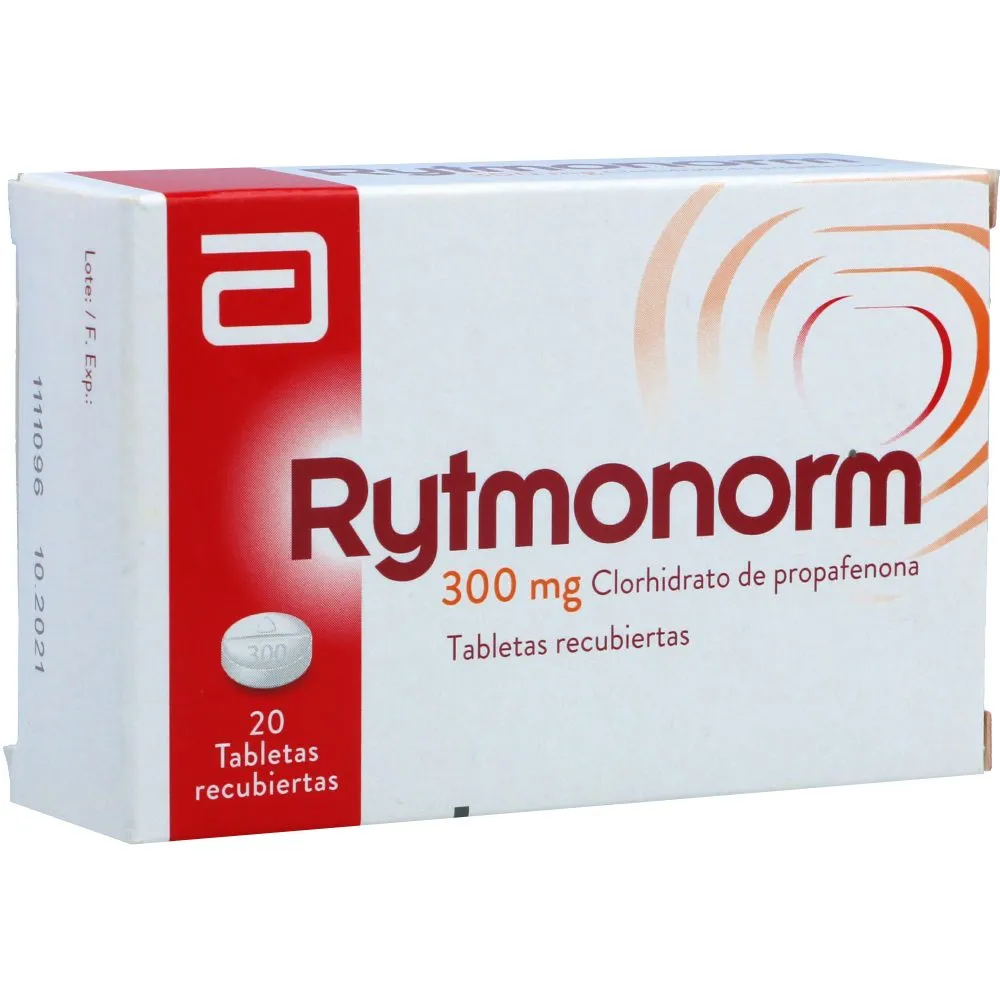
Table of Contents
- Package leaflet: Information for the user
- Introduction
- 1. What Rytmonorm is and what it is used for
- 2. What you need to know before taking Rytmonorm
- 3. How to take Rytmonorm
- 4. Possible adverse effects
- 5. Storage of Rytmonorm
- 6. Package contents and other information
- This information is intended for healthcare professionals only:
- **Other presentations**
Package leaflet: Information for the user
Introduction
Package leaflet: information for the user
Rytmonorm 300 mg coated tablets
Propafenone hydrochloride
Read this entire leaflet carefully before you start taking this medicine, because it contains important information for you.
- Keep this leaflet, as you may need to read it again.
- If you have any questions, ask your doctor, pharmacist or nurse.
- This medicine has been prescribed for you only and must not be given to other people, even if they have the same symptoms as you, since it could harm them.
- If you experience any adverse effects, consult your doctor, pharmacist or nurse, even if they are effects not listed in this leaflet. See section 4.
Contents of the leaflet
-
What Rytmonorm is and what it is used for
-
What you need to know before taking Rytmonorm
-
How to take Rytmonorm
-
Possible side effects
-
How to store Rytmonorm
-
Contents of the pack and other information
1. What Rytmonorm is and what it is used for
Rytmonorm is a medicine used to treat various types of cardiac rhythm disorders. It belongs to a group of medicines called class 1C antiarrhythmics according to the Vaughan Williams classification.
Rytmonorm is used for the treatment and prevention of paroxysmal supraventricular tachycardia, including atrial fibrillation and paroxysmal flutter, as well as paroxysmal ventricular tachycardia due to re-entry phenomena involving the atrioventricular node or accessory pathways (Wolff-Parkinson-White syndrome). It is also used for the treatment and prevention of ventricular arrhythmias, including symptomatic ventricular extrasystoles and/or non-sustained and sustained ventricular tachycardia.
2. What you need to know before taking Rytmonorm
Do not take Rytmonorm
-
If you are allergic to the active substance or to any of the other components of this medicine (listed in section 6).
-
If you have a history of Brugada syndrome (a hereditary condition characterized by an abnormality in the electrocardiogram (ECG) and an increased risk of sudden death). (see Warnings and precautions).
-
If you have had a myocardial infarction within the previous 3 months before starting treatment.
-
If you currently have or have previously had significant heart disease such as:
-
congestive heart failure.
-
cardiogenic shock unless caused by an arrhythmia.
-
severe slowing of the heartbeat (bradycardia).
-
sinus node dysfunction, atrial conduction defects, second- or higher-degree atrioventricular block, or bundle branch block or distal block in the absence of an artificial pacemaker.
-
if you experience a marked drop in blood pressure.
- If you have an electrolyte imbalance in the blood (e.g., disturbances in potassium metabolism).
- If you have severe chronic obstructive pulmonary disease.
- If you have myasthenia gravis.
- If you are taking ritonavir (an antiretroviral used in the treatment of HIV infection; see Taking Rytmonorm with other medicines).
Warnings and precautions
Consult your doctor or pharmacist before taking Rytmonorm.
-
It is essential that every patient receiving propafenone be clinically evaluated and undergo an electrocardiogram before and during treatment with Rytmonorm to determine whether the response to propafenone justifies continued treatment.
-
After treatment with this medicine, your doctor must rule out Brugada syndrome, which may have been present without prior symptoms.
-
If you have a pacemaker, because the treatment may affect it, monitoring is required and, if necessary, reprogramming.
-
If you have atrial fibrillation, because Rytmonorm may lead to the development of a more serious arrhythmia; see section on Possible adverse effects.
-
If you have severe heart disease, as you may be predisposed to serious adverse reactions, in which case treatment with this medicine is contraindicated.
-
If you have asthma or another chronic obstructive respiratory disease.
Children
Interaction studies have only been conducted in adults, so it is unknown whether effects are similar in children.
Elderly patients
Rytmonorm should be used with extreme caution in elderly patients.
Taking Rytmonorm with other medicines
Inform your doctor or pharmacist if you are taking, have recently taken, or might need to take any other medicines.
More adverse effects may occur with Rytmonorm when administered with local anesthetics (e.g., for pacemaker implantation, surgical or dental procedures), as well as with other drugs that have inhibitory effects on the heart such as beta-blockers (for hypertension) or certain antidepressants.
Inform your doctor if you are taking any of the following medicines, as they may increase their blood levels:
-
venlafaxine (for depression)
-
propranolol (for hypertension and angina pectoris)
-
metoprolol (for hypertension)
-
desipramine (for depression)
-
cyclosporine (to suppress the immune system)
-
theophylline (for asthma)
-
digoxin (for heart problems)
If signs of overdose occur, the doses of these medicines should be reduced, as directed by your doctor.
Inform your doctor if you are taking any of the following medicines, as they may increase your blood levels of propafenone hydrochloride, meaning you may require monitoring and dose adjustment:
- ketoconazole (for fungal infections)
- cimetidine (for stomach ulcers)
- quinidine (for heart arrhythmia or malaria)
- erythromycin (antibiotic)
- fluoxetine (for depression)
- paroxetine (for depression)
Blood levels of propafenone hydrochloride may also increase when taken with grapefruit juice.
Concurrent use of Rytmonorm and amiodarone may cause heart disturbances. It may be necessary to adjust the dose of both medicines.
Concurrent use of propafenone and lidocaine increases the risk of lidocaine's side effects on the central nervous system.
Inform your doctor if you are taking any of the following medicines, as they may reduce the effectiveness of Rytmonorm:
- rifampicin (antibiotic)
- phenobarbital (sedative and antiepileptic)
- phenytoin (antiepileptic)
- carbamazepine
In cases of chronic treatment with these medicines and Rytmonorm, the response to Rytmonorm treatment should be monitored.
Inform your doctor if you are taking medications to prevent blood clotting (e.g., acenocoumarol or warfarin), as Rytmonorm may enhance the effect of these medicines, increasing the risk of bleeding. It may be necessary to reduce the dose of the anticoagulant.
Taking Rytmonorm with food and drinks
Due to the bitter taste and superficial anesthetic effect of propafenone hydrochloride, Rytmonorm tablets should be swallowed whole, without sucking or chewing, and taken with liquid.
Pregnancy, breastfeeding, and fertility
If you are pregnant or breastfeeding, think you may be pregnant, or plan to become pregnant, consult your doctor or pharmacist before using this medicine.
There are no adequate and well-controlled studies in pregnant women. Rytmonorm should not be used during pregnancy unless the expected benefit justifies the potential risk to the fetus. Propafenone hydrochloride crosses the placental barrier.
Excretion of propafenone hydrochloride in breast milk has not been studied. Limited data suggest that propafenone hydrochloride may pass into breast milk; therefore, it should be used with caution in breastfeeding mothers.
Driving and using machines
During treatment, blurred vision, dizziness, fatigue, or low blood pressure may occur. If you experience these symptoms, you should not drive or operate dangerous machinery.
Rytmonorm contains sodium
This medicine contains less than 23 mg of sodium (1 mmol) per coated tablet; hence, it is essentially "sodium-free".
3. How to take Rytmonorm
Follow exactly the instructions for administration of this medicine as given by your doctor or pharmacist. If in doubt, consult your doctor or pharmacist.
Rytmonorm is administered orally.
Adults
Your doctor will determine your individual maintenance dose by monitoring your heart, i.e., through several electrocardiographic and blood pressure checks (the titration phase). For the titration phase and maintenance therapy, a total daily dose of 450 mg to 600 mg, divided into two or three doses per day (1 tablet of Rytmonorm 150 mg three times daily or 1 tablet of Rytmonorm 300 mg twice daily), is recommended for patients weighing approximately 70 kg.
Sometimes it may be necessary to increase the daily dose to 900 mg (1 tablet of Rytmonorm 300 mg three times daily).
For patients weighing less than 70 kg, the daily dose should be appropriately reduced, starting at 150 mg twice daily. Dose increases should not be made until the patient has received treatment for 3–4 days.
If you are an elderly patient or have heart damage, Rytmonorm 300 mg, like other antiarrhythmics, should be administered with great care during the titration phase, starting with a dose of 150 mg once daily. Therefore, it is preferable for your doctor to prescribe Rytmonorm 150 mg tablets, gradually increasing the dose as needed. The maintenance dose for each individual must be calculated based on monitoring of heart function and repeated blood pressure measurements (titration phase). Any required dose increase should not be made until after 5 to 8 days of treatment.
The same applies to maintenance therapy. Any necessary dose increase should not be made until after 5 to 8 days of treatment.
Patients with hepatic and/or renal impairment
If you have liver or kidney problems, your doctor will start treatment with a dose of 150 mg once daily (using Rytmonorm 150 mg tablets) and will adjust the dose according to your response to treatment.
Use in children and adolescents
In children, the average daily dose is 10 to 20 mg of propafenone hydrochloride per kilogram of body weight, divided into 3 to 4 daily doses during the initial dose-titration phase and maintenance therapy.
Dose increases should not be made until the patient has been on treatment for 3–4 days.
The maintenance dose must be individually determined for each patient, based on monitoring of heart function and repeated blood pressure measurements (titration phase).
Your doctor will advise you on the duration of your treatment. Do not stop treatment prematurely, as even if you feel better, your condition could worsen or recur.
Remember to take your medicine. Take the tablets at the same time each day.
If you think that the effect of Rytmonorm is too strong or too weak, inform your doctor or pharmacist.
If you take more Rytmonorm than you should
If you take more than the prescribed dose, contact your doctor immediately so that prompt medical attention can be provided. Severe symptoms may occur. If you have taken more Rytmonorm than prescribed, you may experience heart-related effects and low blood pressure, which in severe cases can lead to cardiovascular shock. Headache, dizziness, blurred vision, skin tingling or numbness, tremor, nausea, constipation, and dry mouth are common. In severe intoxications, seizures, skin tingling or numbness, drowsiness, coma, and respiratory arrest may occur. Fatal cases have been reported.
If this occurs, the patient must be monitored in an intensive care unit.
If you have taken more Rytmonorm than you should, contact your doctor, pharmacist, or call the Toxicology Information Service at 91.562.04.20 immediately, indicating the medication and the amount ingested.
If you forget to take Rytmonorm
Do not take a double dose to make up for missed doses.
If you miss a dose, take the medicine as soon as possible and continue treatment as prescribed. However, if the next dose is due soon, it is better not to take the missed dose and wait for the next scheduled dose.
If you stop taking Rytmonorm
If you have any further questions about the use of this medicine, ask your doctor, pharmacist, or nurse.
4. Possible adverse effects
Like all medicines, this medicine can cause adverse effects, although not everyone experiences them.
Adverse effects are classified as very common (may affect more than 1 in 10 people), common (may affect up to 1 in 10 people), uncommon (may affect up to 1 in 100 people), and frequency not known (cannot be estimated from the available data).
Very common adverse reactions associated with propafenone treatment are dizziness, cardiac conduction disorders (heart disturbances), and palpitations.
Within each group, adverse reactions are listed in decreasing order of severity, from most severe to least severe, when the severity to the patient could be determined.
The following adverse effects have been reported:
Blood and lymphatic system disorders
- Uncommon: decreased platelets (blood cells involved in clotting).
- Frequency not known: decreased white blood cells (blood cells that defend the body against infections or foreign substances; may manifest as frequent infections with fever, chills, or sore throat), decreased granulocytes (a type of white blood cell that may increase susceptibility to infections), severe reduction in granulocytes or neutrophils (agranulocytosis, a condition in which the person is more prone to infections).
Immune system disorders
- Frequency not known: hypersensitivity1.
1 May manifest as cholestasis (cessation of bile flow to the duodenum), blood abnormalities, and skin rash.
Metabolism and nutrition disorders
- Uncommon: decreased appetite.
Psychiatric disorders
- Common: anxiety, sleep disturbances.
- Uncommon: nightmares.
- Frequency not known: confusion.
Nervous system disorders
- Very common: dizziness2.
- Common: headache, altered taste perception.
- Uncommon: brief loss of consciousness (syncope), abnormal coordination, tingling sensation, numbness, or pins-and-needles sensation anywhere in the body, but most commonly in feet, hands, arms, or legs (paresthesia).
- Frequency not known: seizures, extrapyramidal symptoms (involuntary movements), restlessness.
2 Excluding vertigo.
Eye disorders
- Common: blurred vision.
Ear and labyrinth disorders
- Uncommon: vertigo.
Cardiac disorders
- Very common: cardiac conduction disorders3 (heart disturbances), palpitations.
- Common: sinus bradycardia (slow heart rate), reduced heartbeats (bradycardia), tachycardia (increased heart rate), atrial flutter (abnormal heart rhythm occurring in the cardiac atrium).
- Uncommon: ventricular tachycardia (increased heart rate originating in the ventricles, with more than 100 beats per minute), arrhythmia4 (abnormal heart rhythm that may increase, decrease, or become irregular).
- Frequency not known: ventricular fibrillation, heart failure5, reduced heart rate.
3 Including sinoatrial block, atrioventricular block, and intraventricular block.
4 Propafenone may be associated with proarrhythmic effects, manifesting as increased heart rate (tachycardia) or ventricular fibrillation. Some of these arrhythmias may be life-threatening and may require resuscitation to prevent potentially fatal outcomes.
5 Worsening of pre-existing heart failure may occur.
Vascular disorders
- Uncommon: hypotension (low blood pressure).
- Frequency not known: hypotension when standing for long periods and/or upon standing up (orthostatic hypotension).
Respiratory, thoracic and mediastinal disorders
- Common: dyspnea (shortness of breath or difficulty breathing).
Gastrointestinal disorders
- Common: abdominal pain, vomiting, nausea, diarrhea, constipation, dry mouth.
- Uncommon: abdominal distension (bloating), flatulence (gas).
- Frequency not known: retching, gastrointestinal discomfort.
Hepatobiliary disorders
- Common: abnormal liver function6.
- Frequency not known: liver injury, obstruction of bile flow from the liver (cholestasis), hepatitis, jaundice (yellowing of the skin and eyes).
Investigations
- Common: abnormal liver function tests detected in blood analyses, such as increased aspartate aminotransferase, increased alanine aminotransferase, increased gamma-glutamyl transferase, and increased blood alkaline phosphatase.
Skin and subcutaneous tissue disorders
- Uncommon: urticaria, itching, skin rash, erythema (redness of the skin).
Musculoskeletal and connective tissue disorders
- Frequency not known: lupus-like syndrome (an autoimmune disease).
Reproductive system and breast disorders
- Uncommon: impotence (erectile dysfunction).
- Frequency not known: decreased sperm count7.
7 The decrease in sperm count is reversible upon discontinuation of propafenone.
General disorders and administration site conditions
- Common: chest pain, asthenia (feeling of tiredness), fatigue, fever.
Reporting of adverse effects
If you experience any type of adverse effect, consult your doctor, pharmacist, or nurse, even if it is a possible adverse effect not listed in this leaflet. You may also report them directly via the Spanish Pharmacovigilance System for Human Medicines: https://www.notificaRAM.es. By reporting adverse effects, you can help provide more information on the safety of this medicine.
5. Storage of Rytmonorm
Keep this medicine out of the sight and reach of children.
This medicine does not require any special storage conditions.
Do not use this medicine after the expiry date stated on the packaging after EXP. The expiry date is the last day of the month indicated.
Medicines should not be disposed of via wastewater or household waste. Dispose of unused containers and medicines at the SIGRE Point in your pharmacy. Ask your pharmacist how to dispose of containers and medicines you no longer need. This will help protect the environment.
6. Package contents and other information
Composition of Rytmonorm
-
The active substance is propafenone hydrochloride. Each tablet contains 300 mg of propafenone hydrochloride.
-
The other components (excipients) are: microcrystalline cellulose, sodium croscarmellose, magnesium stearate, corn starch, hydroxypropylmethylcellulose, macrogol 400, macrogol 6000, titanium dioxide (E 171) and purified water.
Appearance of the product and contents of the pack
Rytmonorm 300 mg film-coated tablets are white round tablets with "300" printed on one side.
Each pack contains 60 film-coated tablets.
Marketing Authorization Holder and Manufacturer
Marketing Authorization Holder
Teva B.V.,
Swensweg 5, 2031GA Haarlem,
The Netherlands
Manufacturer
ITC Production s.r.l.
Via Pontina km 29
00071 Pomezia (RM)
Italy
Local representative:
Teva Pharma, S.L.U.
C/ Anabel Segura, 11, Edificio Albatros B, 1st floor
Alcobendas 28108 Madrid
Spain
Date of the most recent revision of this summary: March 2019
Detailed information on this medicine is available on the website of the Spanish Agency of Medicines and Health Products (AEMPS) http://www.aemps.gob.es/
This information is intended for healthcare professionals only:
Management of overdose
In addition to general emergency measures, monitoring and correction of the patient's vital parameters (as needed) must be performed in an intensive care unit.
Defibrillation as well as infusion of dopamine and isoprenaline have been effective in controlling cardiac rhythm and arterial blood pressure. Seizures have been managed with intravenous diazepam. General supportive measures may be required, such as mechanical ventilation and external cardiac massage.
Attempts to remove propafenone by hemoperfusion are poorly effective.
Hemodialysis is ineffective due to the extensive protein binding of propafenone (> 95%) and its large volume of distribution.
Other presentations
Rytmonorm 150 mg coated tablets. Packs of 60 coated tablets.
Rytmonorm 3.5 mg/ml injectable solution. Packs of 5 ampoules of 20 ml.