Ryeqo 40 mg/1 mg/0.5 mg film-coated tablets
Spain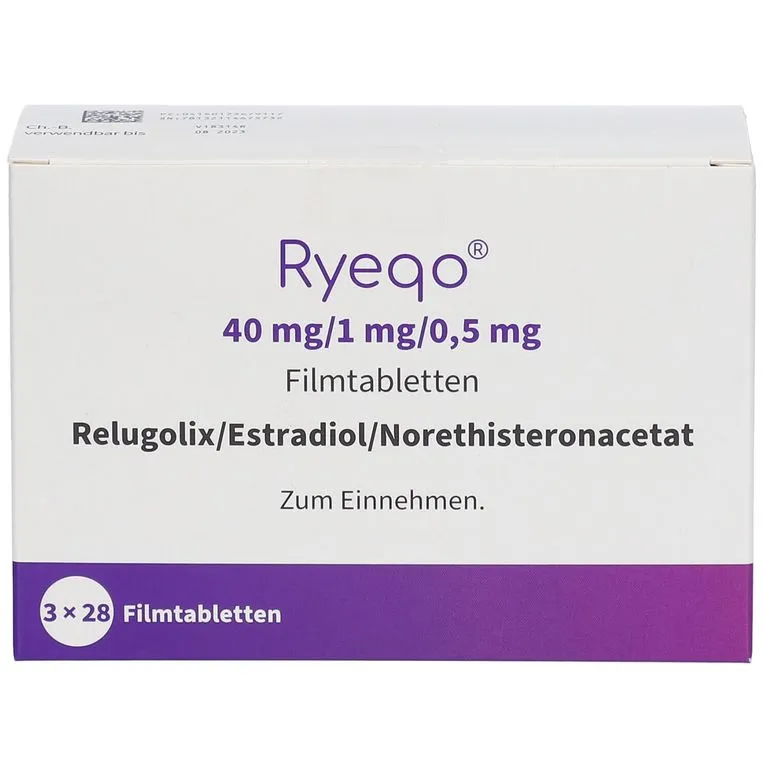
Table of Contents
Package leaflet: Information for the user
Introduction
Package leaflet: information for the user
Ryeqo 40 mg/1 mg/0.5 mg film-coated tablets
relugolix/estradiol/norethisterone acetate
This medicinal product is subject to additional monitoring, which will allow quicker identification of new safety information. You can help by reporting any adverse reactions you may experience. Section 4 includes information on how to report adverse reactions.
Read this entire leaflet carefully before you start taking this medicine, because it contains important information for you.
- Keep this leaflet, as you may need to read it again.
- If you have any questions, ask your doctor or pharmacist.
- This medicine has been prescribed for you only, and you should not give it to others, even if they have the same symptoms as you, since it may harm them.
- If you experience any adverse reactions, consult your doctor or pharmacist, even if they are adverse reactions not listed in this leaflet. See section 4.
Leaflet contents
- What Ryeqo is and what it is used for
- What you need to know before taking Ryeqo
- How to take Ryeqo
- Possible adverse effects
- How to store Ryeqo
- Contents of the pack and other information
1. What Ryeqo is and what it is used for
Ryeqo contains the active substances relugolix, estradiol, and norethisterone acetate.
It is used to treat:
- moderate to severe symptoms of uterine fibroids (commonly known as fibroids), which are non-cancerous tumours of the uterus (womb).
- symptoms associated with endometriosis in women with a history of prior medical or surgical treatment for endometriosis (endometriosis is a common painful disorder in which tissue similar to the tissue lining the inside of the uterus – the endometrium – grows outside the uterus).
Ryeqo is used in adult women (over 18 years of age) who have not yet reached menopause.
In some women, uterine fibroids can cause heavy menstrual bleeding (the so-called "period") and pelvic pain (pain below the navel). Ryeqo is used to treat fibroids, to stop or reduce bleeding and relieve pelvic pain and discomfort associated with uterine fibroids.
Women with endometriosis may experience pelvic or lower abdominal pain, pain during menstrual periods, and pain during sexual intercourse. Ryeqo is used to treat endometriosis in order to reduce symptoms caused by the displacement of uterine lining tissue.
This medicine contains relugolix, which blocks certain receptors in the brain, thereby reducing the production of hormones that in turn stimulate the ovaries to produce estradiol and progesterone. When these are blocked, circulating levels of estrogen and progesterone in the body are reduced. This medicine also contains two types of female hormones: estradiol, which belongs to a group of medicines called estrogens, and norethisterone, which belongs to a group of medicines called progestogens. The inclusion of these hormones in Ryeqo maintains a hormonal state similar to the beginning of the menstrual cycle, thus alleviating symptoms while protecting bone strength.
2. What you need to know before taking Ryeqo
Do not take Ryeqo
Do not take Ryeqo if you have any of the conditions listed below.
If you have or have previously had any of the conditions listed below, you must inform your doctor:
- If you are allergic to relugolix, estradiol, norethisterone, or to any of the other components of this medicine (listed in section 6).
- If you have or have previously had a blood clot in a blood vessel in your legs (deep vein thrombosis), lungs (pulmonary embolism), heart (heart attack), brain (stroke), or elsewhere in the body.
- If you have or have previously had a disease caused by blood clots in the arteries, such as a heart attack, stroke, or angina pectoris.
- If you have a blood clotting disorder (such as protein C deficiency, protein S deficiency, antithrombin III deficiency, or factor V Leiden).
- If you have osteoporosis.
- If you experience headaches with focal neurological symptoms such as paralysis or loss of muscle control, or migraines with visual disturbances.
- If you have any type of cancer that could worsen due to exposure to female sex hormones, such as breast cancer or genital organ cancers.
- If you have or have previously had liver tumours.
- If you have or have previously had liver disease and your liver function test values have not returned to normal.
- If you are pregnant, think you might be pregnant, or are breastfeeding.
- If you experience genital bleeding of unknown origin.
- If you are taking hormonal contraceptives (e.g., contraceptive pills) and do not wish to discontinue their use.
If any of the above conditions develops for the first time while you are taking Ryeqo, stop taking it immediately and consult your doctor without delay.
If you are unsure about any of the points above, speak with your doctor before taking Ryeqo.
Warnings and precautions
Consult your doctor or pharmacist before starting to take Ryeqo.
You should know that most women experience reduced or absent menstrual bleeding (period) during treatment and for several weeks afterward.
Your doctor will ask about your personal and family medical history. Your doctor should also monitor your blood pressure and confirm that you are not pregnant. You may also need to undergo a physical examination and other assessments, such as a breast examination or bone density testing, depending on your individual medical needs and concerns.
Stop taking Ryeqo and seek medical attention urgently if you experience:
-
Any of the conditions listed in the section "Do not take Ryeqo".
-
Signs of liver disease:
-
Yellowing of the skin or whites of the eyes (jaundice).
-
Nausea or vomiting, fever, severe fatigue.
-
Darkening of the urine, itching, or pain in the upper abdominal area.
-
A significant increase in blood pressure (symptoms may include headache, fatigue, dizziness).
-
Migraine for the first time, or unusually severe headaches that occur more frequently than before.
-
Signs that may indicate a blood clot, such as a clot in the leg (i.e., deep vein thrombosis) or in the lung (i.e., pulmonary embolism), a heart attack, or a stroke. For a description of symptoms of these serious conditions, see "Ryeqo and the risk of blood clots".
-
If you become pregnant.
Inform your doctor if you are in any of the following situations:
- If you have one or more of the risk factors for developing a blood clot listed below.
- If you have high blood pressure.
- If you have osteoporosis.
- If you suffer from migraines.
- If you think you might be pregnant. Ryeqo treatment generally causes a significant reduction or complete absence of menstrual bleeding (period), making it difficult to recognize pregnancy.
- If you have previously had or currently have depression.
- If you have kidney disease (renal disease).
Ryeqo and the risk of blood clots
The use of other medicines containing an estrogen and a progestogen increases the risk of blood clots. The risk of blood clots with Ryeqo has not been established. Ryeqo reduces estrogen levels to those similar to the beginning of a normal menstrual cycle.
Factors that may increase the risk of developing a blood clot in a vein or artery:
- As you get older (especially over 35 years of age).
- If you are overweight (body mass index > 30 kg/m²).
- If you have undergone major surgery or have been immobilized for a prolonged period (e.g., with a leg in a cast).
- If you have recently given birth.
- If a close relative has had a blood clot in the leg, lung, or another organ, a heart attack, or a stroke at a young age (e.g., under 50 years).
- If you smoke.
- If you have a heart condition (valve disorder, or abnormal heart rhythm known as atrial fibrillation).
- If you have diabetes.
- If you have conditions such as systemic lupus erythematosus (SLE – a disease affecting your body's natural defense system), sickle cell anemia (an inherited red blood cell disorder), Crohn’s disease or ulcerative colitis (chronic inflammatory bowel diseases), or cancer.
The more risk factors you have, the higher your risk of developing a blood clot.
The symptoms of a blood clot depend on where it occurs.
Symptoms of a blood clot in the leg (deep vein thrombosis; DVT)
Symptoms of a blood clot in the leg, known as deep vein thrombosis (DVT), may include:
- Swelling in the leg and/or foot along a vein.
- Pain or tenderness in the leg, worsening when standing or walking.
- Increased warmth in the affected leg, accompanied by redness or skin discoloration.
*Symptoms of a blood clot in the lung (pulmonary embolism; PE)
Symptoms of a blood clot in the lung, known as pulmonary embolism (PE), may include:
- Sudden unexplained shortness of breath or rapid breathing.
- Sudden cough, possibly with sharp chest pain.
- Coughing up blood.
- Severe dizziness or lightheadedness.
- Rapid or irregular heartbeat.
Symptoms of a heart attack
Symptoms of a heart attack, also known as myocardial infarction, may be temporary and include:
- Pain, discomfort, pressure, heaviness, tightness, or fullness in the chest, arm, or below the breastbone.
- Discomfort radiating to the back, jaw, throat, arm, or stomach.
- Feeling of fullness, indigestion, or suffocation.
- Sweating, nausea, vomiting, or dizziness.
- Severe weakness, anxiety, or shortness of breath.
- Rapid or irregular heartbeat.
Symptoms of a stroke
Symptoms of a stroke may include:
- Sudden numbness or weakness in the face, arm, or leg, especially on one side of the body.
- Sudden difficulty walking, dizziness, loss of balance, or loss of coordination.
- Sudden confusion, difficulty speaking or understanding speech.
- Sudden vision problems in one or both eyes.
- Sudden, severe, or prolonged headache without known cause.
- Loss of consciousness or fainting, with or without seizures.
Surgery
If you are scheduled for surgery, inform your surgeon that you are taking Ryeqo.
Liver tumours or liver disease
In rare cases, liver tumours or liver disease have been reported in women taking estrogens and progestogens. If you experience any symptoms of jaundice, contact your doctor for advice.
Kidney failure (renal disease)
If you notice a decrease in urine output or fluid retention causing swelling in your legs, ankles, or feet, contact your doctor for advice.
Change in menstrual bleeding pattern (period)
Ryeqo treatment generally causes a significant reduction or complete cessation of menstrual bleeding (the "period") within the first 30 days of treatment. However, if you continue to experience excessive bleeding, inform your doctor.
Depression
If you experience mood changes or any depressive symptoms, contact your doctor for advice.
Increased blood pressure
Rarely, treatment with Ryeqo may cause slight increases in blood pressure. If you experience any symptoms of elevated blood pressure, contact your doctor for advice.
Uterine fibroid prolapse and expulsion
Uterine fibroids can develop anywhere within the muscular wall of the uterus, including the submucosal layer, a thin tissue layer inside the uterus. In some women, the fibroid may protrude or pass through the cervix into the vagina, causing a significant worsening of uterine bleeding or pain. If you experience heavy bleeding again after your symptoms have improved with Ryeqo treatment, contact your doctor for advice.
Gallbladder disorders
Some women taking medications containing estrogen and progestogen, including Ryeqo, have reported gallbladder disorders (gallstones or gallbladder inflammation). If you experience unusually severe pain under the ribcage or in the upper abdomen, contact your doctor for advice.
Children and adolescents
Girls under 18 years of age must not take Ryeqo, as the safety and efficacy of Ryeqo in this age group have not been established.
Other medicines and Ryeqo
Inform your doctor or pharmacist if you are taking, have recently taken, or might need to take any other medicines.
Talk to your doctor if you are taking any of the following medicines, as they may affect Ryeqo or be affected by Ryeqo:
- Some medicines used to treat epilepsy (e.g., carbamazepine, topiramate, phenytoin, phenobarbital, primidone, oxcarbazepine, felbamate).
- Some medicines used to treat human immunodeficiency virus/acquired immunodeficiency syndrome (HIV/AIDS) (e.g., ritonavir, efavirenz).
- Some medicines used to treat hepatitis C virus (HCV) (e.g., boceprevir, sofosbuvir, velpatasvir, voxilaprevir, telaprevir, glecaprevir).
- Some medicines used to treat fungal infections (e.g., ketoconazole, itraconazole, fluconazole, griseofulvina).
- Some medicines used to treat bacterial infections (e.g., rifampicin, rifabutin, clarithromycin, erythromycin, gentamicin, tetracycline, griseofulvina).
- Some medicines used to treat high blood pressure in the pulmonary arteries (e.g., bosentan).
- Some medicines used to treat high blood pressure (e.g., diltiazem, carvedilol, verapamil).
- Some medicines used to treat irregular heartbeats (e.g., amiodarone, dronedarone, propafenone, quinidine, verapamil).
- Some medicines used to treat angina pectoris (e.g., ranolazine, carvedilol, verapamil).
- Some medicines used to prevent organ rejection after transplantation (e.g., ciclosporin).
- Herbal medicines containing St. John's wort (Hypericum perforatum).
Pregnancy and breastfeeding
Do not take Ryeqo if you are pregnant or breastfeeding. If you think you might be pregnant or plan to become pregnant, consult your doctor before using this medicine. If you become pregnant, stop taking Ryeqo and contact your doctor.
Ryeqo suppresses ovulation and therefore it is unlikely that you will become pregnant while taking Ryeqo as directed. Ovulation and menstrual bleeding will return rapidly after stopping Ryeqo treatment, and an alternative contraceptive method must be initiated immediately after discontinuing Ryeqo.
Depending on when in your cycle you started taking Ryeqo, complete suppression of ovulation may take some time to occur; therefore, non-hormonal contraceptive methods (e.g., condoms) should be used during the first month of treatment with Ryeqo.
If you miss two or more tablets consecutively, a non-hormonal contraceptive method (e.g., condoms) should be used for the following 7 days of treatment.
Driving and using machines
Ryeqo has no known effect on the ability to drive or operate machinery.
Laboratory tests
If you need a blood or urine test, inform your doctor or laboratory staff that you are taking Ryeqo, as this medicine may affect the results of certain tests.
Ryeqo contains lactose
If your doctor has informed you that you have an intolerance to certain sugars, consult with them before taking this medicine.
3. How to take Ryeqo
Follow exactly the instructions for use of this medicine as given by your doctor. If in doubt, consult your doctor or pharmacist again.
The recommended dose is one tablet daily.
The tablet should be taken orally every day, at approximately the same time, with or without food, and with a little liquid.
It is advisable to start taking Ryeqo within the first 5 days after the start of menstrual bleeding. If you start treatment at another time during your menstrual cycle, you may experience irregular or heavier bleeding.
If you take more Ryeqo than you should
There are no reports of serious harmful effects caused by taking several doses of this medicine at once. High doses of estrogen may cause nausea and vomiting, and vaginal bleeding. If you have taken too many Ryeqo tablets, consult your doctor or pharmacist.
If you forget to take Ryeqo
If you forget to take a tablet, take it as soon as you remember and then take the next day's tablet at the usual time. Do not take a double dose to make up for forgotten doses.
If you forget to take two or more tablets in succession, consult your doctor and use a non-hormonal contraceptive method (e.g., condom) during the following 7 days of treatment.
If you stop taking Ryeqo
If you wish to stop treatment with Ryeqo, speak to your doctor first. Your doctor will explain the effects of stopping treatment and will discuss other options with you.
If you have any further questions about the use of this medicine, ask your doctor or pharmacist.
4. Possible adverse effects
Like all medicines, this medicine can cause adverse effects, although not everyone experiences them.
Seek urgent medical assistance if you experience any of the following signs and symptoms of an allergic reaction:
- swelling of the lips, face, or throat.
The following side effects have been reported with Ryeqo, listed according to their frequency of occurrence.
Very common adverse effects (may affect more than 1 in 10 people):
- headache,
- hot flushes.
Common adverse effects (may affect up to 1 in 10 people):
- irritability,
- decreased interest in sex,
- dizziness,
- nausea,
- hair loss,
- increased sweating,
- night sweats,
- joint pain,
- excessive, irregular, or prolonged uterine bleeding (uterine bleeding),
- dryness of the genital area.
Uncommon adverse effects (may affect up to 1 in 100 people):
- indigestion,
- rash (urticaria),
- angioedema (rapid swelling of mucous membranes or skin, which may occur in the face, mouth, tongue, abdomen, arms, or legs),
- breast lump (breast cyst),
- expulsion of uterine fibroid (the fibroid passes partially or completely through the vagina, usually accompanied by increased vaginal bleeding).
Reporting of adverse effects
If you experience any type of adverse effect, consult your doctor or pharmacist, even if it is a possible adverse effect not listed in this leaflet. You may also report them directly via the Spanish Pharmacovigilance System for Human Medicines: www.notificaram.es. By reporting adverse effects, you can help provide more information on the safety of this medicine.
5. Storage of Ryeqo
Keep this medicine out of sight and reach of children.
Do not use this medicine after the expiry date stated on the outer packaging and on the bottle after EXP. The expiry date refers to the last day of the month indicated.
This medicine does not require any special storage conditions.
Medicines should not be disposed of via wastewater or household waste. Ask your pharmacist how to dispose of medicines and packaging you no longer need. This will help protect the environment.
6. Contents of the pack and other information
Composition of Ryeqo
- The active substances are relugolix, estradiol and norethisterone acetate. One film-coated tablet contains 40 mg of relugolix, 1 mg of estradiol and 0.5 mg of norethisterone acetate.
- The other components are monohydrate lactose, mannitol (E421), sodium starch glycolate, hydroxypropylcellulose (E463), magnesium stearate (E572), hypromellose type 2910 (E464), titanium dioxide (E171), triacetin (E1518) and yellow iron oxide (E172).
Appearance of Ryeqo and contents of the pack
Ryeqo is a round, film-coated tablet, light yellow to yellow in colour, 8 mm in diameter, with "415" on one side and smooth on the other. It is available in high-density polyethylene (HDPE) bottles with desiccant, closed with an induction-sealed polypropylene cap and child-resistant closure, or in PVC/Al blisters with desiccant, packed in triplex laminate sachets (PET/Al/PE). Each carton contains one or three bottles with 28 tablets; or two or six blisters with 14 tablets.
Only certain pack sizes may be marketed.
Marketing Authorization Holder
Gedeon Richter Plc.
Gyömroi út 19-21.
1103 Budapest
Hungary
Manufacturer (Batch Release Sites)
Gedeon Richter Plc.
Gyömroi út 19-21.
1103 Budapest
Hungary
Date of latest revision of this leaflet: 23 February 2024
Other sources of information
Detailed information on this medicine is available on the European Medicines Agency website: http://www.ema.europa.eu.