Rupafin 1 mg/ml oral solution
Spain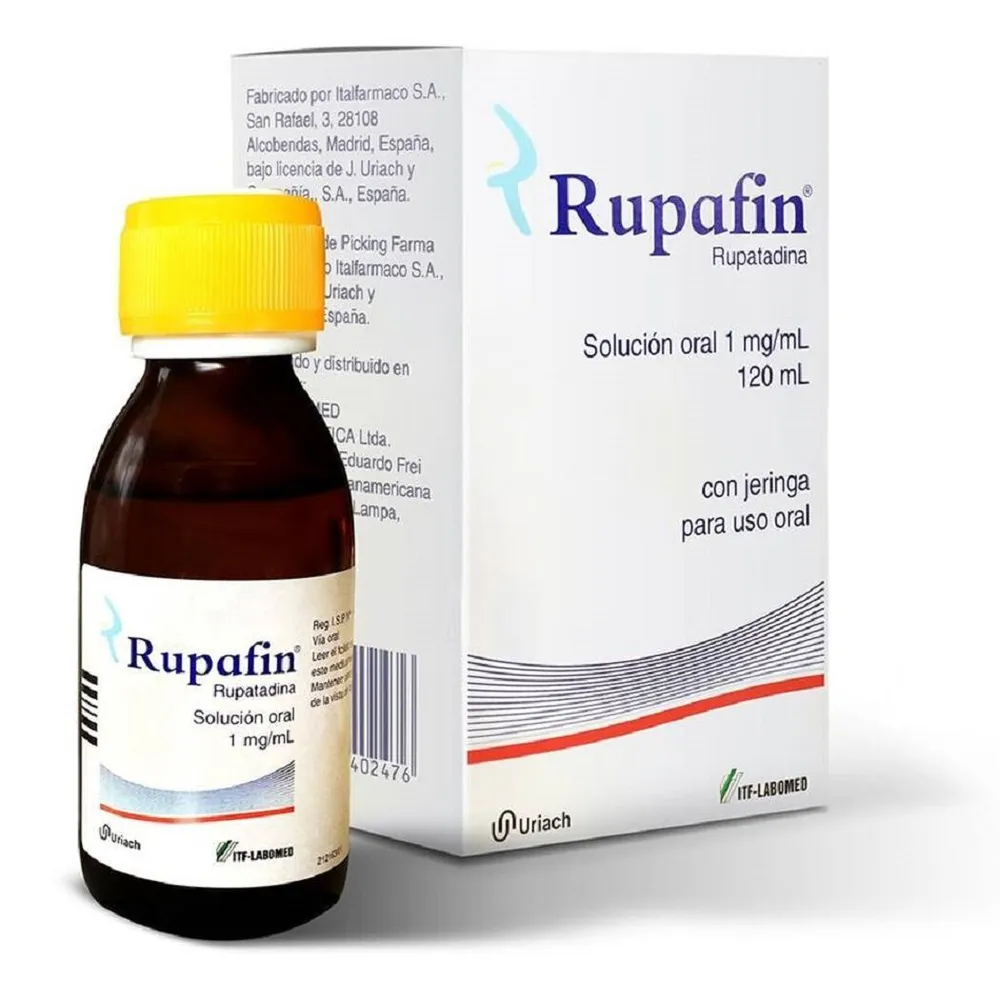
Table of Contents
Package leaflet: Information for the user
Introduction
Package leaflet: information for the patient
Rupafin 1 mg/ml oral solution
Rupatadine
Read the entire leaflet carefully before you start taking this medicine, because it contains important information for you.
- Keep this leaflet, as you may need to read it again.
- If you have any questions, consult your doctor or pharmacist.
- This medicine has been prescribed for you only, and you should not give it to others, even if they have the same symptoms as you, because it could harm them.
- If you experience any adverse reactions, consult your doctor or pharmacist, even if they are adverse reactions not listed in this leaflet. See section 4.
Leaflet contents
- What Rupafin is and what it is used for
- What you need to know before taking Rupafin
- How to take Rupafin
- Possible adverse effects
- How to store Rupafin
- Contents of the container and other information
1. What Rupafin is and what it is used for
Rupafin contains the active substance rupatadine, which is an antihistamine.
Rupafin oral solution is indicated for the relief of symptoms of allergic rhinitis such as sneezing, runny nose, nasal congestion, itching of the nose and eyes in children aged 2 to 11 years.
Rupafin is also indicated for the relief of symptoms associated with urticaria (allergic skin rash), such as itching and skin wheals (redness and swelling of the skin) in children aged 2 to 11 years.
2. What you need to know before starting to take Rupafin
Do not take Rupafin:
- If you are allergic to rupatadine or to any of the other ingredients of this medicine (listed in section 6).
Warnings and precautions
Talk to your doctor or pharmacist before starting to take Rupafin.
If you have renal or hepatic impairment, consult your doctor. The use of Rupafin is currently not recommended in patients with renal or hepatic impairment.
If you have low blood potassium levels and/or a known abnormal heart rhythm pattern (known QTc interval prolongation on ECG), which may occur in certain heart conditions, consult your doctor.
Children
This medicine must not be used in children under 2 years of age or weighing less than 10 kg.
Other medicines and Rupafin
Inform your doctor or pharmacist if you are taking, have recently taken, or might need to take any other medicines.
If you are taking Rupafin, do not take medicines containing ketoconazole (a medicine for fungal infections) or erythromycin (a medicine for bacterial infections).
If you are taking central nervous system depressants, statins (medicines used to treat high cholesterol levels), or midazolam (a medicine used for short-term sedation), consult your doctor before taking Rupafin.
Taking Rupafin with food, drinks and alcohol
Rupafin can be taken with or without food.
Do not take Rupafin together with grapefruit juice, as it may increase the level of rupatadine in your body.
Rupafin at the 10 mg dose does not increase the drowsiness caused by alcohol.
Pregnancy and breastfeeding
If you are pregnant or breastfeeding, think you may be pregnant, or are planning to become pregnant, consult your doctor or pharmacist before using this medicine.
Driving and using machines
At the recommended dose, Rupafin is not expected to affect your ability to drive or operate machinery. However, when you first start using Rupafin, you should take care to observe how the treatment may affect you before driving or operating machinery.
Rupafin contains sucrose, methyl parahydroxybenzoate, and propylene glycol.
If your doctor has informed you of an intolerance to certain sugars, consult your doctor before taking this medicine. It may cause tooth decay.
It may cause allergic reactions (possibly delayed) because it contains methyl parahydroxybenzoate.
This medicine contains 200 mg of propylene glycol in each ml.
If your child is under 5 years of age, speak with your doctor or pharmacist before administering this medicine, particularly if using other medicines containing propylene glycol or alcohol.
If you are pregnant or breastfeeding, do not take this medicine unless advised by your doctor. Your doctor may perform additional monitoring while you are taking this medicine.
If you have liver or kidney disease, do not take this medicine unless advised by your doctor. Your doctor may perform additional monitoring while you are taking this medicine.
This medicine contains less than 23 mg of sodium (1 mmol) per ml, i.e., essentially "sodium-free".
3. How to take Rupafin
Always follow exactly the instructions for use of this medicine as indicated by your doctor. If in doubt, consult your doctor or pharmacist again.
Rupafin oral solution is administered orally.
Dosage in children weighing 25 kg or more: 5 ml (5 mg of rupatadine) of oral solution once daily, taken with or without food.
Dosage in children weighing 10 kg or more and less than 25 kg: 2.5 ml (2.5 mg of rupatadine) of oral solution once daily, taken with or without food.
Your doctor will determine the duration of your treatment with Rupafin.
Instructions for use
- To open the bottle, press down on the cap and turn it counterclockwise.
- Insert the syringe into the hole in the pierced cap and invert the bottle.
- Draw up the prescribed dose into the syringe.
- Administer directly using the dosing syringe.
- Wash the syringe after each use.
If you take more Rupafin than you should
In case of overdose or accidental ingestion, contact your doctor or pharmacist immediately or call the Toxicology Information Service at telephone number 915 620 420, indicating the medicine and the amount ingested.
If you forget to take Rupafin
Do not take a double dose to make up for missed doses.
4. Possible adverse effects
Like all medicines, this medicine can cause adverse effects, although not everyone experiences them.
Frequent adverse effects (may affect up to 1 in 10 people) are headache and somnolence.
Uncommon adverse effects (may affect up to 1 in 100 people) are influenza, nasopharyngitis, upper respiratory tract infections, increased eosinophils, decreased neutrophils, dizziness, nausea, eczema, night sweats, and fatigue.
Reporting of adverse effects:
If you experience any type of adverse effect, consult your doctor or pharmacist, even if it is a possible adverse effect not listed in this leaflet. You may also report them directly through the Spanish Pharmacovigilance System for Human Medicines: https://www.notificaram.es. By reporting adverse effects, you can help provide more information on the safety of this medicine.
5. Storage of Rupafin
Keep this medicine out of the sight and reach of children.
This medicine does not require any special storage conditions.
Do not use this medicine after the expiry date stated on the carton and on the bottle after EXP. The expiry date refers to the last day of the month indicated. The expiry date of the medicine after first opening remains the same as that stated on the carton and on the label of the bottle.
Medicines must not be disposed of via wastewater or household waste. Dispose of empty containers and unused medicines at a SIGRE collection point at your pharmacy. If you are unsure, please consult your pharmacist on how to properly dispose of containers and medicines you no longer need. This will help protect the environment.
6. Contents of the pack and other information
Composition of Rupafin
- The active substance is rupatadine. Each ml contains 1 mg of rupatadine (as fumarate).
- The other components are: propylene glycol (E-1520), anhydrous citric acid, anhydrous disodium phosphate, sodium saccharin, sucrose, methylparaben (E-218), quinoline yellow (E-104), banana flavouring, and purified water. See section 2 “Rupafin contains sucrose, methylparaben and propylene glycol”.
Nature and contents of the container:
Rupafin is a yellow, clear solution.
Rupafin is available in topaz-coloured plastic bottles equipped with an integrated perforated closure and child-resistant cap. Each pack contains one bottle with 120 ml of oral solution and includes a 5 ml oral dosing syringe graduated in 0.25 ml increments.
Marketing Authorization Holder
LABORATORIOS ERN, S.A.
Perú, 228
08020 Barcelona
Spain
Manufacturer
Italfarmaco, S.A.
San Rafael, 3
Pol. Ind. Alcobendas
E-28108 Alcobendas (Spain)
or
NOUCOR HEALTH, S.A.
Av. Camí Reial 51-57
08184 Palau-solità i Plegamans (Barcelona-Spain)
This medicinal product is authorized in the European Economic Area member states under the following names:
Rupatall 1 mg/ml oral solution – Belgium, Luxembourg
Rinialer 1 mg/ml oral solution – Portugal, Malta
Rupafin 1 mg/ml oral solution – Austria, Bulgaria, Croatia, Cyprus, Denmark, Estonia, Germany, Greece, Iceland, Italy, Ireland, Latvia, Liechtenstein, Lithuania, Netherlands, Norway, Poland, Slovenia, Slovakia, Spain
Rupatadine 1 mg/ml oral solution – United Kingdom
Wystamm 1 mg/ml oral solution – France
Tamalis 1 mg/ml oral solution – Hungary, Czech Republic, Romania
Pafinur 1 mg/ml oral solution – Finland, Sweden
Date of the most recent revision of this leaflet: 08/2020
Detailed and up-to-date information on this medicinal product is available on the website of the Spanish Agency of Medicines and Health Products (AEMPS): http://www.aemps.gob.es