Rukobia 600 mg prolonged-release tablets
Spain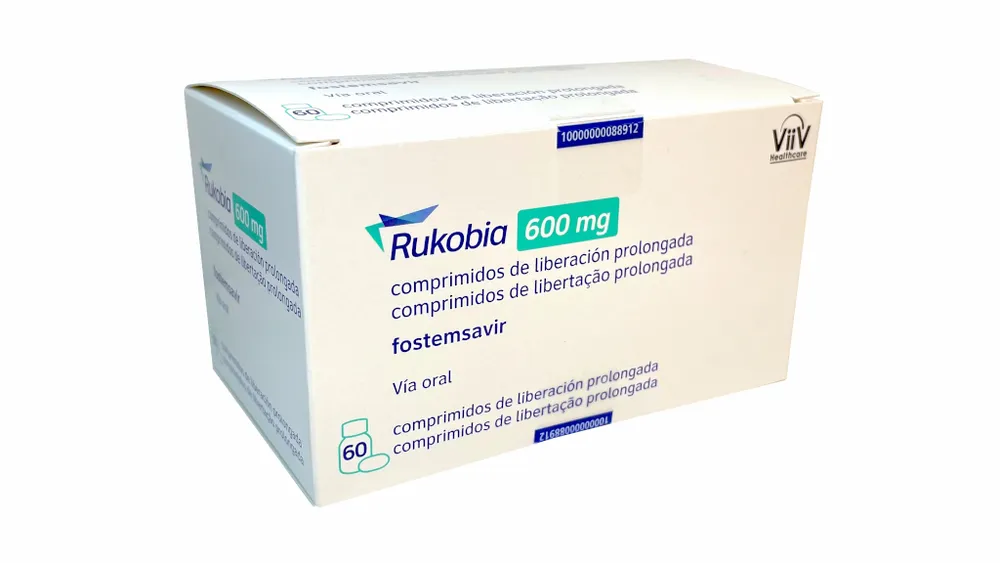
Table of Contents
Package leaflet: Information for the user
Introduction
Package leaflet: information for the patient
Rukobia 600mg prolonged-release tablets
fostemsavir
This medicinal product is subject to additional monitoring, which will allow quicker identification of new safety information. You can help by reporting any side effects you may experience. Information on how to report side effects is included at the end of section 4.
Read this entire leaflet carefully before you start taking this medicine, as it contains important information for you.
- Keep this leaflet, as you may need to read it again.
- If you have any questions, ask your doctor or pharmacist.
- This medicine has been prescribed for you only and must not be given to other people, even if they have the same symptoms as you, since it may harm them.
- If you experience any side effects, consult your doctor or pharmacist, even if they are side effects not listed in this leaflet. See section 4.
Leaflet contents
- What Rukobia is and what it is used for
- What you need to know before taking Rukobia
- How to take Rukobia
- Possible side effects
- How to store Rukobia
- Contents of the pack and other information
1. What Rukobia is and what it is used for
Rukobia contains fostemsavir and is a type of antiretroviral medicine for HIV known as a gp120 attachment inhibitor (AI). It works by binding to the virus and preventing it from attaching to blood cells.
Rukobia is used in combination with other antiretroviral medicines (combination therapy) to treat HIV infection in adults with limited treatment options (other antiretroviral medicines are not sufficiently effective or are not suitable).
Rukobia does not cure HIV infection; it reduces the amount of virus in your body and keeps it at a low level. Since HIV reduces the number of CD4 cells in the body, keeping HIV at a low level also increases the CD4 cell count in the blood. CD4 cells are a type of white blood cell that are important in helping your body fight infections.
2. What you need to know before taking Rukobia
Do not take Rukobia
-
if you are allergic to fostemsavir or to any of the other ingredients of this medicine (listed in section 6)
-
if you are taking any of the following medicines:
- carbamazepine or phenytoin (used to treat epilepsy and prevent seizures)
- mitotane (used to treat various types of cancer)
- enzalutamide (used to treat prostate cancer)
- rifampicin (used to treat certain bacterial infections such as tuberculosis)
- products containing St. John’s wort (Hypericum perforatum) (a herbal product used to treat depression).
-
If you think any of this applies to you, do not take Rukobia until you have consulted your doctor.
Warnings and precautions
Conditions to be aware of
Some people who take medicines for HIV infection develop other disorders, which may be serious. These include:
- symptoms of infection and inflammation
- joint pain, stiffness, and bone problems.
You need to know which important signs and symptoms to watch for while taking Rukobia.
- See section 4 of this leaflet.
Before taking Rukobia, your doctor should know
-
if you have or have had a heart problem, or if you notice any unusual changes in your heartbeat (such as beating too fast or too slow). Rukobia can affect heart rhythm.
-
if you have or have had a liver disease, including hepatitis B or C.
-
Consult your doctor if this applies to you. You may need additional monitoring, including blood tests, while taking your medication.
You will need regular blood tests
While taking Rukobia, your doctor will request periodic blood tests to measure the amount of HIV in your blood and to detect any adverse effects. More information about these adverse effects is in section 4 of this leaflet.
Maintain regular contact with your doctor
Rukobia helps control your condition, but does not cure HIV infection. You must continue to take it every day to prevent your condition from worsening. Because Rukobia does not cure HIV infection, you may continue to develop other infections and HIV-related illnesses.
- Stay in contact with your doctor, and do not stop taking Rukobia without consulting your doctor first.
Children and adolescents
Rukobia is not recommended for individuals under 18 years of age, as it has not been studied in this age group.
Other medicines and Rukobia
Tell your doctor or pharmacist if you are taking, have recently taken, or might need to take any other medicines.
Rukobia must not be taken with certain medicines
Do not take Rukobia if you are taking any of the following medicines:
- carbamazepine or phenytoin, used to treat epilepsy and prevent seizures
- mitotane, used to treat various types of cancer
- enzalutamide, used to treat prostate cancer
- rifampicin, used to treat certain bacterial infections such as tuberculosis
- products containing St. John’s wort (Hypericum perforatum) (a herbal product used to treat depression).
This medicine is not recommended with Rukobia:
-
elbasvir/grazoprevir, used to treat hepatitis C infection.
-
Tell your doctor or pharmacist if you are being treated with this medicine.
Some medicines may affect how Rukobia works
Or increase the likelihood of experiencing adverse effects. Rukobia may also affect how other medicines work.
Tell your doctor if you are taking any of the following medicines:
-
amiodarone, disopyramide, ibutilide, procainamide, quinidine, or sotalol, used to treat heart conditions
-
statins (atorvastatin, fluvastatin, pitavastatin, rosuvastatin, or simvastatin), used to lower cholesterol levels
-
ethinylestradiol, used for contraception
-
tenofovir alafenamide, used as an antiviral.
-
Tell your doctor or pharmacist if you are taking any of these. Your doctor may decide to adjust your dose or consider whether you need additional monitoring.
Pregnancy
If you are pregnant or think you may be pregnant, or plan to become pregnant, do not take Rukobia without consulting your doctor. Your doctor will discuss with you the benefits to you and the risks to your baby of taking Rukobia during pregnancy.
Breast-feeding
It is not recommended that women living with HIV breastfeed, because HIV infection can be transmitted to the baby through breast milk.
It is unknown whether the components of Rukobia pass into breast milk and could harm your baby. If you are breastfeeding or considering breastfeeding, you must consult your doctor as soon as possible.
Driving and use of machines
Rukobia may make you feel dizzy and/or cause other adverse effects that may reduce your alertness.
? Do not drive or operate machinery unless you are certain it does not affect you.
3. How to take Rukobia
Follow exactly the instructions for using this medicine given by your doctor. If in doubt, consult your doctor or pharmacist again.
- The recommended dose of Rukobia is one 600 mg tablet twice daily.
- The Rukobia tablet must be swallowed whole with a little liquid. Do not chew, crush, or split the tablets – doing so may cause the medicine to be released into your body too quickly.
- You may take Rukobia with or without food.
If you take more Rukobia than you should
If you take more Rukobia tablets than prescribed, contact your doctor or pharmacist. If possible, show them the Rukobia package.
If you forget to take Rukobia
Take it as soon as you remember. However, if it is almost time for your next dose, skip the missed dose and return to your regular schedule. Do not take a double dose to make up for a missed dose. If you are unsure what to do, consult your doctor or pharmacist.
If you stop taking Rukobia
Do not stop treatment with Rukobia without first consulting your doctor.
To control your HIV infection and prevent your condition from worsening, take Rukobia for as long as your doctor recommends. Do not interrupt treatment unless instructed by your doctor.
If you have any further questions about the use of this medicine, ask your doctor or pharmacist.
4. Possible adverse effects
Like all medicines, this medicine can cause adverse effects, although not everyone experiences them. Therefore, it is very important that you inform your doctor about any changes in your health.
Symptoms of infection and inflammation are common (may affect up to 1 in 10 people).
People with advanced HIV infection (AIDS) have a weakened immune system and are more prone to developing serious infections (opportunistic infections). When treatment is started, the immune system strengthens, so the body begins to fight these infections.
Symptoms of infection and inflammation may develop due to:
- old, hidden infections reappearing as the body fights them
- or the immune system mistakenly attacking healthy body tissue (autoimmune disorders).
Symptoms of autoimmune disorders may appear many months after starting treatment for HIV infection.
These symptoms may include:
- muscle weakness and/or muscle pain
- pain or swelling of the joints
- weakness starting in the hands and feet and moving upward toward the trunk
- palpitations or tremors
- excessive restlessness and movement (hyperactivity).
If you have any symptoms of infection or inflammation, or notice any of the symptoms listed above:
- Contact your doctor immediately. Do not take any other medicines for infection without first consulting your doctor.
Very common adverse effects (may affect more than 1 in 10 people):
-
nausea
-
diarrhea
-
discomfort (vomiting)
-
stomach ache (abdominal pain)
-
headache
-
rash.
-
Consult your doctor if you experience any of these adverse effects.
Common adverse effects (may affect up to 1 in 10 people):
-
indigestion (dyspepsia)
-
lack of energy (fatigue)
-
changes in heart rhythm seen on electrocardiogram (prolonged QT interval)
-
muscle pain (myalgia)
-
drowsiness
-
dizziness
-
altered taste (dysgeusia)
-
gas
-
difficulty sleeping (insomnia)
-
itching (pruritus).
-
Consult your doctor if you experience any of these adverse effects.
Some adverse effects may only be detected through blood tests and may not appear immediately after starting Rukobia.
Common adverse effects that may show up in blood tests include:
- increased levels of enzymes produced in the muscles (creatine phosphokinase; a marker of muscle damage)
- increased creatinine levels, an indicator of kidney function
- increased levels of enzymes produced in the liver (transaminases, a marker of liver damage).
Other adverse effects that may appear in blood tests
Other adverse effects have occurred in some people, but their exact frequency is unknown:
- increased bilirubin (a substance produced in the liver) in the blood.
Joint pain, stiffness, and bone problems
Some people receiving combination treatment for HIV-1 develop osteonecrosis. In this condition, parts of the bone tissue die due to reduced blood supply to the bones. People may be more likely to develop this condition if they:
- have been on combination therapy for a long time
- are also taking anti-inflammatory medicines called corticosteroids
- drink alcohol
- have a severely weakened immune system
- are overweight.
Signs of osteonecrosis include:
- stiffness in the joints
- discomfort and pain in the joints (especially in the hip, knee, or shoulder)
- difficulty moving.
If you notice any of these symptoms:
- Inform your doctor.
Reporting of adverse effects
If you experience any type of adverse effect, talk to your doctor or pharmacist, even if it is a possible adverse effect not listed in this leaflet. You can also report them directly through the national reporting system listed in Appendix V. By reporting adverse effects, you can help provide more information on the safety of this medicine.
5. Storage of Rukobia
Keep this medicine out of the sight and reach of children.
Do not use this medicine after the expiry date stated on the outer packaging and bottle after EXP. The expiry date refers to the last day of the month indicated.
This medicine does not require any special storage conditions.
Medicines must not be disposed of via wastewater or household waste. Ask your pharmacist how to dispose of medicines and packaging that you no longer need. This will help protect the environment.
6. Contents of the pack and other information
Composition of Rukobia
- The active substance is fostemsavir. Each tablet contains fostemsavir tromethamine equivalent to 600 mg of fostemsavir.
- The other components are hydroxypropyl cellulose, hypromellose, colloidal anhydrous silica, magnesium stearate, poly(vinyl alcohol), titanium dioxide (E171), macrogol 3350, talc, yellow iron oxide (E172), red iron oxide (E172).
Appearance of the product and contents of the pack
Rukobia 600 mg prolonged-release tablets are biconvex, oval-shaped, beige in colour, approximately 19 mm in length, 10 mm in width and 8 mm in thickness, marked with the code 'SV 1V7' on one side.
Each pack contains one or three bottles, each bottle containing 60 prolonged-release tablets.
Only certain pack sizes may be marketed.
Marketing Authorization Holder
ViiV Healthcare BV
Van Asch van Wijckstraat 55H
3811 LP Amersfoort
The Netherlands
Manufacturer
GlaxoSmithKline Manufacturing S.P.A
Strada Provinciale Asolana, 90
San Polo di Torrile
Parma, 43056
Italy
For further information about this medicinal product, contact the local representative of the Marketing Authorization Holder:
Belgium/Belgium/Belgium ViiV Healthcare srl/bv Tel/Tel: + 32 (0) 10 85 65 00 | Lithuania ViiV Healthcare BV Tel: + 370 80000334 |
Bulgaria ViiV Healthcare BV Tel: + 359 2 80018205 | Luxembourg/Luxembourg ViiV Healthcare srl/bv Belgium/Belgium Tel/Tel: + 32 (0) 10 85 65 00 |
Czech Republic GlaxoSmithKline, s.r.o. Tel: + 420 222 001 111 | Hungary ViiV Healthcare BV Tel: + 36 80088309 |
Denmark GlaxoSmithKline Pharma A/S Tlf: + 45 36 35 91 00 | Malta ViiV Healthcare BV Tel: + 356 80065004 |
Germany ViiV Healthcare GmbH Tel.: + 49 (0)89 203 0038-10 | Netherlands ViiV Healthcare BV Tel: + 31 (0)33 2081199 |
Estonia ViiV Healthcare BV Tel: + 372 8002640 | Norway GlaxoSmithKline AS Tlf: + 47 22 70 20 00 |
Greece GlaxoSmithKline Μονοπρόσωπη A.E.B.E. Tel: + 30 210 68 82 100 | Austria GlaxoSmithKline Pharma GmbH Tel: + 43 (0)1 97075 0 |
Spain Laboratorios ViiV Healthcare, S.L. Tel: + 34 900 923 501 | Poland GSK Services Sp. z o.o. Tel.: + 48 (0)22 576 9000 |
France ViiV Healthcare SAS Tél.: + 33 (0)1 39 17 69 69 | Portugal VIIVHIV HEALTHCARE, UNIPESSOAL, LDA Tel: + 351 21 094 08 01 |
Croatia ViiV Healthcare BV Tel: + 385 800787089 | Romania ViiV Healthcare BV Tel: + 40800672524 |
Ireland GlaxoSmithKline (Ireland) Limited Tel: + 353 (0)1 4955000 | Slovenia ViiV Healthcare BV Tel: + 386 80688869 |
Iceland Vistor ehf. Sími: +354 535 7000 | Slovakia ViiV Healthcare BV Tel: + 421 800500589 |
Italy ViiV Healthcare S.r.l Tel: + 39 (0)45 9212611 | Finland GlaxoSmithKline Oy Puh/Tel: + 358 (0)10 30 30 30 |
Cyprus ViiV Healthcare BV Tel: + 357 80070017 | Sweden GlaxoSmithKline AB Tel: + 46 (0)8 638 93 00 |
Latvia ViiV Healthcare BV Tel: + 371 80205045 |
Date of the most recent review of this leaflet: {MM/YYYY}.
Other sources of information
Detailed information on this medicine is available on the website of the European Medicines Agency: http://www.ema.europa.eu.