Royen 500 mg hard capsule
Spain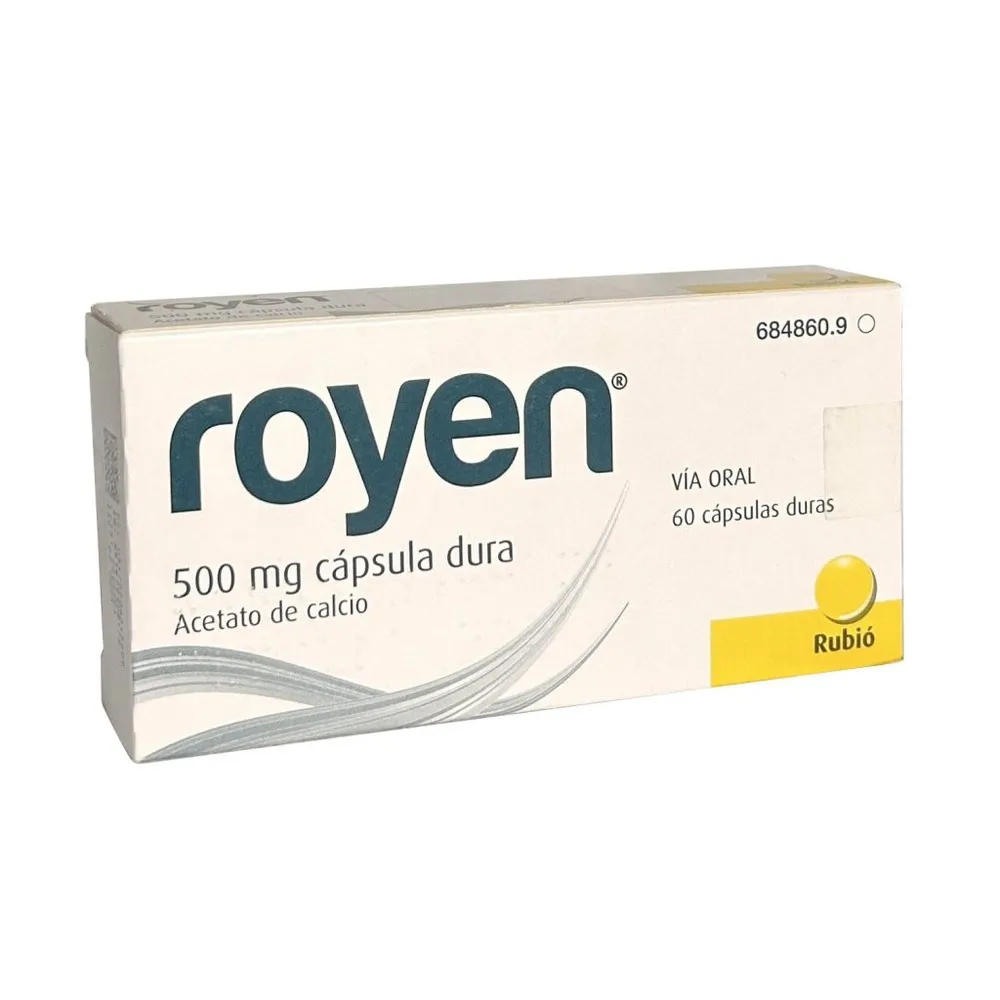
Table of Contents
Package leaflet: Information for the user
Introduction
Package leaflet: information for the user
ROYEN 500 mg hard capsule
Calcium acetate
Read the entire leaflet carefully before you start taking this medicine.
- Keep this leaflet as you may need to read it again.
- If you have any questions, ask your doctor or pharmacist.
- This medicine has been prescribed for you and you should not give it to others, even if they have the same symptoms, as it may harm them.
- If you consider any of the side effects you experience to be severe, or if you notice any side effect not listed in this leaflet, inform your doctor or pharmacist.
Leaflet contents:
- What ROYEN 500 mg is and what it is used for
- Before you take ROYEN 500 mg
- How to take ROYEN 500 mg
- Possible side effects
- How to store ROYEN 500 mg
- Further information
1. What ROYEN 500 mg is and what it is used for
ROYEN 500 mg is available as hard capsules for oral administration, in packaging containing 60 and 120 hard capsules.
Calcium acetate is a medicine that belongs to a group of medicines called binders. It binds to dietary phosphate and forms insoluble phosphates that are eliminated in the feces, thereby helping to control blood phosphate levels.
ROYEN 500 mg hard capsule is indicated for:
- Control of hyperphosphatemia (elevated phosphate levels in blood) in patients with advanced renal insufficiency.
2. BEFORE TAKING ROYEN 500 mg
Do not take ROYEN:
- If you are allergic to calcium acetate or to any of the other components of ROYEN 500 mg.
- If you have hypercalcemia (high levels of calcium in the blood) or hypercalciuria (excessive excretion of calcium in the urine).
Take special care with ROYEN:
- At the beginning of treatment, as excessive dosing of ROYEN may cause an increase in blood calcium levels. Your doctor should determine the calcium concentration in your blood twice a week. Blood phosphorus levels should also be monitored periodically.
- If you are being treated with digitalis, because increased blood calcium levels may cause cardiac arrhythmias.
- Do not take other calcium supplements together with ROYEN, as this could lead to overdose and a potentially serious increase in blood calcium levels. For the same reason, it is important to monitor your daily intake of calcium-rich foods, such as dairy products and similar items.
If you are on dialysis, reducing the concentration of calcium in the dialysate may reduce the incidence and severity of ROYEN-induced increases in blood calcium levels.
Consult your doctor if any of the above-mentioned conditions have ever applied to you.
Use of other medicines:
Inform your doctor or pharmacist if you are taking, or have recently taken, any other medicines, including those obtained without a prescription.
Inform your doctor if you are taking any of the following medicines, as they may interact with calcium acetate, and it may therefore be necessary to adjust the dose or discontinue one of the treatments:
- Tetracyclines (a specific group of antibiotics).
- Zinc: zinc levels should be monitored, as ROYEN reduces its intestinal absorption.
- Antacids or other preparations containing high levels of calcium, which may contribute to increased blood calcium levels.
Pregnancy:
Consult your doctor or pharmacist before using any medicine.
It is unknown whether ROYEN may cause fetal harm when administered to pregnant women or may affect reproductive capacity.
ROYEN may be administered to pregnant or breastfeeding women only if strictly necessary.
Driving and operating machinery:
The influence of ROYEN on the ability to drive and operate machinery is negligible.
3. HOW TO TAKE ROYEN 500 mg
Follow exactly the instructions for administration of Royen 500 mg provided by your doctor. If you have any doubts, consult your doctor or pharmacist.
ROYEN is taken orally. Swallow the capsules with a glass of water.
The usual dose is 3 to 5 capsules with each meal (breakfast, lunch, and dinner), according to medical judgment.
Begin ROYEN treatment with a low dose. Do not increase the dose without first determining serum calcium levels.
The dose of ROYEN should be adjusted based on the calculation of daily calcium intake. The recommended initial dose of ROYEN for a dialysis patient is 2 capsules at breakfast, lunch, and dinner. This dose may be gradually increased until serum phosphate levels are below 6 mg/dL, while monitoring for increases in blood calcium.
Your doctor will determine the duration of your ROYEN treatment. Do not stop treatment prematurely, as this may cause a sudden increase in serum phosphate levels. Likewise, do not use it longer than indicated by your doctor.
If you feel that the effect of ROYEN is too strong or too weak, inform your doctor or pharmacist.
If you take more ROYEN than you should:
If you have taken more ROYEN than you should, consult your doctor or pharmacist immediately, stating the medication and the amount ingested.
The most common symptom in case of overdose is elevated blood calcium. If the increase is mild, it can be easily managed by reducing the ROYEN dose or temporarily interrupting treatment. In case of severe hypercalcemia, hemodialysis should be performed and treatment temporarily discontinued until your doctor indicates otherwise.
In case of overdose or accidental ingestion, contact the Toxicology Information Service. Telephone: 91 562 04 20.
If you forget to take ROYEN:
Do not take a double dose to make up for missed doses.
If you interrupt treatment with ROYEN:
Consult your doctor, who will advise you on the dosing regimen to follow until you reach your maintenance dose.
4. Possible adverse effects
Like all medicines, ROYEN may cause adverse effects, although not everybody gets them.
Rare (less than 1 in 1,000 but more than 1 in 10,000 treated subjects):
- Nausea, vomiting, diarrhoea, constipation, abdominal pain.
- Asthenia, fatigue.
- Mild increase in blood calcium.
- Severe increase in blood calcium which may cause confusion, delirium, stupor and coma.
Very rare (less than 1 in 10,000 treated subjects, including isolated reports):
- Itching, which may be due to allergic reactions.
If you consider that any of the adverse effects you experience is severe or if you notice any adverse effect not listed in this leaflet, inform your doctor or pharmacist.
5. Storage of ROYEN 500 mg
Do not store above 25°C.
Keep out of the reach and sight of children.
Do not use ROYEN after the expiry date stated on the packaging. The expiry date refers to the last day of the month indicated.
Medicines should not be disposed of via wastewater or household waste. Ask your pharmacist how to properly dispose of any unused medicine and its packaging. This will help protect the environment.
6. ADDITIONAL INFORMATION
Composition of ROYEN:
The active substance in this medicine is calcium acetate.
Each capsule contains 500 mg of calcium acetate (equivalent to 127 mg of calcium).
The other components are: magnesium stearate and talc. The capsule shell also contains gelatin, titanium dioxide, and indigo carmine.
Appearance of the product and contents of the container:
ROYEN 500 mg hard capsule is presented as capsules for oral administration, in packaging containing 60 and 120 capsules.
Marketing Authorization Holder and Manufacturer:
LABORATORIOS RUBIÓ, S.A.
C/ Industria, 29
Polígono Industrial Comte de Sert
08755 Castellbisbal, Barcelona – Spain
This leaflet was approved in
June 2012