Rovamycine 1.5 million IU film-coated tablets
Spain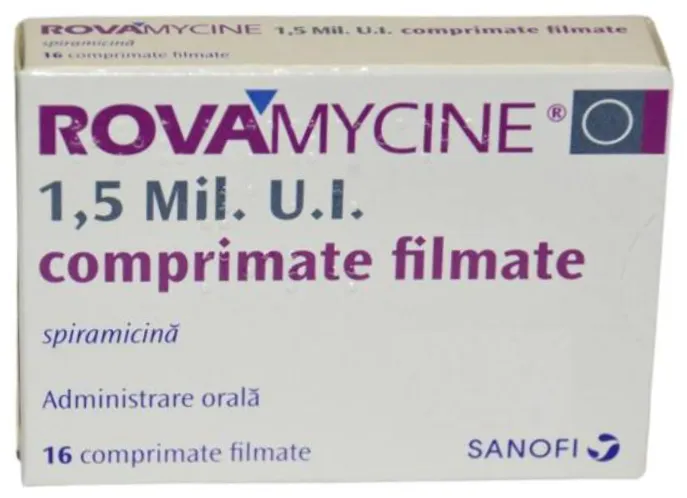
Table of Contents
- Patient Information Leaflet
- Introduction
- **Read the entire leaflet carefully before starting to use this medicine**
- **Package leaflet contents:**
- 1. What Rovamycine is and what it is used for
- 2. What you need to know before taking Rovamycine
- 3. How to take Rovamycine
- 4. Possible adverse effects
- 5. Storage of Rovamycine
- 6. Contents of the pack and other information
Patient Information Leaflet
Introduction
Package leaflet: Information for the patient
Rovamycine 1.5 million IU film-coated tablets
Spiramycin
Read the entire leaflet carefully before starting to use this medicine
- Keep this leaflet, as you may need to read it again.
- If you have any questions, consult your doctor or pharmacist.
- This medicine has been prescribed for you; do not give it to others, even if they have the same symptoms, as it may harm them.
- If you consider any of the side effects you experience to be severe, or if you notice any side effects not listed in this leaflet, inform your doctor or pharmacist. See section 4.
Package leaflet contents:
- What Rovamycine is and what it is used for
- What you need to know before taking Rovamycine
- How to take Rovamycine
- Possible side effects
- How to store Rovamycine
- Contents of the pack and other information
1. What Rovamycine is and what it is used for
Rovamycine belongs to a group of medicines called macrolides. Antibiotics stop the growth of bacteria that cause infections.
Antibiotics are used to treat bacterial infections and are not effective against viral infections such as flu or the common cold.
It is important that you follow your doctor's instructions regarding dose, dosing interval, and duration of treatment.
Do not store or reuse this medicine. If you have any antibiotic left over after completing treatment, return it to the pharmacy for proper disposal. Do not dispose of medicines via wastewater or household waste.
Rovamycine is used to treat infections caused by susceptible microorganisms in:
-
Tonsillitis (infection of the throat). Pharyngitis (infection of the pharynx).
-
Sinusitis (infection of the paranasal sinuses located around the forehead, cheeks, and eyes).
-
Otitis (ear infection).
-
Infections of the oral cavity.
-
Gonococcal infections (sexually transmitted infection).
-
Toxoplasmosis (an infection caused by a parasite).
2. What you need to know before taking Rovamycine
Do not take Rovamycine
If you are allergic to the active substance or to any of the other ingredients of this medicine (listed in section 6).
Warnings and precautions
Talk to your doctor or pharmacist before starting to take Rovamycine.
- Caution should be exercised in patients with known risk factors for cardiac arrhythmias such as QT interval prolongation: hypocalcemia, hypomagnesemia, congenital long QT syndrome, heart disease, and concomitant use of medications known to prolong the QT interval.
Elderly patients, neonates, and women may be more sensitive to the QT-prolonging effect.
-
Serious skin adverse reactions have been reported. If signs of these serious skin reactions appear, such as progressive skin rash, often with blisters or mucosal lesions, treatment with Rovamycine must be discontinued (see Possible side effects).
-
If you have glucose-6-phosphate dehydrogenase enzyme deficiency, your doctor will advise you not to take Rovamycine, as very rare cases of acute hemolysis (a blood disorder) have been observed in such individuals.
Use of Rovamycine with other medicines
Inform your doctor or pharmacist if you are taking, have recently taken, or might need to take any other medicines, including those obtained without a prescription.
-
Hydroxychloroquine or chloroquine (used to treat conditions such as rheumatoid arthritis, or to treat or prevent malaria): Taking these medicines together with Rovamycine may increase the likelihood of heart-related adverse effects that could be life-threatening.
-
It is important that you inform your doctor if you are being treated with levodopa (a medicine used for Parkinson's disease), as spiramycin reduces the blood levels of levodopa, which may reduce the effectiveness of levodopa treatment; your doctor may therefore need to adjust your levodopa dose.
Spiramycin, like other antibiotics, should be used with caution in patients receiving medications known to affect QT interval prolongation (e.g., Class IA and III antiarrhythmics, some antidepressants, anti-infectives, or antipsychotics) (see Warnings and precautions).
Pregnancy, breast-feeding and fertility
If you are pregnant or breast-feeding, think you may be pregnant or are planning to become pregnant, consult your doctor or pharmacist before using this medicine.
The safety of Rovamycine during pregnancy has not been studied. Although no effects on fetal or neonatal development have been observed to date, the potential risks and benefits of its use should be carefully evaluated.
If you are breast-feeding, it is recommended not to take Rovamycine, as spiramycin, the active substance of this medicine, is excreted in breast milk.
Driving and using machines
There are no studies on the influence of Rovamycine on the ability to drive and operate machinery; however, to date, no such influence has been observed.
Rovamycine contains sodium
This medicine contains less than 23 mg of sodium (1 mmol) per tablet; therefore, it is essentially "sodium-free".
3. How to take Rovamycine
Follow exactly the instructions for the use of Rovamycine provided by your doctor. Consult your doctor or pharmacist if you have any doubts.
Remember to take your medicine.
Take Rovamycine tablets with a sufficient amount of liquid (a glass of water).
Your doctor will tell you how long your treatment with Rovamycine should last. Do not stop the treatment prematurely, as this could worsen your condition or lead to the development of bacterial resistance.
If you think that the effect of Rovamycine is too strong or too weak, inform your doctor or pharmacist.
Your doctor will decide the most appropriate dose for you.
The usual dose is:
Adults
The usual dose for adults is generally 4 tablets per day, divided into 2 or 3 doses. If necessary, your doctor may increase your dose up to 8 or 10 tablets.
If you have any impairment in kidney function, your doctor will not usually need to adjust your dose, as the amount of medication eliminated in the urine is very small.
Children
In children, the daily dose is 1 to 4 tablets, divided into 2 or 3 doses.
Your doctor will tell you how long your treatment with Rovamycine should last. Do not stop your treatment before being instructed to do so by your doctor, or take more tablets than recommended.
If you take more Rovamycine than you should
Contact your doctor or pharmacist immediately, or go to the nearest hospital emergency department, where your symptoms will be treated. Bring this leaflet with you. Due to the risk of QT interval prolongation, electrocardiographic monitoring is recommended.
In case of overdose or accidental ingestion, contact your doctor or pharmacist immediately or call the Toxicology Information Service at: 91 562 04 20, stating the medication and the amount ingested.
If you forget to take Rovamycine
Do not take a double dose to make up for missed doses.
4. Possible adverse effects
Like all medicines, Rovamycine may produce adverse effects, although not all people will experience them.
The following frequency definitions have been used for classification:
Very common: may affect more than 1 in 10 people
Common: may affect up to 1 in 10 people
Uncommon: may affect up to 1 in 100 people
Rare: may affect up to 1 in 1,000 people
Very rare: may affect up to 1 in 10,000 people
Frequency not known (cannot be estimated from available data)
Blood and lymphatic system disorders:
- Frequency not known: acute haemolysis (blood disorder) (see section Warnings and precautions), leucopenia, neutropenia (low levels of white blood cells).
Immune system disorders:
- Frequency not known: anaphylactic shock (severe allergic reaction that may be life-threatening), vasculitis (inflammation of blood vessels), including Henoch-Schönlein purpura.
Nervous system disorders:
- Very common: occasional transient paraesthesia (tingling in hands or feet).
- Common: transient dysgeusia (change in taste sensation).
Cardiac disorders:
- Frequency not known: ventricular arrhythmia, ventricular tachycardia, torsade de pointes, which may lead to cardiac arrest (see section Warnings and precautions).
Gastrointestinal disorders:
- Common: abdominal pain, nausea, vomiting, diarrhoea, and pseudomembranous colitis (severe inflammation of the intestine, which may very rarely occur after antibiotic treatment).
Skin and subcutaneous tissue disorders:
- Common: rash.
- Frequency not known: urticaria (hives, skin irritation and itching), pruritus (itching), angioedema (allergic reaction causing swelling of feet, hands, throat, lips and respiratory tract), Stevens-Johnson Syndrome, Toxic Epidermal Necrolysis, and Generalized Acute Exanthematous Pustulosis, whose symptoms may include the appearance of blisters on the skin, mouth, eyes or genitals (see section Warnings and precautions).
Hepatobiliary disorders:
- Frequency not known: cholestatic or mixed hepatitis.
Investigations:
- Frequency not known: QT interval prolongation on electrocardiogram, liver function test abnormalities.
Reporting of adverse effects
If you experience any type of adverse effect, consult your doctor or pharmacist, even if it is a possible adverse effect not listed in this leaflet. You may also report them directly via the Spanish Pharmacovigilance System for Human Medicines: https://www.notificaram.es. By reporting adverse effects, you can help provide more information on the safety of this medicine.
5. Storage of Rovamycine
Keep this medicine out of the reach and sight of children.
Do not store above 25°C.
Medicines must not be disposed of via wastewater or household waste. Dispose of empty containers and unused medicines at the SIGRE collection point in your pharmacy. If you are unsure, ask your pharmacist how to properly dispose of containers and unused medicines. This will help protect the environment.
Do not use Rovamycine after the expiry date stated on the packaging after EXP. The expiry date refers to the last day of the month indicated.
6. Contents of the pack and other information
Composition of Rovamycine
- The active substance is spiramycin. Each tablet contains 1.5 million IU of spiramycin.
The other components are:
Tablet core: Pregelatinized corn starch, hydroxypropylcellulose, sodium croscarmellose, magnesium stearate, anhydrous colloidal silica, microcrystalline cellulose.
Tablet coating: hypromellose, macrogol 6000, titanium dioxide (E 171).
Presentation of the product and contents of the pack
Rovamycine is presented as film-coated tablets, round, flat, white in colour, with "RPR 107" engraved on one side.
Each pack contains 24 tablets.
Marketing Authorisation Holder and Manufacturer
Marketing Authorisation Holder:
The Simple Pharma Company Limited
Ground Floor, 71 Lower Baggot Street, Dublin,
D02 P593, Ireland
Manufacturer:
Famar Health Care Services Madrid, S.A.U.
Avda. de Leganés, 62
28923 Alcorcón (Madrid)
Date of the most recent review of this summary: November 2023
Detailed information on this medicine is available on the website of the Spanish Agency for Medicines and Health Products (AEMPS) http://www.aemps.gob.es/.