Rocuronium B. Braun 10 mg/ml solution for injection and infusion EFG
Spain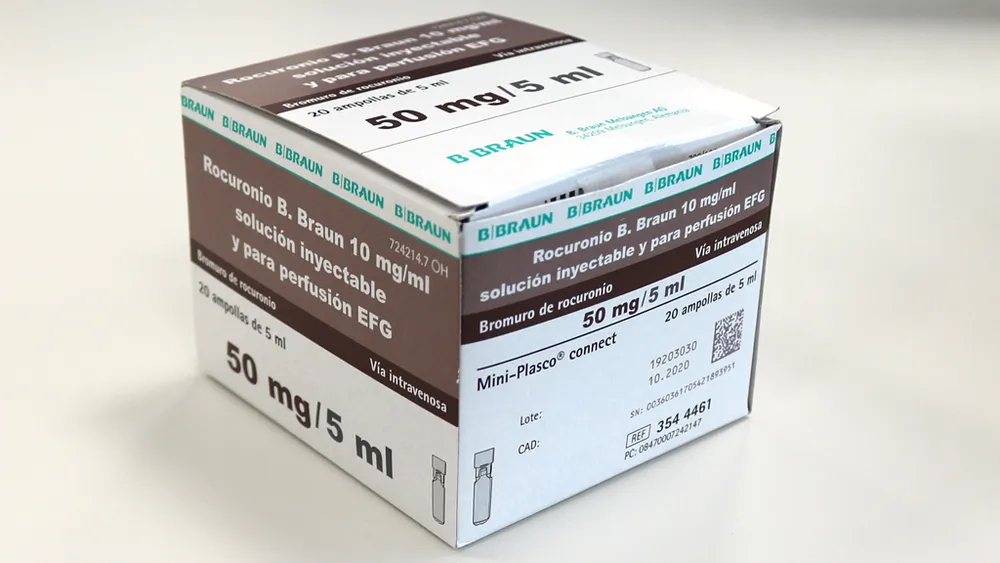
Table of Contents
Patient Information Leaflet
Introduction
Patient Information Leaflet
Rocuronium B. Braun 10 mg/ml solution for injection and infusion EFG
rocuronium bromide
Please read all of this leaflet carefully before you are given this medicine, because it contains important information for you.
- Keep this leaflet, as you may need to read it again.
- If you have any questions, ask your doctor, pharmacist or nurse.
- If you experience any side effects, talk to your doctor, pharmacist or nurse, including any side effects not listed in this leaflet. See section 4.
Contents of this leaflet:
- What Rocuronium B. Braun is and what it is used for
- What you need to know before being given Rocuronium B. Braun
- How Rocuronium B. Braun is used
- Possible side effects
- How to store Rocuronium B. Braun
- Contents of the pack and other information
1. What Rocuronio B. Braun is and what it is used for
Rocuronio B. Braun belongs to a group of medicines called muscle relaxants. Under normal circumstances, your nerves send messages to muscles through impulses. Rocuronio B. Braun works by blocking these impulses, thereby causing the muscles to relax.
When you undergo surgery, your muscles need to be completely relaxed. This makes the surgical procedure easier for the surgeon.
In adults and children, when under general anesthesia, Rocuronio B. Braun may be used to facilitate the insertion of a tube into your trachea to assist with breathing (mechanical ventilation) and to ensure that your muscles remain relaxed during surgery.
If you are an adult, your doctor may also use this medicine for a short period as an adjunctive treatment in the intensive care unit (ICU) (for example, to facilitate the insertion of a tube into your trachea). Additionally, you may receive this medicine whenever an emergency situation arises and you require rapid intubation to prepare you for surgery.
2. What you need to know before using Rocuronium B. Braun
Do not use Rocuronium B. Braun:
- If you are allergic to rocuronium, bromide, or any of the other ingredients of this medicine (listed in section 6).
Warnings and precautions
Talk to your doctor, pharmacist, or nurse before using this medicine:
- If you are allergic to any muscle relaxant.
- If you have kidney, liver, or gallbladder disorders.
- If you have heart diseases or conditions affecting blood circulation.
- If any parts of your body are swelling due to fluid accumulation (edema, for example, in the ankle area).
- If you suffer from neuromuscular diseases (muscle disorders such as polio (poliomyelitis), myasthenia gravis, Eaton-Lambert syndrome).
- If you have low calcium levels in the blood (hypocalcemia), for example, due to massive blood transfusions.
- If you have low potassium levels in the blood (hypokalemia), for example, due to severe vomiting, diarrhea, or diuretic therapy.
- If you have high magnesium levels in the blood (hypermagnesemia).
- If you have low protein levels in the blood (hypoproteinemia).
- If you are dehydrated.
- If you have excess acid in the blood (acidosis).
- If you have elevated carbon dioxide levels in the blood (hypercapnia).
- If you have excessive weight loss (cachexia).
- If you are overweight or of advanced age.
- If you have burns.
- If you have a rare tumor of the adrenal glands (pheochromocytoma); this may increase the risk of severe high blood pressure.
Use of Rocuronium B. Braun with other medicines
Your doctor or pharmacist must know if you are taking, have recently taken, or might need to take any other medicines, such as:
- Antibiotics.
- Antidepressants containing lithium.
- Medicines for treating heart diseases or high blood pressure (for example: quinidine, calcium channel blockers, adrenergic blocking agents (e.g., beta-blockers, alpha-blockers).
- Diuretics (medicines to increase urine volume).
- Certain laxatives such as magnesium salts.
- Quinine (used to treat pain and infections).
- Medicines used to treat epilepsy (e.g., phenytoin, carbamazepine).
- Long-term use of corticosteroids in the ICU.
- Medicines used to treat myasthenia gravis (neostigmine, pyridostigmine, edrophonium, aminopyridine).
- Theophylline (used to treat asthma).
- Medicines used to treat and prevent viral infections (protease inhibitors).
Please note:
You may be given other medicines during the procedure that could influence the effects of rocuronium. These include certain anesthetics (e.g., local anesthetics, inhaled anesthetics), other muscle relaxants, and protamine, which reverses the anticoagulant effect (prevention of blood clot formation) of heparin. Your doctor must take all of this into account when deciding the correct dose of rocuronium for you.
Pregnancy, breastfeeding, and fertility
If you are pregnant or breastfeeding, think you might be pregnant, or are planning to become pregnant, consult your doctor or pharmacist before using this medicine. Available data on the use of Rocuronium B. Braun in pregnant women are very limited, and there are no data available regarding breastfeeding. Rocuronium B. Braun should only be administered during pregnancy or breastfeeding if your doctor considers that the benefits outweigh the potential risks. Rocuronium B. Braun may be administered during cesarean section.
There are no data available on the effect of this medicine on fertility.
Driving and using machines
Rocuronium B. Braun has a major influence on the ability to drive and use machines. Therefore, driving or operating potentially dangerous machinery is not recommended during the first 24 hours after full recovery from the effects of this medicine. Your doctor will advise you when you can resume driving and using machinery. After receiving treatment, you must be accompanied home by a responsible adult.
Rocuronium B. Braun contains sodium
This medicine contains less than 1 mmol of sodium (23 mg) per dose and is therefore considered essentially "sodium-free".
3. How to use Rocuronium B. Braun
Rocuronium B. Braun must be administered by your anaesthetist. It is given intravenously either as a single injection or by continuous infusion (over a prolonged period of time).
Adults
The usual dose is 0.6 mg per kg of body weight, and its effect lasts between 30 and 40 minutes. During surgery, the effect of Rocuronium B. Braun is continuously monitored. Therefore, your doctor may administer additional doses of this medicine depending on your individual condition. Additional doses may be given if needed. Your anaesthetist will adjust the dose according to your needs, which depends on many factors, such as possible interactions with other medicines (drug interactions), the expected duration of surgery, your age, or your general health status.
This medicine is for single use only.
Use in children and adolescents
This medicine may be administered to neonates (0 to 27 days), infants (28 days to 2 months), young children (3 to 23 months), children (2 to 11 years), and adolescents (12 to ≤17 years). The anaesthetist will adjust the dose according to your child's needs. Your doctor will take into account that higher infusion rates may be required for children.
Experience with rocuronium bromide in a special anaesthetic technique called rapid sequence induction is limited in children and adolescents. Therefore, the use of rocuronium bromide for this purpose is not recommended in paediatric patients.
Elderly patients, obese/overweight patients, and patients with hepatic and/or biliary and/or renal impairment:
Your doctor may need to adjust the dose you receive, depending on your individual condition.
If you receive more Rocuronium B. Braun than you should
Your anaesthetist will monitor you while you are under the effects of Rocuronium B. Braun, so it is unlikely that you will receive an overdose. If this occurs, it may increase muscle relaxation. In such a case, your anaesthetist may administer medications to reverse this effect and will ensure that anaesthesia and artificial ventilation are maintained until you are able to breathe on your own again.
Other questions
If you have any further questions about the use of this medicine, ask your doctor, pharmacist, or nurse.
Information for healthcare professionals, please see section below.
4. Possible adverse effects
Like all medicines, this medicine can cause adverse effects, although not everyone will experience them.
The following adverse effects may be serious. If you experience any of the following, inform your doctor or nurse immediately:
Very rare (may affect up to 1 in 10,000 people):
Hypersensitivity reactions (allergic reactions) and associated symptoms. A hypersensitivity reaction may include rash, itching, difficulty breathing, low blood pressure, rapid heartbeat, circulatory collapse, shock, or swelling of the face, lips, throat, or tongue, hives, wheals, skin redness. Additionally, during anesthesia, you may experience difficulty with your respiratory system (anesthesia-related airway complication).
Frequency not known (cannot be estimated from available data):
- Cessation of breathing.
- Respiratory failure.
- Severe allergic spasm of the coronary blood vessels (Kounis syndrome), causing chest pain (angina) or heart attack (myocardial infarction).
Other adverse effects include:
Uncommon/rare (may affect between 1 and 10 out of 1,000 people):
- Increase in heart rate (tachycardia)*.
- Delayed recovery from anesthesia.
- Decrease in blood pressure (hypotension).
- Ineffectiveness of the medicine.
- Increase or decrease in the overall effect of the medicine.
- Increase or decrease in your body's response to this medicine.
- Pain at the injection site.
- Prolongation of the muscle relaxation effect (prolongation of neuromuscular blockade).
Very rare (may affect up to 1 in 10,000 people):
- Increased level of histamine in the blood.
- Wheezing (bronchospasm).
- Loss of movement (flaccid paralysis).
- Muscle weakness (after long-term use of this medicine in the ICU, especially if administered with cortisone).
Frequency not known (cannot be estimated from available data):
- Dilated pupils (mydriasis) or non-reactive pupils that do not change size in response to light or other stimuli.
*Clinical studies suggest that in paediatric patients, an increase in heart rate is common and may affect up to 1 in 10 people.
Reporting of adverse effects
If you experience any type of adverse effect, talk to your doctor, pharmacist, or nurse, even if it is a possible adverse effect not listed in this leaflet. You can also report them directly via the Spanish Pharmacovigilance System for Human Medicinal Products: www.notificaRAM.es
By reporting adverse effects, you can help provide more information on the safety of this medicine.
5. Storage of Rocuronium B. Braun
Keep this medicine out of the sight and reach of children.
Do not use this medicine after the expiry date stated on the vial label and outer packaging (after "EXP"). The expiry date refers to the last day of the month indicated.
Do not store above 25°C.
After first opening: the product should be used immediately after opening the ampoule.
After dilution: Chemical and physical in-use stability has been demonstrated for 24 hours at room temperature, exposed to ambient light in glass and plastic containers, for solutions of 5.0 mg/mL and 0.1 mg/mL (diluted with sodium chloride 9 mg/mL (0.9%) and glucose 50 mg/mL (5%) solution for infusion).
From a microbiological standpoint, the diluted product should be used immediately. If not used immediately, the user is responsible for the storage duration and conditions prior to use, which normally should not exceed 24 hours at 2–8°C, unless the dilution has been carried out under controlled and validated aseptic conditions.
Do not use this medicine if the solution is not clear or contains particles.
Medicines must not be disposed of via wastewater or household waste. Ask your pharmacist how to dispose of medicines and containers you no longer need. This will help protect the environment.
6. Contents of the pack and other information
Composition of Rocuronium B. Braun
- The active substance is rocuronium bromide.
1 ml contains 10 mg of rocuronium bromide.
Each 5 ml vial contains a total of 50 mg of rocuronium bromide.
- The other components are gluconolactone, sodium acetate trihydrate, sodium citrate dihydrate,
and water for injections.
Appearance of the product and contents of the container
Rocuronium B. Braun is a clear, colourless to pale yellowish-brown solution for injection or infusion.
Pack sizes:
Rocuronium B. Braun is available in packs of 20 plastic vials containing 5 ml of solution.
Marketing Authorisation Holder and Manufacturer
- Braun Melsungen AG
Carl-Braun-Strasse 1
34212 Melsungen, Germany
Postal address:
34209 Melsungen, Germany
Telephone: +49/5661/71-0
Fax: +49/5661/71-4567
This medicinal product is authorised in the Member States of the European Economic Area and in the United Kingdom (Northern Ireland) under the following names:
Austria | Rocuronium bromide B. Braun 10 mg/ml |
Belgium | Rocuronium bromide B. Braun 10 mg/ml solution for injection/infusion |
Bulgaria | Rocuronium bromide B. Braun 10 mg/ml solution for injection/infusion |
Croatia | Rocuronium bromide B. Braun 10 mg/ml solution for injection/infusion |
Cyprus | Rocuronium B. Braun 10 mg/ml |
Czech Republic | Rocuronium B. Braun 10 mg/ml |
Finland | Rocuronium B. Braun 10 mg/ml |
Germany | Rocuronium bromide B. Braun 10 mg/ml |
Ireland | Rocuronium 10 mg/ml |
Italy | Rocuronium B. Braun 10 mg/ml |
Luxembourg | Rocuronium bromide B. Braun 10 mg/ml |
Netherlands | Rocuronium bromide B. Braun 10 mg/ml |
Slovak Republic | Rocuronium B. Braun 10 mg/ml |
Slovenia | Rocuronium bromide B. Braun 10 mg/ml solution for injection/infusion |
Spain | Rocuronium B. Braun 10 mg/ml |
Sweden | Rocuronium B. Braun 10 mg/ml |
United Kingdom (Northern Ireland) | Rocuronium 10 mg/ml |
Date of the most recent review of this leaflet: January 2026
This information is intended for healthcare professionals only:
Preparation guide for:
Rocuronium B. Braun 10 mg/ml solution for injection and infusion EFG
It is important that you read the entire content of this guide prior to preparing this medication.
Preparation for intravenous administration
For single use only.
Rocuronium B. Braun is administered intravenously by bolus injection or continuous infusion.
Rocuronium B. Braun has been shown to be compatible with: sodium chloride 9 mg/ml (0.9%) solution and glucose 50 mg/ml (5%) solution.
Unused solutions must be discarded.
This medicine must not be mixed with other medicinal products except those mentioned above.
Chemical incompatibility of Rocuronium B. Braun has been demonstrated when added to solutions containing the following active substances: amphotericin, amoxicillin, azathioprine, cefazolin, cloxacillin, dexamethasone, diazepam, enoximone, erythromycin, famotidine, furosemide, hydrocortisone sodium succinate, insulin, Intralipid, methohexital, methylprednisolone, prednisolone sodium succinate, thiopental, trimethoprim, and vancomycin.
If Rocuronium B. Braun is administered through the same infusion line as other medicinal products, it is important that the infusion line is adequately flushed, for example, with sodium chloride 9 mg/ml (0.9%) solution for infusion, between the administration of Rocuronium B. Braun and other medicinal products with demonstrated or not established incompatibility with Rocuronium B. Braun.