Roclanda 50 micrograms/ml + 200 micrograms/ml eye drops solution
Spain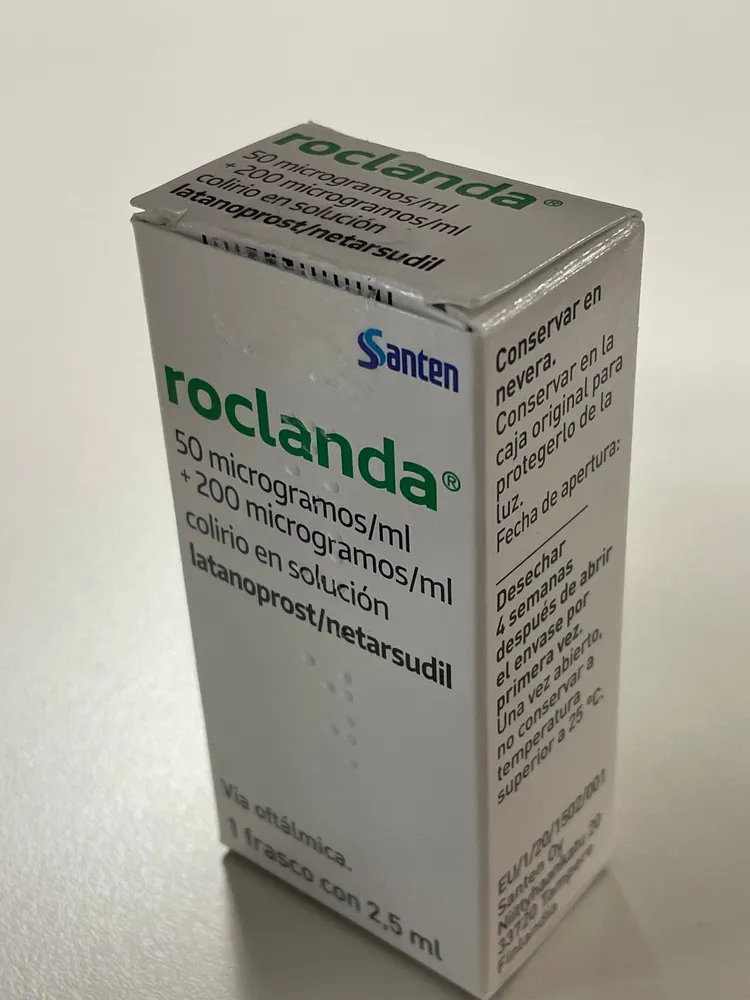
Table of Contents
Package leaflet: Information for the user
Introduction
Package leaflet: information for the patient
Roclanda 50 micrograms/ml + 200 micrograms/ml eye drops solution
latanoprost/netarsudil
Read the entire leaflet carefully before you start using this medicine, as it contains important information for you.
- Keep this leaflet, as you may need to read it again.
- If you have any questions, consult your doctor or pharmacist.
- This medicine has been prescribed for you only, and you should not give it to others, even if they have the same symptoms as you, because it could harm them.
- If you experience any adverse effects, consult your doctor or pharmacist, even if they are adverse effects not listed in this leaflet. See section 4.
Leaflet contents
- What Roclanda is and what it is used for
- What you need to know before using Roclanda
- How to use Roclanda
- Possible side effects
- How to store Roclanda
- Contents of the pack and other information
1. What Roclanda is and what it is used for
Roclanda contains the active substances latanoprost and netarsudil. Latanoprost belongs to a group of medicines called "prostaglandin analogues". Netarsudil belongs to a group of medicines called "Rho kinase inhibitors". They work in different ways to reduce the amount of fluid inside the eye, thereby lowering the pressure.
Roclanda is used to reduce intraocular pressure in adults with an eye disease called "glaucoma" or with ocular hypertension. If the pressure in the eye is too high, it may damage vision.
2. What you need to know before using Roclanda
Do not use Roclanda:
- if you are allergic to latanoprost, netarsudil, or any of the other ingredients of this medicine (listed in section 6).
Warnings and precautions
Consult your doctor or pharmacist before starting to use Roclanda if you think your case matches any of the following situations:
- you have dry eye;
- you or your child have eye problems (such as eye pain, irritation or inflammation, blurred vision);
- you have severe asthma or poorly controlled asthma;
- you have had or currently have a viral eye infection caused by the herpes simplex virus;
- if you wear contact lenses. You may use Roclanda, but you must follow the instructions for contact lens wearers in section 3.
Do not use Roclanda more than once a day, as you may experience more side effects.
Inform your doctor if you experience decreased vision or eye pain during treatment with this medicine. This could be due to a type of inflammation of the transparent outer layer of the eye (reticular epithelial corneal edema). This effect has been reported after administration of this medicine in the eye of patients with certain risk factors, such as previous eye surgery. It usually improves when administration of the medicine is stopped.
Children and adolescents
Roclanda must not be used in children and adolescents under 18 years of age, as its safety and efficacy are unknown in this age group.
Other medicines and Roclanda
Roclanda may interact with other medicines. Inform your doctor or pharmacist if you are taking, have recently taken, or might need to take any other medicines, especially those containing another prostaglandin analogue such as latanoprost (see section 3 “How to use Roclanda”).
Pregnancy and breastfeeding
If you are pregnant or breastfeeding, think you may be pregnant, or are planning to become pregnant, consult your doctor or pharmacist before using this medicine. Do not use Roclanda if you are pregnant or breastfeeding.
Driving and using machines
The effect of Roclanda on the ability to drive and use machines is negligible.
You may experience blurred or altered vision immediately after using Roclanda. Do not drive or operate machinery until these symptoms have resolved.
Roclanda contains benzalkonium chloride
This medicine contains benzalkonium chloride, which can be absorbed by soft contact lenses and may alter the color of contact lenses. Remove contact lenses before using this medicine and wait 15 minutes before reinserting them (see section 3 “How to use Roclanda”).
Benzalkonium chloride may cause eye irritation, particularly if you have dry eye or other corneal diseases (the transparent layer at the front of the eye). Consult your doctor if you experience a foreign body sensation, stinging, or eye pain after using this medicine.
3. How to use Roclanda
Follow exactly the administration instructions for this medicine as indicated by your doctor or pharmacist. If in doubt, consult your doctor or pharmacist again.
Roclanda should only be applied to the eyes (ophthalmic use).
The recommended dose is one drop in each affected eye once daily, in the evening. Use the medicine at approximately the same time each day. Do not use it more than once a day.
Do not use more than one drop per day in the affected eye.
Instructions for use
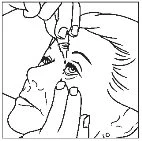
- Wash your hands before using the medicine. Contact lenses must be removed before instilling latanoprost + netarsudil (see section 2 “Warnings and precautions”).
- Do not touch the dropper tip with your fingers when opening or closing the bottle, as the eye drops could become contaminated.
- Unscrew the cap of the bottle and place it on a clean surface. Continue holding the bottle, making sure the tip does not come into contact with anything.
- Hold the bottle, pointing downward, between your thumb and the other fingers.
- Tilt your head backward.
- Gently pull down the lower eyelid with a clean finger to form a "pocket" between the eyelid and the eye. The drop should be instilled into this pocket.
- Bring the dropper tip close to the eye. If helpful, you may do this in front of a mirror.
- Do not touch your eyes, eyelids, surrounding areas, or other surfaces with the dropper tip, as the eye drops could become contaminated.
- Gently squeeze the bottle to instill one drop of Roclanda into the eye.
- Instill only one drop at a time. If the drop misses the eye, try again.
- Press with a finger at the inner corner of the eye, near the nose, for 1 minute. Keep the eye closed.
- If you need to use the eye drops in both eyes, repeat the steps for the other eye while the bottle is still open.
- Replace the cap to close the bottle.
- Return the bottle to the box to protect it from light until the next use.
If you are using other eye drops, wait at least five minutes after using them before applying Roclanda, as netarsudil may cause blood vessel dilation. If you use ophthalmic ointments, apply them last.
If you use more Roclanda than you should
Rinse your eyes with lukewarm water. Do not instill additional drops until your next scheduled dose.
If you forget to use Roclanda
Continue with the next dose as planned. Do not use a double dose to make up for missed doses.
If you stop using Roclanda
Do not stop treatment with Roclanda without first talking to your doctor. If you stop using Roclanda, your intraocular pressure may not be controlled, which could lead to vision loss.
If you have any further questions about the use of this medicine, ask your doctor or pharmacist.
4. Possible adverse effects
Like all medicines, this medicine can cause adverse effects, although not everyone will experience them. Usually, you may continue using the eye drops unless the effects are severe. If you are concerned, speak with your doctor or pharmacist. Do not stop using the eye drops without first talking to your doctor.
The following adverse effects have been observed with Roclanda and other medicines containing latanoprost or netarsudil alone:
-
Very common (may affect more than 1 in 10 people)
-
Ocular effects:
-
eye redness; fine deposits on the front part of the eye (cornea verticillata)
-
pain at the site of drop instillation
-
gradual increase in brown pigmentation in the coloured part of the eye (iris), leading to a change in eye colour
-
gradual increase in colour (darkening), length, thickness, and number of eyelashes.
-
Common (may affect up to 1 in 10 people)
-
Ocular effects:
-
eye redness shortly after application of the eye drops; spots or areas of eye redness
-
eye infection or inflammation; conjunctivitis (eye inflammation or prominent blood vessels) due to an allergic reaction; dry eye or small breaks in the tear film on the eye surface (punctate keratitis)
-
eye discharge; watery eyes
-
eyelid itching; swelling around the eye; formation of crusts on the eyelid
-
blurred vision and slight decrease in vision; blurred vision
-
eye pain; sensation of grittiness or foreign body in the eye
-
General adverse effects:
-
redness or itching of the facial skin.
-
Uncommon (may affect up to 1 in 100 people)
-
Ocular effects:
-
increased pressure of the fluid inside the eye;
-
inflammation of the coloured part of the eye (iris); iris swelling;
-
increased wrinkling of the transparent layer at the front of the eye where it meets the lower eyelid (conjunctivochalasis); small coloured spots on the eye surface; shiny/glassy eyes; eye fatigue; numbness or burning sensation in the eye; increased sensitivity to light
-
eye allergy
-
blindness; double vision or visual halos
-
blockage of the tear duct; dry eye caused by inflammation of the eyelid glands
-
abnormal inward or outward turning of the lower eyelid; eyelash loss; skin discolouration of the eyelid
-
eye disease related to diabetes (diabetic retinopathy)
-
Adverse effects in other body parts:
-
nasal obstruction; nosebleeds; nasal discomfort and pain
-
headache; dizziness; feeling of discomfort (nausea, vomiting)
-
redness or itching of the skin; dry skin; skin thickening; skin stinging
-
muscle pain, spasm, or weakness; joint pain; jaw pain; cartilage inflammation
-
chest pain (angina pectoris); awareness of heartbeats (palpitations)
-
asthma and breathing difficulty (dyspnea).
-
Rare (may affect up to 1 in 1,000 people)
-
Ocular effects:
-
swelling or itching causing damage to the eye surface; swelling around the eye (periorbital edema); scarring of the eye surface
-
misdirected eyelash growth or development of an additional row of eyelashes
-
fluid accumulation in the coloured part of the eye (iris cyst); skin reactions on the eyelids; darkening of the eyelid skin
-
viral eye infection caused by the herpes simplex virus.
-
Adverse effects in other body parts:
-
worsening of asthma
-
intense itching of the skin
-
Very rare (may affect up to 1 in 10,000 people)
-
Ocular effects:
-
appearance of sunken eyes (increased depth of the eye socket).
-
Adverse effects in other body parts:
-
worsening of angina pectoris in patients with heart disease.
-
Frequency not known (cannot be estimated from available data)
- Ocular effects:
- inflammation of the outer transparent layer of the cornea (epithelial corneal edema, reticular pattern).
- Ocular effects:
Reporting of adverse effects
If you experience any adverse effect, consult your doctor or pharmacist, even if it is a possible adverse effect not listed in this leaflet. You may also report them directly through the national reporting system detailed in Appendix V. By reporting adverse effects, you can help provide more information on the safety of this medicine.
5. Storage of Roclanda
Keep this medicine out of the sight and reach of children.
Do not use this medicine after the expiry date stated on the label of the carton and bottle following EXP. The expiry date is the last day of the month indicated.
Unopened bottle: store in a refrigerator (between 2 °C and 8 °C).
After opening the bottle: do not store above 25 °C.
Keep in the original carton to protect from light.
To avoid infection, do not use the bottle more than 4 weeks after first opening; use a new bottle.
Medicines must not be disposed of via wastewater or household waste. Ask your pharmacist how to dispose of medicines and packaging you no longer need. This will help protect the environment.
6. Contents of the pack and other information
Composition of Roclanda
- The active substances are latanoprost and netarsudil. Each ml of solution contains 50 micrograms of latanoprost and 200 micrograms of netarsudil (as mesylate).
- The other ingredients are benzalkonium chloride (see "Roclanda contains benzalkonium chloride" in section 2), mannitol (E 421), boric acid, sodium hydroxide (E 524) (for pH adjustment), and water for injections.
Nature and contents of the container
Roclanda 50 micrograms/ml + 200 micrograms/ml ophthalmic solution (eye drops) is a clear liquid eye drop solution presented in a plastic bottle. Each bottle contains 2.5 ml of medicine and each pack contains 1 or 3 bottles with screw caps. Not all pack sizes may be marketed.
Marketing Authorization Holder
Santen Oy
Niittyhaankatu 20, 33720 Tampere, Finland
Manufacturer
Santen Oy
Kelloportinkatu 1, 33100 Tampere, Finland
Further information on this medicinal product is available upon request from the local representative of the Marketing Authorization Holder:
Belgium/Belgium/Belgium Santen Oy Tel/Tel: +32 (0) 24019172 | Lithuania Santen Oy Tel: +370 37 366628 |
| Luxembourg/Luxembourg Santen Oy Tél/Tel: +352 (0) 27862006 |
Czech Republic Santen Oy Tel: +358 (0) 3 284 8111 | Hungary Santen Oy Tel: +358 (0) 3 284 8111 |
Denmark Santen Oy Tlf: +45 898 713 35 | Malta Santen Oy Tel: +358 (0) 3 284 8111 |
Germany Santen GmbH Tel: +49 (0) 3030809610 | Netherlands Santen Oy Tel: +31 (0) 207139206 |
Estonia Santen Oy Tel: +372 5067559 | Norway Santen Oy Tlf: +47 21939612 |
Greece Santen Oy Tel: +358 (0) 3 284 8111 | Austria Santen Oy Tel: +43 (0) 720116199 |
Spain Santen Pharmaceutical Spain S.L. Tel: +34 914 142 485 | Poland Santen Oy Tel.: +48(0) 221042096 |
France Santen S.A.S. Tél: +33 (0) 1 70 75 26 84 | Portugal Santen Oy Tel: +351 308 805 912 |
Croatia Santen Oy Tel: +358 (0) 3 284 8111 | Ireland Santen Oy Tel: +353 (0) 16950008 |
Romania Santen Oy Tel: +358 (0) 3 284 8111 | Slovenia Santen Oy Tel: +358 (0) 3 284 8111 |
Iceland Santen Oy Sími: +358 (0) 3 284 8111 | Slovakia Santen Oy Tel: +358 (0) 3 284 8111 |
Italy Santen Italy S.r.l. Tel: +39 0236009983 | Finland/Suomi Santen Oy Puh/Tel: +358 (0) 974790211 |
Cyprus Santen Oy Tel: +358 (0) 3 284 8111 | Sweden Santen Oy Tel: +46 (0) 850598833 |
Latvia Santen Oy Tel: +371 677 917 80 |
Date of the most recent review of this leaflet:
Other sources of information
Detailed information on this medicine is available on the website of the European Medicines Agency: http://www.ema.europa.eu.