Rinobanedif nasal ointment
Spain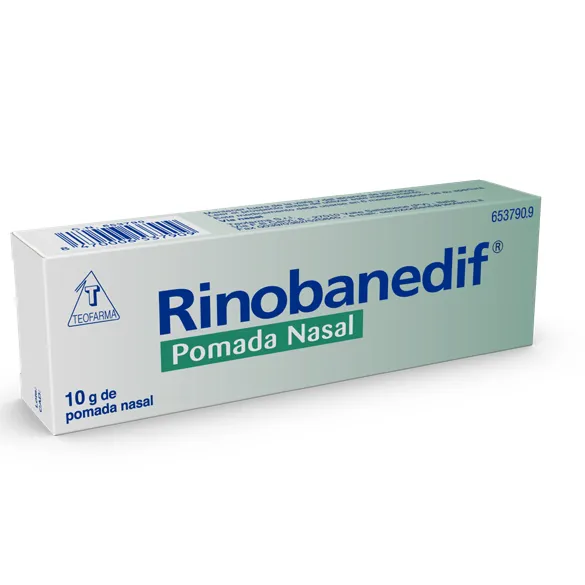
Table of Contents
Patient Information Leaflet
Introduction
Patient Information Leaflet
Rinobanedif Nasal Ointment
Read the entire package leaflet carefully before you start using this medicine, because it contains important information for you.
If you experience any adverse effects, consult your doctor or pharmacist, even if they are adverse effects not listed in this leaflet. See section 4. |
Package leaflet
-
What Rinobanedif is and what it is used for
-
What you need to know before using Rinobanedif
-
How to use Rinobanedif
-
Possible side effects
-
Storage of Rinobanedif
-
Contents of the pack and other information
1. What Rinobanedif is and what it is used for
Rinobanedif is a nasal ointment containing, as active ingredients, two antibiotics (bacitracin and neomycin), a corticosteroid, prednisolone (anti-inflammatory), phenylephrine (nasal decongestant), chlorobutanol (antiseptic), and two components with aromatic properties (eucalyptus oil and niaouli essence). When applied to the nasal mucosa, Rinobanedif provides antiseptic, anti-inflammatory, and vasoconstrictor activity.
Antibiotics are used to treat bacterial infections and are not effective against viral infections such as influenza or the common cold.
It is important to follow your doctor's instructions regarding dosage, administration interval, and duration of treatment.
Do not store or reuse this medicine. If you have any antibiotic left over after completing treatment, return it to the pharmacy for proper disposal. Do not dispose of medicines via the drain or in household waste.
Rinobanedif is indicated for the local treatment of nasal mucosal conditions accompanied by congestion, inflammation (such as some symptoms of rhinitis), and/or minor wounds, with or without crust formation, in adults and children over 6 years of age.
2. What you need to know before using Rinobanedif
Do not use Rinobanedif:
- If you are allergic to the active substances or to any of the other components of this medicine (listed in section 6).
- If you have tuberculosis, syphilis, fungal or viral infections (e.g., herpes or varicella), including in the respiratory tract.
- In the eyes or on open wounds.
- In children under 6 years of age.
Warnings and precautions
Consult your doctor or pharmacist before starting to use Rinobanedif.
-
Use with caution in the following conditions: coronary or cardiac arterial disease, hypertension, irregular heartbeats (arrhythmias), thyroid disorders, diabetes mellitus, difficulty urinating due to prostate problems, glaucoma (increased pressure inside the eyes), recent nasal septum ulcers, recent nasal surgery, or recent nasal trauma.
-
Due to the nasal corticosteroid content (prednisolone), any of the adverse effects reported with oral corticosteroid use may occur, especially when used at high doses or for prolonged periods. These may include disturbances of glands located near the kidneys, leading to symptoms such as obesity, growth retardation in children, etc. (Cushing's syndrome).
-
This medicine should not be used for prolonged periods.
-
If you are hypersensitive to certain antibiotics (aminoglycosides), you may also be sensitive to neomycin, and if you are sensitive to neomycin, you may also be sensitive to bacitracin, which are components of this medicine.
Children
Do not administer to children under 6 years of age, as the safety and efficacy of this medicine have not been established in this age group.
Children are more prone to corticosteroid-related adverse effects than adults.
Other medicines and Rinobanedif
Inform your doctor or pharmacist if you are taking, have recently taken, or might need to take any other medicines, including those obtained without a prescription.
Some medicines may enhance the effects of Rinobanedif, and your doctor will closely monitor you if you are taking these (including certain HIV medications: ritonavir, cobicistat).
If sufficient systemic absorption occurs, hypertensive crises and cardiac arrhythmias may arise, especially when administered concomitantly with MAOIs (monoamine oxidase inhibitors, used as antidepressants or for other indications), tricyclic antidepressants, or beta-blockers (for heart conditions). Interactions may also occur with maprotiline (an antidepressant) and other aminoglycosides (antibiotics).
Pregnancy, breastfeeding, and fertility
If you are pregnant or breastfeeding, think you may be pregnant, or are planning to become pregnant, consult your doctor or pharmacist before using this medicine.
Since some of the components of Rinobanedif may be absorbed into the circulation, especially when administered in large amounts and over prolonged periods, it should not be used during pregnancy unless the physician considers that the benefit to the mother outweighs the potential risks to the fetus or infant. Do not use Rinobanedif during lactation. |
Driving and use of machines
No effects on the ability to drive and use machines have been reported.
3. How to use Rinobanedif
Follow exactly the instructions for administering the medicine contained in this leaflet or those indicated by your doctor or pharmacist. If in doubt, ask your doctor or pharmacist.
The recommended dose is:
Adults and children over 6 years: Apply 1 to 3 times per day.
The average duration of treatment will be 5 days.
Use in children
Do not administer to children under 6 years of age.
For nasal use.
Instructions for correct use of the ointment
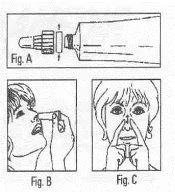
Opening the tube and method of use: To open the tube, unscrew the cap-cannula assembly and remove the safety seal (Fig. A). Replace the cannula and screw it tightly back on to pierce the aluminum seal of the tube. Apply a small amount of Rinobanedif into both nasal passages (Fig. B), ensuring even distribution of the ointment by gently massaging the area externally (Fig. C). |
|
After application, clean the tip of the tube with a clean, damp cloth. Do not use the container for more than one person.
Consult your doctor if symptoms worsen or do not improve after 7 days of treatment.
If you use more Rinobanedif than you should
Due to the route of administration, intoxication is very unlikely.
In case of overdose, the effects that may occur would primarily be local irritation, and, if sufficient absorption of phenylephrine occurs, cardiovascular disturbances (cardiac arrhythmias, hypertension) may appear.
In the event of accidental ingestion of one container, gastric irritation would occur, but cardiovascular disturbances would not necessarily occur initially.
Treatment in case of overdose or accidental ingestion should include monitoring of blood pressure and electrocardiogram. Additionally, in case of ingestion (greater than or equal to one container), vomiting should be induced or gastric lavage performed, and a mucosal protectant administered.
In case of overdose or accidental ingestion, contact your doctor or pharmacist immediately, go to a medical center, or call the Toxicology Information Service at Tel. 91 562 04 20, indicating the medication and the amount ingested.
If you forget to use Rinobanedif
Do not use a double dose to make up for a missed dose.
If you have any further questions about the use of this medicine, ask your doctor or pharmacist.
4. Possible adverse effects
Like all medicines, this medicine can cause adverse effects, although not everyone experiences them.
The assessment of adverse effects is based on the following frequency categories:
Very common: may affect more than 1 in 10 people
Common: may affect up to 1 in 10 people
Uncommon: may affect up to 1 in 100 people
Rare: may affect up to 1 in 1,000 people
Very rare: may affect up to 1 in 10,000 people
Frequency not known (cannot be estimated from available data)
The following adverse effects may occur during the use of Rinobanedif ointment:
- Common: allergic contact dermatitis (inflammation at the site of application) may occur; rebound nasal congestion may appear after prolonged or excessive use.
- Uncommon: skin-type allergic reactions have been observed: redness, itching, dryness, or burning sensation of the nasal mucosa. Rarely: sneezing and signs of systemic absorption such as headache, dizziness, nervousness, irregular heartbeat, hypertension, and anaphylactic reaction (exaggerated allergic reaction), generally if the ointment is applied to deep lesions.
- Very rarely: ototoxicity (hearing loss), nephrotoxicity (kidney impairment), especially if renal dysfunction is present, mild nasal bleeding, nasal dryness, and irritation.
The adverse effects of corticosteroids increase with factors enhancing absorption, such as prolonged use, application over large areas, or use of occlusive dressings.
With the use of topical corticosteroids, particularly via the nasal route, the following additional adverse effects may occur:
Disorders of smell and taste; rarely, ulceration or perforation of the nasal septum.
Other corticosteroid-related adverse effects include: skin atrophy, changes in skin color, tendency to bruise, appearance of blood vessels under the skin surface, inflammation of hair follicles (folliculitis), increased hair growth, stretch marks, acne, and secondary infections such as fungal infections.
Adverse effects due to corticosteroid absorption: a condition characterized by obesity, rounded face, fat accumulation in the cervical area, delayed wound healing, psychiatric symptoms, etc. (Cushing's syndrome); cataracts, glaucoma.
Reporting of adverse effects
If you experience any type of adverse effect, consult your doctor or pharmacist, even if it is a possible adverse effect not listed in this leaflet. You may also report them directly through the Spanish Pharmacovigilance System for Human Medicinal Products: https://www.notificaRAM.es. By reporting adverse effects, you can help provide more information on the safety of this medicine.
5. Storage of Rinobanedif
No special storage conditions are required.
This medicine should be used within 6 months after opening.
Keep this medicine out of the sight and reach of children.
Do not use this medicine after the expiry date stated on the packaging after EXP. The expiry date is the last day of the month indicated.
Medicines should not be disposed of via wastewater or household waste. Dispose of unused medicines and their containers at the SIGRE collection point at your pharmacy. If you have any doubts, ask your pharmacist how to dispose of medicines and containers you no longer need. This will help protect the environment.
6. Contents of the pack and other information
Composition of Rinobanedif
- The active substances are: bacitracin zinc, neomycin sulfate, prednisolone, phenylephrine hydrochloride, chlorobutanol hemihydrate, eucalyptus oil, and niaouli essential oil. Each gram of ointment contains: 500 IU of bacitracin zinc, 5 mg of neomycin sulfate (equivalent to 3.5 mg of neomycin base), 3 mg of prednisolone (0.3%), 2.5 mg of phenylephrine hydrochloride (0.25%), 8 mg of chlorobutanol hemihydrate, 2.00 mg - 2.86 mg of eucalyptus oil (equivalent to 2 mg of 1,8-cineole), and 1.54 mg - 2.22 mg of niaouli essential oil (equivalent to 1 mg of 1,8-cineole).
- The other components (excipients) are: cholesterol, plastibase, soft white paraffin, and liquid paraffin.
Appearance of the product and contents of the pack
Rinobanedif is a nasal ointment; it is greasy, yellowish-white in colour.
Each pack contains one aluminium tube with 10 g of nasal ointment.
Marketing Authorization Holder and Manufacturer
Marketing Authorization Holder:
TEOFARMA S.R.L.
Via F.lli Cervi, 8
27010 Valle Salimbene (PV) - Italy
Manufacturer:
DOPPEL FARMACEUTICI, S.R.L.
Via Martiri delle Foibe, 1, Cortemaggiore
(Piacenza) - 29016 - Italy
Date of the most recent revision of this leaflet: February 2020
Detailed and up-to-date information on this medicinal product is available on the website of the Spanish Agency for Medicines and Health Products (AEMPS) http://www.aemps.gob.es