RiaSTAP 1 g powder for solution for injection or infusion
Spain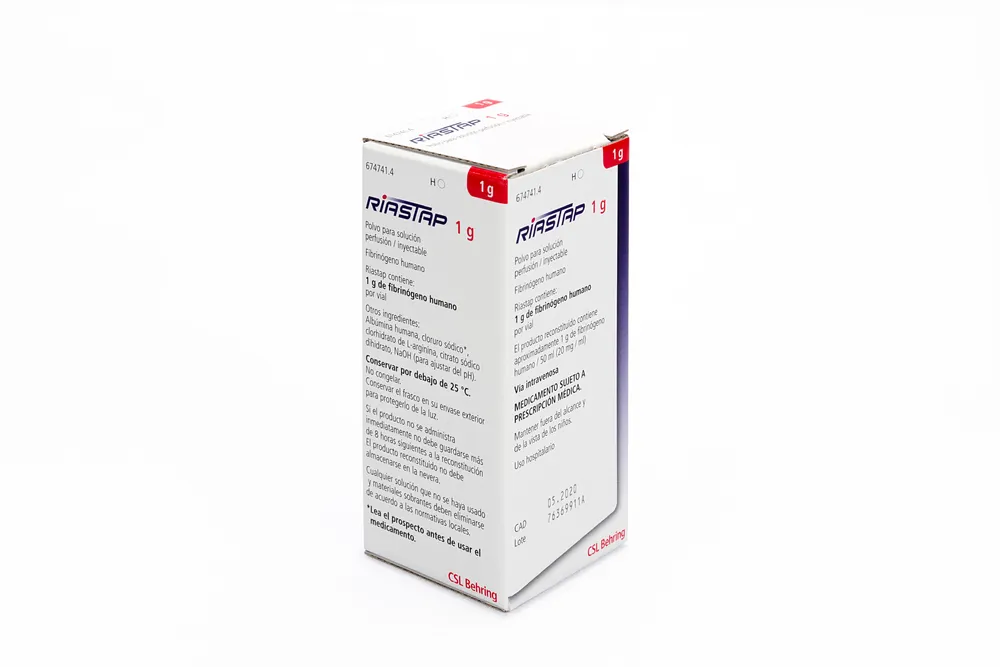
Table of Contents
Patient Information Leaflet
Introduction
Patient Information Leaflet
Riastap 1g
Powder for solution for injection and infusion
Human fibrinogen
Read this entire leaflet carefully before you start using this medicine, as it contains important information for you.
- Keep this leaflet, as you may need to read it again.
- If you have any questions, ask your doctor or pharmacist.
- This medicine has been prescribed for you only, and you should not give it to other people, even if they have the same symptoms as you, because it may harm them.
- If you experience any adverse effects, consult your doctor or pharmacist, even if they are adverse effects not listed in this leaflet. See section 4.
Leaflet Contents
- What Riastap is and what it is used for
- What you need to know before using Riastap
- How to use Riastap
- Possible adverse effects
- How to store Riastap
- Contents of the pack and other information
1. What Riastap is and what it is used for
What is Ristap?
Riastap contains human fibrinogen, a protein important for blood clotting. A deficiency in fibrinogen means that blood does not clot as quickly as it should, leading to an increased tendency to bleed. Replacement of human fibrinogen with Riastap restores the blood clotting mechanism.
What is Riastap used for?
Riastap is used for the treatment of bleeding in patients with congenital fibrinogen deficiency (hypo- or afibrinogenemia) who have a tendency to bleed.
2. What you need to know before using Riastap
The following sections contain information your doctor must consider before administering Riastap to you.
Do not use Riastap:
- if you are allergic to human fibrinogen or any of the other components of this medicine (listed in section 6).
Inform your doctor if you are allergic to any medicines or foods.
Warnings and precautions:
-
If you have previously experienced allergic reactions to Riastap. You should take antihistamines and corticosteroids as prophylaxis if your doctor recommends it.
-
In case of allergic or anaphylactic reactions (severe allergic reaction causing serious breathing difficulties or dizziness). Administration of Riastap must be stopped immediately (e.g., by stopping the infusion).
-
Due to an increased risk of blood clot formation in blood vessels (thrombosis), particularly:
-
when high doses or repeated doses are administered,
-
if you have had a heart attack (history of coronary artery disease or myocardial infarction),
-
if you have liver disease,
-
if you have recently undergone surgery (postoperative patients),
-
if you are about to undergo surgery (preoperative patients),
-
in newborns (neonates),
-
if you have a higher-than-normal risk of blood clots (patients at risk of thromboembolic events or disseminated intravascular coagulation).
Your doctor must carefully weigh the benefits of Riastap treatment against the risks of these complications.
Viral safety
When medicines prepared from human blood or plasma are manufactured, certain measures are taken to prevent transmission of infections to patients. These measures include:
- careful selection of blood and plasma donors to ensure donors at risk of carrying infections are excluded, and
- testing of each individual donation and pooled plasma for signs of viruses and infections.
In addition, manufacturers of these products include necessary steps during processing to inactivate or remove viruses. Despite these measures, when medicines prepared from human blood or plasma are administered, the possibility of transmitting infections cannot be completely ruled out. This applies to any emerging or unknown viruses or other types of infections.
The measures taken are considered effective against enveloped viruses such as human immunodeficiency virus (HIV, AIDS virus), hepatitis B virus, and hepatitis C virus (liver inflammation), and against non-enveloped viruses such as hepatitis A virus (liver inflammation) and parvovirus B19.
Your doctor may recommend vaccination against hepatitis A and B if you regularly or repeatedly receive medicines prepared from human plasma.
It is strongly recommended that each time Riastap is administered, the date of administration, batch number, and injected volume be recorded.
Use of Riastap with other medicines
- Inform your doctor or pharmacist if you are using, have recently used, or might need to use any other medicines.
- Riastap must not be mixed with other medicines, except those mentioned in the section "This information is intended for healthcare professionals only".
Pregnancy and breastfeeding
- If you are pregnant or breastfeeding, think you may be pregnant, or plan to become pregnant, consult your doctor or pharmacist before using this medicine.
- During pregnancy and breastfeeding, Riastap should only be administered if clearly indicated.
Driving and using machines
The effect of Riastap on the ability to drive and use machines is negligible or none.
Important information about some of the ingredients of Riastap
Riastap contains up to 164 mg (7.1 mmol) of sodium per vial. This corresponds to 11.5 mg (0.5 mmol) of sodium per kilogram of body weight when the recommended initial dose of 70 mg/kg body weight is administered. Please take this into account if you are on a sodium-controlled diet.
3. How to use Riastap
Treatment must be initiated and supervised by a physician experienced in this type of disorder.
Posology
The amount of human fibrinogen required and the duration of treatment depend on:
- the severity of your condition
- the location and intensity of bleeding
- the patient's clinical status
If you take more Riastap than you should
During treatment, your doctor should regularly monitor your blood coagulation status. In case of overdose, the risk of developing thromboembolic complications increases.
Method of administration
If you have further questions about the use of this product, consult your doctor or pharmacist (see the section "This information is intended for healthcare professionals only").
4. Possible adverse effects
Like all medicines, this medicine can cause adverse effects, although not everyone experiences them.
Please inform your doctor immediately:
- if you experience any adverse effect
- if you notice any adverse effect not listed in this leaflet.
The following adverse effect is very common (may affect more than 1 in 10 people):
- Increase in body temperature
The following adverse effect has been observed uncommonly (may affect up to 1 in 100 people):
- Sudden allergic reaction (such as skin redness, generalized erythema, drop in blood pressure, difficulty breathing).
The following adverse effect has been observed frequently (may affect up to 1 in 10 people; however, incidence was higher in patients who did not receive fibrinogen):
- Risk of increased formation of blood clots (see section 2 "What you need to know before using Riastap").
Reporting of adverse effects
If you experience any type of adverse effect, consult your doctor or pharmacist, even if it is a possible adverse effect not listed in this leaflet. You may also report them directly via the Spanish Pharmacovigilance System for Human Medicines: www.notificaram.es. By reporting adverse effects, you can help provide more information on the safety of this medicine.
5. Storage of Riastap
- Keep out of the reach and sight of children.
- Do not use Riastap after the expiry date stated on the label and outer carton.
- Do not store above 25 °C.
- Do not freeze.
- Store the vial in its outer packaging to protect from light.
- The reconstituted solution must be used immediately.
- If the reconstituted solution is not administered immediately, storage at room temperature (maximum +25 °C) must not exceed 8 hours.
- Do not refrigerate the solution after reconstitution.
6. Further Information
Composition of Riastap
The active substance is:
Human fibrinogen (1 g/vial; after reconstitution with 50 ml of water for injections, approx. 20 mg/ml).
For further information, see the section "This information is intended for healthcare professionals only".
Other ingredients are:
Human albumin, sodium chloride, L_arginine hydrochloride, sodium citrate dihydrate, sodium hydroxide (to adjust pH).
Refer to the last paragraph of section 2, "Important information about some of the ingredients of Riastap".
Appearance of Riastap and contents of the pack
Riastap is presented as a white powder.
After reconstitution with water for injections, the resulting solution should be clear or slightly opalescent—i.e., it may shimmer when held up to light—but must not contain any particles.
Presentation
Pack of 1 g (Figure 1)
- One vial containing 1 g of human fibrinogen
- Pall® syringe filter
- Mini-Spike® aspiration spike
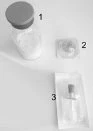 Figure 1
Marketing Authorization Holder and Manufacturer
CSL Behring GmbH
Emil_von_Behring_Strasse 76
35041 Marburg
Germany
Local representative:
CSL Behring, S.A.
c/ Tarragona 157, 18th floor
08014 Barcelona
Spain
This medicinal product is authorized in the Member States of the European Economic Area under the following names:
Riastap 1 g powder for solution for injection/infusion United Kingdom
Riastap 1g, poudre pour solution injectable/perfusion France
Riastap 1g prašek za raztopino za injiciranje ali infundiranje Slovenia
Riastap 1 g Germany, Ireland
Riastap Belgium, Cyprus, Denmark, Finland, Greece, Iceland, Italy, Luxembourg, Malta, Norway, Poland, Slovakia, Spain, Sweden
Date of latest review of this leaflet: December 2023
Detailed and up-to-date information on this medicinal product is available on the website of the Spanish Agency of Medicines and Health Products (AEMPS) http://www.aemps.es/
This information is intended for healthcare professionals only:
Dosage
The fibrinogen (functional) level should be determined in order to calculate the individual dose. The amount and frequency of administration must be calculated for each patient based on periodic measurement of plasma fibrinogen levels and continuous monitoring of the patient's clinical status and any other replacement therapies used.
The normal plasma fibrinogen level ranges from 1.5 to 4.5 g/l. The critical plasma fibrinogen level below which bleeding risk increases is approximately 0.5–1.0 g/l. In major surgery, replacement therapy must be monitored using coagulation assays.
Initial dose
If the patient's fibrinogen level is unknown, the recommended dose is 70 mg per kg of body weight, administered intravenously.
Subsequent doses
In mild cases (e.g., nasal bleeding, intramuscular hemorrhage, or menorrhagia), a target level of 1 g/l should be achieved and maintained for at least three days. In severe cases (e.g., head trauma or intracranial hemorrhage), a target level of 1.5 g/l should be achieved and maintained for seven days.
Fibrinogen dose = [Target level (g/l) – measured level (g/l)]
(mg/kg body weight) 0.017 (g/l per mg/kg body weight)
Dosing in neonates, infants, and children
Clinical study data on Riastap dosing in children are limited. Based on these studies and extensive clinical experience with fibrinogen-containing products, the recommended doses for children are the same as those recommended for adults.
Method of administration
General instructions
- Reconstitution and transfer must be performed under aseptic conditions.
- Before administration, reconstituted solutions should be visually inspected for foreign particles and discoloration.
- The solution should be practically colorless or slightly yellowish, clear or slightly opalescent, and have a neutral pH. Do not use cloudy solutions or those containing deposits.
Reconstitution
-
Allow the solvent and powder in unopened vials to reach room temperature or body temperature (not exceeding 37°C).
-
Riastap must be reconstituted with water for injections (50 ml, not included).
-
Wash hands or wear gloves before reconstituting the product.
-
Remove the cap from the Riastap vial, exposing the central surface of the stopper.
-
Disinfect the stopper surface with an antiseptic and allow it to dry.
-
Transfer the solvent into the vial using an appropriate transfer device, ensuring complete wetting of the powder.
-
Gently swirl the vial until the powder is completely dissolved and the solution is ready for administration. Avoid vigorous shaking, as this may cause foaming. Complete dissolution usually occurs within approximately 5 minutes and should not take longer than 15 minutes.
-
Open the plastic blister containing the Mini-Spike® aspiration spike provided with Riastap (Figure 2).
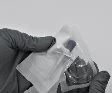 Figure 2
- Take the provided aspiration spike and insert it into the stopper of the vial containing the reconstituted product (Figure 3).
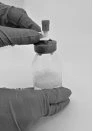 Figure 3
- After inserting the aspiration spike, remove the cap. Do not touch the exposed surface after removing the cap.
- Open the blister containing the Pall® syringe filter provided with Riastap (Figure 4).
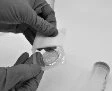 Figure 4
- Screw the syringe onto the filter (Figure 5).
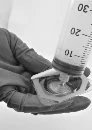 Figure 5
- Screw the syringe with the attached filter onto the aspiration spike (Figure 6).
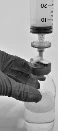 Figure 6
- Draw the reconstituted product into the syringe (Figure 7).
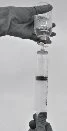 Figure 7
- After completion, remove the filter, the aspiration spike, and the empty vial from the syringe, dispose of them properly, and proceed with administration as usual.
- The reconstituted product should be administered immediately via a separate injection/infusion line.
- Take care to prevent blood from entering syringes containing the product.
Administration
For intravenous administration at room temperature, use of a standard infusion set is recommended. Inject or infuse the reconstituted solution slowly intravenously at a rate comfortable for the patient. The infusion rate should not exceed 5 ml per minute.