Rhodogil 750,000 IU/125 mg film-coated tablets
Spain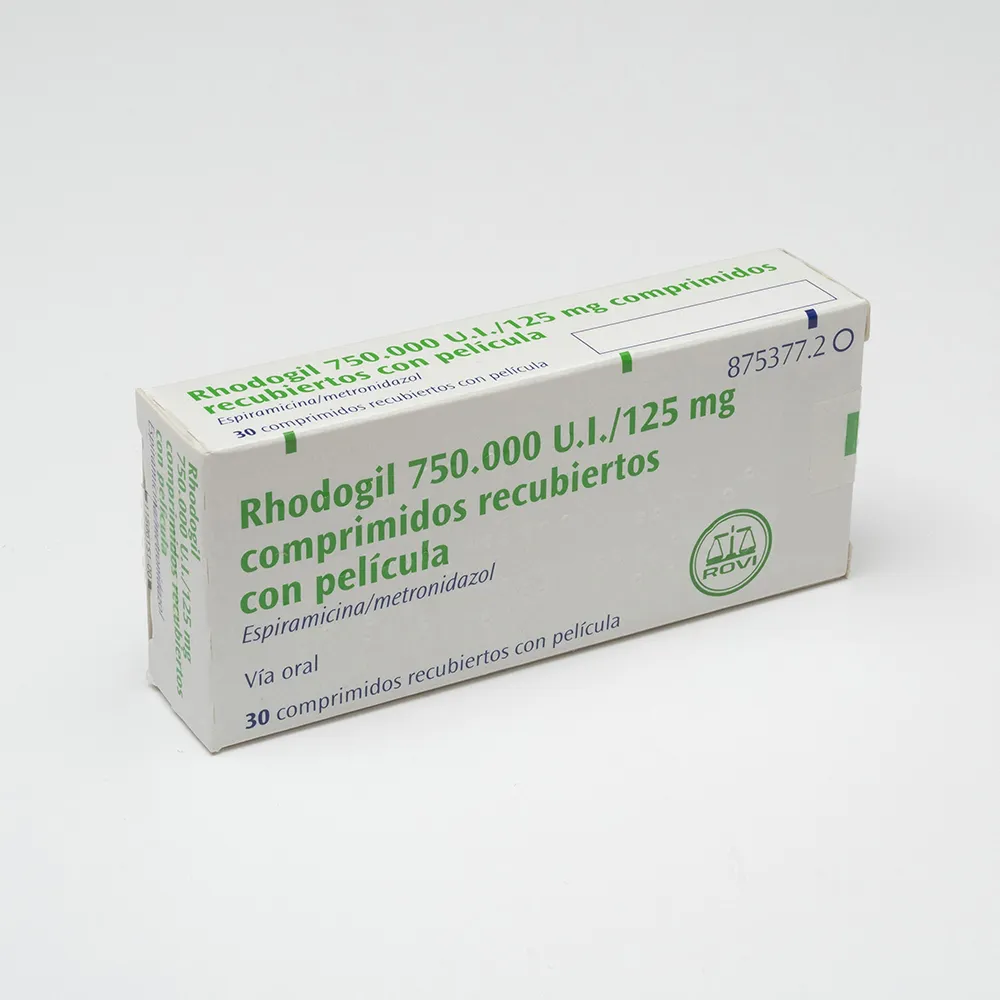
Table of Contents
Package leaflet: Information for the user
Introduction
Package leaflet: information for the user
Rhodogil 750,000 IU/125 mg film-coated tablets
Spiramycin and Metronidazole
Read all of this leaflet carefully before you start taking this medicine
- Keep this leaflet, as you may need to read it again.
- If you have any questions, ask your doctor or pharmacist.
- This medicine has been prescribed for you only, and you should not give it to other people, even if they have the same symptoms as you, because it may harm them.
- If you consider any of the side effects you experience to be serious, or if you notice any side effects not mentioned in this leaflet, inform your doctor or pharmacist.
Contents of the leaflet
- What Rhodogil tablets are and what they are used for
- Before taking Rhodogil tablets
- How to take Rhodogil tablets
- Possible side effects
- How to store Rhodogil tablets
- Further information
1. What Rhodogil tablets are and what they are used for
This medicine is a synergistic combination of two antibacterial agents: metronidazole and spiramycin, which is effective against a wide range of microorganisms, especially those involved in infections of the oral cavity (for example, dental infections).
Antibiotics are used to treat bacterial infections and are not effective against viral infections
It is important that you follow your doctor's instructions regarding dose, dosing interval, and duration of treatment.
Do not keep or reuse this medicine. If you have any antibiotic left after completing the treatment, return it to the pharmacy for proper disposal. Do not dispose of medicines via wastewater or household waste.
It is indicated for:
- Treatment and prevention of acute, chronic, or recurrent stomatological infections such as dental abscesses and periodontitis.
- Oro-pharyngeal infections caused by anaerobic germs.
- Otitis and sinusitis.
- Prevention of local postoperative infectious complications in odonto-stomatological surgery.
2. Before taking Rhodogil tablets
Do not take Rhodogil tablets
- If you are allergic (hypersensitive) to metronidazole or spiramycin or imidazoles or to any of the other components of Rhodogil.
- If you have liver problems.
If in doubt, consult your doctor or pharmacist.
Take special care with Rhodogil tablets
-
If you experience neurological disorders such as difficulty in performing movements and lack of motor coordination (ataxia), altered sense of touch or perception of pain, heat, tingling, burning, prickling sensations in any limb, incoordination or seizures, as well as disturbances in balance (vertigo), you must stop taking the medicine.
-
If you suffer from serious diseases of the nerves or brain, you must inform your doctor, due to the possibility of worsening of these conditions.
-
If you have or have had any blood disease or disorder, your doctor will advise you to have periodic blood tests to monitor white blood cell count (leukocytes), both during and after treatment, since a reduction in the number of white blood cells in the blood (leukopenia) may occur.
-
If you have hepatic insufficiency, your doctor will prescribe liver function tests due to the possibility of worsening of your condition. Also, since this medicine is eliminated from the body through the liver, the dose should be adjusted according to the degree of liver dysfunction.
-
If you consume alcoholic beverages, unpleasant reactions may occur, known as the Antabuse effect, including nausea, vomiting, sweating and skin redness. Alcoholic drinks and medications containing alcohol must be avoided during treatment and for at least one day afterwards.
-
Cases of severe hepatotoxicity/acute liver failure, some fatal, have been reported in patients with Cockayne syndrome receiving medications containing metronidazole.
If you have Cockayne syndrome, your doctor must frequently monitor your liver function during and after treatment with metronidazole.
- Cases of serious skin reactions, of a blistering type, have been reported with metronidazole, such as Stevens-Johnson syndrome [(SJS), generalized eruption with blisters and skin peeling, particularly around the mouth, nose, eyes and genitals], toxic epidermal necrolysis [(TEN), similar to the previous reaction but causing widespread skin peeling (more than 30% of body surface area)], or acute generalized exanthematous pustulosis [(AGEP), generalized scaly red rash with bumps under the skin and blisters, accompanied by fever. It mainly appears in skin folds, trunk, and upper limbs].
If symptoms or signs of these serious skin reactions (SJS, TEN or AGEP) occur, treatment must be stopped immediately.
Inform your doctor immediately and stop taking metronidazole if you experience:
-
Stomach pain, anorexia, nausea, vomiting, fever, general malaise, fatigue, jaundice, dark urine, clay-colored stools or itching.
-
Mental health problems such as irrational thoughts, hallucinations, confusion or depression, including thoughts of self-harm or suicide. These symptoms may occur even in people who have never had similar problems before. If you or someone around you notices any of these symptoms, stop taking this medicine and contact your doctor immediately.
-
Metronidazole, one of the active substances in this medicine, may cause a reddish-brown discoloration of the urine due to pigments resulting from the transformation of the drug in the body.
Consult your doctor if you have had or currently have any of the above conditions.
If your treatment is prolonged, the use of Rhodogil is not recommended for longer periods than indicated by your doctor.
Use of other medicines
Inform your doctor or pharmacist if you are using or have recently used any other medicines, including those obtained without a prescription.
Hydroxychloroquine or chloroquine (used to treat conditions such as rheumatoid arthritis, or to treat or prevent malaria): Taking these medicines together with Rhodogil may increase the risk of side effects affecting your heart, which could be life-threatening.
Interactions with Rhodogil when taken with other medicines may be due to spiramycin and metronidazole, which are the active ingredients of this medicine.
Due to spiramycin:
Caution is advised when taking it with levodopa combined with carbidopa, as it may reduce the effect of levodopa.
Due to metronidazole:
-
If you are taking disulfiram, you must not take metronidazole at the same time, nor within two weeks after stopping disulfiram treatment, as it may cause delirious episodes and states of confusion.
-
You must avoid consuming alcoholic drinks and medications containing alcohol, as unpleasant reactions may occur, known as the Antabuse effect, including flushing, skin redness, vomiting, and rapid heartbeat.
-
You should exercise caution when taking metronidazole with:
- Oral anticoagulants, as it may increase the risk of bleeding; Lithium, Cyclosporine, Phenytoin, because effects of these medicines may be increased.
- Phenobarbital, Antacids (aluminum hydroxide), and Prednisone, because they may reduce the effect of metronidazole.
- Cimetidine, because it may enhance the effect and/or toxicity of metronidazole.
-
Busulfan, since metronidazole may increase the toxicity and plasma levels of busulfan.
-
Metronidazole increases the toxicity of 5-fluorouracil, and in laboratory tests, metronidazole may give a false positive result in a test called the Nelson test.
-
Inform your doctor if you are taking any medicine that may cause ECG changes (certain antiarrhythmics (medicines for heart rhythm disorders), certain antibiotics, psychotropic medicines).
Taking Rhodogil tablets with food and drinks
It is recommended not to take Rhodogil with food, as its absorption may be reduced.
It is recommended to avoid alcoholic drinks and medications containing alcohol.
Pregnancy and breastfeeding
If you are pregnant or think you may be pregnant, do not take Rhodogil without first consulting your doctor.
Consult your doctor or pharmacist before using any medicine.
If you are breastfeeding an infant, do not take Rhodogil, since metronidazole and spiramycin, the active ingredients of this medicine, pass into breast milk.
Driving and use of machines
Do not drive or operate machinery if you experience confusion, fatigue, disturbance of balance (vertigo), hallucinations, seizures or visual disturbances after taking Rhodogil.
Rhodogil contains sorbitol and sodium
This medicine contains less than 23 mg of sodium (1 mmol) per tablet; this is essentially “sodium-free”.
This medicine contains 8 mg of sorbitol in each tablet.
3. How to take Rhodogil tablets
Follow exactly the instructions given by your doctor for taking this medicine. If in doubt, consult your doctor or pharmacist.
Remember to take your medicine.
Swallow the tablets whole with sufficient liquid (a glass of water).
Your doctor will determine how long you should take this medicine. Do not stop treatment early, as this could worsen your condition or lead to the development of bacterial resistance.
If you think that the effect of Rhodogil is too strong or too weak, inform your doctor or pharmacist.
Your doctor will prescribe the lowest effective dose required to achieve the desired effect.
The recommended dose is:
Usual dose for adults over 15 years of age
4 to 6 tablets per day, divided into 2 or 3 doses (corresponding to a daily dose of 3–4.5 million IU of spiramycin and 500–750 mg of metronidazole).
Usual dose for children under 15 years of age
-
Ages 10 to 15: 3 tablets per day (corresponding to a daily dose of 2.25 million IU of spiramycin and 375 mg of metronidazole).
-
This pharmaceutical form is not suitable for children aged 5 to 10 years. Use in this age group is at the physician's discretion. The recommended usual dose for this age group is 2 tablets per day (corresponding to a daily dose of 1.5 million IU of spiramycin and 250 mg of metronidazole).
If you have impaired kidney function, your doctor will not usually need to adjust your dose, as only a very small amount of the medicine is excreted in the urine.
The usual duration of treatment is 6 to 10 consecutive days.
If you take more Rhodogil tablets than you should
Contact your doctor or pharmacist immediately, or go to the nearest hospital emergency department. Bring this leaflet and the medicine packaging with you.
Common symptoms of overdose include vomiting, ataxia (lack of coordination), mild disorientation, dry mouth, tendency to faint (feeling of impending loss of consciousness), hot flushes, skin rash, headache, mild depression, altered taste sensation, and nausea. Gastric lavage and symptomatic treatment are recommended.
In case of overdose or accidental ingestion, contact the Toxicology Information Service. Telephone: 91 562 04 20.
If you forget to take Rhodogil tablets
Do not take a double dose to make up for forgotten doses.
If you stop taking Rhodogil tablets
If you have any further questions about the use of this medicine, ask your doctor or pharmacist.
4. Possible adverse effects
Like all medicines, Rhodogil may produce adverse effects, although not everyone experiences them.
Very common adverse effects (may affect more than 1 in 10 people)
- Paresthesia (tingling in hands or feet, altered sense of touch or perception of pain and heat, and pricking sensations)
Common adverse effects (may affect up to 1 in 10 people)
- Nausea
- Vomiting
- Diarrhea
- Taste disturbance
- Rash
Uncommon adverse effects (may affect up to 1 in 1,000 people)
- Gait disturbance
- Ataxia (lack of muscle coordination)
- Nosebleed
- Sweating
- Chest tightness
- Sensation of cold in the mouth or pharynx
Very rare adverse effects (may affect up to 1 in 10,000 people)
- Pseudomembranous colitis (severe inflammation of the intestine, which may very rarely occur after antibiotic treatment)
- Anaphylactic shock (a severe allergic reaction that may be life-threatening)
- Transient visual disturbances such as double vision
- Myopia (difficulty seeing distant objects)
- Blurred vision
- Flushing
- Increased liver enzymes (AST, ALT, alkaline phosphatase)
- A very rare, serious adverse reaction has been reported with metronidazole use: brain disease (encephalopathy). Symptoms vary but may include fever, neck stiffness, headache, or seeing or hearing things that are not real. You may also experience difficulty using your arms and legs or speaking, or feel confused. Contact your doctor immediately if you notice any of these adverse reactions.
Adverse effects with unknown frequency (frequency cannot be estimated from available data)
- Stomach pain
- Metallic taste
- Anorexia (loss of appetite)
- Discoloration of the tongue
- Inflammation of the tongue with dry mouth sensation
- Stomatitis (inflammation of the mucous membrane of the mouth)
- Reversible pancreatitis (reversible inflammation of the pancreas)
- Indigestion
- Peripheral sensory neuropathy
- Seizures
- Subacute cerebellar syndrome (sudden onset of uncoordinated muscle movement, speech disorder, involuntary and uncontrolled eye movements, gait disturbance, and tremor), which resolves upon discontinuation of treatment
- Optic neuritis (inflammation of the optic nerve)
- Headache
- Psychotic disorders (including confusion and hallucinations)
- Depression
- Difficulty falling asleep
- Optic neuropathy (damage to the optic nerve that may cause sudden vision loss in the affected eye)
- Decreased visual acuity
- Impairment in color vision
- Agranulocytosis (reduction in a type of white blood cells called granulocytes)
- Neutropenia (reduction in a type of blood cells called neutrophils)
- Thrombocytopenia (reduction in the number of blood platelets)
- Cholestatic hepatitis (liver inflammation with impaired bile flow)
- Mixed liver injury
- Hepatocellular injury (sometimes with jaundice (yellowing of eyes and skin))
- Liver failure
- Angioedema (swelling of feet, hands, throat, lips, and airways)
- Stevens-Johnson syndrome (widespread blistering rash and skin peeling, particularly around the mouth, nose, eyes, and genitals)
- Toxic epidermal necrolysis (widespread blistering rash and skin peeling, particularly around the mouth, nose, eyes, and genitals, leading to extensive skin shedding (more than 30% of body surface))
- Acute generalized exanthematous pustulosis (widespread scaly red rash with bumps under the skin and pustules, accompanied by fever. It mainly affects skin folds, trunk, and upper limbs)
- Itching
- Urticaria
- Henoch-Schönlein purpura (a type of blood vessel inflammation)
- Fever
- Fatigue
- Vasculitis (inflammation of blood vessels)
- Aseptic meningitis (a type of inflammation of the meninges, the membranes covering the brain and spinal cord)
- Changes in the heart's electrical activity seen on ECG (prolongation of the QT interval), observed when metronidazole was administered with medications known to potentially prolong the QT interval.
If you consider any of the adverse effects you experience to be severe, or if you notice any adverse effects not listed in this leaflet, inform your doctor or pharmacist.
Reporting of adverse effects
If you experience any type of adverse effect, consult your doctor or pharmacist, even if it is a possible adverse effect not listed in this leaflet. You can also report them directly via the Spanish Pharmacovigilance System for Human Medicines: www.notificaRAM.es. By reporting adverse effects, you can help provide more information on the safety of this medicine.
5. Storage of Rhodogil tablets
Keep Rhodogil out of the reach and sight of children.
Do not use Rhodogil after the expiry date stated on the packaging. The expiry date refers to the last day of the month indicated.
Do not store above 25°C.
Medicines must not be disposed of via wastewater drains or household waste. Return unused medicines and their packaging to the SIGRE Point at your pharmacy. If in doubt, ask your pharmacist how to dispose of medicines and packaging you no longer need. This will help protect the environment.
6. Information provided
Composition of Rhodogil tablets
The active substances are spiramycin and metronidazole. Each tablet contains 750,000 I.U. of the active substance spiramycin and 125 mg of the active substance metronidazole.
The other components are: maize starch, povidone, croscarmellose sodium, colloidal anhydrous silica, sorbitol, magnesium stearate, microcrystalline cellulose, hypromellose, macrogol 6000, titanium dioxide (E-171).
Appearance of the medicinal product and contents of the pack
Rhodogil tablets are film-coated, round, white tablets for oral administration. They are supplied in packs of 30 tablets.
Marketing Authorization Holder
Laboratorios Farmacéuticos Rovi, S.A.
C/Julián Camarillo, 35
28037 Madrid
Spain
Manufacturer responsible
ROVI Pharma Industrial Services, S.A.
Vía Complutense, 140
28805 Alcalá de Henares (Madrid)
Spain
Date of the most recent review of this leaflet: July 2022
Detailed and up-to-date information on this medicinal product is available on the website of the Spanish Agency for Medicines and Health Products (AEMPS) http://www.aemps.gob.es/.