Rhinospray 1.18 mg/ml solution for nasal spray
Spain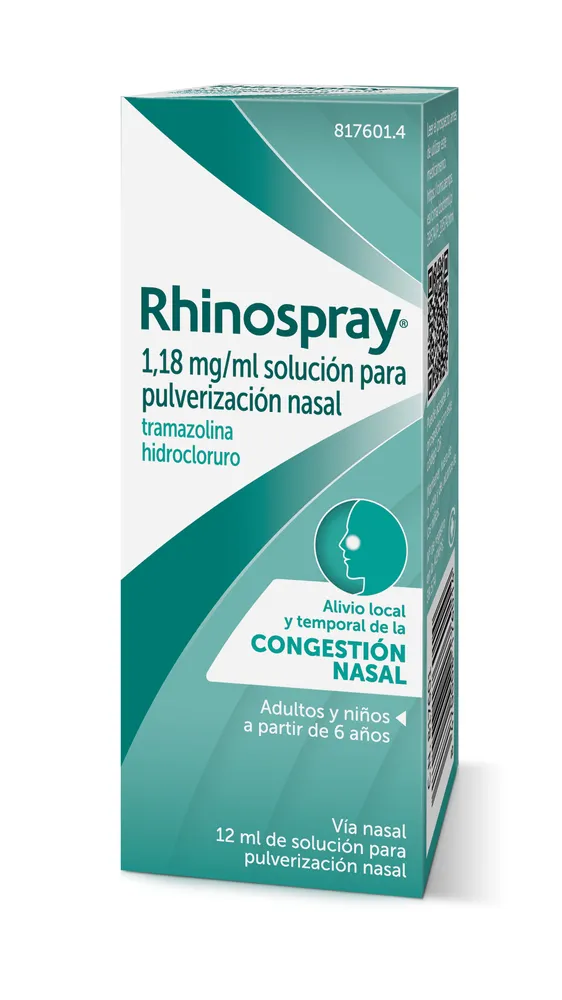
Table of Contents
Patient Information Leaflet
Introduction
Package leaflet: Information for the patient
Rhinospray 1.18 mg/ml nasal spray solution
tramazoline hydrochloride
Read the entire leaflet carefully before you start using this medicine, as it contains important information for you.
Follow exactly the instructions for use provided in this leaflet or as directed by your doctor or pharmacist.
- Keep this leaflet, as you may need to refer to it again.
- If you need advice or more information, consult your pharmacist.
- If you experience any adverse effects, consult your doctor or pharmacist, even if they are effects not listed in this leaflet. See section 4.
- You should consult a doctor if your condition worsens or if you do not improve after 3 days of treatment.
Contents of the leaflet
- What Rhinospray is and what it is used for
- What you need to know before using Rhinospray
- How to use Rhinospray
- Possible side effects
- How to store Rhinospray
- Contents of the pack and other information
1. What Rhinospray is and what it is used for
Rhinospray is a nasal decongestant medicine containing tramazoline hydrochloride as the active substance. When administered into the nose, it produces local constriction of blood vessels, thereby decongesting the nasal mucosa.
This medicine is indicated for the local and temporary relief of nasal congestion in adults and children aged 6 years and older.
You should consult a doctor if symptoms worsen or do not improve after 3 days of treatment.
2. What you need to know before using Rhinospray
Do not use Rhinospray
- if you are allergic to tramazoline hydrochloride, to other adrenergic decongestants, or to any of the other ingredients of this medicine (listed in section 6).
- if you have an eye disease with increased pressure, nasal dryness with crust formation (dry rhinitis), or if you have undergone cranial surgery through the nasal cavity.
- if you have recently undergone head surgery (if you have had transnasal or transoral cranial surgery).
- Children under 6 years of age must not use this medicine.
Warnings and precautions
Talk to your doctor or pharmacist before using Rhinospray:
- If you have high blood pressure, heart disease, thyroid disorders, diabetes, prostate problems, porphyria metabolism disorder, or pheochromocytoma (a tumor of the adrenal glands).
- If you are being treated with medicines for depression or medicines for blood pressure disorders.
- Prolonged use of nasal decongestants may cause chronic inflammation and atrophy of the nasal mucosa, leading to nasal blockage. If you suffer from chronic nasal obstruction, consult your doctor and do not continue using the product on your own initiative.
- When the effect of the medicine decreases, rebound inflammation of the nasal mucosa may occur.
- Avoid contact with the eyes to prevent irritation.
- If it causes insomnia, avoid using the medicine late in the afternoon or at night.
Children
Do not administer to children under 6 years of age. Children may be especially prone to adverse effects of this medicine.
Use in people aged 65 years and over
Consult your doctor or pharmacist, as elderly individuals are more sensitive to the adverse effects of this medicine.
Other medicines and Rhinospray
Inform your doctor or pharmacist if you are taking, have recently taken, or might need to take any other medicines.
Concomitant use of Rhinospray with certain antidepressants (MAOIs or tricyclic antidepressants) or with medicines used to treat low blood pressure (vasopressors) may cause an increase in blood pressure.
Concomitant use with tricyclic antidepressants may also cause heart rhythm disturbances (arrhythmias). Interaction with antihypertensives (medicines used to lower high blood pressure) may lead to cardiovascular disturbances.
Pregnancy and breastfeeding
If you are pregnant, breastfeeding, think you may be pregnant, or are planning to become pregnant, consult your doctor or pharmacist before using this medicine.
This medicine must not be used during pregnancy or breastfeeding.
Driving and using machines
Do not drive or operate machinery if you experience hallucinations, drowsiness, sedation, fatigue, or dizziness.
Rhinospray contains benzalkonium chloride
This medicine contains 0.20 mg of benzalkonium chloride per ml.
Benzalkonium chloride may cause irritation or inflammation inside the nose, especially when used for long-term treatment.
3. How to use Rhinospray
Follow exactly the administration instructions for this medicine as given by your doctor or pharmacist. If in doubt, consult your doctor or pharmacist again.
Rhinospray containers can be used not only as sprays but also as droppers.
The recommended dose is:
Adults and children aged 6 years and older: 2–3 drops or 1–2 sprays into each nostril as needed, up to 3 times daily if necessary.
Use in children
Do not administer this medicine to children under 6 years of age.
This medicine is for nasal use.
Before each application, observe the following instructions:
- Blow your nose before using the product.
- For spray application: The bottle should be used with the applicator inserted into the nostril, held upright. Press firmly and quickly once on the walls of the bottle while simultaneously inhaling deeply through the nose, keeping the other nostril closed. Remove the bottle from the nasal cavity without releasing pressure on the bottle walls. Repeat this process in the other nostril. If a second spray is required, repeat the procedure.
For drop application: Tilt the bottle downward, placing the applicator near the nostril and press the walls of the bottle until the required number of drops are released. Repeat this process in the other nostril.
After each use, clean the tip of the applicator with a clean, damp cloth before closing the container.
To minimize the risk of infection transmission, this medicine must not be used by more than one person.
If symptoms worsen, persist, or new symptoms appear after 3 days of treatment, consult your doctor.
If you use more Rhinospray than you should
In case of overdose or accidental ingestion, phases of stimulation and depression of the central nervous system may occur (anxiety, agitation, hallucinations, and seizures; decrease in body temperature, lethargy, drowsiness, and coma, respectively). Other symptoms may include dilation and constriction of the pupils, sweating, fever, pallor, bluish discoloration of the lips, cardiovascular disturbances, respiratory disorders, and psychological disturbances.
Especially in children, poisoning may result in increased blood pressure followed by a drop in blood pressure, increased heart rate, anxiety, hallucinations, and seizures, followed by decreased body temperature, lethargy, drowsiness, shock, decreased heart rate, and coma.
If you have used more Rhinospray than you should, consult your doctor or pharmacist immediately, or call the Toxicology Information Service at 915 620 420, stating the name of the medicine and the amount administered.
4. Possible adverse effects
Like all medicines, this medicine may produce adverse effects, although not everyone experiences them.
Frequent (may affect more than 1 in 10 people)
- nasal discomfort
Uncommon (may affect up to 1 in 100 people)
- restlessness
- headache
- palpitations
- nasal congestion, nasal dryness, nasal discharge, sneezing
- nausea
Rare (may affect up to 1 in 1,000 people)
- dizziness, taste disturbance
- nosebleed
Frequency not known
- hypersensitivity (allergy)
- hallucinations, insomnia
- somnolence, sedation
- heart rhythm disturbances
- skin rashes, itching, skin swelling
- mucosal swelling, fatigue
- increased blood pressure
Reporting of adverse effects
If you experience any type of adverse effect, consult your doctor or pharmacist, even if it is a possible adverse effect not listed in this leaflet. You can also report them directly via the Spanish Pharmacovigilance System for Human Medicines: https://www.notificaram.es. By reporting adverse effects, you can help provide more information on the safety of this medicine.
5. Storage of Rhinospray
No special storage conditions are required.
Keep this medicine out of the sight and reach of children.
Do not use this medicine after the expiry date stated on the packaging, following EXP. The expiry date refers to the last day of the month indicated.
Medicines must not be disposed of via wastewater or household waste. Unused containers and medicines should be taken to the SIGRE Point at your pharmacy. If in doubt, ask your pharmacist how to dispose of medicines and containers you no longer need. This will help protect the environment.
6. Contents of the pack and other information
Composition of Rhinospray
- The active substance is tramazoline hydrochloride. Each ml of solution contains 1.18 mg of tramazoline hydrochloride.
- The other components (excipients) are sorbitol solution, benzalkonium chloride, citric acid monohydrate, disodium phosphate, sodium chloride and purified water.
Appearance of the product and contents of the pack
Rhinospray is a clear, colourless solution with a barely perceptible odour, for nasal spray or nasal drops.
It is supplied in a plastic container containing 12 ml of solution.
Marketing Authorisation Holder and Manufacturer
Marketing Authorisation Holder:
Opella Healthcare Spain, S.L.
C/ Rosselló i Porcel, 21
08016 Barcelona,
Spain
Manufacturer:
Istituto de Angeli, S.r.l.
Località Prulli, 103/C
50066 Reggello (Florence) – Italy
Date of the most recent revision of this leaflet: November 2025
You can access detailed information about this medicine by scanning with your mobile phone (smartphone) the QR code included in the leaflet. You can also access this information at the following internet address: https://cima.aemps.es/cima/dochtml/p/39574/ P_39574.html
Detailed information about this medicine is available on the website of the Spanish Agency of Medicines and Health Products (AEMPS) http://www.aemps.gob.es/