Rhinocort 64 micrograms nasal spray suspension
Spain
Table of Contents
- Patient Information Leaflet
- Introduction
- 1. What Rhinocort 64 micrograms is and what it is used for
- 2. What you need to know before using Rhinocort 64 micrograms
- 3. How to use Rhinocort 64 micrograms
- 4. Possible adverse effects
- 5. Storage of Rhinocort 64 micrograms
- 6. Contents of the container and additional information
Patient Information Leaflet
Introduction
Patient Information Leaflet
Rhinocort 64 micrograms nasal spray suspension
Budesonide
Read the entire patient information leaflet carefully before you start using this medicine, as it contains important information for you. Follow exactly the instructions for use provided in this leaflet or as directed by your doctor or pharmacist.
|
Package leaflet contents
- What Rhinocort 64 micrograms is and what it is used for.
- What you need to know before using Rhinocort 64 micrograms.
- How to use Rhinocort 64 micrograms.
- Possible side effects.
- How to store Rhinocort 64 micrograms.
- Contents of the pack and other information.
1. What Rhinocort 64 micrograms is and what it is used for
Rhinocort 64 micrograms contains the active substance budesonide, which belongs to a group of medicines called glucocorticoids and is used to reduce inflammation. Rhinocort 64 micrograms reduces inflammation of the nasal mucosa (the inside lining of the nose).
Rhinocort 64 micrograms is used to relieve nasal symptoms (such as sneezing, itching, runny nose, and congestion) of allergic rhinitis caused by pollen and other airborne allergens, such as house dust mites, fungal spores, or animal hair, in adults.
Maximum protection may not be achieved during the first few days; therefore, it is important to continue regular use to ensure full therapeutic benefit.
Consult your doctor if symptoms do not improve or worsen after 7 days.
This medicine should not be used continuously for more than 3 months unless otherwise directed by your doctor.
2. What you need to know before using Rhinocort 64 micrograms
Do not use Rhinocort 64 micrograms:
- If you are allergic to the active substance or to any of the other ingredients of this medicine (listed in section 6).
- If you have symptoms or signs of a localized infection in the nasal passages.
Warnings and precautions
Consult your doctor or pharmacist before starting to use Rhinocort 64 micrograms if:
- You suffer from severe or frequent nosebleeds
- You have recently had nasal ulcers, have undergone nasal surgery, or have sustained a nasal injury that has not healed properly.
- You suffer from tuberculosis, a chest infection, chickenpox or measles, or have been in contact with someone who has tuberculosis, chickenpox or measles.
- You have ever had glaucoma (increased eye pressure) or cataracts.
- You have an eye infection.
- You have diabetes.
- You have liver problems.
Consult your doctor or pharmacist if you experience any of the following conditions while using Rhinocort 64 micrograms:
- Blurred vision or other visual disturbances
- Any sign of infection, such as persistent fever
If symptoms persist or worsen, or if new symptoms appear, you should stop using Rhinocort 64 micrograms and consult your doctor.
Children and adolescents
The long-term effects in children are not known, but it may cause growth retardation. If slowed growth is observed, consult your doctor to evaluate the treatment.
Use of Rhinocort 64 micrograms with other medicines:
Inform your doctor or pharmacist if you are using, have recently used, or might need to use any other medicines. This includes medicines obtained without a prescription and herbal remedies. Some medicines may increase the effects of Rhinocort. In particular, inform your doctor or pharmacist if you are taking the following medicines:
-
Medicines to treat fungal infections (such as itraconazole or ketoconazole).
-
Antibiotics (such as clarithromycin)
-
Medicines for HIV (such as saquinavir, atazanavir, indinavir, nelfinavir, ritonavir or medicines containing cobicistat).
-
Cimetidine (a medicine for stomach acidity).
-
Estrogens used as hormone replacement therapy or contraceptive pills.
-
Another medicine containing corticosteroids (such as creams for eczema, asthma inhalers, tablets, injections, nasal sprays, eye or nose drops).
-
You have recently stopped taking corticosteroid tablets such as prednisolone or corticosteroid injections.
Pregnancy and breastfeeding
If you are pregnant or breastfeeding, think you might be pregnant, or plan to become pregnant, consult your doctor or pharmacist before using this medicine. You should contact your doctor as soon as possible if you become pregnant during treatment with Rhinocort 64 micrograms.
Driving and use of machinery
There is no indication that Rhinocort 64 micrograms may affect your ability to drive or operate machinery.
Rhinocort 64 micrograms contains potassium sorbate.
Since Rhinocort 64 micrograms contains potassium sorbate as an excipient, it may cause local skin reactions (e.g., contact dermatitis).
Warning for athletes: Athletes are advised that this medicine contains a component that may result in a positive doping test.
3. How to use Rhinocort 64 micrograms
Follow exactly the administration instructions for Rhinocort 64 micrograms provided in this leaflet or as directed by your doctor or pharmacist. If in doubt, consult your doctor or pharmacist again.
Adults:
The recommended initial daily dose is two sprays into each nostril.
This dose may be administered either as two applications (2 x 64 micrograms) in each nostril once daily in the morning, or one application (1 x 64 micrograms) in each nostril, once in the morning and once in the evening.
Once complete symptom relief has been achieved, the dose may be reduced to one application in each nostril once daily, preferably in the morning.
Do not administer more than four applications in one day.
Consult a doctor or pharmacist if symptoms worsen or do not improve after 7 days.
Do not use continuously for longer than 3 months.
You may notice symptom relief from the first day of treatment; however, it may take several days of treatment to achieve full effect (sometimes up to 2 weeks).
Do not share the spray with other people due to the risk of contagion.
Avoid contact of the product with the eyes. If contact occurs, rinse the eyes immediately with abundant water.
Before using Rhinocort 64 micrograms for the first time, read the section "Instructions for use", which explains how the spray pump works. Follow the instructions carefully.
Use in children
This medicine must not be used in children or adolescents under 18 years of age.
If you use more Rhinocort 64 micrograms than you should
A single administration of more than the recommended dose usually does not cause harmful effects. However, if this occurs over a long period (months), adverse effects may occur, and you should consult your doctor or pharmacist.
In case of overdose or accidental ingestion, go immediately to a medical center or call the Toxicology Information Service at +34915620420, indicating the medicine and the amount ingested.
If you forget to use Rhinocort 64 micrograms:
If you miss a dose of Rhinocort 64 micrograms, wait until the next scheduled dose. Do not take a double dose to make up for missed doses. Simply apply the next dose as needed.
Instructions for use
Read the following instructions carefully and follow them exactly.
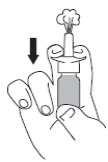
Before using the Rhinocort 64 micrograms nasal spray for the first time, shake the container, remove the protective cap, and, holding the container upright, press the pump several times (5–10 times) into the air until a uniform spray appears (see Figure 1). If the spray is not used daily, the pump must be re-primed. In this case, one (1) single press into the air is sufficient.
-
Blow your nose. Shake the container and remove the cap.
-
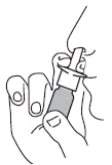
Hold the container in an upright position as shown in the figures.
-
Insert the tip of the nasal applicator into one nostril and direct it toward the side of the nose, away from the center (the "septum"). Press once or twice, depending on the required dose. Repeat the procedure in the other nostril.
-
Replace the cap. Do not use the Rhinocort 64 micrograms nasal spray more times than recommended in this leaflet.
Cleaning
Clean the plastic parts regularly. To do this, remove the cap and the nasal applicator. Wash the plastic parts with lukewarm water. Allow them to dry completely in the air before reassembling.
Do not attempt to clean the nasal applicator with a pin or any sharp object.
When you no longer need this medicine, it is advisable to discard any remaining contents, even if not completely used.
If you have any further questions about the use of this medicine, ask your doctor or pharmacist.
4. Possible adverse effects
Like all medicines, this medicine can cause adverse effects, although not everyone will experience them.
If you experience any of the following symptoms, stop using this nasal spray and consult a doctor immediately:
- Sudden signs of an allergic reaction such as rash, itching, hives or redness of the skin, swelling of the face, lips, mouth, tongue or other parts of the body, difficulty breathing, wheezing or difficulty swallowing or breathing, or feeling faint.
Other adverse effects include:
Common (may affect up to 1 in 10 patients):
- Infections of the nose, throat or sinuses.
- Nosebleeds (epistaxis) or nasal irritation.
- Pain in the mouth and/or throat.
- Ear infection.
- Headache.
- Abdominal discomfort.
- Fever.
Uncommon (may affect up to 1 in 100 patients):
- Muscle cramps.
Rare (may affect up to 1 in 1,000 patients):
- Effects on the adrenal glands (small glands located above the kidneys).
- Nasal ulcers or perforation of the membrane separating the nasal passages (nasal septum).
- Voice changes.
- Bruising.
- Blurred vision.
Adverse effects for which frequency is not known:
- Cataracts (loss of transparency of the eye lens).
- Glaucoma (increased intraocular pressure).
- Angioedema.
- Dermatitis.
- Erythema.
- Rash.
- Urticaria.
Other side effects reported in children
Reduced growth has been reported in children treated with nasal corticosteroids.
The following adverse effects have also been frequently reported in children: stomach discomfort, headache, cough, fever or high temperature, inflammation and infections of the ears, tonsils, sinuses or lungs, or skin rash.
Psychiatric or behavioural disorders such as hyperactivity, sleep disorders, nervousness, depression or aggression have been reported rarely (especially in children).
Reporting of adverse effects
If you experience any adverse effect, talk to your doctor or pharmacist, even if it is a possible adverse effect not listed in this leaflet. You can also report them directly via the Spanish Pharmacovigilance System for Human Medicines: www.notificaRAM.es. By reporting adverse effects, you can help provide more information on the safety of this medicine.
5. Storage of Rhinocort 64 micrograms
Replace the protective cap after using Rhinocort 64 micrograms.
Do not store above 30 °C. Do not freeze.
Keep this medicine out of the sight and reach of children.
Do not use this medicine after the expiry date stated on the packaging after “EXP”. The expiry date refers to the last day of the month indicated.
Medicines must not be disposed of via wastewater or household waste. Return unused medicines and their containers to the SIGRE Point at your pharmacy. Ask your pharmacist how to dispose of medicines and containers you no longer need. This helps protect the environment.
6. Contents of the container and additional information
Composition of Rhinocort 64 micrograms
-
The active substance is budesonide.
-
The other components (excipients) are: disodium edetate, potassium sorbate (E 202), anhydrous glucose, microcrystalline cellulose (E 460), sodium carboxymethylcellulose (E 466), polysorbate 80 (E 433), hydrochloric acid and purified water.
Appearance of the product and contents of the container
Rhinocort 64 micrograms is presented in a 10 ml brown glass bottle (120 sprays) equipped with a spray pump and a nasal applicator. The liquid contained is a suspension intended for nasal spray. Each spray contains 64 micrograms of the active substance.
Marketing Authorization Holder and Manufacturer
The Marketing Authorization Holder is:
JNTL Consumer Health (Spain), S.L.
C/ Vía de los Poblados 1, Edificio E, planta 3
28033-Madrid
Spain
The Manufacturer is:
McNeil AB
Norrbroplatsen 2
251 09 Helsingborg
Sweden
Date of the most recent review of this leaflet: March 2022
Detailed information on this medicine is available on the website of the Spanish Agency of Medicines and Medical Devices (AEMPS) (http://www.aemps.gob.es/)