Retirides 1 mg/g cream
Spain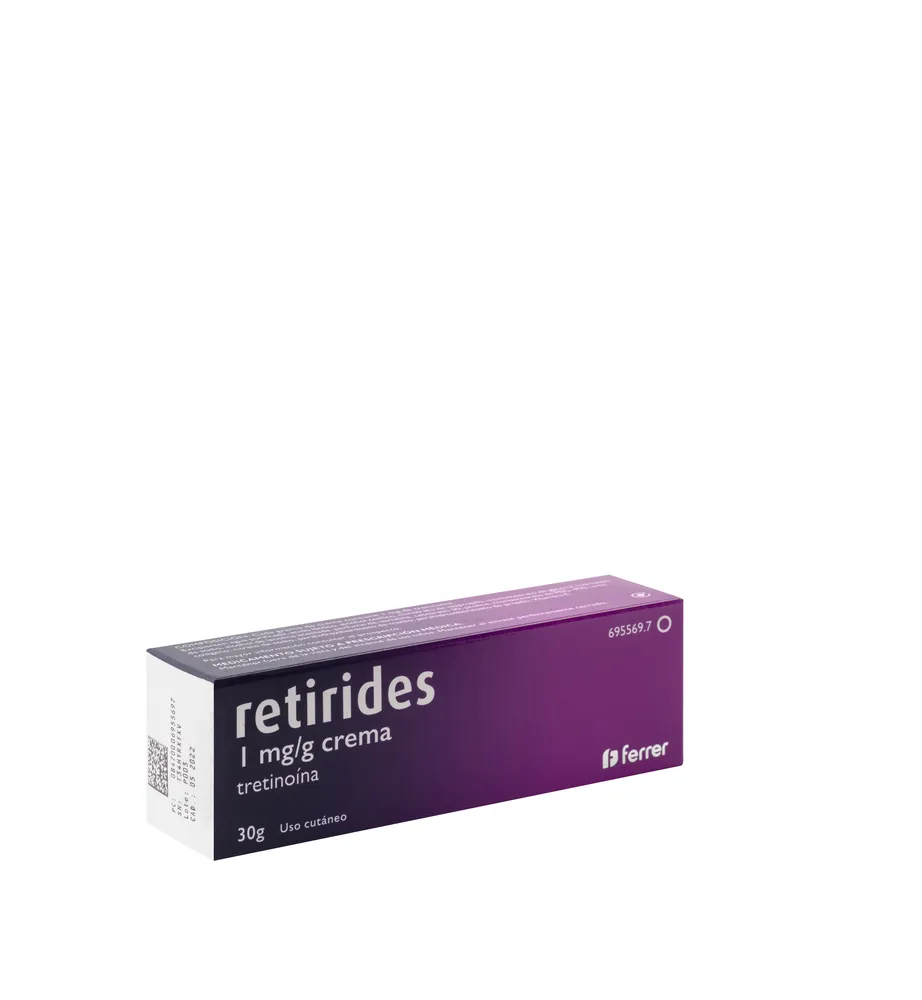
Table of Contents
- Package leaflet: Information for the user
- Introduction
- 1. What Retirides 1 mg/g cream is and what it is used for
- 2. What you need to know before using Retirides 1 mg/g cream
- 3. How to use Retirides 1 mg/g cream
- 4. Possible adverse effects
- 5. Storage of Retirides 1 mg/g cream
- 6. Contents of the container and additional information
Package leaflet: Information for the user
Introduction
Package leaflet: information for the user
Retirides 1 mg/g cream
Tretinoin
Read the entire leaflet carefully before you start using this medicine, because it contains important information for you.
- Keep this leaflet, as you may need to read it again.
- If you have any questions, ask your doctor or pharmacist.
- This medicine has been prescribed for you only and must not be given to other people, even if they have the same symptoms, as it may harm them.
- If you experience any adverse effects, consult your doctor or pharmacist, even if they are adverse effects not listed in this leaflet. See section 4.
Contents of the leaflet
- What Retirides 1 mg/g cream is and what it is used for
- What you need to know before using Retirides 1 mg/g cream
- How to use Retirides 1 mg/g cream
- Possible side effects
- How to store Retirides 1 mg/g cream
- Contents of the pack and other information
1. What Retirides 1 mg/g cream is and what it is used for
This cream belongs to a group of medicines called anti-acne agents.
Retirides is a cream containing the active substance tretinoin, a derivative of Vitamin A, indicated for the topical treatment of mild to moderate acne.
Retirides should be used under medical supervision.
2. What you need to know before using Retirides 1 mg/g cream
Do not use Retirides 1 mg/g cream
- if you are allergic to tretinoin or any of the other ingredients of this medicine (listed in section 6)
- if you have a personal or family history of cutaneous epithelioma (skin cancer)
- if you are pregnant
- if you are planning to become pregnant
- if you are using photosensitizing medicines
Warnings and precautions
Talk to your doctor or pharmacist before starting to use Retirides 1 mg/g cream
- take special care if you have eczema, as this medicine may cause skin irritation. If your skin is irritated, it is advisable to wait until the irritation has resolved before starting treatment with Retirides 1 mg/g cream.
- care should be taken to avoid contact with the eyes, eyelids, corners of the nose, mouth, mucous membranes, or other areas where treatment is not indicated, to minimize potential additional skin irritation. Care should be taken not to leave accumulated medication in skin folds. There is an increased risk of irritation in more sensitive skin areas such as the neck and forearms; therefore, it is recommended to reduce the frequency of application.
- exposure to sunlight, including ultraviolet (UVA) sunlamps, should be avoided or minimized during treatment with tretinoin. Patients with sunburn should be advised not to use the product until they have fully recovered. When sun exposure cannot be avoided, sunscreen products (minimum sun protection factor SPF 15) and protective clothing should be used on treated areas.
- if you experience persistent or severe irritation, you should completely stop applying Retirides 1 mg/g cream and, if necessary, consult your doctor.
Other medicines and Retirides 1 mg/g cream
Inform your doctor or pharmacist if you are taking, have recently taken, or might need to take any other medicines.
Do not use Retirides 1 mg/g cream if you are taking photosensitizing medicines (medicines that increase the skin's sensitivity to sunlight), such as thiazides, tetracyclines, fluoroquinolones, phenothiazines, sulfonamides.
Use Retirides 1 mg/g cream with caution in the presence of:
- Topical medications used in the treatment of acne and/or photoaging.
- Cosmetics with abrasive, drying, or peeling effects, including soaps, shampoos, cosmetics, and astringents (especially those containing alcohol or fragrances, e.g.: colognes, pre- and post-shaving lotions, etc.), medicated shampoos or soaps, permanent wave solutions, electrolysis, depilatory creams or waxes, or other preparations or procedures that may irritate the skin, unless performed under medical supervision.
Pregnancy, breastfeeding and fertility
DO NOT use Retirides 1 mg/g cream if you are pregnant or planning to become pregnant. Your doctor can provide you with further information.
It is not known whether tretinoin is excreted in breast milk, so appropriate precautions should be taken when using this medicine during breastfeeding.
Consult your doctor or pharmacist before using any medicine.
Use in children
The safety and efficacy of Retirides 1 mg/g cream have not been established in this population.
Use in people over 50 years of age
The safety and efficacy of Retirides 1 mg/g cream have not been established in this population.
Driving and using machines
No effects on the ability to drive or operate machinery have been reported.
Retirides 1 mg/g cream contains cetyl alcohol, lanolin, methyl parahydroxybenzoate, propyl parahydroxybenzoate, benzyl salicylate, geraniol, amyl cinnamaldehyde, linalol, and butylhydroxytoluene.
This medicine may cause local skin reactions (such as contact dermatitis) because it contains cetyl alcohol and lanolin.
It may cause allergic reactions (possibly delayed) because it contains methyl parahydroxybenzoate and propyl parahydroxybenzoate.
This medicine contains vertaline perfume containing the allergens benzyl salicylate, geraniol, amyl cinnamaldehyde, and linalol, which may cause allergic reactions.
This medicine may cause local skin reactions (such as contact dermatitis) or irritation of the eyes and mucous membranes because it contains vertaline perfume (containing butylhydroxytoluene E-321).
3. How to use Retirides 1 mg/g cream
Follow exactly the instructions for use of this medicine as given by your doctor. If in doubt, consult your doctor again.
Depending on skin type and severity of the condition, at the physician's discretion, the cream of the appropriate concentration will be prescribed (since Retirides is available in concentrations of 0.25 mg/g, 0.5 mg/g, and 1 mg/g), and the number of daily applications will be recommended.
Treatment should be initiated with the lowest concentration cream (0.25 mg/g), applied once daily. Subsequently, and according to the individual patient's response, the concentration of the cream and/or the number of applications may be increased.
Avoid frequent washing of the face. Washing two or three times a day is sufficient, using a neutral soap and taking care to dry gently without rubbing.
Do not apply the cream until at least half an hour after washing the face.
Apply a sufficient amount of cream to cover the affected area and gently massage, avoiding contact with the eyes, eyelids, corners of the nose, mouth, and mucous membranes.
In any case, your doctor will determine the duration of your treatment with Retirides 1 mg/g cream.
In acne treatments, irritation is directly linked to the efficacy of the product and subsides when applications are spaced out. During the first weeks of treatment, an apparent worsening of symptoms and signs of irritation may occur. This reaction is normal, as it reflects the accelerated elimination of microcysts forming deep within the skin.
Excessive application of Retirides 1 mg/g cream does not improve treatment outcomes and may instead cause marked irritation, including redness, peeling, itching, etc.
During treatment, cosmetics may be used concurrently, particularly moisturizing products, but they should not be applied to the skin at the same time as the cream.
If you use more Retirides 1 mg/g cream than you should
If you have used more Retirides 1 mg/g cream than recommended, consult your doctor or pharmacist immediately.
Oral ingestion of Retirides 1 mg/g cream may lead to effects similar to those associated with excessive oral intake of vitamin A, for example, pruritus, skin dryness, arthralgia (neuralgia or joint pain), anorexia, vomiting, etc.
In case of overdose or accidental ingestion, contact the National Toxicology Information Service at Tel. 91 5620420.
If you have any further questions about the use of this product, ask your doctor or pharmacist.
4. Possible adverse effects
Like all medicines, this medicine may cause adverse effects, although not everyone experiences them.
Topical application of Retirides 1 mg/g cream may cause transient itching, sensation of warmth, slight redness, and skin peeling similar to mild sunburn, dryness, severe local erythema, development of edema at the application site, burns, blisters, ulcers, and pruritus. Skin dryness or peeling may persist throughout therapy, although these effects generally diminish during the course of treatment.
In acne treatments, skin irritation is directly related to the efficacy of tretinoin-based products and resolves when applications are spaced out.
Rarely, contact allergies have occurred with topical use of tretinoin.
There have been reports of temporary increases and decreases in pigmentation due to repeated application. Increased sensitivity to sunlight or other sources of UVB radiation has also been observed.
To date, all adverse effects associated with Retirides 1 mg/g cream have been reversible upon discontinuation of treatment.
Reporting of adverse effects
If you experience any type of adverse effect, consult your doctor or pharmacist, even if it is a possible adverse effect not listed in this leaflet. You may also report them directly via the Spanish Pharmacovigilance System for Human Medicines: www.notificaRAM.es.
By reporting adverse effects, you can help provide more information on the safety of this medicine.
5. Storage of Retirides 1 mg/g cream
Keep this medicine out of the sight and reach of children.
This medicine does not require special storage conditions. Keep the tube tightly closed.
Do not use this medicine after the expiry date stated on the packaging after EXP. The expiry date refers to the last day of the month indicated.
Medicines must not be disposed of via wastewater drains or household waste. Dispose of unused containers and medicines at the SIGRE collection point at your pharmacy. If in doubt, ask your pharmacist how to dispose of unused containers and medicines. This will help protect the environment.
6. Contents of the container and additional information
Composition of Retirides 1 mg/g cream
- The active substance is tretinoin, in an amount of 0.1 g per 100 g of cream.
- The other components are: decyl oleate, isopropyl myristate, glycerol monostearate, acetylated lanolin alcohol, ceteareth-30, cetostearyl alcohol, proline, polyethylene glycol 400 monostearate, urea, collagen, methyl parahydroxybenzoate (E-218), propyl parahydroxybenzoate (E-216), lactic acid, sodium citrate, sodium hydroxide, tocopheryl acetate, perfume Vertalina 72 (contains benzyl salicylate, geraniol, amyl cinnamaldehyde, linalool and butylhydroxytoluene E-321) and purified water.
Appearance of the product and contents of the container
Retirides 1 mg/g cream is an oil/water emulsion for topical use, supplied in a 30 ml tube.
Marketing Authorization Holder
Galenicum Derma, S.L.U.
Ctra N-1, Km 36
28750 San Agustin del Guadalix (Madrid)
Spain
Manufacturer
LABORATORIOS ERN, S.A.
Can Salvatella Industrial Estate. Calle Gorcs i Lladó, 188
Barberà del Vallès (Barcelona)
Spain
Date of the most recent review of this leaflet: October 2018
Detailed and up-to-date information on this medicinal product is available on the website of the Spanish Agency of Medicines and Health Products (AEMPS) http://www.aemps.gob.es/.