Resincalcio powder for oral suspension
Spain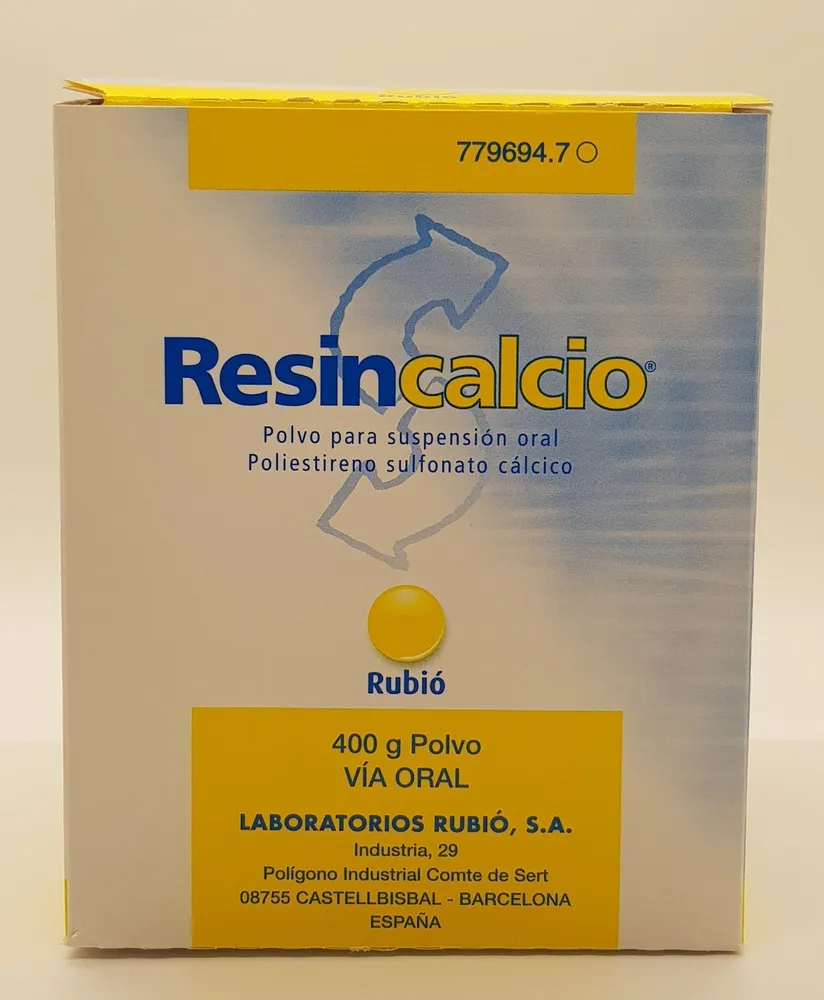
Table of Contents
- Package leaflet: Information for the user
- Introduction
- 1. What Resincalcio is and what it is used for
- 2. What you need to know before starting Resincalcio
- **Use of Resincalcio with other medicines**
- **Pregnancy and breastfeeding**
- **Driving and use of machines**
- 3. How to take Resincalcio
- 4. Possible adverse effects
- 5. Storage of Resincalcio
- 6. Contents of the pack and other information
- ***Marketing Authorization Holder and Manufacturing Responsible Party***
Package leaflet: Information for the user
Introduction
Package leaflet: information for the user
Resincalcio powder for oral suspension
Calcium polystyrene sulfonate
Read the entire leaflet carefully before you start taking this medicine, because it contains important information for you.
- Keep this leaflet, as you may need to read it again.
- If you have any questions, ask your doctor or pharmacist.
- This medicine has been prescribed for you only, and you should not give it to others, even if they have the same symptoms as you, because it may harm them.
- If you experience any adverse effects, consult your doctor or pharmacist, even if they are adverse effects not listed in this leaflet. See section 4.
Leaflet contents:
- What Resincalcio is and what it is used for
- What you need to know before taking Resincalcio
- How to take Resincalcio
- Possible adverse effects
- How to store Resincalcio
- Contents of the pack and other information
1. What Resincalcio is and what it is used for
Resincalcio contains calcium polystyrene sulfonate. Calcium polystyrene sulfonate is an ion-exchange resin used in the treatment of hyperkalemia, acting by reducing potassium ion concentration in the blood.
Resincalcio is indicated for:
- Treatment and prevention of hyperkalemia (elevated levels of potassium in the blood).
2. What you need to know before starting Resincalcio
Do not take Resincalcio:
- If you are allergic to polystyrene sulfonate resins or to any of the other components of this medicine (listed in section 6).
- If you have high levels of calcium in your blood.
- If you have renal insufficiency associated with conditions such as hyperparathyroidism, multiple myeloma, sarcoidosis, or metastatic carcinoma.
- If you have intestinal obstruction.
- If you are taking sorbitol.
- It must not be administered orally in neonates.
- If you have very low levels of potassium in your blood.
Warnings and precautions
Consult your doctor or pharmacist before starting to take Resincalcio.
- If you are taking Resincalcio, your doctor should perform frequent blood tests to monitor your ion levels.
- Be especially careful if you suffer from constipation, as you may be more sensitive to worsening of this condition. If laxatives are used to prevent this problem, it is recommended to avoid laxatives containing magnesium and/or sorbitol.
- Make sure to take the medicine in the correct posture (it is important to remain upright while taking the medicine to prevent powder from entering the lungs).
- If you have abnormal intestinal movements due to your medical condition (including conditions following surgery or use of medications), as these may cause various disorders, including bloating, severe constipation, reduced blood supply to the intestine, or intestinal rupture.
Use of Resincalcio with other medicines
Inform your doctor or pharmacist if you are taking, have recently taken, or might need to take any other medicines.
Tell your doctor if you are taking any of the following medicines, as they may interact with calcium polystyrene sulfonate, which may require adjustment of the dose or interruption of one of the treatments:
- Levothyroxine or thyroxine (medicines used in thyroid disorders).
- Tetracyclines (a specific group of antibiotics).
- Cardiac glycosides such as digoxin (medicines used for certain heart conditions).
- Antacids and laxatives (magnesium, aluminum or calcium hydroxide, aluminum carbonate, etc.). In these cases, it is recommended to separate administration by at least 2 hours.
- Lithium (a medicine used for mental health disorders).
- Sorbitol (a laxative).
Taking Resincalcio with food and drinks
Administration of Resincalcio with fruit juices is not recommended (due to their high potassium content).
Pregnancy and breastfeeding
If you are pregnant or breastfeeding, think you may be pregnant, or are planning to become pregnant, consult your doctor or pharmacist before using this medicine.
Pregnancy
As there are no studies providing conclusive data on the safety of using this medicine in pregnant women, the administration of Resincalcio should be closely supervised by a physician.
Breastfeeding
There are no studies providing conclusive data on the safety of using this medicine in breastfeeding women. Therefore, the administration of Resincalcio should be closely supervised by a physician.
Driving and use of machines
It is unknown whether administration of calcium polystyrene sulfonate may affect the ability to drive vehicles or operate machinery.
Resincalcio contains sodium benzoate (E-211) and sodium
This medicine contains a maximum of 35 mg of sodium benzoate (E-211) per dose.
This medicine contains less than 23 mg of sodium (1 mmol) per dose; hence, it is essentially “sodium-free”.
3. How to take Resincalcio
Follow exactly the instructions for use of this medicine as given by your doctor or pharmacist. If in doubt, consult your doctor or pharmacist again.
This medicine is administered orally. It is recommended that you take Resincalcio with a sufficient amount of water or sugar water.
Try to take the medicine in a correct posture (it is important to remain upright while taking the medicine to prevent powder from entering the lungs).
The recommended dose is:
- Adults:
Administer 15 g of Resincalcio three or four times a day suspended in water or sugar water.
- Children:
Acute hyperkalemia: The recommended dose is up to 1 g per kg of body weight per day, divided into several doses.
Maintenance: The recommended dose is 500 mg per kg of body weight per day, divided into several doses.
If you take more Resincalcio than you should
If you have taken more Resincalcio than you should, consult your doctor or pharmacist immediately, indicating the medicine and the amount ingested.
In case of overdose or accidental ingestion, contact the Toxicology Information Service, telephone 915 620 420.
If you forget to take Resincalcio
Do not take a double dose to make up for missed doses.
If you stop taking Resincalcio
If you have forgotten to take several doses, consult your doctor so that they can advise you on the dosing regimen to follow until you reach your maintenance dose.
If you have any further questions about the use of this medicine, ask your doctor or pharmacist.
4. Possible adverse effects
Like all medicines, this medicine can cause adverse effects, although not everyone will experience them.
Frequent (may affect up to 1 in 10 people):
- excess calcium in the blood
- low levels of potassium in the blood
- nausea
- constipation in elderly people
Uncommon (may affect up to 1 in 100 people):
- diarrhoea
- decreased appetite (anorexia)
Rare (may affect up to 1 in 1,000 people):
- large, hard, dry mass of faeces (faecalomas) in severe cases
Very rare (may affect up to 1 in 10,000 people):
- tissue death (necrosis) of the colon
- acute inflammation of the bronchi or a particular type of pneumonia caused by pulmonary aspiration of the medicine, which can be prevented by maintaining a correct posture when taking the medicine.
Contact your doctor or nurse immediately if you notice any of the following serious side effects:
- Severe stomach pain, rectal pain
- Swelling, severe constipation
- Severe nausea and vomiting
- Black, bloody or tar-like stools, coughing up blood or vomiting material that looks like "coffee grounds"
If you consider any of the adverse effects you experience to be serious, or if you notice any adverse effect not listed in this leaflet, inform your doctor or pharmacist.
Reporting of adverse effects
If you experience any type of adverse effect, consult your doctor or pharmacist, even if it is a possible adverse effect not listed in this leaflet. You may also report them directly via the Spanish Pharmacovigilance System for Human Medicinal Products: https://www.notificaram.es. By reporting adverse effects, you can help provide more information on the safety of this medicine.
5. Storage of Resincalcio
No special storage conditions are required.
Keep this medicine out of the sight and reach of children.
Do not use this medicine after the expiry date stated on the packaging after EXP.
The expiry date refers to the last day of the month indicated.
Medicines must not be disposed of via wastewater or household waste. Dispose of unused medicines and their containers at a SIGRE collection point at your pharmacy. If you are unsure, ask your pharmacist how to dispose of medicines and containers you no longer need. This will help protect the environment.
6. Contents of the pack and other information
Composition of Resincalcio
- The active substance is calcium polystyrene sulfonate. Each 100 g of oral suspension powder contains 99.75 g of calcium polystyrene sulfonate.
- The other components are: vanilla flavour (contains sodium benzoate (E-211)).
Appearance of the medicinal product and contents of the container
Resincalcio is a fine, golden or brown oral suspension powder with a slight vanilla taste and odour.
- Multi-dose bottles of 400 g capacity, accompanied by a dosing spoon delivering approximately 5 g of oral suspension powder.
- 26 single-dose sachets containing 15 g of oral suspension powder.
Marketing Authorization Holder and Manufacturing Responsible Party
LABORATORIOS RUBIÓ S.A.,
C/ Industria, 29. Pol. Ind. Comte de Sert,
08755 CASTELLBISBAL (Barcelona) SPAIN
Date of the most recent review of this leaflet: September 2023
Detailed and up-to-date information on this medicinal product is available on the website of the Spanish Agency for Medicines and Health Products (AEMPS) (http://www.aemps.gob.es/).