Replagal 1 mg/ml concentrate for solution for infusion
Spain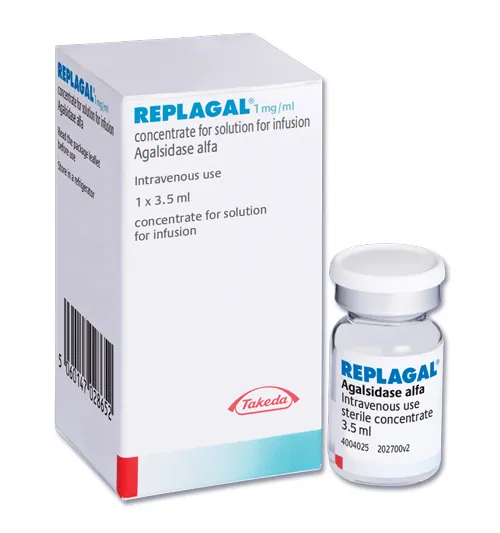
Table of Contents
Package leaflet: Information for the user
Introduction
Package leaflet: information for the user
Replagal 1 mg/ml concentrate for solution for infusion
Agalsidase alfa
Read the entire leaflet carefully before starting to take this medicine, because it contains important information for you.
-
Keep this leaflet, as you may need to read it again.
-
If you have any questions, ask your doctor or pharmacist.
-
This medicine has been prescribed for you only, and you should not give it to other people, even if they have the same symptoms as you, because it may harm them.
-
If you experience any adverse reaction, consult your doctor or pharmacist, even if it is an adverse reaction not listed in this leaflet. See section 4.
Leaflet contents:
- What Replagal is and what it is used for
- What you need to know before administration of Replagal
- How Replagal is administered
- Possible side effects
- How to store Replagal
- Contents of the pack and other information
1. What Replagal is and what it is used for
The active substance in Replagal is agalsidase alfa (1 mg/ml). Agalsidase alfa is a form of the human enzyme α-galactosidase. It is produced by activating the α-galactosidase A gene in cells. The enzyme is then extracted from the cells and processed into a sterile concentrate for infusion solution.
Replagal is used to treat adult patients, as well as adolescents and children aged 7 years and older, who have a confirmed diagnosis of Fabry disease. It is used as a long-term enzyme replacement therapy in cases where enzyme levels in the body are absent or lower than normal, as occurs in Fabry disease.
After 6 months of treatment, Replagal significantly reduced pain in patients compared to patients treated with placebo (inactive medicine). Replagal reduced left ventricular mass in treated patients compared to those treated with placebo. These results suggest that disease symptoms are improving or that the disease is stabilizing.
2. What you need to know before receiving Replagal
Do not receive Replagal
- if you are allergic to agalsidase alfa or to any of the other ingredients of this medicine (listed in section 6).
Warnings and precautions
Talk to your doctor or pharmacist before starting treatment with Replagal.
If you experience any of the following symptoms during or after an infusion, you must inform your doctor immediately:
-
high fever, chills, sweating, rapid heartbeat
-
vomiting
-
dizziness
-
hives (rash)
-
swelling of the hands, feet, ankles, face, lips, mouth, or throat, which may cause difficulty swallowing or breathing.
Your doctor may temporarily stop the infusion (for 5–10 minutes) until symptoms resolve and then resume the infusion.
Your doctor may also treat the symptoms with other medications (antihistamines or corticosteroids). In most cases, you will still be able to continue receiving Replagal even if these symptoms occur.
If you experience a severe allergic (anaphylactic-type) reaction, Replagal administration will be stopped immediately, and your doctor will initiate appropriate treatment.
If treatment with Replagal causes your body to produce antibodies, this will not necessarily reduce the effectiveness of Replagal, and the antibodies may disappear over time.
If you have advanced kidney disease, you may find that your treatment with Replagal has limited effect on your kidneys. Consult your doctor or pharmacist before starting Replagal.
Children
Experience in children aged 0 to 6 years is limited; therefore, no dosage recommendation can be made for this age group.
Use of Replagal with other medicines
Inform your doctor or pharmacist if you are taking, have recently taken, or might need to take any other medicines.
Tell your doctor if you are taking any medicine containing chloroquine, amiodarone, primaquine, or gentamicin. There is a theoretical risk of reduced activity of agalsidase alfa.
Pregnancy and breastfeeding
The very limited clinical data available on exposure to Replagal during pregnancy have not shown adverse effects on the mother or newborn.
If you are pregnant or breastfeeding, think you may be pregnant, or are planning to become pregnant, consult your doctor or pharmacist before using this medicine.
Driving and using machines
You may drive and operate machinery while receiving Replagal.
Replagal contains sodium
This medicine contains 14.2 mg of sodium (the main component of table/cooking salt) per vial. This corresponds to 0.7% of the maximum daily recommended sodium intake for an adult.
Replagal contains polysorbate 20
This medicine contains 0.836 mg of polysorbate 20 per vial, equivalent to 0.22 mg/ml. Polysorbates may cause allergic reactions. Inform your doctor if you or your child has any known allergies.
Maintenance of records
To improve traceability of biological medicines, the name and batch number of the administered medicine should be clearly recorded by your healthcare professional. Speak with your healthcare professional if you have any questions.
3. How Replagal is administered
This medicine must be administered and supervised by trained healthcare professionals, who will also calculate the dose to be given. While under medical supervision, Replagal may be self-administered (you or your caregiver may administer it) after receiving appropriate training from the responsible physician or nurse. Self-administration should be performed in the presence of a responsible adult.
The recommended dose is an infusion of 0.2 mg per kilogram of body weight. This corresponds to approximately 14 mg or 4 vials (glass bottles) of Replagal for a person weighing about 70 kg.
Use in children and adolescents
For children and adolescents aged 7 to 18 years, a dose of 0.2 mg/kg every two weeks may be used.
Children and adolescents may be more likely than adults to experience an infusion-related reaction. Consult your doctor if you experience any adverse effects during the infusion.
Method of administration
Replagal must be diluted in a 9 mg/ml sodium chloride (0.9%) solution before administration.
After dilution, Replagal is administered intravenously, usually into a vein in the arm.
The infusion should be given every two weeks.
Each time you receive treatment, it will take approximately 40 minutes to administer Replagal intravenously. Treatment will be supervised by a physician specialized in the management of Fabry disease.
In the case of self-administration, the dose or infusion rate must not be changed without prior authorization from the responsible physician.
If you use more Replagal than you should
If you think you have used more Replagal than you should, contact your doctor.
If you use less Replagal than you should
If you think you have used less Replagal than you should, contact your doctor.
If you forget to use Replagal
If you miss an infusion of Replagal, contact your doctor.
If you stop treatment with Replagal
Do not stop taking Replagal without consulting your doctor. If you have any further questions about the use of this medicine, ask your doctor or pharmacist.
4. Possible adverse effects
Like all medicines, this medicine can cause adverse effects, although not everyone experiences them.
If you experience a severe allergic (anaphylactic-type) reaction, administration of Replagal will be stopped immediately and your doctor will initiate appropriate treatment.
Most of these reactions are mild or moderate. Approximately 1 in 7 patients (a "very common" reaction) may experience a reaction during or after Replagal infusion (infusion-related reaction). These reactions include chills, headache, nausea, fever, facial flushing, fatigue, low blood pressure, unsteadiness, sweating, breathing difficulties, itching, tremors, cough, and vomiting. However, some adverse effects may be serious and require treatment. Infusion-related reactions affecting the heart, including heart rhythm disorders, myocardial ischemia, and heart failure, may occur in patients with Fabry disease affecting cardiac structures (reactions with "frequency not known" (cannot be estimated from available data)). Your doctor may temporarily interrupt the infusion (5–10 minutes) until symptoms resolve and then restart the infusion. Your doctor may also treat symptoms with other medications (antihistamines or corticosteroids). In most cases, Replagal can still be administered even if these symptoms occur.
List of other adverse effects:
Very common (may affect more than 1 in 10 people):
- Tissue swelling (e.g., in arms and legs)
- Numbness or pain in fingers or toes
- Ringing in the ears
- Palpitations
- Sore throat
- Abdominal pain, diarrhea
- Rash
- Back or limb pain, muscle pain, joint pain
- Chest pain, flu-like symptoms, fever, nausea
Common (may affect up to 1 in 10 people):
- Changes in taste, prolonged sleep
- Eye tearing
- Increased ringing in the ears
- Increased heart rate, heart rhythm disturbances
- Increased blood pressure, decreased blood pressure, facial flushing
- Hoarseness, throat tightness, nasal secretions
- Abdominal discomfort
- Acne, skin redness, itching, or skin spots, excessive sweating
- Bone and muscle discomfort, swelling of limbs or joints
- Hypersensitivity
- Chest tightness, increased feeling of lack of energy, sensation of cold or heat, flu-like symptoms, general discomfort
Uncommon (may affect up to 1 in 100 people):
- Severe allergic (anaphylactic-type) reaction
- Abnormal eyelid reflex
- Increased heart rate
- Reduced oxygen levels in blood and sticky throat secretions
- Altered sense of smell
- Fluid collection under the skin causing swelling of body parts, reticular skin discoloration, e.g., in the leg
- Feeling of heaviness
- Rash at injection site
Children and adolescents
Adverse effects reported in children were generally similar to those reported in adults. However, infusion-related reactions (fever, breathing difficulties, chest pain) and worsening of pain occurred more frequently.
Reporting of adverse effects
If you experience any adverse effect, consult your doctor or pharmacist, even if it is a possible adverse effect not listed in this leaflet. You may also report them directly through the national reporting system listed in Appendix V. By reporting adverse effects, you can help provide more information on the safety of this medicine.
5. Storage of Replagal
Keep this medicine out of sight and reach of children.
Do not use this medicine after the expiry date stated on the label and the carton after EXP. The expiry date refers to the last day of the month indicated.
Store in a refrigerator (between 2°C and 8°C).
Do not use Replagal if you notice any change in colour or the presence of foreign particles.
Medicines should not be disposed of via wastewater or household waste. Ask your pharmacist how to dispose of medicines and containers you no longer need. This will help protect the environment.
6. Contents of the pack and other information
Composition of Replagal
-
The active substance is agalsidase alfa. Each ml of Replagal contains 1 mg of agalsidase alfa.
-
The other components are: monobasic sodium phosphate monohydrate (E339), polysorbate 20 (E432), sodium chloride, sodium hydroxide (E524), water for injections.
See section 2 "Replagal contains sodium" and "Replagal contains polysorbate 20".
Nature of the product and contents of the container
Replagal is a concentrate for solution for infusion. Your medicine is available in vials containing 3.5 mg/3.5 ml of agalsidase alfa. Pack sizes of 1, 4 or 10 vials are available. Some pack sizes may not be marketed.
Marketing Authorization Holder
Takeda Pharmaceuticals International AG Ireland Branch
Block 2 Miesian Plaza
50–58 Baggot Street Lower
Dublin 2
D02 HW68
Ireland
Manufacturer
Takeda Pharmaceuticals International AG Ireland Branch
Block 2 Miesian Plaza
50–58 Baggot Street Lower
Dublin 2
D02 HW68
Ireland
Shire Pharmaceuticals Ireland Limited
Block 2 & 3 Miesian Plaza
50–58 Baggot Street Lower
Dublin 2
Ireland
More information on this medicine is available upon request by contacting the local representative of the Marketing Authorization Holder:
Belgium/Belgium/Belgium Takeda Belgium NV Tel/Tel: +32 2 464 06 11 | Lithuania Takeda, UAB Tel: +370 521 09 070 |
| Luxembourg/Luxembourg Takeda Belgium NV Tél/Tel: +32 2 464 06 11 |
Czech Republic Takeda Pharmaceuticals Czech Republic s.r.o. Tel: +420 234 722 722 | Hungary Takeda Pharma Kft. Tel: +356 21419070 |
Denmark Takeda Pharma A/S Tlf: +45 46 77 10 10 | Malta Drugsales Ltd Tel: +30 210 6387800 |
Germany Takeda GmbH Tel: +49 (0)800 825 3325 | Netherlands Takeda Nederland B.V. Tel: +31 20 203 5492 |
Estonia Takeda Pharma OÜ Tel: +372 6177 669 | Norway Takeda AS Tlf: +47 800 800 30 |
Greece Takeda HELLAS S.A. Tel: +30 210 6387800 | Austria Takeda Pharma Ges.m.b.H. Tel: +43 (0) 800-20 80 50 |
Spain Takeda Farmacéutica España, S.A. Tel: +34 917 90 42 22 | Poland Takeda Pharma Sp. z o.o. Tel.: +48223062447 |
France Takeda France SAS Tél.: +33 1 40 67 33 00 | Portugal Takeda Farmacêuticos Portugal, Lda. Tel: +351 21 120 1457 |
Croatia Takeda Pharmaceuticals Croatia d.o.o. Tel: +385 1 377 88 96 | Romania Takeda Pharmaceuticals SRL Tel: +40 21 335 03 91 |
Ireland Takeda Products Ireland Ltd Tel: 1800 937 970 | Slovenia Takeda Pharmaceuticals farmacevtska družba d.o.o. Tel: +386 (0) 59 082 480 |
Iceland Vistor ehf. Tel: +354 535 7000 | Slovakia Takeda Pharmaceuticals Slovakia s.r.o. Tel: +421 (2) 20 602 600 |
Italy Takeda Italia S.p.A. Tel: +39 06 502601 | Finland Takeda Oy Tel: 0800 774 051 |
Cyprus A.POTAMITIS MEDICARE LTD Tel: +357 22583333 | Sweden Takeda Pharma AB Tel: 020 795 079 |
Latvia Takeda Latvia SIA Tel: +371 67840082 |
Date of the most recent review of this leaflet:
Other sources of information
Detailed information on this medicine is available on the website of the European Medicines Agency: http://www.ema.europa.eu/. This site also provides links to other websites on rare diseases and orphan medicinal products.
This information is intended for healthcare professionals only:
Instructions for use, handling and disposal
Treatment with Replagal must be supervised by a physician experienced in the management of patients with Fabry disease or other inherited metabolic disorders.
Replagal is administered at a dose of 0.2 mg/kg body weight every other week by intravenous infusion over 40 minutes.
- Calculate the required dose and the number of Replagal vials needed.
- Dilute the total required volume of Replagal concentrate in 100 ml of 9 mg/ml sodium chloride solution for infusion (0.9% w/v). Take precautions to ensure sterility of the prepared solutions, as Replagal contains no preservative or bacteriostatic agent; aseptic technique must be used. After dilution, the solution should be mixed gently without shaking.
- The solution should be inspected visually for the presence of particulate matter and discoloration prior to administration.
- Administer the infusion solution over 40 minutes using an intravenous line with an in-line filter. Since no preservatives are present, administration should be initiated as soon as possible. However, the diluted solution has been shown to be chemically and physically stable for 24 hours at 25 °C.
- Do not use the same intravenous line for the infusion of Replagal and concomitant infusion of other agents.
- For single use only. Any unused medicine and all materials that have come into contact with it should be disposed of in accordance with local regulations.