Remsima 120 mg solution for injection in pre-filled pen
Spain
Table of Contents
Package leaflet: Information for the user
Introduction
Package leaflet: Information for the user
Remsima 120 mg solution for injection in a pre-filled pen
infliximab
Read all of this leaflet carefully before you start using this medicine because it contains important information for you.
- Keep this leaflet. You may need to read it again.
- Your doctor will also give you a patient alert card containing important safety information you need to know before and during treatment with Remsima.
- When you start a new card, keep this card as a reference for 4 months after your last dose of Remsima.
- If you have any questions, ask your doctor, pharmacist, or nurse.
- This medicine has been prescribed for you only. Do not give it to other people, even if they have the same symptoms as you, because it may harm them.
- If you experience any side effects, talk to your doctor, pharmacist, or nurse, even if they are side effects not listed in this leaflet. See section 4.
Contents of the leaflet
- What Remsima is and what it is used for
- What you need to know before using Remsima
- How to use Remsima
- Possible side effects
- How to store Remsima
- Contents of the pack and other information
- Instructions for use
1. What Remsima is and what it is used for
Remsima contains the active substance infliximab. Infliximab is a monoclonal antibody – a type of protein that binds to a specific target in the body called TNF (tumour necrosis factor) alpha.
Remsima belongs to a group of medicines known as "TNF blockers". It is used in adults for the following inflammatory conditions:
- Rheumatoid arthritis
- Psoriatic arthritis
- Ankylosing spondylitis (Bechterew's disease)
- Psoriasis
- Crohn's disease
- Ulcerative colitis
Remsima works by selectively binding to TNF alpha and blocking its action. TNF alpha is involved in inflammatory processes in the body, so by blocking it, inflammation in your body can be reduced.
Rheumatoid arthritis
Rheumatoid arthritis is an inflammatory disease of the joints. If you have active rheumatoid arthritis, you will first be given other medicines. If these medicines do not work well enough, you will be given Remsima in combination with another medicine called methotrexate to:
- reduce the signs and symptoms of your disease,
- slow down joint damage,
- improve your physical function.
Psoriatic arthritis
Psoriatic arthritis is an inflammatory disease of the joints, usually accompanied by psoriasis. If you have active psoriatic arthritis, you will first be given other medicines. If these medicines do not work well enough, you will be given Remsima to:
- reduce the signs and symptoms of your disease,
- reduce joint damage,
- improve your physical function.
Ankylosing spondylitis (Bechterew's disease)
Ankylosing spondylitis is an inflammatory disease of the spine. If you have ankylosing spondylitis, you will first be given other medicines. If these medicines do not work well enough, you will be given Remsima to:
- reduce the signs and symptoms of your disease,
- improve your physical function.
Psoriasis
Psoriasis is an inflammatory disease of the skin. If you have moderate to severe plaque psoriasis, you will first be given other medicines or treatments such as phototherapy. If these medicines or treatments do not work well enough, you will be given Remsima to reduce the signs and symptoms of your disease.
Ulcerative colitis
Ulcerative colitis is an inflammatory disease of the intestine. If you have ulcerative colitis, you will first be given other medicines. If these medicines do not work well enough, you will be given Remsima to treat your disease.
Crohn's disease
Crohn's disease is an inflammatory disease of the intestine. If you have Crohn's disease, you will first be given other medicines. If these medicines do not work well enough, you will be given Remsima to:
- treat active Crohn's disease,
- reduce the number of abnormal passages (fistulas) between your intestine and your skin, which have not been controlled by other medicines or surgery.
2. What you need to know before using Remsima
Do not use Remsima if:
- you are allergic to infliximab or any of the other ingredients of Remsima (listed in section 6),
- you are allergic to proteins derived from mice,
- you have tuberculosis (TB) or another serious infection such as pneumonia or septicemia (a serious bacterial infection of the blood),
- you have moderate or severe heart failure.
If any of the above apply to you, do not use Remsima. If you are unsure, consult your doctor before being administered Remsima.
Warnings and precautions
Talk to your doctor before or during treatment with Remsima if:
You have previously received treatment with any medicine containing infliximab
- Inform your doctor if you have previously received treatment with medicines containing infliximab and are now restarting treatment with Remsima.
- If you have interrupted treatment with infliximab for more than 16 weeks, there is an increased risk of allergic reactions when restarting treatment.
Local reactions at the injection site
- Some patients receiving infliximab by subcutaneous injection have experienced local reactions at the injection site. Signs of a local reaction may include redness, pain, itching, swelling, hardening, bruising, bleeding, cold sensation, tingling, irritation, rash, ulcer, wheals, blisters, and scabs at the skin site of injection.
- Most of these reactions are mild to moderate and resolve on their own within one day.
Infections
- Before being administered Remsima, inform your doctor if you have an infection, even if it is mild.
- Before being administered Remsima, inform your doctor if you have ever lived in or traveled to areas where infections such as histoplasmosis, coccidioidomycosis, or blastomycosis are common. These infections are caused by specific types of fungi that can affect the lungs or other parts of your body.
- You may be more susceptible to infections while being treated with Remsima. If you are 65 years of age or older, your risk is higher.
- These infections can be serious and include tuberculosis, infections caused by viruses, fungi, bacteria, or other environmental organisms, and septicemia, which can potentially be fatal.
Inform your doctor immediately if you notice signs of infection during treatment with Remsima, such as fever, cough, flu-like symptoms, general malaise, redness or warmth of the skin, wounds, or dental problems. Your doctor may recommend temporarily stopping treatment with Remsima.
Tuberculosis (TB)
- It is very important to inform your doctor if you have ever had TB or have been in close contact with someone who has or had TB.
- Your doctor will perform a test to check for TB. Cases of TB have been reported in patients treated with infliximab, including in patients who have previously been treated for TB. Your doctor will record these test results on your patient information card.
- If your doctor considers you to be at risk for TB, you may be treated with TB medications before starting Remsima.
Inform your doctor immediately if you notice signs of TB during treatment with Remsima. Symptoms include persistent cough, weight loss, fatigue, fever, and night sweats.
Hepatitis B virus
- Before using Remsima, inform your doctor if you are a carrier of hepatitis B or have ever had it.
- Inform your doctor if you think you may be at risk of contracting hepatitis B.
- Your doctor should perform tests for the hepatitis B virus.
- Treatment with TNF blockers, such as Remsima, may cause reactivation of the hepatitis B virus in carriers, which in some cases can be potentially fatal.
- If you experience reactivation of hepatitis B, your doctor may need to stop your treatment and may prescribe effective antiviral therapy along with supportive treatment.
Heart problems
- Inform your doctor if you have any heart problems, such as mild heart dysfunction (mild heart failure).
- Your doctor will want to closely monitor your heart.
Inform your doctor immediately if you notice new or worsening signs of heart dysfunction during treatment with Remsima. Symptoms include difficulty breathing or swelling of the feet.
Cancer and lymphoma
- Before being administered Remsima, inform your doctor if you have or have ever had lymphoma (a type of blood cancer) or any other cancer.
- Patients with long-standing, severe rheumatoid arthritis may have an increased risk of developing lymphoma.
- Patients treated with Remsima may have an increased risk of developing lymphoma or other types of cancer.
- Some patients receiving TNF blockers, including infliximab, have developed a rare type of cancer called hepatosplenic T-cell lymphoma. Most of these patients were adolescent boys or young men, and most had Crohn’s disease or ulcerative colitis. This type of cancer is usually fatal. Almost all patients had also received azathioprine or mercaptopurine in addition to TNF blockers.
- Some patients treated with infliximab have developed certain types of skin cancer. Inform your doctor if you notice skin changes or skin growths during or after treatment.
- Some women treated with infliximab for rheumatoid arthritis have developed cervical cancer. Women treated with Remsima, even those over 60 years of age, may be advised by their doctor to have regular cervical cancer screening.
Lung disease or heavy smokers
- Before being administered Remsima, inform your doctor if you have a lung disease called chronic obstructive pulmonary disease (COPD) or if you are a heavy smoker.
- Patients with COPD and heavy smokers may have an increased risk of developing cancer with Remsima treatment.
Nervous system disorders
- Before being administered Remsima, inform your doctor if you have or have ever had a condition affecting your nervous system. This includes multiple sclerosis, Guillain-Barré syndrome, seizures, or a diagnosis of “optic neuritis.”
Inform your doctor immediately if you notice symptoms of a nervous system disorder during treatment with Remsima. Symptoms may include changes in vision, weakness in arms or legs, numbness or tingling anywhere in the body.
Abnormal skin openings
- Consult your doctor if you have any abnormal skin ulcers (fistulas) before being administered Remsima.
Vaccines
- Talk to your doctor if you have recently received or need to receive a vaccine.
- Before starting treatment with Remsima, you should receive all recommended vaccines. You may receive some vaccines during treatment with Remsima, but you must not receive live microbial vaccines (vaccines containing live but weakened infectious agents) while using Remsima, as they may cause infections.
- If you received Remsima during pregnancy, your baby may also have an increased risk of infection from receiving live microbial vaccines during the first year of life. It is important to inform your baby’s doctors and other healthcare professionals about your Remsima treatment so they can decide when your baby can be vaccinated, including live microbial vaccines such as the BCG vaccine (used to prevent tuberculosis).
- If you are breastfeeding, it is important to inform your baby’s doctors and other healthcare professionals about your Remsima treatment before your baby is vaccinated. For more information, see the section on Pregnancy, breastfeeding, and fertility.
Therapeutic infectious agents
- Inform your doctor if you have recently received or are scheduled to receive treatment with an infectious agent (such as BCG instillation used in cancer treatment).
Surgery or dental procedures
- Inform your doctor if you are scheduled for any surgery or dental procedure.
- Inform your surgeon or dentist that you are being treated with Remsima and show them your patient information card.
Liver problems
- Some patients who received Remsima have developed serious liver problems.
- Inform your doctor immediately if you notice symptoms of liver problems during treatment with Remsima. Symptoms may include yellowing of the skin or eyes, dark brown urine, pain or swelling in the upper right part of the stomach, joint pain, skin rash, or fever.
Low blood cell counts
- In some patients receiving Remsima, the body may not produce enough blood cells that help fight infections or stop bleeding.
- Inform your doctor immediately if you notice symptoms of low blood cell counts during treatment with Remsima. Symptoms may include persistent fever, bleeding or easy bruising, small red or purple spots under the skin due to bleeding, or paleness.
Immune system disorders
- Some patients who received Remsima have developed symptoms of an immune system disorder called lupus.
- Inform your doctor immediately if you develop symptoms of lupus during treatment with Remsima. Symptoms may include joint pain or a rash on the cheeks or arms after sun exposure.
Children and adolescents
Do not give this medicine to children and adolescents under 18 years of age, as there is no data demonstrating that this medicine is safe and effective in this age group.
Other medicines and Remsima
Patients with inflammatory diseases are often already taking medicines to treat their condition. These medicines may cause side effects. Your doctor will advise you on which other medicines you should continue using while on Remsima treatment.
Inform your doctor if you are using, have recently used, or might need to use any other medicines, including other medicines for Crohn’s disease, ulcerative colitis, rheumatoid arthritis, ankylosing spondylitis, psoriatic arthritis, or psoriasis, or over-the-counter medicines such as vitamins or herbal remedies.
In particular, inform your doctor if you are taking any of the following medicines:
- Medicines that affect your immune system.
- Kineret (containing anakinra). Remsima and Kineret should not be used together.
- Orencia (containing abatacept). Remsima and Orencia should not be used together.
You must not receive live microbial vaccines while using Remsima. If you used Remsima during pregnancy or are receiving Remsima while breastfeeding, inform your baby’s doctor and other healthcare professionals about your Remsima treatment before your baby receives any vaccine.
If you are unsure whether any of the above apply to you, consult your doctor, pharmacist, or nurse before starting to use Remsima.
Pregnancy, breastfeeding, and fertility
- If you are pregnant or breastfeeding, think you may be pregnant, or plan to become pregnant, consult your doctor before using this medicine. Remsima should only be used during pregnancy or breastfeeding if your doctor considers it necessary.
- You should avoid becoming pregnant while being treated with Remsima and for 6 months after stopping treatment. Discuss contraceptive measures during this time with your doctor.
- If you received Remsima during pregnancy, your baby may have an increased risk of infection.
- It is important to inform your baby’s doctors and other healthcare professionals about your Remsima treatment before your baby is vaccinated. If you received Remsima during pregnancy, administering the BCG vaccine (used to prevent tuberculosis) to your baby within 12 months of birth may result in infection with serious complications, including death. Live microbial vaccines such as the BCG vaccine should not be given to your baby within 12 months after birth unless otherwise recommended by your baby’s doctor. For more information, see the section on Vaccines.
- If you are breastfeeding, it is important to inform your baby’s doctors and other healthcare professionals about your Remsima treatment before your baby is vaccinated. Live microbial vaccines should not be given to your baby while you are breastfeeding unless otherwise recommended by your baby’s doctor.
- In infants born to women treated with infliximab during pregnancy, a severe decrease in white blood cell count has been reported. If your baby has persistent fevers or infections, contact your baby’s doctor immediately.
Driving and using machines
It is unlikely that Remsima will affect your ability to drive or operate tools or machinery. However, if you feel tired, dizzy, or unwell after receiving Remsima, do not drive or use tools or machinery.
Remsima contains sodium and sorbitol
This medicine contains less than 1 mmol of sodium (23 mg) per dose, which is essentially “sodium-free,” and 45 mg of sorbitol in each 120 mg dose.
Remsima contains polysorbate 80
This medicine contains 0.5 mg of polysorbate 80 in each pre-filled syringe, equivalent to 0.5 mg/ml. Polysorbates may cause allergic reactions. Inform your doctor if you have any known allergies.
3. How Remsima will be administered to you
Follow exactly the instructions for administration of this medicine given by your doctor.
If in doubt, consult your doctor again.
Rheumatoid arthritis
Your doctor will start your treatment with or without two intravenous infusion doses of Remsima of 3 mg per kg of body weight (administered into a vein, usually in the arm, over a period of 2 hours). If intravenous infliximab infusions are given to initiate treatment, they are administered two weeks apart by intravenous infusion. Four weeks after the last intravenous infusion, Remsima will be administered to you by injection under the skin (subcutaneous injection). If subcutaneous injections of Remsima are used to initiate treatment, Remsima 120 mg must be administered as a single subcutaneous injection, followed by additional subcutaneous injections at 1, 2, 3, and 4 weeks after the first injection, and then every 2 weeks thereafter.
The usual recommended dose of subcutaneous Remsima is 120 mg once every 2 weeks, regardless of body weight.
Psoriatic arthritis, ankylosing spondylitis (Bechterew's disease), and psoriasis
Your doctor will start your treatment with two intravenous infusion doses of Remsima of 5 mg per kg of body weight (administered into a vein, usually in the arm, over a period of 2 hours), given two weeks apart by intravenous infusion. Four weeks after the last intravenous infusion, Remsima will be administered to you by injection under the skin (subcutaneous injection).
The usual recommended dose of subcutaneous Remsima is 120 mg once every 2 weeks, regardless of body weight.
Crohn's disease and ulcerative colitis
Your doctor will start your treatment with two or three intravenous infusion doses of Remsima of 5 mg per kg of body weight (administered into a vein, usually in the arm, over a period of 2 hours). These are administered two weeks apart by intravenous infusion, and an additional intravenous infusion may be given 4 weeks after the second infusion. Four weeks after the last intravenous infusion, Remsima will be administered to you by injection under the skin (subcutaneous injection).
The usual recommended dose of subcutaneous Remsima is 120 mg once every 2 weeks, regardless of body weight.
How Remsima will be administered to you
- Remsima 120 mg injectable solution is administered by subcutaneous injection only. It is important to check product labels to ensure that the correct formulation is being administered as prescribed.
- For patients with rheumatoid arthritis, your doctor may initiate treatment with Remsima with or without two intravenous infusion doses of Remsima. For patients with ankylosing spondylitis, psoriatic arthritis, or psoriasis, two intravenous infusion doses of Remsima will be administered to initiate your treatment with Remsima. For patients with Crohn's disease or ulcerative colitis, two or three intravenous infusion doses of infliximab will be administered to initiate your treatment with Remsima.
- For patients with rheumatoid arthritis, if treatment with Remsima is initiated without two intravenous infusion doses of Remsima, the following table indicates the frequency with which Remsima 120 mg is normally administered subcutaneously after the first dose.
2nd dose | 1 week after the 1st dose |
3rd dose | 2 weeks after the 1st dose |
4th dose | 3 weeks after the 1st dose |
5th dose | 4 weeks after the 1st dose |
Additional doses | 6 weeks after the 1st dose and subsequently every 2 weeks |
- Your doctor or nurse will administer intravenous infliximab infusions two weeks apart, and an additional intravenous infusion may be given 4 weeks after the second infusion at your doctor's discretion for patients with Crohn's disease and ulcerative colitis to initiate treatment with Remsima. The first subcutaneous injection of Remsima will be administered 4 weeks after the last intravenous infusion, followed by subcutaneous injections of Remsima given every 2 weeks.
- The first subcutaneous injection of Remsima will be administered under your doctor's supervision.
- After adequate training, if you feel properly trained and confident to self-inject Remsima, your doctor may allow you to administer subsequent doses of Remsima at home.
- Speak with your doctor if you have any questions about how to self-administer an injection. You will find detailed "Instructions for use" at the end of the package leaflet.
If you use more Remsima than you should
If more Remsima has been used than recommended (either by injecting too much at one time or using it too frequently), speak with a doctor, pharmacist, or nurse immediately. Always keep the medicine packaging with you, even if it is empty.
If you forget to use Remsima
Missed dose within 7 days
If you miss a dose of Remsima by up to 7 days after the originally scheduled dose, you should take the missed dose immediately. Take the next dose on the originally planned date and then continue with the original dosing schedule.
Missed dose after 8 or more days
If you miss a dose of Remsima by 8 or more days after the originally scheduled dose, you should not take the missed dose. Take the next dose on the originally planned date and then continue with the original dosing schedule.
If you are unsure when to inject Remsima, contact your doctor.
If you have any further questions about the use of this medicine, consult your doctor, pharmacist, or nurse.
4. Possible adverse effects
Like all medicines, this medicine can cause adverse effects, although not everyone gets them. Most adverse effects are mild to moderate. However, some patients may experience serious adverse effects and may require treatment. Adverse effects may also occur after your treatment with Remsima has ended.
Immediately tell your doctor if you notice any of the following:
- Signs of an allergic reaction such as swelling of the face, lips, mouth or throat, which may cause difficulty swallowing or breathing, skin rash, hives, swelling of the hands, feet or ankles. Some of these reactions may be serious or potentially fatal. An allergic reaction may occur within 2 hours of your infusion or later. Other allergic adverse effects may occur up to 12 days after your infusion, such as muscle pain, fever, joint or jaw pain, sore throat, or headache.
- Signs of local reaction at the injection site such as redness, pain, itching, swelling, hardening, bruising, bleeding, feeling cold, tingling sensation, irritation, rash, ulcer, wheals, blisters, and crusts.
- Signs of a heart problem such as chest pain or discomfort, arm pain, stomach pain, shortness of breath, anxiety, dizziness, fainting, sweating, nausea (feeling sick), vomiting, palpitations or pounding in the chest, fast or slow heartbeat, and swelling of the feet.
- Signs of infection (including TB) such as fever, tiredness, persistent cough, difficulty breathing, flu-like symptoms, weight loss, night sweats, diarrhea, wounds, pus accumulation in the abdomen or around the anus (abscess), dental problems, or a burning sensation when urinating.
- Possible signs of cancer including, but not limited to, swollen lymph nodes, weight loss, fever, unusual skin nodules, changes in moles or skin pigmentation, or unusual vaginal bleeding.
- Signs of a lung problem such as cough, difficulty breathing, or chest tightness.
- Signs of a nervous system problem (including eye problems) such as signs of a stroke (sudden numbness or weakness of the face, arm or leg, especially on one side of the body; sudden confusion, difficulty speaking or understanding; difficulty seeing in one or both eyes; difficulty walking, dizziness, loss of balance or coordination, or a severe headache), seizures, numbness/tingling anywhere in the body, or weakness in arms or legs, vision disturbances such as double vision or other eye problems.
- Signs of a liver problem (including hepatitis B infection, when you have had hepatitis B previously) such as yellowing of the skin or eyes, dark brown urine, pain or swelling in the upper right part of the stomach, joint pain, skin rash, or fever.
- Signs of an immune system disorder called lupus such as joint pain or a sun-sensitive rash on cheeks or arms (lupus), or cough, difficulty breathing, fever, or skin rash (sarcoidosis).
- Signs of low blood cell counts such as persistent fever, bleeding or bruising easily, small red or purple spots caused by bleeding under the skin, or paleness.
- Signs of serious skin problems such as target-like or circular red patches, often with central blisters on the trunk, large areas of peeling and shedding skin (exfoliation), mouth, throat, nose, genital or eye ulcers, or small pus-filled bumps that may spread over the body. These skin reactions may be accompanied by fever.
Immediately tell your doctor if you notice any of the above.
The following adverse effects have been observed with Remsima:
Very common: may affect more than 1 in 10 people
- Stomach pain, nausea
- Viral infections such as herpes or flu
- Upper respiratory tract infections such as sinusitis
- Headache
- Adverse reaction due to an infusion
- Pain
Common: may affect up to 1 in 10 people
- Changes in liver function, increased liver enzymes (shown in blood tests)
- Lung or chest infections such as bronchitis or pneumonia
- Difficulty or painful breathing, chest pain
- Bleeding in the stomach or intestines, diarrhea, indigestion, heartburn, constipation
- Hives-like rash (wheals), itchy skin rash or dry skin
- Balance problems or dizziness
- Fever, increased sweating
- Circulatory problems such as low or high blood pressure
- Bruising, hot flush or nosebleeds, warmth, redness of the skin (flushing)
- Feeling tired or weak
- Bacterial infections such as sepsis, abscess or skin infection (cellulitis)
- Fungal skin infection
- Blood problems such as anemia or low white blood cell count
- Swollen lymph nodes
- Depression, sleep problems
- Eye problems, including red eyes and infections
- Rapid heartbeat (tachycardia) or palpitations
- Joint, muscle or back pain
- Urinary tract infection
- Psoriasis, skin problems such as eczema and hair loss
- Injection site reactions such as pain, swelling, redness or itching
- Chills, fluid accumulation under the skin causing swelling
- Numbness or tingling sensation
Uncommon: may affect up to 1 in 100 people
- Poor blood supply, swelling of a vein
- Blood accumulation outside blood vessels (haematoma) or bruising
- Skin problems such as blisters, warts, abnormal skin color or pigmentation, swollen lips, skin thickening, redness, scaly or peeling skin
- Severe allergic reactions (e.g., anaphylaxis), immune system disorder called lupus, allergic reactions to foreign proteins
- Wounds that heal slowly
- Inflammation of the liver (hepatitis) or gallbladder, liver damage
- Feeling forgetful, irritable, confused, nervous
- Eye problems, including blurred or reduced vision, swollen eyes or styes
- Heart malfunction or worsening of existing heart condition, decreased heart rate
- Fainting
- Seizures, nerve problems
- Intestinal ulcer or intestinal obstruction, stomach pain or cramps
- Inflammation of the pancreas (pancreatitis)
- Fungal infections such as Candida infection or fungal nail infection
- Lung problems (such as oedema)
- Fluid around the lungs (pleural effusion)
- Narrowing of the airways in the lungs, causing difficulty breathing
- Inflammation of the membrane protecting the lung, causing severe chest pain that worsens with breathing (pleurisy)
- Tuberculosis
- Kidney infections
- Low platelet count, too many white blood cells in blood, bruising or black or blue marks
- Vaginal infections
- Blood test results showing “antibodies” against your own body
- Changes in cholesterol and fat levels in the blood
- Weight gain (for most patients, weight gain was small)
Rare: may affect up to 1 in 1,000 people
- A type of blood cancer (lymphoma)
- Your blood does not supply enough oxygen to your body, circulatory problems such as narrowing of a blood vessel
- Inflammation of the membranes protecting the brain (meningitis)
- Infections due to a weakened immune system
- Hepatitis B infection, when you have had hepatitis B previously
- Inflammation of the liver caused by an immune system problem (autoimmune hepatitis)
- Liver problem causing yellowing of the skin and eyes (jaundice)
- Swelling or abnormal tissue growth
- Severe allergic reaction that may cause loss of consciousness and may be potentially fatal (anaphylactic shock)
- Inflammation of small blood vessels (vasculitis)
- Immune system disorders that may affect the lungs, skin and lymph nodes (such as sarcoidosis)
- Accumulation of immune cells as a result of an inflammatory response (granulomatous lesions)
- Lack of interest or emotion
- Serious skin problems such as toxic epidermal necrolysis, Stevens-Johnson syndrome and acute generalized exanthematous pustulosis
- Other skin problems such as erythema multiforme, blisters and peeling of the skin, or boils (furunculosis)
- Severe nervous system disorders such as transverse myelitis, multiple sclerosis-like illness, optic neuritis and Guillain-Barré syndrome
- Inflammation in the eye that may cause vision changes, including blindness
- Fluid in the membrane protecting the heart (pericardial effusion)
- Severe lung problems (such as interstitial lung disease)
- Melanoma (a type of skin cancer)
- Cervical cancer
- Low blood cell counts, including a severe decrease in the number of white blood cells in blood
- Small red or purple spots caused by bleeding under the skin
- Abnormal values of a blood protein called “complement factor” which is part of the immune system
- Lichenoid reactions (itchy red-purple skin rash and/or thick whitish-grey lines on mucous membranes)
Frequency not known: cannot be estimated from the available data
- Cancer
- A rare blood cancer affecting mainly young men (hepatosplenic T-cell lymphoma)
- Liver failure
- Merkel cell carcinoma (a type of skin cancer)
- Kaposi’s sarcoma, a rare cancer associated with human herpesvirus 8 infection. Kaposi’s sarcoma usually presents more commonly as purplish skin lesions
- Worsening of a disease called dermatomyositis (manifested as a skin rash accompanied by muscle weakness)
- Heart attack
- Stroke
- Temporary loss of vision during or within 2 hours of infusion
- Infection due to a live microorganism vaccine because of a weakened immune system
- Problems following a medical procedure (including infectious and non-infectious problems)
Reporting of adverse effects
I f you experience any adverse effect, talk to your doctor, pharmacist or nurse, even if it is a possible adverse effect not listed in this leaflet. You can also report them directly through the national reporting system listed in Appendix V. By reporting adverse effects, you can help provide more information on the safety of this medicine.
5. Storage of Remsima
- Keep this medicine out of the sight and reach of children.
- Do not use this medicine after the expiry date stated on the label and the carton after EXP. The expiry date refers to the last day of the month indicated.
- Store in a refrigerator (between 2°C and 8°C). Do not freeze. Keep the medicine in its original packaging to protect it from light.
- This medicine may also be stored in the original carton outside the refrigerator at a temperature not exceeding 25°C for a single period of up to 28 days, but without exceeding the original expiry date. In this case, the medicine must not be returned to refrigerated storage. Write the new expiry date on the carton, including day/month/year. Dispose of this medicine if not used by the new expiry date or by the expiry date printed on the carton, whichever comes first.
- Medicines should not be disposed of via wastewater or household waste. Ask your pharmacist how to dispose of medicines and packaging you no longer need. This will help protect the environment.
6. Contents of the pack and other information
Composition of Remsima
- The active substance is infliximab. Each single-dose pre-filled syringe of 1 ml contains 120 mg of infliximab.
- The other components are acetic acid, sodium acetate trihydrate, sorbitol (E420), polysorbate 80 (E433), and water for injections.
Appearance of the product and contents of the pack
Remsima is a solution that ranges from clear to opalescent and from colourless to pale brown, supplied in a single-use pre-filled pen.
Each pack contains 1 pre-filled pen with 2 alcohol-impregnated wipes, 2 pre-filled pens with 2 alcohol-impregnated wipes, 4 pre-filled pens with 4 alcohol-impregnated wipes, or 6 pre-filled pens with 6 alcohol-impregnated wipes.
Not all pack sizes may be marketed.
Marketing Authorization Holder
Celltrion Healthcare Hungary Kft.
1062 Budapest
Váci út 1-3. WestEnd Office Building B tower
Hungary
Manufacturer responsible
Nuvisan GmbH
Wegenerstraße 13,
89231 Neu Ulm,
Germany
Nuvisan France SARL
2400, Route des Colles,
06410, Biot,
France
Kymos, SL
Ronda De Can Fatjó 7B, Parc Tecnològic del Vallès,
Cerdanyola del Vallès,
Barcelona, 08290, Spain
Midas Pharma GmbH
Rheinstraße 49
55218 Ingelheim am Rhein
Germany
For further information on this medicinal product, please contact the local representative of the Marketing Authorization Holder:
Belgium/Belgium/Belgium Celltrion Healthcare Belgium BVBA Tel/Tel: + 32 1528 7418 | Lithuania Celltrion Healthcare Hungary Kft. 1062 Budapest Váci út 1-3. WestEnd Office Building B tower Hungary |
| Luxembourg/Luxembourg Celltrion Healthcare Belgium BVBA Tel/Tel: + 32 1528 7418 |
Czech Republic Celltrion Healthcare Hungary Kft. 1062 Budapest Váci út 1-3. WestEnd Office Building B tower Hungary | Hungary Celltrion Healthcare Hungary Kft. 1062 Budapest Váci út 1-3. WestEnd Office Building B tower Hungary |
Denmark Celltrion Healthcare Denmark ApS Frederiksberg C, Denmark Tlf: +45 3535 2989 | Malta Mint Health Ltd. Tel: +356 2093 9800 |
Germany Celltrion Healthcare Deutschland GmbH Tel: + 49 (0)30 346494150 | Netherlands Celltrion Healthcare Netherlands B.V. Tel: + 31 20 888 7300 |
Estonia Celltrion Healthcare Hungary Kft. 1062 Budapest Váci út 1-3. WestEnd Office Building B tower Hungary | Norway Celltrion Healthcare Norway AS Fjordalléen 16, 0250 Oslo, Norway [email protected] |
Greece BIANEX S.A. Tel: +30 210 8009111 – 120 | Austria Astro-Pharma GmbH Tel: +43 1 97 99 860 |
Spain KERN PHARMA, S.L. Tel: +34 93 700 25 25 | Poland Celltrion Healthcare Hungary Kft. 1062 Budapest Váci út 1-3. WestEnd Office Building B tower Hungary |
France Celltrion Healthcare France SAS Tél: + 33 (0)1 71 25 27 00 | Portugal Celltrion Portugal, Unipessoal Lda. Tel: + 351 21 936 8542 |
Croatia OKTAL PHARMA d.o.o. Tel: +385 1 6595 777 | Romania Celltrion Healthcare Hungary Kft. 1062 Budapest Váci út 1-3. WestEnd Office Building B tower Hungary |
Ireland Celltrion Healthcare Ireland Limited Tel: +353 1 223 4026 | Slovenia OKTAL PHARMA d.o.o. Tel: +386 1 519 29 22 |
Iceland Vistor hf. Sími: +354 535 7000 | Slovakia Celltrion Healthcare Hungary Kft. 1062 Budapest Váci út 1-3. WestEnd Office Building B tower Hungary |
Italy Celltrion Healthcare Italy S.r.l. Via Luigi Galvani, 24 - 20124 Milano (MI) Tel: +39 0247 927040 | Finland Celltrion Healthcare Finland Oy. Puh/Tel: +358 29 170 7755 |
Cyprus C.A. Papaellinas Ltd Tel: + 357 22741741 | Sweden Celltrion Sweden AB Tel: +46 8 80 11 77 [email protected] |
Latvia Celltrion Healthcare Hungary Kft. 1062 Budapest Váci út 1-3. WestEnd Office Building B tower Hungary |
Date of last review of this leaflet: {MM/YYYY}
Other sources of information
Detailed information on this medicinal product is available on the website of the European Medicines Agency: http://www.ema.europa.eu.
This leaflet can be found on the website of the European Medicines Agency in all languages of the European Union/European Economic Area.
- Instructions for use
Read these instructions carefully before using the Remsima pen. Consult your healthcare professional if you have any questions about how to use the Remsima pen.
Important information
- Use the pen ONLY if your healthcare professional has trained you in the correct way to prepare and administer an injection.
- Ask your healthcare professional how often you need to administer an injection.
- Rotate the injection site each time you give an injection. Each new injection site should be at least 3 cm away from the previous injection site.
- Do not use the pen if it has been dropped or is visibly damaged. A damaged pen may not work properly.
- Do not reuse the pen.
- Do not shake the pen at any time.
About the Remsima pen
Parts of the pen (seeFigure A ):
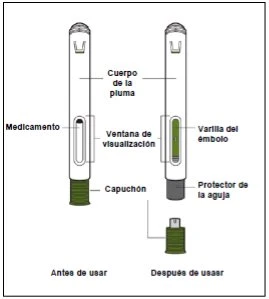
Figure A
- Do not remove the cap until you are ready to administer the injection. Once you remove the cap, do not recap the pen.
Preparing for injection
- Gather injection supplies.
- Prepare a clean, flat surface such as a table or countertop, in a well-lit area.
- Remove the pen from its box stored in the refrigerator.
- Make sure you have the following supplies:
- Pen
- Alcohol wipe
- Cotton ball or gauze*
- Adhesive bandage*
- Sharps disposal container*
*Items not included in the pack .
- Inspect the pen.
Do not use the pen if:
- It is cracked or damaged.
- The expiry date has passed.
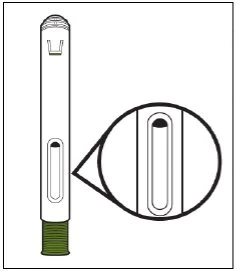
- Inspect the medicine (see Figure B).
The liquid should be clear, colorless to pale brown. Do not use the pen if the liquid is cloudy or discolored, or if it contains particles. Note: You may see bubbles in the liquid. This is normal. |
Figure B |
- Wait 30 minutes.
- Leave the pen at room temperature for 30 minutes to warm up naturally.
Do not heat the pen using sources of heat, such as hot water or a microwave.
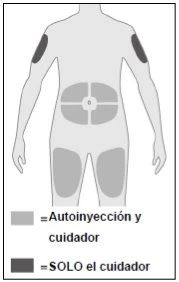
- Choose an injection site (see Figure C).
You may administer the injection in the following areas:
DO NOT administer the injection into skin that is within 5 cm of the navel, or that is tender, damaged, bruised, or scarred. Note: Rotate the injection site each time an injection is given. Each new injection site should be at least 3 cm away from the previous injection site. |
Figure C |
-
Wash your hands.
- Wash your hands with soap and water, and dry them thoroughly.
-
Clean the injection site.
- Clean the injection site with an alcohol wipe.
- Allow the skin to dry before administering the injection.
Do not blow on or touch the injection site before administering the injection.
Administer the injection
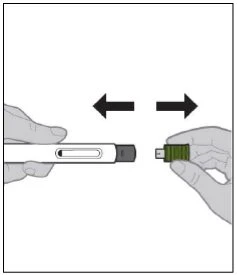
- Remove the cap (see Figure D).
Do not touch the needle shield. Doing so may result in a needlestick injury. Note: It is normal to see a few drops of liquid coming from the needle after removing the cap. |
Figure D |
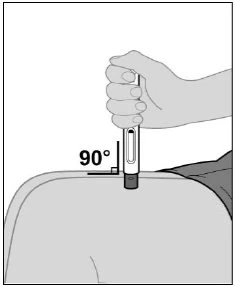
- Place the pen at the injection site (see Figure E).
|
Figure E |
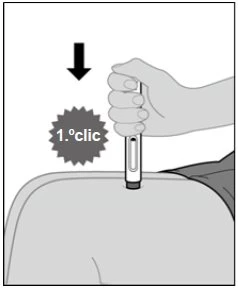
- Begin the injection (see Figure F).
Note: When the injection starts, you will hear the first click and the olive-green plunger rod will begin to fill the viewing window.
|
Figure F |
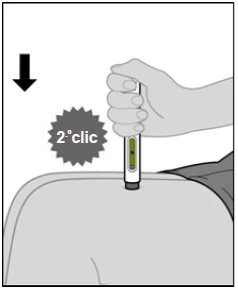
- Complete the injection (see Figure G).
|
Figure G |
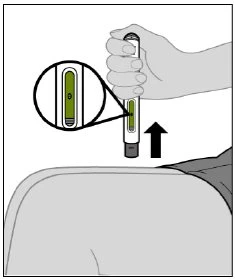
- Remove the pen from the injection site.
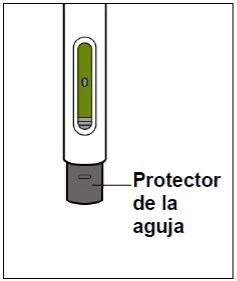
Do not rub the injection site. Note: After removing the pen from the injection site, the needle will be automatically covered (see Figure I). Note: If the olive-green plunger rod does not completely fill the viewing window, you will not receive the full dose. Do not reuse the pen in this case. Contact your healthcare provider immediately. |
Figure H |
Figure I |
After the injection
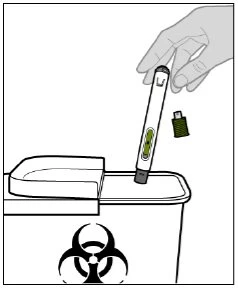
- Dispose of the pen (see Figure J).
Do not recap the pen. Note: Keep the pen and sharps disposal container out of sight and reach of children. |
Figure J |