Remifentanil Kern Pharma 2 mg powder for concentrate for solution for injection and infusion EFG
Spain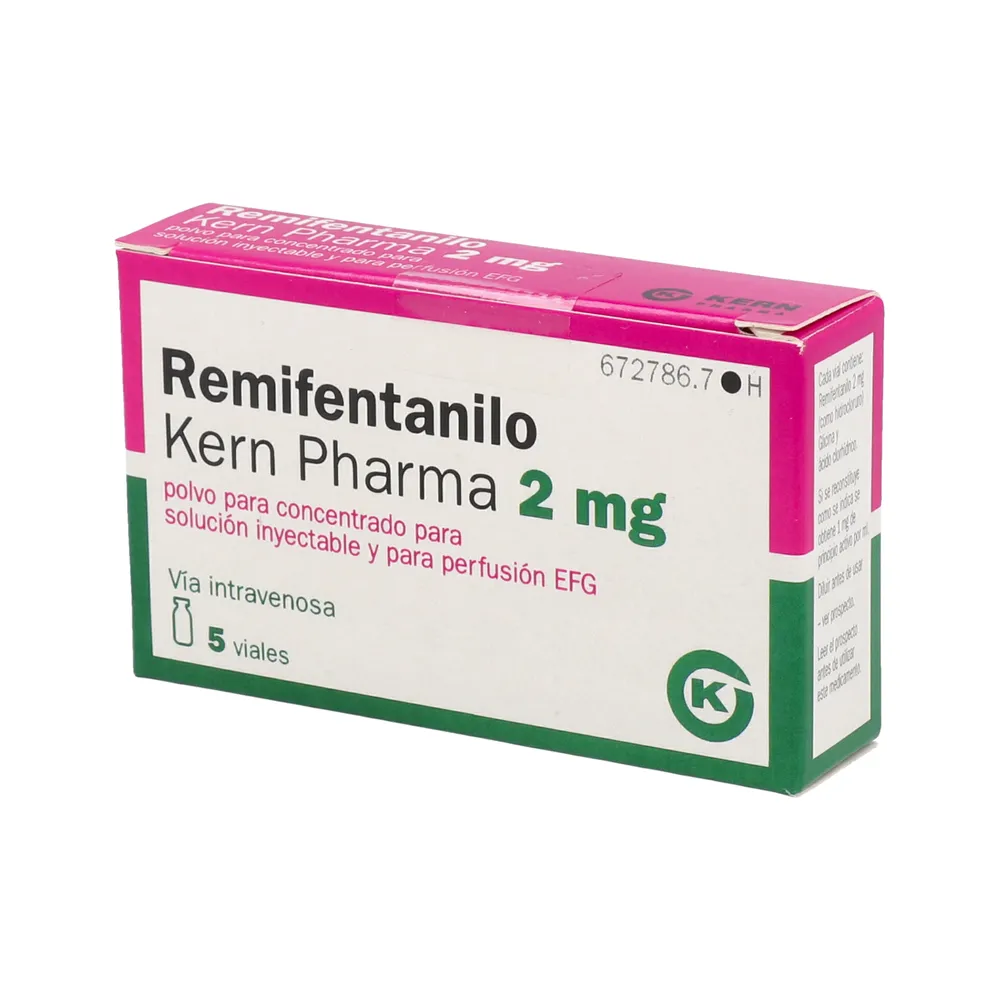
Table of Contents
- Package leaflet: Information for the user
- Introduction
- 1. What Remifentanilo Kern Pharma is and what it is used for
- 2. What you need to know before taking Remifentanil Kern Pharma
- 3. How to take Remifentanil Kern Pharma
- 4. Possible adverse effects
- 5. Storage of Remifentanil Kern Pharma
- 6. Package contents and other information
Package leaflet: Information for the user
Introduction
Package leaflet: information for the user
Remifentanilo Kern Pharma 2 mg powder for concentrate for solution for infusion and for injection EFG
Remifentanil
Read all of this leaflet carefully before you start taking this medicine.
- Keep this leaflet, as you may need to read it again.
- If you have any questions, ask your doctor or pharmacist.
- This medicine has been prescribed for you and you should not give it to other people, even if they have the same symptoms as you, because it may harm them.
- If you consider any of the side effects you experience to be severe, or if you notice any side effects not listed in this leaflet, inform your doctor or pharmacist.
Contents of the leaflet:
- What Remifentanilo Kern Pharma is and what it is used for
- What you need to know before taking Remifentanilo Kern Pharma
- How to take Remifentanilo Kern Pharma
- Possible side effects
- How to store Remifentanilo Kern Pharma
- Contents of the pack and other information
1. What Remifentanilo Kern Pharma is and what it is used for
Remifentanil is an anesthetic that belongs to a group of medicines called opioids (substances that have an action similar to morphine in the body).
This medicine is used:
- to help you sleep before surgery,
- to keep you asleep and prevent you from feeling pain during surgery,
- to stop you from feeling pain while receiving treatment in the Intensive Care Unit.
2. What you need to know before taking Remifentanil Kern Pharma
Do not take Remifentanil Kern Pharma
- if you are allergic (hypersensitive) to remifentanil or to any of the other ingredients,
- if you are allergic (hypersensitive) to other opioid medicines, such as morphine,
- if it is used as the sole agent to induce anaesthesia.
Due to the presence of glycine in the formulation, remifentanil must not be administered for epidural or intrathecal use (injection into the area around the spine or into the cerebrospinal fluid).
Take special care with Remifentanil Kern Pharma
Before starting treatment with Remifentanil Kern Pharma, inform your doctor:
-
if you or a family member have ever abused or been dependent on alcohol, prescription medicines, or illegal drugs ("addiction"),
-
if you are a smoker,
-
if you have ever had mood disorders (depression, anxiety, or personality disorder) or have been treated by a psychiatrist for other mental illnesses.
-
if you have ever had respiratory problems (breathing difficulties),
-
if you have severe heart problems (heart failure),
-
if you have been told that your blood pressure is low (hypotension),
-
if you have had severe liver problems (liver failure),
-
if you feel weak or have experienced a reduction in blood volume (hypovolemia). You should also exercise caution if you are elderly.
While being treated with Remifentanil Kern Pharma:
-
As with other morphine derivatives, you may experience:
-
respiratory disturbances (breathing too shallow or too slow),
-
muscle rigidity. This effect is dose- and rate-of-administration-dependent. Therefore, when administered intravenously as a single slow bolus, Remifentanil Kern Pharma must not be given in less than 30 seconds.
-
low blood pressure (hypotension) or decreased heart rate (bradycardia).
If this occurs, your doctor will administer specific and appropriate treatment. Your doctor will adjust the dose and rate of administration.
Your doctor will ensure that you have satisfactorily recovered your general condition before allowing you to leave the recovery room.
- Remifentanil has a rapid offset of action. There will be no residual analgesic activity within 5 to 10 minutes after discontinuation of administration. During procedures known to be painful, upon awakening, or during use in an Intensive Care Unit, analgesics should be administered before stopping remifentanil infusion.
Sufficient time must be allowed to ensure that longer-acting analgesics become effective. These analgesics should be selected based on the type of surgery and the level of postoperative monitoring.
This medicine contains remifentanil, which is an opioid. Repeated use of opioids may lead to diminished effectiveness of the medicine (tolerance). It may also cause dependence and abuse, which in turn may lead to potentially fatal overdose. If you are concerned about becoming dependent on remifentanil, it is important to consult your doctor.
Occasionally, withdrawal reactions (e.g., rapid heartbeat, high blood pressure, and agitation) have been reported after abrupt discontinuation of treatment with this medicine, especially when treatment has been administered for more than 3 days (see also section 4. Possible side effects). If you experience these symptoms, your doctor may restart treatment with the medicine and gradually reduce the dose.
Use of other medicines
Inform your doctor or pharmacist if you are taking, have recently taken, or might take any other medicines, including those obtained without a prescription.
This is because remifentanil may interact with other medicines and cause adverse effects.
In particular, inform your doctor or pharmacist if you are taking medicines for the heart or blood pressure such as beta-blockers or calcium channel blockers, or medicines to induce sleep, reduce anxiety, or relax muscles, belonging to a group of agents called benzodiazepines, or medicines used to treat depression such as selective serotonin reuptake inhibitors (SSRIs), serotonin-norepinephrine reuptake inhibitors (SNRIs), and monoamine oxidase inhibitors (MAOIs). The concomitant use of these medicines with remifentanil is not recommended, as it may increase the risk of serotonin syndrome, a potentially life-threatening condition.
The concomitant use of remifentanil and sedative medicines such as benzodiazepines or related drugs increases the risk of drowsiness, breathing difficulties (respiratory depression), coma, and may be fatal. Therefore, concomitant use should only be considered when no other treatment options are possible. The concomitant use of opioids and other medicines used to treat epilepsy, nerve pain, or anxiety (gabapentin and pregabalin) increases the risk of opioid overdose and respiratory depression, and may be potentially fatal.
However, if your doctor prescribes remifentanil together with sedative medicines, the dose and duration of concomitant treatment must be limited by your doctor.
Inform your doctor about all sedative medicines you are taking and follow your doctor's instructions carefully regarding dosage. It may be helpful to inform friends or family members so they are aware of the aforementioned signs and symptoms. Contact your doctor if you experience such symptoms.
Pregnancy and breastfeeding
Inform your doctor if you are pregnant, planning to become pregnant, or breastfeeding.
Generally, this medicine should not be used during pregnancy unless your doctor specifically instructs otherwise.
You must not breastfeed for 24 hours following administration of remifentanil.
There are insufficient data to recommend the use of remifentanil during labour and caesarean section.
Consult your doctor or pharmacist before using any medicine.
If you receive this medicine during labour or shortly before delivery, it may affect your baby's breathing. Both you and your baby will be monitored for signs of excessive drowsiness or breathing difficulties.
Driving and using machines
Do not drive or operate tools or machinery after receiving this medicine, as it may impair your reaction ability. Your doctor will advise you how long you should wait before driving or using machines.
Athletes
Athletes should exercise caution, as this medicine contains an active substance that may result in a positive doping test.
3. How to take Remifentanil Kern Pharma
You must never administer this medicine to yourself. This medicine will always be administered by qualified personnel and under carefully controlled conditions.
Dosage
The dose you will receive depends on:
- the type of surgery,
- how much pain relief you need.
Doses vary from patient to patient. It depends on your age, body weight, and general condition.
Your doctor will decide the dose appropriate for you. He/she will adjust it according to the effect achieved during anesthesia.
Method of administration
This medicine will be administered to you intravenously.
Remifentanil may be given:
- as a single injection into your vein (bolus injection),
- as a continuous infusion into your vein. This is when the medicine is given slowly over a long period of time.
Special caution must be taken to avoid any accidental administration, particularly at the end of anesthesia.
Duration of treatment
Your doctor will decide the duration of therapy appropriate for you and your surgery.
The use of Remifentanil in mechanically ventilated intensive care patients is not recommended for periods longer than 3 days.
If you take more Remifentanil Kern Pharma than you should
Your doctor will promptly take the necessary actions.
If you stop treatment with Remifentanil Kern Pharma
Like other morphine derivatives, this medicine may cause dependence.
Consult your doctor or pharmacist if you have any doubts about the use of this medicine.
4. Possible adverse effects
Like all medicines, Remifentanil Kern Pharma can cause adverse effects, although not everyone will experience them.
Very common adverse effects (affect more than 1 in 10 people)
- muscle rigidity – please also see section 2,
- low blood pressure (hypotension) – please also see section 2,
- nausea, vomiting.
Common adverse effects (affect 1 to 10 in 100 people)
- decreased heart rate (bradycardia) – please also see section 2,
- postoperative increase in blood pressure (hypertension),
- respiratory disturbances (breathing too shallow or too slow) – please also see section 2, breathing pauses (apnea),
- itching (pruritus),
- postoperative tremors,
- cough.
Uncommon adverse effects (affect 1 to 10 in 1,000 people)
- lack of oxygen in the blood (hypoxia),
- constipation,
- postoperative pain.
Rare adverse effects (affect 1 to 10 in 10,000 people)
- in patients receiving remifentanil together with one or more anesthetic drugs, allergic reactions have been observed, including acute allergic hypersensitivity reaction (anaphylaxis),
- feeling drowsy (sedation) during recovery from general anesthesia,
- in patients receiving remifentanil together with other anesthetic drugs, cardiac pause/cardiac arrest has been observed, usually preceded by a decreased heart rate (bradycardia).
Adverse effects of unknown frequency
- withdrawal syndrome (may present with the following adverse effects: increased heart rate, arterial hypertension, feeling agitated or restless, nausea, vomiting, diarrhea, anxiety, chills, tremors, and sweating),
- irregular heartbeat (arrhythmia).
If you consider any of the adverse effects you experience to be severe, or if you notice any adverse effects not listed in this leaflet, inform your doctor or pharmacist.
Reporting of adverse effects
If you experience any type of adverse effect, consult your doctor or pharmacist, even if it is a possible adverse effect not listed in this leaflet. You may also report them directly via the Spanish Pharmacovigilance System for Human Medicinal Products: www.notificaram.es. By reporting adverse effects, you can help provide more information on the safety of this medicine.
5. Storage of Remifentanil Kern Pharma
Keep this medicine out of the sight and reach of children.
Do not use remifentanil after the expiry date stated on the carton and vial. The expiry date refers to the last day of the month indicated.
Do not store above 30°C.
Chemical and physical stability during use of the reconstituted solution has been demonstrated for 24 hours at 25°C.
Chemical and physical stability during use of the diluted solution has been demonstrated for 4 hours at 25°C.
From a microbiological standpoint, the product should be used immediately. If not used immediately, the storage times and conditions shall be the responsibility of the user and under normal circumstances should not exceed 24 hours at 2-8°C, unless reconstitution/dilution has taken place under controlled and validated aseptic conditions.
Do not use Remifentanil Kern Pharma if any signs of deterioration are observed after reconstitution.
Medicines must not be disposed of via wastewater or household waste. Unused medicines and their containers should be taken to a pharmacy’s SIGRE collection point. If you have any doubts, ask your pharmacist how to dispose of medicines and containers you no longer need. This will help protect the environment.
6. Package contents and other information
Composition of Remifentanil Kern Pharma
- The active substance is remifentanil. Each vial contains 2 mg of remifentanil (as hydrochloride).
After reconstitution, the solution contains 1 mg/ml of remifentanil (as hydrochloride), when prepared as recommended.
- The other components are: glycine and hydrochloric acid 37% (to adjust pH).
Appearance of Remifentanil Kern Pharma and contents of the pack
Remifentanil is a white or almost white powder for concentrate for solution for injection and infusion.
Pack size: 5 vials.
Marketing Authorization Holder
Kern Pharma, S.L.
Venus, 72 - Pol. Ind. Colón II
08228 Terrassa - Barcelona
Spain
Manufacturer
Laboratorio Reig Jofré, S.A.
Gran Capitán 10
08970 Sant Joan Despí (Barcelona)
Spain
This leaflet was last reviewed in May 2022
Detailed and up-to-date information on this medicine is available on the website of the Spanish Agency of Medicines and Health Products (AEMPS) http://www.aemps.gob.es/
<---------------------------------------------------------------------------------------------------------------->
This information is intended for healthcare professionals only:
Remifentanil Kern Pharma 2 mg powder for concentrate for solution for injection and infusion
Handling and usage instructions
This medicine must be reconstituted by adding 2 ml of injection solvent to obtain a reconstituted solution with a remifentanil concentration of approximately 1 mg/ml.
After reconstitution, the solution must not be administered directly but should be further diluted.
For manually performed infusions, remifentanil may be diluted to concentrations ranging from 20 to 250 micrograms/ml (the recommended dilution is 50 micrograms/ml in adults and 20 to 25 micrograms/ml in children aged 1 year or older).
For administration via TCI (target-controlled infusion), the recommended dilution of remifentanil is 20 to 50 micrograms/ml.
Reconstitution and dilution of the remifentanil solution may be carried out using one of the following injection solvents:
- water for injection,
- glucose 50 mg/ml (5%) solution for injection,
- glucose 50 mg/ml (5%) and sodium chloride 9 mg/ml (0.9%) solution for injection,
- sodium chloride 9 mg/ml (0.9%) solution for injection,
- sodium chloride 4.5 mg/ml (0.45%) solution for injection.
The dilution depends on the technical capacity of the infusion device and the patient's anticipated requirements.
This medicine is compatible with lactated Ringer's solution, lactated Ringer's solution with glucose 50 mg/ml (5%), and with propofol when administered via an intravenous catheter.
Dosage
Refer to the Summary of Product Characteristics for dosage information.
Depending on the indication, dosage recommendations are provided for adults and/or children (aged 1 to 12 years), with adjustments suggested for special populations.
Management of overdose
Due to the very short duration of action, the potential for harmful effects following an overdose is limited to the immediate period after administration. Discontinuation of the drug results in a rapid response, with return to baseline status within 10 minutes.
In case of overdose or suspected overdose, the following protocol should be followed:
- discontinue administration of the medicine,
- maintain a patent airway,
- initiate assisted ventilation with oxygen,
- and establish hemodynamic stability.
If respiratory depression is associated with muscle rigidity, a neuromuscular blocker may be required to facilitate ventilation.
To maintain vascular filling, administration of certain drugs (vasopressors) may be useful to correct hypotension, along with other supportive measures.
An intravenous opioid antagonist such as naloxone may be administered to treat severe respiratory depression and muscle rigidity. It is unlikely that the duration of respiratory depression after overdose will exceed the duration of action of the antidote.
Stability and storage conditions
Remifentanil Kern Pharma contains no preservatives and is for single use only. Any unused material should be discarded.
Medicines must not be disposed of via wastewater or household waste.
Incompatibilities
Remifentanil Kern Pharma must only be reconstituted or diluted with the recommended injection solutions.
It must not be reconstituted or mixed with lactated Ringer's solution or lactated Ringer's solution with glucose 50 mg/ml (5%).
This medicine must not be mixed with propofol in the same solution for intravenous administration.
Administration of this medicine through the same intravenous line as blood, serum, or plasma is not recommended.
This medicine must not be mixed with other medicinal products prior to administration.