Relax 40 mg film-coated tablets
Spain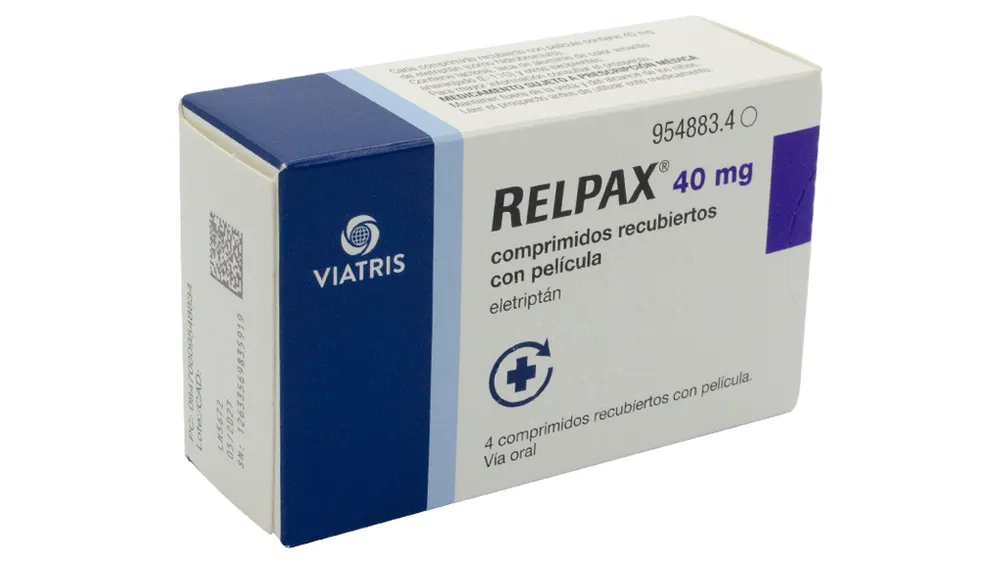
Table of Contents
Package leaflet: Information for the user
Introduction
Package leaflet: information for the user
RELPAX 40 mg film-coated tablets
eletriptan
Read the entire leaflet carefully before you start taking this medicine, as it contains important information for you.
- Keep this leaflet, as you may need to read it again.
- If you have any questions, consult your doctor or pharmacist.
- This medicine has been prescribed for you only, and you must not give it to other people, even if they have the same symptoms as you, because it could harm them.
- If you experience any adverse effects, consult your doctor or pharmacist, even if they are adverse effects not listed in this leaflet. See section 4.
Contents of the leaflet
- What Relpax is and what it is used for
- What you need to know before taking Relpax
- How to take Relpax
- Possible adverse effects
- How to store Relpax
- Contents of the pack and other information
1. What Relpax is and what it is used for
Relpax contains eletriptan as the active substance. Relpax belongs to a group of medicines known as serotonin receptor agonists. Serotonin is a natural substance found in the brain that helps narrow blood vessels.
Relpax can be used for the treatment of migraine headache with or without aura in adults. Before the migraine headache begins, you may experience a phase called "aura," during which visual disturbances, numbness, and speech disturbances may occur.
2. What you need to know before taking Relpax
Do not take Relpax:
- If you are allergic (hypersensitive) to eletriptan or to any of the other components of this medicine (listed in section 6).
- If you have severe liver or kidney disease.
- If you have moderate or severe high blood pressure, or untreated mild high blood pressure.
- If you have heart problems [for example, heart attack, angina, heart failure, or significant abnormalities in heart rhythm (arrhythmia), transient and sudden narrowing of one of the coronary arteries].
- If you have poor circulation (peripheral vascular disease).
- If you have ever had a stroke (even if it was mild and lasted only minutes or hours).
- If you have taken ergotamine or ergot-type medications (including methysergide) within 24 hours before or after taking Relpax.
- If you are currently taking other medicines ending in “triptan” (for example sumatriptan, rizatriptan, naratriptan, zolmitriptán, almotriptán, and frovatriptán).
Inform your doctor and do not take Relpax if you currently have or have ever had any of these conditions.
Warnings and precautions
Consult your doctor or pharmacist before taking Relpax if:
- You have diabetes.
- You smoke or are undergoing nicotine replacement therapy.
- You are a man over 40 years of age.
- You are a postmenopausal woman.
- You or a family member has coronary artery disease.
- You have been informed that you may have an increased risk of heart disease; inform your doctor before taking Relpax.
Repeated use of migraine medications
If you repeatedly use Relpax or any other migraine treatment for several days or weeks, this may cause long-lasting daily headaches. Inform your doctor if this occurs, as you may need to stop treatment temporarily.
Taking Relpax with other medicines
Inform your doctor or pharmacist if you are currently taking, have recently taken, or might need to take any other medicines.
Taking Relpax together with certain medicines may cause serious adverse effects. Do not take Relpax if:
- You have taken ergotamine or ergot-type medications (including methysergide) within 24 hours before or after taking Relpax.
- You are taking other medicines ending in “triptan” (for example sumatriptan, rizatriptán, naratriptán, zolmitriptán, almotriptán, and frovatriptán).
Some medicines may affect how Relpax works, or Relpax may reduce the effectiveness of other medicines taken at the same time. This includes:
- Medicines used to treat fungal infections (for example ketoconazole and itraconazole).
- Medicines used to treat bacterial infections (for example erythromycin, clarithromycin, and josamicin).
- Medicines used to treat HIV/AIDS (for example ritonavir, nelfinavir, and indinavir).
The herbal preparation St. John’s wort (Hypericum perforatum) should not be taken at the same time as this medicine. If you are already taking St. John’s wort, consult your doctor before stopping it.
Inform your doctor before starting treatment with eletriptan if you are taking certain medicines (commonly known as SSRIs* or SNRIs**) for depression or other mental disorders. These medicines may increase the risk of developing serotonin syndrome when used in combination with certain migraine medicines. See Section 4 “Possible side effects” for more information about the symptoms of serotonin syndrome.
*SSRIs – Selective serotonin reuptake inhibitors.
**SNRIs – Serotonin and norepinephrine reuptake inhibitors.
Taking Relpax with food and drinks
Relpax can be taken before or after food and drinks.
Pregnancy and breastfeeding
Consult your doctor or pharmacist before using any medicine.
If you are pregnant or breastfeeding, think you may be pregnant, or plan to become pregnant, consult your doctor before using this medicine.
Breastfeeding is not recommended for 24 hours following the administration of this medicine.
Driving and using machines
Relpax, or migraine itself, may cause drowsiness. This medicine may also cause dizziness. Therefore, you should avoid driving or operating machinery during a migraine attack or after taking this medicine.
Relpax contains lactose, orange-yellow aluminium lake (E110), and sodium
Lactose is a type of sugar. This medicine contains lactose. If your doctor has informed you that you have an intolerance to certain sugars, consult him before taking this medicine.
This medicine may cause allergic reactions because it contains orange-yellow aluminium lake (E110). It may cause asthma, particularly in patients allergic to acetylsalicylic acid.
This medicine contains less than 23 mg of sodium (1 mmol) per tablet; therefore, it is essentially “sodium-free”.
3. How to take Relpax
Follow exactly the administration instructions for this medicine as indicated by your doctor. If in doubt, consult your doctor or pharmacist again.
Adults
You may take the medicine at any time after the onset of migraine headache, but it is best to take it as soon as possible. However, you should only take Relpax during the headache phase of migraine. You must not take this medicine to prevent a migraine attack.
- The recommended initial dose is 40 mg (two Relpax 20 mg tablets or one Relpax 40 mg tablet per day) taken orally.
- Swallow the tablet whole with some water.
- If the first tablet does not relieve your migraine, you must not take a second tablet for the same attack.
- If, after taking the first tablet, your migraine improves but later returns, you may take a second tablet. However, you must wait at least 2 hours after taking the first tablet before taking the second tablet.
- You must not take more than 80 mg (four Relpax 20 mg tablets or two Relpax 40 mg tablets) within 24 hours.
- If you do not obtain relief with a 40 mg dose (two Relpax 20 mg tablets or one Relpax 40 mg tablet), consult your doctor. Your doctor will decide whether your dose should be increased to 80 mg (four Relpax 20 mg tablets or two Relpax 40 mg tablets) for subsequent attacks.
Use in children and adolescents under 18 years of age
The use of Relpax tablets is not recommended in children and adolescents under 18 years of age.
Patients over 65 years of age
The use of Relpax tablets is not recommended in patients over 65 years of age.
Renal impairment
This medicine may be used in patients with mild or moderate kidney problems. In these patients, the recommended initial dose is 20 mg (one Relpax 20 mg tablet), and the total daily dose must not exceed 40 mg (two Relpax 20 mg tablets or one Relpax 40 mg tablet).
Hepatic impairment
This medicine may be used in patients with mild or moderate liver problems. Dose adjustments are not required for mild or moderate hepatic impairment.
If you take more Relpax than you should
If you accidentally take more Relpax than you should, contact your doctor immediately or go to the nearest hospital emergency department. Always bring the medicine packaging with you, even if it is empty. Adverse effects of Relpax overdose include high blood pressure and heart problems.
Contact your doctor, pharmacist, or call the Toxicology Information Service at telephone number 91 562 04 20 immediately, stating the medicine and the amount taken.
It is recommended to bring the medicine packaging and leaflet to the healthcare professional.
If you forget to take Relpax
If you forget to take a dose, take it as soon as you remember, unless it is almost time for your next dose. Do not take a double dose to make up for forgotten doses.
If you have any further questions about the use of this medicine, ask your doctor or pharmacist.
4. Possible adverse effects
Like all medicines, this medicine can cause adverse effects, although not everyone experiences them.
Tell your doctor immediately if you experience any of the following symptoms after taking the medicine:
- Sudden wheezing, difficulty breathing, swelling of the eyelids, face or lips, skin rash or itching (especially affecting the whole body), as these may be signs of a hypersensitivity reaction (allergy).
- Pain and tightness in the chest, which may be severe and affect the throat. These may be symptoms of problems with blood circulation in the heart (ischaemic heart disease).
- Signs and symptoms of serotonin syndrome, which may include restlessness, hallucinations, loss of coordination, rapid heartbeat, increased body temperature, rapid changes in blood pressure, and overactive reflexes.
Other adverse effects that may occur are:
Common adverse effects:
(may affect up to 1 in 10 people)
- Chest pain or tightness, palpitations, increased heart rate.
- Dizziness, spinning sensation (vertigo), headache, numbness, decreased sense of touch or pain.
- Sore throat, sensation of tightness in the throat, dry mouth.
- Abdominal and stomach pain, indigestion (upset stomach), nausea (a feeling of uneasiness and discomfort in the stomach or abdomen that leads to vomiting).
- Muscle stiffness (increased muscle tone), muscle weakness, back pain, muscle pain.
- General feeling of weakness, sensation of heat, chills, runny nose, sweating, tingling or abnormal sensation, flushing, pain.
Uncommon adverse effects:
(may affect up to 1 in 100 people)
- Difficulty breathing, yawning.
- Swelling of the face or hands and feet, inflammation or infection of the tongue, skin rash, itching.
- Increased sensitivity to touch or pain (hyperesthesia), loss of coordination, reduced or slowed movements, tremor, slurred speech.
- Feeling unlike oneself (depersonalization), depression, abnormal thinking, feeling agitated, feeling confused, changes in mood (euphoria), periods of unresponsiveness (stupor), general feeling of discomfort, illness or malaise (malaise), trouble sleeping (insomnia).
- Loss of appetite and weight loss (anorexia), taste disturbances, thirst.
- Joint degeneration (osteoarthritis), bone pain, joint pain.
- Increased need to urinate, problems urinating, excessive urine output, diarrhea.
- Abnormal vision, eye pain, light sensitivity, dry or watery eyes.
- Ear pain, ringing in the ears (tinnitus).
- Poor circulation (peripheral vascular disorder).
Rare adverse effects:
(may affect up to 1 in 1,000 people)
- Shock, asthma, hives, skin disorders, swollen tongue.
- Chest or throat infection, enlarged lymph nodes.
- Decreased heart rate.
- Emotional lability (mood changes).
- Joint degeneration (arthritis), muscle disturbance, twitching.
- Constipation, inflammation of the oesophagus, belching.
- Breast pain, heavy or prolonged menstruation.
- Eye infection (conjunctivitis).
- Voice changes.
Other described adverse effects include fainting, high blood pressure, inflammation of the large intestine, vomiting, blood vessel and brain events, inadequate blood supply to the heart, heart attack, spasm of the arteries and heart muscles.
Your doctor may carry out regular blood tests to monitor for increased liver enzymes or any blood-related problems.
Reporting of adverse effects
If you experience any type of adverse effect, consult your doctor or pharmacist, even if they are possible adverse effects not listed in this leaflet. You can also report them directly via the Spanish Pharmacovigilance System for Human Medicines: https://www.notificaram.es. By reporting adverse effects, you can help provide more information on the safety of this medicine.
5. Storage of Relpax
Keep this medicine out of sight and reach of children.
Do not use this medicine after the expiry date stated on the packaging. The expiry date is the last day of the month indicated.
PVC/Aclar/Aluminum blisters: No special storage conditions are required.
HDPE bottles: Store in the original container. Keep the container tightly closed to protect from moisture.
Medicines must not be disposed of via wastewater or household waste. Dispose of unused medicines and their containers at the SIGRE point in your pharmacy. If you are unsure, ask your pharmacist how to dispose of unused medicines and their containers. This will help protect the environment.
6. Contents of the pack and other information
Composition of Relpax 40 mg film-coated tablets
The active substance is eletriptan (as eletriptan hydrobromide).
Each Relpax 40 mg film-coated tablet contains 40 mg of eletriptan (as hydrobromide).
The other components are: microcrystalline cellulose, lactose monohydrate, sodium croscarmellose, magnesium stearate, titanium dioxide (E-171), hypromellose, glycerol triacetate and orange-yellow FCF aluminium lake (E-110) (see section 2).
Appearance of the product and contents of the pack
Relpax tablets are orange, round, film-coated tablets.
Relpax 40 mg film-coated tablets are marked with “VLE” on one side and “REP 40” on the other.
Relpax is supplied in opaque PVC/Aclar/aluminium blisters containing 2, 3, 4, 5, 6, 10, 18, 30 and 100 tablets or in HDPE bottles with HDPE/PP child-resistant closures containing 30 and 100 tablets.
Only some pack sizes may be commercially available.
Marketing Authorisation Holder and Manufacturer
Marketing Authorisation Holder
Viatris Healthcare, S.L.
Calle General Aranaz, 86, 3rd floor
28027 Madrid
Spain
Manufacturer
Pfizer Italia S.r.l.,
Località Marino del Tronto
63100 Ascoli Piceno
Italy
Local Representative
Viatris Pharmaceuticals, S.L.U.
Calle General Aranaz, 86
28027 Madrid
Spain
This medicinal product is authorised in the Member States of the European Economic Area under the following names:
Relert 20 mg and 40 mg film-coated tablets: Belgium, Finland, Luxembourg, Portugal, Spain, United Kingdom.
Relpax 20 mg and 40 mg film-coated tablets: Austria, Denmark, France, Germany, Greece, Iceland, Ireland, Italy, Norway, Spain, Sweden, Netherlands, United Kingdom.
Date of the most recent review of this leaflet: January 2021
Detailed and up-to-date information on this medicinal product is available on the website of the Spanish Agency of Medicines and Health Products (AEMPS) http://www.aemps.gob.es/