Rectogesic 4 mg/g rectal ointment
Spain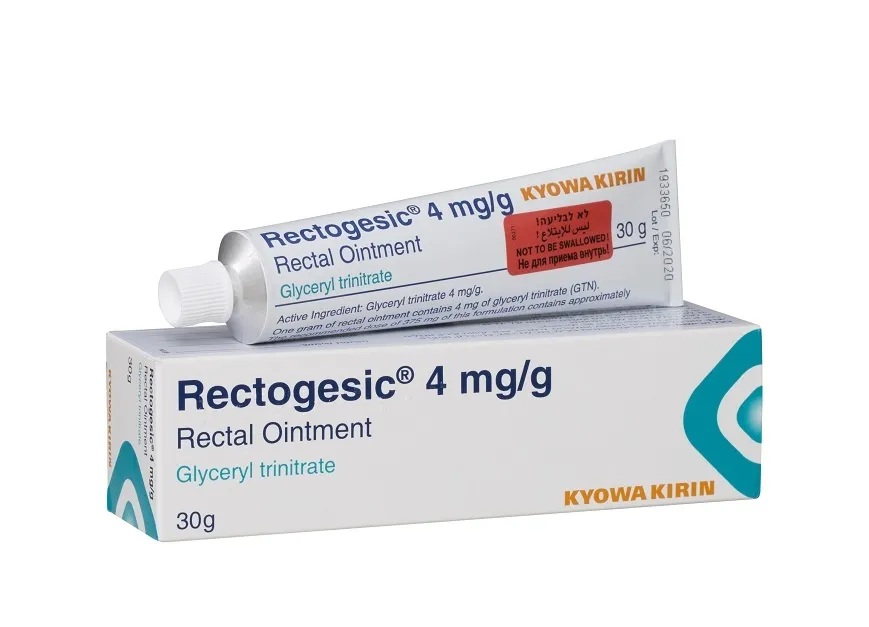
Table of Contents
Package leaflet: Information for the user
Introduction
PACKAGE LEAFLET: INFORMATION FOR THE USER
Rectogesic 4 mg/g Rectal Ointment
Glyceryl trinitrate
Read the entire leaflet carefully before you start using this medicine, because it contains important information for you.
-
Keep this leaflet, as you may need to read it again.
-
If you have any questions, ask your doctor or pharmacist.
-
This medicine has been prescribed for you only, and you should not give it to other people even if they have the same symptoms as you, because it could harm them.
-
If you experience any adverse effects, consult your doctor or pharmacist, even if they are adverse effects not listed in this leaflet. See section 4.
Contents of the leaflet:
- What Rectogesic is and what it is used for
- What you need to know before using Rectogesic
- How to use Rectogesic
- Possible adverse effects
- How to store Rectogesic
- Contents of the pack and other information
1. What RECTOGESIC is and what it is used for
RECTOGESIC is a rectal ointment containing glyceryl trinitrate as the active substance. Glyceryl trinitrate belongs to a group of medicines called organic nitrates.
The ointment will help relieve painful symptoms caused by chronic anal fissures. An anal fissure is a tear in the skin lining the anal canal. Topical application of glyceryl trinitrate to the anal canal reduces anal pressure and increases blood flow, thereby reducing the sensation of pain.
2. What you need to know before using RECTOGESIC
Do not use Rectogesic:
-
if you are allergic to glyceryl trinitrate or to other similar medicines
-
if you are allergic to any of the other ingredients of this medicine (listed in section 6)
-
if you have low blood pressure
-
if you have heart or blood vessel disorders
-
if you have closed-angle glaucoma, a condition in which the pressure inside the eyes increases rapidly and may lead to vision loss
-
if you have migraine or recurrent headaches
-
if you have increased intracranial pressure or high cranial pressure (for example, head injury or cerebral hemorrhage; a hemorrhage caused by the rupture of a blood vessel in the brain, which can be fatal without immediate medical treatment. Cerebral hemorrhage is usually considered a type of stroke) or inadequate cerebral circulation (low blood flow volume in the brain)
-
if you have anemia (low iron content in the blood)
-
if you are taking any of the following medicines: erectile dysfunction medications such as sildenafil citrate, tadalafil, vardenafil; medications for angina or heart pain, such as glyceryl trinitrate (NTG), isosorbide dinitrate, amyl nitrite, or butyl nitrite; medications for high blood pressure or depression (tricyclic antidepressants), acetylcysteine, or alteplase
Take special care with Rectogesic:
-
if you have liver or kidney disease
-
if you are to be given heparin, blood parameters should be closely monitored, as it may be necessary to adjust the heparin dose. Talk to your doctor before stopping treatment with Rectogesic
-
if you also have hemorrhoids (piles) and notice more bleeding than usual, you should stop treatment with Rectogesic. Discuss this with your doctor
-
if you experience severe headaches when using Rectogesic, inform your doctor. Your doctor will decide whether you need a different amount of Rectogesic or whether treatment should be stopped completely
Rectogesic may lower blood pressure. When getting up from a lying or sitting position, do so slowly to avoid dizziness. The drop in blood pressure is more likely if you drink alcohol during treatment with Rectogesic.
Children and adolescents
Rectogesic is not suitable for children and adolescents under 18 years of age, as it has not been evaluated in patients of this age group.
Taking Rectogesic with other medicines
Tell your doctor or pharmacist if you are using or have recently used any other medicines, including those obtained without a prescription.
The following medicines may increase the blood pressure-lowering effect of Rectogesic:
- Medicines for depression (tricyclic antidepressants)
- Medicines for the treatment of erectile dysfunction (male impotence) (sildenafil citrate, tadalafil, vardenafil)
- Medicines for high blood pressure
- Diuretics
- Commonly used tranquilizers
- Medicines used to treat heart problems (isosorbide dinitrate and amyl nitrite or butyl nitrite)
Other medicines:
- Acetylcysteine may increase the effects of Rectogesic on blood flow
- The effects of heparin (used to control blood clots) may be reduced when used together with Rectogesic
- The effects of alteplase (used to treat heart problems) may be reduced when used simultaneously with Rectogesic
- The use of Rectogesic with dihydroergotamine (used to treat migraine) may increase the effects of dihydroergotamine and cause coronary vasoconstriction (narrowing of the blood vessels of the heart leading to reduced blood flow)
- Acetylsalicylic acid and non-steroidal anti-inflammatory drugs (certain types of painkillers) may alter the therapeutic effect of Rectogesic
Use of Rectogesic with alcohol
Be cautious with alcohol consumption, as the ointment may have a stronger effect than usual.
Pregnancy and breastfeeding
You should not use Rectogesic during pregnancy or breastfeeding.
Consult your doctor or pharmacist before using any medicine during pregnancy or breastfeeding.
Driving and using machines
No studies have been conducted on the ability to drive and use machines with Rectal Ointment Rectogesic 4 mg/g. If you begin to feel dizzy, drowsy, or experience blurred vision when starting to use the ointment, do not drive or operate machinery until these effects have disappeared.
Rectogesic contains lanolin and propylene glycol
This medicine contains lanolin (wool fat), which may cause local skin reactions (such as contact dermatitis). This medicine also contains propylene glycol, which may cause skin irritation.
3. How to use RECTOGESIC
Method of administration
RECTOGESIC 4 mg/g Rectal Ointment is for rectal use only.
Follow exactly the instructions given by your doctor for using this medicine. If in doubt, consult your doctor or pharmacist again. The recommended dose is approximately 375 mg of ointment (approximately 1.5 mg of glyceryl trinitrate) applied into the anal canal every 12 hours.
Your finger may be covered with plastic wrap or a finger cot before applying the ointment. Finger cots can be obtained from your local pharmacy or a surgical supply provider, and plastic wrap from a local store. The covered finger is placed next to the 2.5 cm dosing line shown on the outer package, and an amount of ointment equal in length to the line is squeezed out onto the fingertip by gently pressing the tube. Gently insert the ointment into the anal canal using your finger. The ointment-covered finger should be inserted up to the first knuckle (approximately 1 cm) into the anus.
Apply the ointment every twelve hours as directed by your doctor and do not exceed the recommended dose. Wash your hands after each use and dispose of the finger cot or plastic wrap properly (not down the toilet).
Treatment may continue until pain resolves, or up to a maximum of 8 weeks. If pain persists after using Rectogesic, you should consult your doctor again to rule out other causes of pain.
If you use more Rectogesic than you should
If you apply more ointment than recommended, you may experience dizziness or lightheadedness. You may also feel a rapid heartbeat or palpitations. If you experience these symptoms, remove any excess ointment and contact your doctor or pharmacist immediately.
If you forget to use Rectogesic
Do not apply a double dose to make up for missed doses. Apply the next dose at your usual time.
If you have any further questions about the use of this medicine, ask your doctor or pharmacist.
4. Possible adverse effects
Like all medicines, this medicine may cause adverse effects, although not everyone experiences them.
Serious adverse effects:
- Anaphylactoid reaction (allergic reaction, potentially life-threatening, with swelling of the face, lips, tongue or throat, difficulty breathing, shortness of breath or fainting). If you experience any of these symptoms, stop using the ointment and consult a doctor immediately.
- Skin allergic reactions (potentially severe). If you experience any allergic skin reaction, stop using the ointment and consult a doctor immediately.
Other adverse effects:
Very common (may affect more than 1 in 10 people)
- Headaches, which may become severe. If you develop headaches as a side effect, wipe off any residual ointment. If headaches become bothersome, consult your doctor whether you should discontinue use of the medicine.
Common (may affect up to 1 in 10 people)
- Dizziness
- Nausea
Uncommon (may affect up to 1 in 100 people)
- Diarrhea
- Vomiting
- Rectal bleeding, rectal disorder
- Anal discomfort, itching or burning in the anal canal
- Rapid heartbeat or palpitations
Rare (may affect up to 1 in 1,000 people)
- Dizziness upon standing
Adverse effects of unknown frequency (frequency cannot be estimated from available data)
- Drowsiness, fainting
- Low blood pressure
- Irritation, rash or pain at the application site
Other known adverse effects associated with glyceryl trinitrate products (frequency unknown)
- Flushing
- Unstable angina (chest pain)
- High blood pressure upon discontinuation of treatment
- Methaemoglobinaemia (symptoms are bluish/purple skin discoloration and shortness of breath)
Reporting of adverse effects
If you experience any adverse effect, talk to your doctor or pharmacist, even if it is a possible adverse effect not listed in this leaflet. You may also report them directly via the Spanish Pharmacovigilance System for Human Medicines: https://www.notificaRAM.es.
By reporting adverse effects, you can help provide more information on the safety of this medicine.
5. Storage of RECTOGESIC
Keep this medicine out of the sight and reach of children.
Do not use this medicine after the expiry date stated on the tube and carton after EXP. The expiry date is the last day of the month indicated.
- Do not store above 25°C.
- Do not freeze.
- Keep the tube tightly closed.
After first opening, use the ointment within 8 weeks.
6. Contents of the pack and other information
Composition of Rectogesic
The active substance is glyceryl trinitrate. One gram of rectal ointment contains 4 mg of glyceryl trinitrate. The normal dose of 375 mg of Rectogesic contains approximately 1.5 mg of glyceryl trinitrate.
The other components (excipients) are: propylene glycol, lanolin, sorbitan sesquioleate, hard paraffin, and white soft paraffin.
Appearance of Rectogesic and pack size
Rectogesic is an opaque, smooth, whitish rectal ointment formulation supplied in 30 g aluminium tubes.
Marketing Authorisation Holder and Manufacturer
Marketing Authorisation Holder
Grünenthal Pharma, S.A.
Doctor Zamenhof, 36
28027 Madrid
Spain
Manufacturer
PHARBIL Waltrop GmbH
Im Wirrigen 25
45731 Waltrop
Germany
Date of the most recent review of this leaflet: May 2015
Detailed and up-to-date information on this medicinal product is available on the website of the Spanish Agency of Medicines and Health Products (AEMPS) http://www.aemps.gob.es/